If you've been injured because of someone else's carelessness in Atlanta, you're dealing with a lot more than just physical pain. Georgia law understands this, allowing you to seek financial recovery through three main types of damages in personal injury cases: economic damages for your direct financial losses, non-economic damages for your personal suffering, and in some situations, punitive damages meant to punish especially bad behavior.
What Compensation Can You Recover After an Injury?
When an accident turns your life upside down, the first step toward getting back on your feet is knowing your right to compensation. The pile of medical bills, missed paychecks, and the huge changes to your daily routine can feel overwhelming. Luckily, the legal system gives you a way to hold the responsible person or company financially accountable.
This guide will walk you through the categories of compensation you can seek. We'll start with the tangible, receipt-based losses before moving into the more personal, non-financial impacts. Finally, we’ll cover the damages that are meant to penalize extreme recklessness.
The Foundation of a Claim
The main idea behind personal injury compensation is to make you whole again—to restore you, as much as money can, to the position you were in before the accident. This requires a careful accounting of every loss, both the ones you can see and the ones you can't. It's a common need; in the United States, an estimated 39.5 million injuries need medical attention each year, which shows how often these situations happen.
My goal is to give you a straightforward understanding of the compensation available to you. It's about ensuring fairness and helping you secure the resources needed for your recovery.
In the most tragic situations involving a death, the process needs even more care. Families looking for justice often find that understanding the role of private autopsies in wrongful death cases can be a valuable step in proving who was at fault and securing the compensation they deserve.
Each part of your claim requires solid documentation and a clear legal strategy. To see how all these pieces fit together, you can learn more about the complete personal injury claims process in our detailed overview. Knowing the different types of damages is the best starting point.
Economic Damages: The Tangible Financial Losses
When we talk about the types of damages in personal injury cases, the easiest to understand are economic damages. These are the straightforward, black-and-white costs that come directly from your injury. Think of them as any expense you can prove with a receipt, an invoice, or a pay stub.
These are the immediate financial burdens you face, starting the moment the accident happens—from the ambulance ride and emergency room bills to any surgeries or hospital stays. It's the stack of bills piling up on your kitchen table.
As you can see, these damages are all about the direct, out-of-pocket costs and the income you’ve lost. They’re the dollars and cents of your recovery.
Itemizing Your Financial Recovery
To build a strong claim for economic damages, documentation is everything. Every bill, every invoice, every pay stub tells a part of your story and adds up to the total compensation you need to get back on your feet financially.
To paint a clearer picture, let’s break down the common types of economic damages you can claim.
Common Examples of Economic Damages
| Category of Loss | Description & Examples |
|---|---|
| Current & Future Medical Expenses | All costs tied to your treatment, from the initial ambulance ride and ER visit to ongoing physical therapy, prescriptions, and medical devices. |
| Lost Wages | The income you've already missed because your injury kept you from working. This is usually proven with pay stubs or employment records. |
| Loss of Earning Capacity | A look into the future. If your injuries permanently impact your ability to earn at the same level as before, this compensates for that lost potential. |
| Property Damage | If you were in a car wreck, this covers the cost to repair or replace your vehicle and any other personal property that was damaged. |
| Out-of-Pocket Costs | The smaller, yet significant, expenses that add up: transportation to doctor appointments, hiring help for household chores, or home modifications like ramps. |
These examples show just how quickly the financial impact of an injury can build up. It’s not just about the big hospital bills.
Beyond the immediate medical expenses, many people take a serious hit to their income, which highlights the value of things like having disability insurance to protect your income.
The core idea behind economic damages is to make you financially whole again. The person or entity responsible for your injury should also be responsible for fixing the financial hole it created in your life.
Calculating these losses means carefully adding up every documented expense you have. For future costs, it’s not just guesswork; we often bring in medical and financial experts to project what you’ll need for the rest of your life. This detailed approach is so important to making sure every single financial consequence of your injury is accounted for when pursuing the different types of damages in personal injury cases.
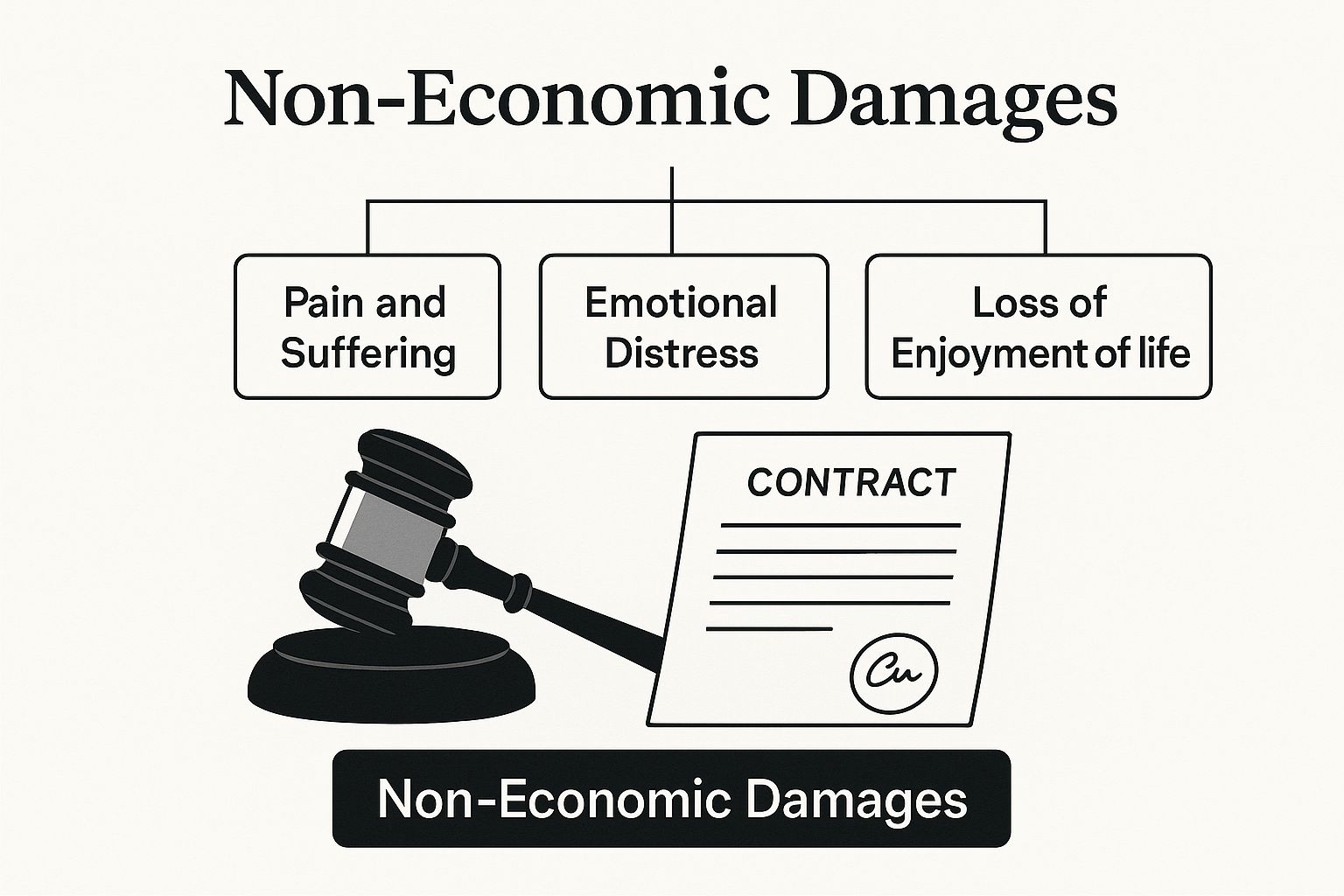
Non-Economic Damages: Valuing Your Pain and Suffering

While economic damages add up the bills you can see—medical invoices, repair estimates, lost pay stubs—an injury’s deepest impacts rarely come with a price tag. These are the personal hardships that change your life in ways a receipt can never capture. Fully understanding these non-economic losses is essential to understanding the different types of damages in personal injury cases.
Non-economic damages are designed to provide compensation for these intangible, but very real, losses. They are legal recognition that the true cost of an accident extends far beyond medical bills and lost wages. It’s about the human toll of the trauma.
What Is Pain and Suffering?
In legal terms, pain and suffering is a broad concept covering the physical and emotional distress you are forced to endure after an accident. This isn’t just about the immediate hurt; it’s about the ongoing challenges that follow.
- Physical Pain: This includes the actual, physical discomfort from your injuries. It could be chronic back pain that never fades, constant headaches, or nerve damage that makes simple movements a daily struggle.
- Emotional Distress: This is the mental burden the accident puts on you. It often shows up as anxiety every time you get behind the wheel, depression from being unable to provide for your family, or a persistent fear that you’ll never feel like your old self again.
These elements are deeply personal and vary from one person to the next. For example, a severe injury can result in permanent scarring or disfigurement, which carries its own unique emotional weight. You can learn more about how compensation is determined for these specific injuries in our guide on scarring and disfigurement claims.
Loss of Enjoyment of Life
Beyond pain, a serious injury can rob you of the ability to participate in the hobbies and activities that once brought you joy. Legally, this is known as loss of enjoyment of life or, in some contexts, loss of consortium. It provides compensation for your inability to live your life as you did before the accident.
Think about it. What is the value of not being able to play catch with your kids, tend to your garden, go for your morning run, or simply enjoy a walk without debilitating pain? This loss is a significant, recognized part of a personal injury claim.
These non-economic damages can vary dramatically depending on the severity and permanence of the injuries. In one landmark personal injury verdict, a jury awarded $36.4 million, with $25 million designated for future non-economic damages and $8.2 million for past losses. The case involved a severe car accident that left the victim with chronic pain and life-altering health problems, demonstrating just how significant these awards can be when an injury changes a person's life forever.
Assigning a dollar value to these abstract losses is one of the most important functions of a personal injury case. We analyze the severity of the injury, the projected recovery time, and the total impact on your daily life to ensure the full human cost is properly recognized. This is a core part of the types of damages in personal injury cases.
Punitive Damages: When Conduct Goes Beyond Negligence
While economic and non-economic damages are about making you whole again, a third, far less common category exists for truly outrageous behavior. These are punitive damages, and their goal isn't to compensate you—it's to punish the at-fault party.
Think of it this way: compensatory damages pay you back for your losses. Punitive damages are designed to send a powerful message that a defendant's conduct was so reckless or malicious that it will not be tolerated by society. They are reserved for actions that show a conscious disregard for the safety and rights of others.
When Might Punitive Damages Apply?
Because the legal standard is so high, punitive damages are not awarded often. The conduct must go far beyond simple carelessness or a momentary lapse in judgment.
Here are a few examples of situations where a court might consider them:
- A drunk driver with multiple prior DUI convictions who causes a catastrophic collision.
- A medical professional who intentionally alters patient records to hide a severe act of malpractice.
- A manufacturer that knowingly sells a product with a dangerous defect, hiding safety test results to protect its profits.
In Georgia, the law requires "clear and convincing evidence" that the defendant's actions showed willful misconduct, malice, fraud, or a conscious indifference to the consequences. This is a much higher burden of proof than required for other types of damages in personal injury cases.
Punitive damages are the legal system's way of penalizing defendants for particularly bad conduct. For example, a landmark $250 million mesothelioma verdict likely included a massive punitive component because a company willfully exposed people to asbestos for decades. To learn more, read about personal injury statistics and major verdicts.
Ultimately, these damages are the exception, not the rule. They are a powerful tool the legal system uses to deter extreme misconduct and hold wrongdoers accountable on a level that goes beyond simply paying a victim for their losses. Understanding their unique role is key when looking at all the types of damages in personal injury cases.
How a Final Compensation Value Is Determined
Knowing the different types of damages in personal injury cases is one half of the equation. The other is understanding how a final dollar value is actually calculated. Insurance companies and law firms don't just pick a number out of thin air; they use specific methods to translate your losses into a settlement figure. My goal is to pull back the curtain on this process so you can see how the numbers come together.
For economic damages, the calculation is mostly straightforward addition. We carefully gather and tally every single document with a price tag attached—medical bills, pharmacy receipts, vehicle repair estimates, and documented proof of lost wages from your employer. Think of it as a detailed accounting of all your tangible, out-of-pocket financial losses.
Valuing Non-Economic Damages
Putting a number on non-economic damages, like pain and suffering, is less about simple math and more about principled evaluation. Since these losses don't come with a neat receipt, we rely on established methods to assign them a fair and justifiable value.
One of the most common approaches is the multiplier method. Here’s the breakdown:
- First, we calculate the total sum of your economic damages (all those medical bills, lost wages, etc.).
- Next, we multiply that total by a number, which typically falls between 1.5 and 5.
- The multiplier isn't random. It’s chosen based on the severity of your injuries, the projected length of your recovery, and the long-term impact on your daily life.
A minor sprain with a quick recovery might warrant a 1.5 multiplier. In contrast, a permanent, life-altering injury could easily justify a multiplier of 4 or 5. This method is especially useful when grappling with the profound, lifelong consequences of a catastrophic injury, which requires a deep understanding of future medical and personal needs. You can learn more about how we handle these severe situations by reading about our approach to Atlanta catastrophic injury lawyer services.
Another strategy is the per diem (Latin for "per day") approach. This method assigns a daily rate for your pain and suffering, running from the date of the accident until you reach what doctors call "maximum medical improvement." The daily rate is often tied to your daily earnings, based on the argument that enduring constant pain is at least as difficult as putting in a day's work.
Ultimately, a final compensation value is the sum of your proven economic damages plus the carefully calculated value of your non-economic damages.
These methods aren't just for show; they provide a logical starting point for negotiations. By presenting a clear, reasoned calculation for how we arrived at a settlement demand, we build a strong, defensible case for the full compensation you are owed. This transparent approach is absolutely necessary when discussing the various types of damages in personal injury cases.
Building a Strong Foundation for Your Injury Claim
A strong personal injury claim is built on a solid foundation of evidence. To effectively pursue the types of damages in personal injury cases we’ve discussed, you must carefully document every aspect of your losses from day one. Think of it as creating a detailed ledger of your journey, where each entry strengthens your case for fair compensation.
This isn't just about paperwork; it's about telling your story with clear, undeniable proof. The more organized you are, the better we can demonstrate the full impact the injury has had on your life, both financially and personally.
Creating Your Evidence Checklist
The best way to protect your rights is to be proactive. Keeping good records prevents important details from being forgotten or disputed later on by an aggressive insurance adjuster. Start immediately and be consistent.
Here is a practical checklist of what you should begin collecting right away:
- All Medical Records: This is non-negotiable. Keep every single bill from hospitals and doctors, receipts for prescriptions, and any reports or notes from your medical providers. This file is the primary proof of your injuries and the costs of your treatment.
- A Daily Journal: Write down how you feel each day. Document your pain levels on a scale of 1-10, note any physical limitations you experience, and describe how the injury prevents you from doing routine activities. This journal becomes a powerful tool for proving pain and suffering.
- Visual Evidence: A picture is worth a thousand words, especially in court. Take photos of your injuries as they heal over time. Also, be sure to photograph any damage to your vehicle or other property involved in the incident.
- Proof of Lost Work: Your financial losses must be clearly proven. Keep all pay stubs and ask your employer for a letter detailing your job title, pay rate, and the exact dates you were unable to work due to your injury.
Following all your doctor's orders is another essential step. It shows that you are actively participating in your recovery, which is important for both your health and the credibility of your claim.
Also, be mindful of deadlines. Georgia has strict time limits for filing a personal injury lawsuit. For more details, you can learn about the statute of limitations for personal injury in GA in our guide.
These simple, organized steps are the building blocks for a successful claim. They are your best defense in protecting your right to compensation for all the different types of damages in personal injury cases.
Common Questions About Injury Compensation
When you're trying to figure out what compensation you might be entitled to, a lot of questions come up. Here in Atlanta, we hear many of the same concerns from people trying to figure out their next steps after an accident. Let's clear up some of the most frequent ones.
Is There a Cap on Damages in Georgia?
For most personal injury cases in Georgia, like a typical car accident, there is no cap on what you can recover for economic or non-economic (pain and suffering) damages.
However, punitive damages are a different story. They are generally capped at $250,000. There are some very specific exceptions, like in product liability cases or when the at-fault party acted with a specific intent to cause harm, as laid out in the Official Code of Georgia.
How Long Do I Have to File a Claim?
Time is a big factor. In Georgia, the statute of limitations for most personal injury claims is a strict two years from the date the injury occurred. If you miss this deadline, you will almost certainly lose your right to recover any compensation, no matter how strong your case is.
The two-year deadline is a firm rule in Georgia's legal system. Waiting too long can prevent you from holding the responsible party accountable.
It's always best to act quickly to make sure your rights are fully protected.
Will My Personal Injury Settlement Be Taxed?
Generally, no. According to the Internal Revenue Service (IRS), money you receive as compensation for physical injuries or sickness is not considered taxable income. This includes funds for your medical bills and for emotional distress that stems directly from the physical injury.
There are a couple of important exceptions to keep in mind:
- Any portion of a settlement awarded specifically for punitive damages is almost always taxable.
- Compensation for lost wages may also be subject to income tax.
Understanding the nuances of the different types of damages in personal injury cases is absolutely key to ensuring you receive a fair and complete recovery.