As an Atlanta personal injury attorney, I find that legal jargon can often feel like a foreign language. My goal is to make these ideas simple and clear. Let's start with a foundational concept you'll see in any claim: what is burden of proof? Simply put, it's the legal responsibility one party has to provide enough evidence to convince a judge or jury that their side of the story is true. If you bring a claim, the duty to prove it is yours.
The Core Idea: Proving Your Case

When you file a personal injury claim after an accident, the legal system doesn’t just take your word for it. Instead, it places the initial burden of proof squarely on your shoulders. As the plaintiff (the person filing the lawsuit), you are the one who must prove the key elements of your case.
Think of it like building a bridge. You can't just declare that a bridge should exist; you have to gather the materials (your evidence), draw up a solid blueprint (your legal argument), and construct it piece by piece until it's strong enough to stand on its own. If any part of that structure is weak, the entire claim could collapse.
Who Carries the Weight?
In almost every civil lawsuit, including personal injury cases, the person bringing the claim starts with this responsibility.
Let’s say you were hurt in a car accident in Atlanta. To win your case, you must prove:
- The other driver had a duty to drive safely.
- They breached that duty by acting negligently (e.g., speeding or texting).
- That specific breach of duty directly caused the accident.
- You suffered actual damages (injuries, medical bills, lost wages) as a result.
Each one of these points is a building block. My job as your attorney is to collect and present the evidence needed to support every single one. If you’re curious about other legal terms you might hear, our firm has a helpful legal dictionary to clarify these concepts.
The general rule in American civil litigation is that the plaintiff carries the initial burden. This principle ensures that the person making an accusation is also responsible for substantiating it with facts and evidence, preventing baseless claims from clogging the courts.
To simplify these concepts, here’s a quick-reference table.
Key Elements of Burden of Proof at a Glance
| Concept | Simple Explanation |
|---|---|
| Plaintiff | The person who files the lawsuit and initially has the burden of proof. |
| Defendant | The person being sued, who must defend against the plaintiff's claims. |
| Evidence | Facts, testimony, and documents used to prove a claim. |
| Standard of Proof | The level of certainty required to win the case (e.g., "by a preponderance of the evidence"). |
Understanding these roles is the first step in seeing how a case is built from the ground up.
Not All Proof Is Created Equal
It’s also important to know that the "weight" of proof required can change dramatically depending on the type of case. As we'll get into, the standard for a personal injury claim is very different from the standard in a criminal trial.
This is because the stakes are vastly different—financial compensation versus a person's liberty. This foundational concept—that the plaintiff must prove their claim—is the starting point for every legal journey and shapes the entire strategy for seeking justice. Understanding the what is burden of proof is the first step toward building a strong case.
Civil vs. Criminal Cases: How the Scales Are Weighed
Not all legal battles are judged by the same rules. The level of proof you need to win your case hinges entirely on what’s at stake, which is the core of understanding the burden of proof. The difference between a civil personal injury claim and a criminal trial is one of the most fundamental distinctions in our entire legal system.
When you file a personal injury claim in Atlanta, the standard you’re held to is called the preponderance of the evidence. It sounds technical, but the concept is actually much simpler—and more achievable—than the high-drama standards you see on TV.
Preponderance of the Evidence: Your Personal Injury Standard
Think about those classic scales of justice. To meet the preponderance of the evidence standard, your job is to tip the scales just slightly in your favor. All you have to do is show that your version of events is more likely true than not.
If you can persuade a judge or jury that there's even a 51% chance the other party's negligence caused your injuries, you have met your burden of proof. This doesn't require absolute certainty. It just means your claim is more probable than the alternative.
Let's break it down:
- Your Evidence: The police report from the scene, your medical records, statements from witnesses, and photos of the crash.
- Defendant's Evidence: Their own testimony, maybe a conflicting witness account, or an argument that you were the one at fault.
We put all of that evidence on the scales. If the weight on your side is even a little bit heavier, you win. This standard makes sense for civil cases because the outcome is usually about financial compensation for damages, not taking away someone's freedom.
Beyond a Reasonable Doubt: The Criminal Standard
Now, let's contrast that with the heavy burden in criminal cases. Here, the prosecution must prove the defendant’s guilt beyond a reasonable doubt. This is the highest standard in American law, and for good reason.
A criminal conviction carries life-altering consequences: massive fines, a permanent criminal record, and, most importantly, the loss of liberty through prison time. Because the stakes are so incredibly high, the system demands near-certainty before rendering a guilty verdict.
The "beyond a reasonable doubt" standard means the evidence must be so compelling that no reasonable person could have any real doubt the defendant is guilty. We're not talking about 51% here; this is much closer to 99% certainty.
This stark difference in standards has deep historical roots. In common-law systems like ours, the "preponderance of the evidence" standard is accepted as a practical way to achieve accurate results in civil disputes. Interestingly, some civil-law systems in other parts of the world demand a higher level of proof even in non-criminal cases, requiring a judge to be firmly convinced before ruling. You can read more about these fascinating differences in legal systems.
This high bar in criminal law is the bedrock of a core principle: you are innocent until proven guilty. Our system is built on the belief that it’s far better to let a guilty person walk free than to wrongfully imprison an innocent one. This is why the burden of proof is so important—it changes entirely based on the potential consequences of the verdict.
A Deeper Look at the Different Standards of Proof
Once we've separated civil and criminal law, we can dig into the specific standards of proof the legal system uses. Think of them as rungs on a ladder—each one demanding a higher degree of certainty. Understanding these levels is key to answering the question: what is burden of proof in any given situation, from a traffic stop to a murder trial.
Reasonable Suspicion and Probable Cause
Before a case ever sees the inside of a courtroom, two important standards govern how law enforcement can interact with the public.
- Reasonable Suspicion: This is a fairly low bar. It’s more than a gut feeling but far less than solid proof. An officer needs this to briefly stop and question someone, but only if they can point to specific, observable facts suggesting a crime might be afoot.
- Probable Cause: This is a step up. It's what police need to make an arrest or get a warrant to search your property. Probable cause exists when there are enough facts and circumstances to make a reasonable person believe a crime has actually been committed.
These two standards are foundational for police work. But as soon as a case moves into the legal system, the proof required gets much more specific.
Preponderance of the Evidence: Your Personal Injury Standard
This is the standard we work with in nearly all Atlanta personal injury claims. As mentioned, preponderance of the evidence simply means you must prove your claim is more likely true than not. All we have to do is tip the scales past 51% in your favor.
It’s the go-to standard for civil disputes because it’s seen as the fairest way to resolve conflicts where money, not liberty, is on the line. The Supreme Court has repeatedly confirmed this, making it the default unless a specific law demands a higher bar. This approach is designed to balance the risk of an incorrect verdict almost equally between both parties.
This infographic breaks down how the key legal standards stack up.
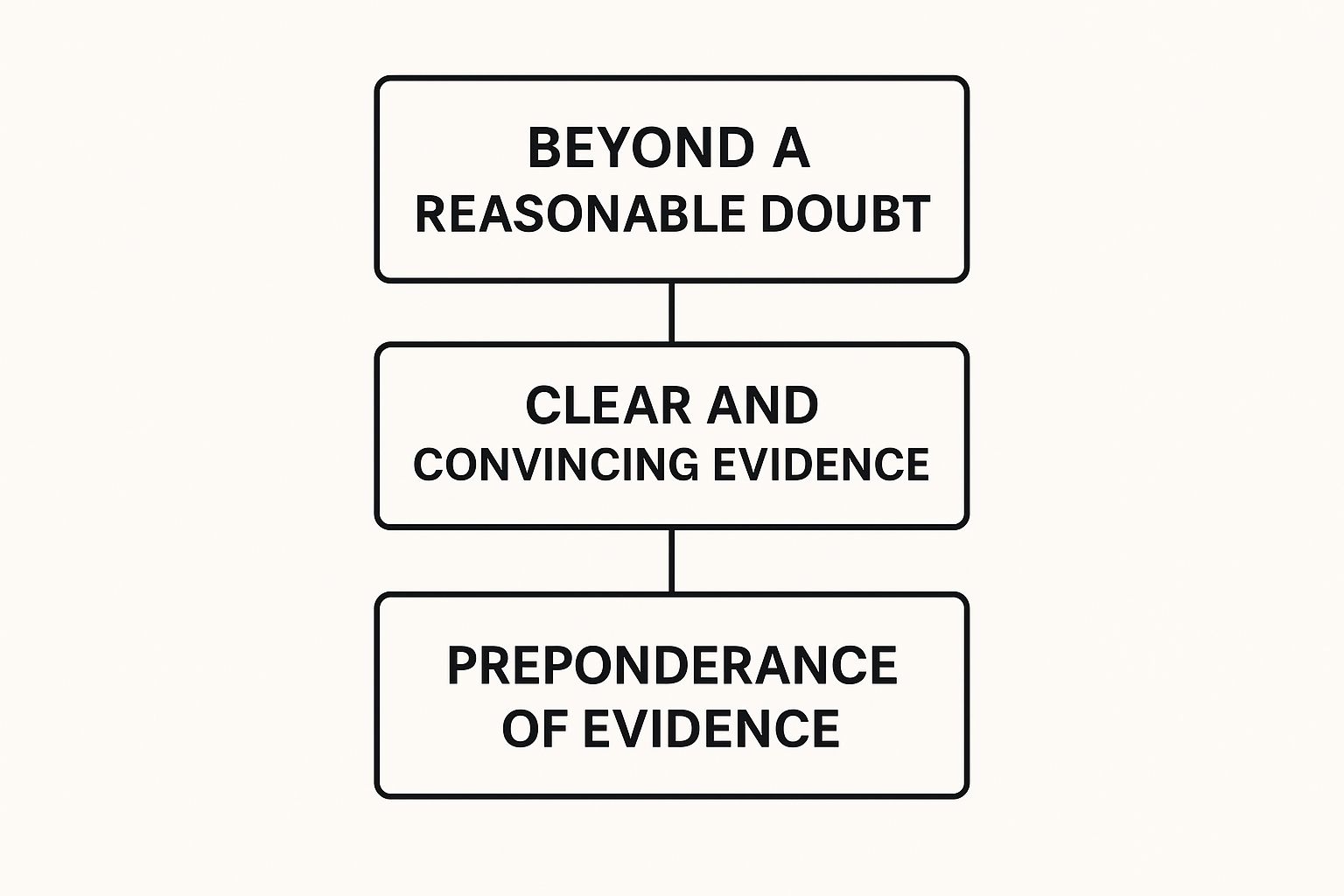
As you can see, the jump from the civil standard to the criminal one is significant, showing just how much more certainty is required when someone's freedom is at stake.
Clear and Convincing Evidence
Positioned between the 51% civil standard and the near-certainty of a criminal case is clear and convincing evidence. This tougher standard is reserved for specific civil cases where the stakes are much higher than just financial loss.
This standard requires the evidence to be highly and substantially more probable to be true than not. The trier of fact must have a firm belief or conviction in its factuality.
You'll typically see this standard in cases involving:
- Allegations of fraud or misrepresentation
- Contests over the validity of a will
- Proceedings to terminate parental rights
Because these situations carry severe, often irreversible consequences, the law demands a greater degree of proof than a simple majority.
Beyond a Reasonable Doubt
Finally, we reach the top of the ladder: beyond a reasonable doubt. This is the highest and most demanding standard in American law, used exclusively in criminal trials. It carries such immense weight because a person’s liberty hangs in the balance.
The prosecution must present evidence so powerful that there is no other logical explanation for the facts except that the defendant committed the crime. This doesn't require the elimination of all doubt, just all reasonable doubt. Interestingly, while the legal community generally pegs this standard at around 90.1% certainty, a Duke University study found that judges' personal interpretations can vary significantly.
Understanding this full spectrum is so important. Each standard of proof has a specific purpose, carefully calibrated to match the severity of the consequences. The answer to what is burden of proof isn't a single definition but a sliding scale designed to protect everyone involved in our justice system.
How the Burden of Proof Can Shift During a Lawsuit

In a personal injury case, the burden of proof almost always starts with the plaintiff—the person who filed the lawsuit. But the legal system is more dynamic than that. In certain situations, the responsibility to prove a fact can actually flip from one side to the other.
This "shifting" of the burden is a significant part of our legal process. It happens when specific circumstances make it only fair to require the defendant to explain what happened, rather than forcing the injured person to prove every last detail. Think of it as the law acknowledging that sometimes, the facts speak for themselves.
When "The Thing Speaks for Itself"
One of the most powerful examples of a shifting burden comes from a legal doctrine called res ipsa loquitur. That’s Latin for "the thing speaks for itself." It applies in situations where an accident is so unusual that it simply couldn't have happened unless someone was negligent.
For this principle to kick in, a few key conditions usually need to be met:
- The incident is the kind that doesn't normally happen without negligence.
- The object or situation that caused the harm was under the defendant's exclusive control.
- The injured person did nothing to contribute to their own injury.
A classic, tragic example is found in medical malpractice. Imagine a surgeon leaves a sponge inside a patient after an operation. It's self-evident that sponges don't belong inside people, and the surgical team had total control over that operating room.
In a case like this, the court can shift the burden of proof. Now, instead of the patient having to prove the surgeon was negligent, the burden flips. The surgeon and their team must prove they were not negligent. This is a vital tool for holding people accountable when the victim couldn't possibly have direct evidence of the mistake. The entire Atlanta personal injury lawsuit process can hinge on powerful legal doctrines like this one.
Affirmative Defenses: Another Way the Burden Shifts
The burden of proof also moves when a defendant uses an affirmative defense. This is a legal strategy where the defendant effectively says, "Okay, what the plaintiff says happened is true, but I had a legally valid reason for my actions that excuses me from fault."
By raising an affirmative defense, the defendant introduces a whole new set of facts into the case. And because they are the ones making this new claim, the burden is on them to prove it.
By raising an affirmative defense, the defendant takes on a new, specific burden of proof. They must prove their defense by a preponderance of the evidence—the same standard the plaintiff had to meet for their initial claim.
Common examples of affirmative defenses include:
- Self-Defense: "Yes, I hit the plaintiff, but only to protect myself from their attack."
- Statute of Limitations: "The plaintiff's claim may be valid, but they waited too long to file their lawsuit."
- Comparative Fault: In Georgia, this involves arguing the plaintiff was also partially to blame for their own injuries.
Each of these arguments requires the defendant to bring their own evidence to the table and convince the court their defense is valid. It's important to understand that the burden of proof isn't a static, one-sided obligation; it's a dynamic element that can and does move depending on the facts and legal strategies in play.
Meeting Your Burden of Proof in an Atlanta Injury Claim

Legal theories are one thing, but how does it all come together in your Atlanta personal injury case? It’s time to move from theory to practice. Meeting your burden of proof simply means building a clear, convincing story showing the defendant’s negligence more likely than not caused your injuries.
My job as your attorney is to gather all the individual pieces of that story and assemble them into a powerful narrative for the insurance company, a judge, or a jury. We work together to collect every shred of evidence available to tip the scales of justice in your favor.
The Building Blocks of Your Case
Think of each piece of evidence as a single brick in a wall. No single brick wins the case on its own, but together, they create an undeniable structure. Our primary focus is always on gathering items that establish the defendant's fault and document the full scope of your losses.
Here are the most common types of evidence we use to build a strong personal injury claim:
- Official Accident Reports: This is often the first official record of what happened. We get reports from the Atlanta Police Department, Fulton County Sheriff's Office, or the Georgia State Patrol to review the officer's initial findings, diagrams, and any citations they issued.
- Medical Records and Bills: Documents from providers like Grady Hospital or Piedmont are essential. They create a clear timeline of your injuries, prove the treatments you required, and detail the exact financial cost of your recovery.
- Eyewitness Testimony: A statement from someone who saw the accident unfold can be incredibly persuasive. When a neutral third party confirms your version of events, it adds significant weight to your side of the scale.
- Photos and Videos: Visual proof is powerful. Pictures or videos from the scene showing property damage, skid marks, road conditions, and your injuries help a jury understand exactly what happened in a way words alone cannot.
- Expert Opinions: Sometimes, we need a specialist to explain the technical details. To meet the burden of proof, it's often necessary to rely on specialized testimony, like understanding the role of a medical malpractice expert witness. We also use accident reconstructionists to show precisely how a crash occurred.
It’s important to remember that evidence must be collected quickly. Georgia has strict deadlines for filing a lawsuit, and knowing the statute of limitations for personal injury in GA is a vital part of a successful strategy.
An Example on I-285
Let’s walk through a hypothetical car accident on I-285 in Atlanta. You were driving safely when a commercial truck swerved into your lane, causing a serious collision. The trucking company denies their driver was at fault. Here’s how we would meet the burden of proof.
We must prove four things: duty, breach, causation, and damages.
- Duty: This is the easiest part. All drivers, especially commercial truck operators, have a legal duty to drive safely.
- Breach: Did the driver fail in that duty? We’d use the GSP crash report noting an improper lane change, data from the truck's "black box" showing the driver never braked, and testimony from another driver who saw the truck drifting.
- Causation: Next, we connect the driver's mistake directly to your injuries. Your medical records from Emory University Hospital would show you suffered a broken arm and a concussion in the crash. We might also bring in an accident reconstruction expert to create a simulation showing how the force of the truck's impact would cause those specific injuries.
- Damages: Finally, we prove your losses. We present your medical bills, pay stubs showing lost income from being unable to work, and testimony from you and your family about the pain and suffering these injuries have caused.
By layering each piece of evidence, we move from a simple accusation to a substantiated claim. We show the jury not just that the truck driver was negligent, but precisely how that negligence created a chain reaction that led directly to your harm.
This methodical approach is how we transform a difficult event into a compelling legal case. The goal is to leave no doubt that your claim is more than 51% likely to be true, satisfying the burden of proof and securing the justice you deserve.
Common Questions About Burden of Proof
We get it—the legal system can feel like a maze of confusing terms and high stakes. Here in Atlanta, our clients often come to us with similar questions about their personal injury claims and what it really takes to win. To help you feel more comfortable with the process, we've answered some of the most frequent questions we hear about the burden of proof.
Our goal is to give you clear, straightforward information so you can feel more in control of your case.
Does Having More Evidence Automatically Mean I Win?
Not at all. While it's tempting to think a mountain of documents will secure a win, courts focus on the quality and relevance of your evidence, not just the quantity.
Think of it this way: a single, clear security video showing the accident is far more powerful than a stack of blurry photos and irrelevant paperwork. Your job isn't to overwhelm the court with volume; it's to present a coherent, persuasive story backed by strong, credible proof. The right evidence tells the right story.
What Happens If I Can't Meet My Burden of Proof?
This is a direct question with a blunt answer: if the plaintiff fails to meet their burden of proof, the defendant wins. The court will dismiss your case, and you will not be able to recover any compensation for your injuries.
This is exactly why building a strong case from day one is so important. As the person bringing the claim, the law puts the responsibility squarely on your shoulders to prove your case. Even a completely valid claim will fail without sufficient evidence to back it up. To get a better handle on terms like this, an essential legal terminology glossary can be a great resource.
Can the Other Side Present Evidence Against Me?
Absolutely. The American legal system is adversarial, meaning both sides have the opportunity to present their case. The defendant and their lawyers will actively work to dismantle your claim by introducing their own evidence, witnesses, and arguments.
Their strategy typically involves one of two approaches:
- Discredit Your Case: They will look for holes in your story, arguing that your evidence is weak, unreliable, or incomplete.
- Present an Alternate Theory: They will offer a different version of events, often one that shifts some or all of the blame onto you.
An experienced personal injury attorney anticipates these tactics. We proactively identify potential weaknesses in your case and shore them up before they can be exploited in court. This ensures your claim is built to withstand challenges from the other side.
At Jamie Ballard Law, we're here to carry that burden for you. If you've been injured in Atlanta, you don't have to face the legal system alone. Contact us for a free, no-obligation consultation to discuss your case. Let us fight for the justice and compensation you deserve. Learn more at https://jamieballardlaw.com.