Hello, I'm an Atlanta personal injury attorney, and if you've been injured, you'll likely encounter a lot of paperwork. But few documents are as final as a release from claims agreement. This is a very important legal document that officially ends your case.
Think of it as the last handshake that seals the deal on a legal settlement. It's a binding contract where you agree to give up your right to sue someone over an incident, and in return, you get an agreed-upon payment. It’s the official end of the line for your claim, so understanding it is essential.
What a Release From Claims Means for Your Injury Case

When you get hurt in an accident, the road to compensation has several stages. The very last step, right before the settlement check is cut, is signing this release. The at-fault party's insurance company won't pay a dime until they have this signed document in hand. It’s their way of closing the book on your case for good.
By signing, you're making a legally enforceable promise: you will not seek any more money or file any future lawsuits against them for this specific incident. This agreement is what makes a settlement final and gives the insurer a guarantee that the matter is completely resolved.
The Purpose Behind the Document
At its core, a release creates certainty for everyone involved. The insurance company gets the peace of mind that they won't be sued again over the same accident, and you get the compensation you agreed to. Before you sign anything, it's a good idea to understand the strategies for maximizing your personal injury case settlement to ensure the amount is fair.
Here’s why you have to get this part right:
- Finality is Absolute: Once you sign, you can't go back and ask for more money. This holds true even if your injuries turn out to be far more serious than you first thought.
- Protection for the Other Party: The release acts as a legal shield, protecting the person or company that caused your injury from any future lawsuits related to this one event.
- It Triggers Your Payment: Insurance companies will not issue a settlement check until they receive your signed release. It’s the key that unlocks your compensation.
This document formally ends your legal matter and locks in the settlement terms. The language is always very specific and legally dense, which is why a thorough review with an attorney is an absolute must before you sign a final release from claims.
Breaking Down the Key Parts of a Release Agreement
Every release agreement looks a little different, but they all share the same basic structure. Think of these core components as the main parts of the contract. If you understand their function, you'll know exactly what you’re signing before you give up your right to sue.
Let's walk through the standard sections you’ll find in almost every release.
Identifying the Parties and Consideration
First, the document must clearly name the “parties” involved. This means you, the “releasor” (the person giving up the claim), and the person or company being let off the hook, known as the “releasee.” This section has to be precise—no room for confusion about who is covered by the agreement.
Next up is “consideration.” This is the legal term for what you get in exchange for dropping your claim, which is almost always the settlement money. The exact dollar amount must be spelled out. This is the payment that makes the deal final. If you run into unfamiliar legal terms like this, our legal dictionary can help clear things up.
A release is fundamentally a trade: you trade your right to sue for a guaranteed payment. The terms of that trade must be crystal clear to protect both sides from future disputes.
Defining the Scope of the Release
This is arguably the most important part of the entire document: the "scope of the release." This section specifies exactly which claims you are signing away. Often, it will use broad language, stating you release the other party from all “known and unknown” claims related to the incident. That language is designed to be permanent and all-encompassing.
The sheer volume of claims handled worldwide shows why insurers push for such finality. In just five years, the insurance industry managed around 530,000 corporate claims, paying out roughly €88.7 billion. You can learn more from these global insurance claim trends.
Finally, be on the lookout for “boilerplate” language. These are the standardized clauses that appear in nearly every contract, covering things like confidentiality or confirming that no verbal promises were made. It's not just filler—you have to read and understand every single word.
To make it easier, here’s a quick breakdown of the common elements you’ll encounter.
Key Elements in a Release From Claims
| Element | What It Means for You |
|---|---|
| Parties | Identifies you (Releasor) and the person/company you are releasing (Releasee). |
| Consideration | The settlement amount or other value you receive for signing away your claim. |
| Scope of Release | Details the specific claims ("known and unknown") you are giving up permanently. |
| Confidentiality | A clause preventing you from discussing the settlement amount or incident details. |
| No Admission of Fault | States that the payment is not an admission of wrongdoing by the other party. |
| Governing Law | Specifies which state's laws will be used to interpret the agreement if a dispute arises. |
These are the core pieces of the puzzle. Understanding them puts you in a much stronger position when you have that final release from claims sitting in front of you.
Common Types of Release Forms Explained
Not every release from claims form is a one-size-fits-all document. The specific type you get from an insurer will depend entirely on the facts of your case, and it's important to understand what makes each one different.
If you sign the wrong version, you could accidentally give up more legal rights than you ever intended.
The most common version you’ll see is the General Release. Think of this as the broadest, most comprehensive agreement possible. By signing it, you agree to waive all known and unknown claims you might have against the other party related to that single incident. It’s designed to be a complete and total end to the matter.
Specific and Mutual Releases
On the other hand, you might come across a Specific Release. This type is much narrower. It only applies to a particular, named claim described in the document.
For example, a specific release might cover only the property damage to your car but leave your injury claim open for future negotiation. These are less common in personal injury settlements, where the goal is usually total closure.
Another type is the Mutual Release, where both sides agree to let each other off the hook. This is often used when there’s a genuine dispute about who was at fault. Both you and the other party agree to walk away and not pursue any further claims against one another. It's a clean break for everyone involved.
This infographic breaks down the decision-making path for the core parts of any release document you might see.
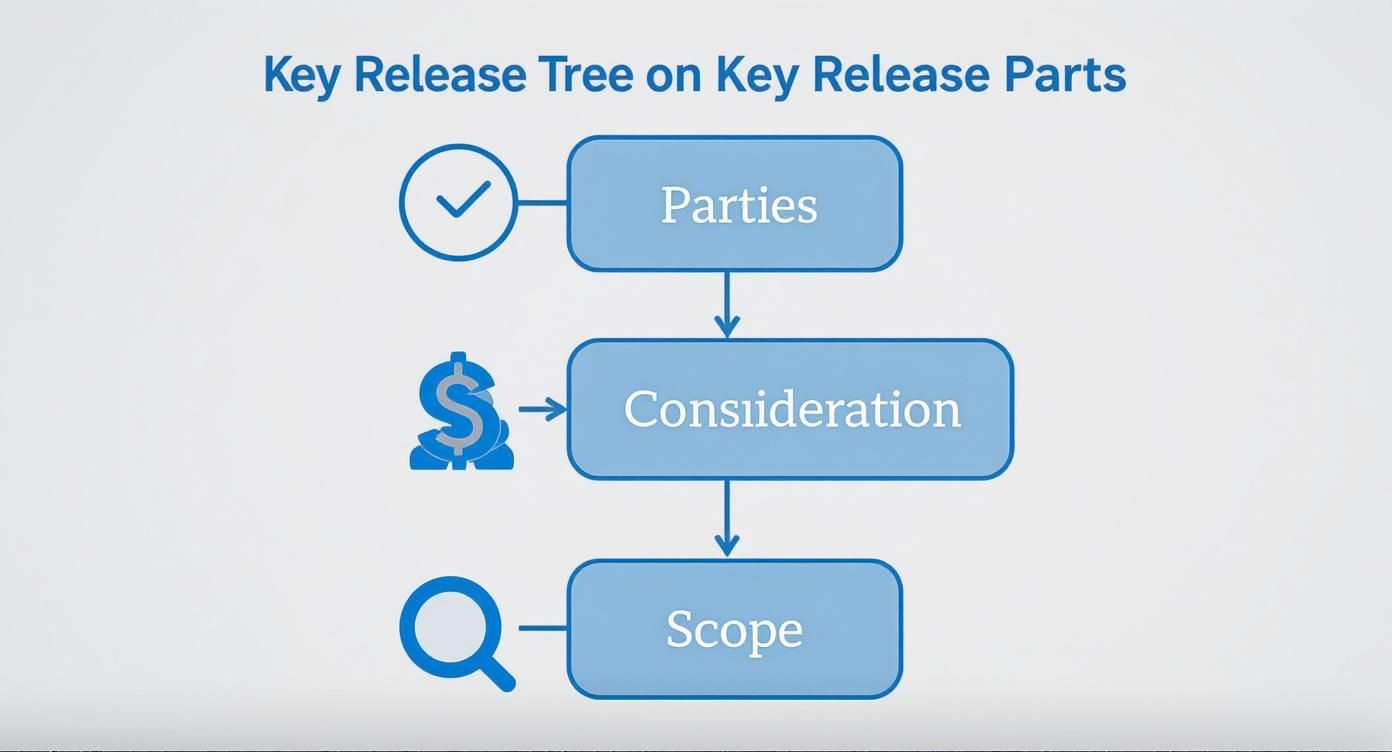
As the visualization shows, no matter the type, the core elements remain the same: identifying the parties, stating the payment amount, and defining the scope of what you’re giving up.
Beyond these standard forms, specialized documents exist for different legal contexts. It's worth noting that AI tools can assist in drafting various legal documents, including specific types like Release Deeds, which shows how technology is adapting to these legal needs.
Grasping these distinctions is a key step in protecting your interests. For more helpful information, you can explore the various topics covered in our online legal resources. A solid understanding of each document ensures you make an informed decision when presented with a final release from claims.
Why You Must Carefully Review Any Release Before Signing

Signing a release from claims is a permanent, legally binding decision. Think of it as the final word on your injury case. Once your signature is on that document, the door to seeking any more compensation slams shut for good.
This is true even if your injuries turn out to be far more severe than you or your doctor first thought. The finality of the document is absolute. Any future medical bills, lost wages, or unexpected pain and suffering tied to that incident become your burden to bear alone.
Common Traps Hidden in the Fine Print
An insurer’s release form is a legal shield crafted to protect them, not you. It's easy to fall into traps hidden in the dense legal language. For instance, some releases use vague wording that could accidentally release parties you never intended to, like your own insurance company or a negligent third party.
Another common pitfall is when the written terms don't match the verbal agreement you thought you had. What was said on the phone doesn't matter in court—only the document you sign does. The stakes are immense; total insurance claims paid out last year reached approximately USD 1.1 trillion, a figure that shows the massive financial interests at play. You can find more details in the Global Insurance Market Report.
The single most important thing to remember is this: a release protects the insurer by ending your rights. Before signing, you must be completely sure the settlement fully covers all your past, present, and future needs related to the injury.
A Quick Checklist Before You Sign
Before your pen ever touches that paper, stop and ask yourself these questions. This isn't just about the money you get today; it's about protecting your future. You should also be aware of how the statute of limitations for personal injury in Georgia affects your timeline for making these decisions.
- Is the settlement amount correct and written out clearly?
- Are all parties being released named specifically and correctly?
- Have I reached maximum medical improvement so I know the true, long-term extent of my injuries?
- Does the language cover "unknown" injuries, and do I fully grasp what that means for my future?
- Are there any terms I don't understand, like confidentiality clauses or lien agreements?
Never let an insurance adjuster pressure you into signing quickly. A thorough, careful review is your right and your best defense against an unfair settlement. Taking the time to be absolutely certain is the smartest move you can make when presented with a release from claims.
What to Expect After You Sign the Release

You’ve reviewed the document, agreed to the terms, and put your signature on the release from claims. So, what’s next? Signing that paper is the final green light for the insurance company to start cutting the check.
Once the insurer gets the signed release, they'll process and mail the settlement funds. The good news is that technology has sped this up quite a bit. Over the last five years, the average time to release a payment has dropped by 30%, falling from around 21 days to just 15. You can dig into the specifics in this Swiss Re industry report.
Final Steps Before You Receive Your Funds
Even after the check is sent, the money doesn’t land in your bank account right away. A few steps have to happen first. The settlement check is almost always sent directly to your attorney’s office, where it’s deposited into a secure trust account.
This isn't just a delay tactic; it’s a required legal step to settle any outstanding debts connected to your case. The most common of these are medical liens.
A medical lien is a legal right to repayment that a healthcare provider—like a hospital, surgeon, or even your health insurance company—places on your settlement. It ensures they get paid for the treatment they provided for your injuries before you receive your portion.
Your attorney will manage this process, using the settlement funds to pay off any liens and cover case-related costs. After every financial obligation is satisfied, the remaining amount is yours. This structured process ensures all debts are cleared before you get the final payment from the release from claims.
Answering Your Questions About Release Agreements
When you’re near the end of a settlement, the final paperwork can feel overwhelming. Many clients we work with here in Atlanta have the same questions when they first see a release from claims document. Let's clear up some of the most common concerns.
Can I Cancel a Release After Signing It?
Almost never. A release is a formal, legally binding contract meant to be the final word on the matter.
Exceptions are incredibly rare. To undo a signed release, you'd typically have to prove you were a victim of outright fraud, were under extreme duress, or lacked the mental capacity to understand what you were signing. Proving any of these is a steep uphill battle, so it's best to assume your signature is the final, irreversible step. For more on contract principles, check out this helpful guide from Wikipedia.
What if My Injuries Are Worse Than I Thought?
This is precisely one of the biggest risks of settling and signing a release too quickly. Nearly every release agreement, especially a "General Release," will include language that covers all "known and unknown" injuries.
This clause means that if you later discover your condition has worsened—or a new, related injury surfaces—you have already signed away your right to seek additional compensation. That’s why a complete medical prognosis from your doctor is non-negotiable before you even think about settling.
The core purpose of a release is to end all future financial liability for the insurer. They are paying for a guarantee that the matter is completely finished, regardless of what happens with your health down the road.
Does Signing a Release Mean I Admitted Fault?
No, a standard release does not function as an admission of guilt. In fact, most forms include a specific clause stating the opposite.
This language clarifies that the payment is a compromise of a disputed claim and is not an admission of liability by the other party. The insurer is simply paying to close the case and avoid the cost and uncertainty of a lawsuit—not because their client is admitting they did anything wrong. For more general information, you can review resources from Georgia's Office of Commissioner of Insurance.
Do I Have to Sign the First Release an Insurer Sends Me?
Absolutely not. A release is part of the overall settlement negotiation, not a take-it-or-leave-it demand.
You should never feel pressured to sign a legal document, particularly one you don’t fully understand. The terms of the release, just like the settlement amount, can be discussed and potentially modified. It is always wise to have an attorney review the document to ensure your rights are fully protected before you agree to the final terms of the release from claims.
At Jamie Ballard Law, we believe an informed decision is the best way to protect your future. If you have questions about a personal injury claim or a release agreement you've been asked to sign, we are here to provide clear, honest answers. Contact us for a free, no-obligation case evaluation at https://jamieballardlaw.com.