As an Atlanta personal injury attorney, I know the moments after a crash are disorienting and stressful. When you're in a rental car accident, your first priority is always safety. Taking the right steps right after the collision can have a big impact on your physical recovery and the outcome of any personal injury claims. I want to give you some helpful, straightforward guidance based on my experience.
Your First Moves at the Scene of the Accident
The screech of tires and the jarring impact trigger a rush of adrenaline. It's easy to feel overwhelmed, but staying as calm as possible to focus on a few key actions will protect both you and your legal rights. The goal is to secure the scene, get necessary medical help, and start creating an accurate record of what happened.
Prioritize Safety Above All Else
Your immediate concern is the well-being of everyone involved. Before you do anything else, check on yourself and your passengers for injuries. If you are able, check on the occupants of the other vehicle(s).
If anyone is hurt—even if it seems minor—it’s best to stay put and wait for medical professionals. Moving someone with a potential neck or back injury can cause permanent harm.
If the vehicles are in a live lane of traffic and can be moved safely, pull over to the shoulder or a nearby lot. This is important for preventing a secondary, more serious accident. Turn on your hazard lights immediately to make your vehicle visible to other drivers.
Call 911 Immediately
No matter how minor the accident seems, you should always call 911. There are two very important reasons for this:
- Medical Assistance: Paramedics can assess injuries right away. This is vital because the shock of a crash can mask symptoms of serious injuries like internal bleeding or concussions.
- Official Police Report: A police officer will document the accident scene, creating an official report. This document is a powerful piece of evidence, providing an objective account of the incident, road conditions, and the officer’s initial assessment of fault. You can find out how to get a copy of your report from the Georgia Department of Transportation.
When you speak with the 911 operator, be clear and concise. Provide your exact location, state that you've been in an accident, and mention any apparent injuries.
A Quick Tip from Experience: Never agree with the other driver to just "exchange information and handle it without police." Without an official report, the other party could later change their story or deny the accident ever happened, leaving you in an incredibly difficult position.
Be Careful What You Say
After a crash, emotions run high. It’s natural to want to be polite or even apologize, but you must be very careful with your words. Do not admit fault, even if you think you might have been partially to blame. Avoid reflexive statements like "I'm so sorry" or "I didn't see you."
Insurance companies can and will interpret these phrases as an admission of guilt to use against you. Stick to the facts when speaking with the other driver and the police. Calmly exchange names, contact information, and insurance details.
If the rental car is severely damaged and can't be driven, you may need to arrange for specialized salvage towing services to have it removed. The responding officer or the rental company can often help coordinate this. Remember, the immediate aftermath of a rental car accident sets the stage for everything that follows. Taking these controlled, deliberate steps is essential.
Gathering the Right Evidence for Your Claim
Once you've made sure the scene of the rental car accident is secure and everyone is safe, it's time to shift gears. The evidence you collect in these first few minutes is the bedrock of your entire claim. It creates a factual, objective record that insurance adjusters and rental companies can't easily dispute. Your smartphone is your best friend here.
You need to think like an investigator. Start snapping photos and recording videos—far more than you think you’ll ever need. Get every angle of the damage to all vehicles involved. Wide shots are great for showing where the cars ended up, but you also need tight, close-up shots of the actual points of impact. And don't stop there. Look for skid marks, scattered debris, and any traffic signs or signals nearby. Capture it all.
Documenting the Scene and Conditions
The environment tells its own part of the story, providing context that can be important later on.
- Weather and Road Conditions: Was it raining, foggy, or bright and sunny? Were the roads slick with rain, or was there loose gravel from a construction zone? These details matter.
- Time and Location: Note the exact time of the crash. Drop a pin on your phone’s map or identify the nearest cross-streets and landmarks. Precision is key.
- Surrounding Area: Take pictures of the entire intersection, any visible speed limit signs, and anything else that helps build a complete picture of what the scene looked like.
This information creates an undeniable timeline and setting for the accident, which becomes invaluable when it’s time to reconstruct what happened.
Exchanging Information Calmly and Correctly
You are required to exchange information with the other driver, but it's important to keep the conversation short and to the point. Stick to the facts. Don't get drawn into an argument or discuss who was at fault.
Politely ask for the following and take clear photos of each item:
- The other driver’s license.
- Their insurance card.
- Their vehicle’s license plate.
- Their name and phone number.
You'll need to provide your information as well. Have your driver's license, the rental agreement paperwork, and your personal insurance card ready to show them.
An important takeaway here is to never rely on a verbal promise that someone will text or email you their information later. Get photographic proof of their documents before you leave the scene. Cooperation can vanish once a driver is away from the accident.
To make sure you don't miss anything in the heat of the moment, here’s a quick-reference checklist.
Essential Evidence Checklist at the Accident Scene
| Evidence Type | What to Collect | Why It's Important |
|---|---|---|
| Photographs & Videos | Damage to all cars (wide & close-up), license plates, skid marks, debris, traffic signs. | Creates an unbiased visual record of the aftermath and contributing factors. |
| Driver Information | Photos of the other driver's license, insurance card, and phone number. | Essential for filing a claim and ensuring you can contact the at-fault party. |
| Scene Documentation | Notes or photos of the location, time, weather, and road conditions. | Helps reconstruct the accident and establishes environmental factors. |
| Witness Information | Name, phone number, and a brief recorded statement (if they consent). | Provides an impartial, third-party account to support your version of events. |
| Police Report | The responding officer's name, badge number, and the official police report number. | The official report is a powerful piece of evidence for establishing fault. |
Having this information organized and ready will make the claims process significantly smoother.
The Power of an Unbiased Witness
Independent witnesses are gold. They have no skin in the game and can offer a purely objective account of what they saw unfold. If anyone stopped to help or witnessed the crash, ask if they'd be willing to share what they saw.
If they agree, get their full name and phone number. You could even ask if they'd mind you recording a short audio or video statement on your phone. A simple prompt like, "Could you just describe what you saw happen?" is all you need.
This third-party perspective can be the tiebreaker, especially when the other driver starts changing their story. Collecting this evidence properly from the very start is a major step in how to file a car accident claim in Atlanta. A well-documented file gives you the strongest possible footing after a rental car accident.
Reporting the Accident to the Rental Agency and Insurers
After a rental car wreck, you’re suddenly dealing with a lot more than just the other driver. The rental agency and multiple insurance companies are now involved, and knowing who to call—and in what order—is important for protecting yourself financially.
Your very first call, after the scene is secure and police have been notified, should be to the rental car company. Dig out that rental agreement you tucked away in the glove box; it will have a 24/7 emergency or accident support number. Report the accident as soon as you safely can. They need to know what happened to their vehicle and will have their own set of procedures for you to follow.
This is also your chance to get clarity on the coverage you selected at the counter. Did you purchase the Collision Damage Waiver (CDW) or Loss Damage Waiver (LDW)? These aren't technically insurance policies, but they act like one by releasing you from financial responsibility for damage to their car, as long as you didn't violate the rental agreement.
Figuring Out Your Insurance Coverage
Untangling which insurance policy pays for what can feel like a puzzle, but there’s usually a specific pecking order. Multiple policies can come into play, and you need to understand how they stack up to avoid getting hit with unexpected bills.
- Your Personal Auto Insurance: In most situations, your own car insurance is the primary policy. The liability coverage you carry for your personal vehicle typically extends to a rental, covering the damage and injuries you might cause to others.
- Credit Card Benefits: Many major credit cards offer rental car insurance as a perk, but it's almost always secondary coverage. This means it only kicks in after your primary auto insurance has paid out, covering things like your deductible or other gaps.
- Rental Company's Waiver (CDW/LDW): If you bought this, it usually covers damage to the rental car itself, no matter who was at fault.
A common scenario is that your personal auto policy covers liability, while either a credit card benefit or the purchased CDW/LDW handles the damage to the actual rental vehicle. The key is to notify all potential insurers immediately.
Notifying Your Own Insurance Company
Next, call your own auto insurance agent or their claims department. This is a very important step. Even if the accident clearly wasn't your fault, your policy might need to provide initial coverage for things like medical payments or if you discover the at-fault driver is uninsured.
Have this information handy when you make the call:
- Your policy number.
- The exact date, time, and location of the crash.
- The police report number, if available.
- The other driver’s name and insurance details.
- The rental company's contact info and your rental agreement number.
The evidence you gathered at the scene is what will back up everything you report to these companies.
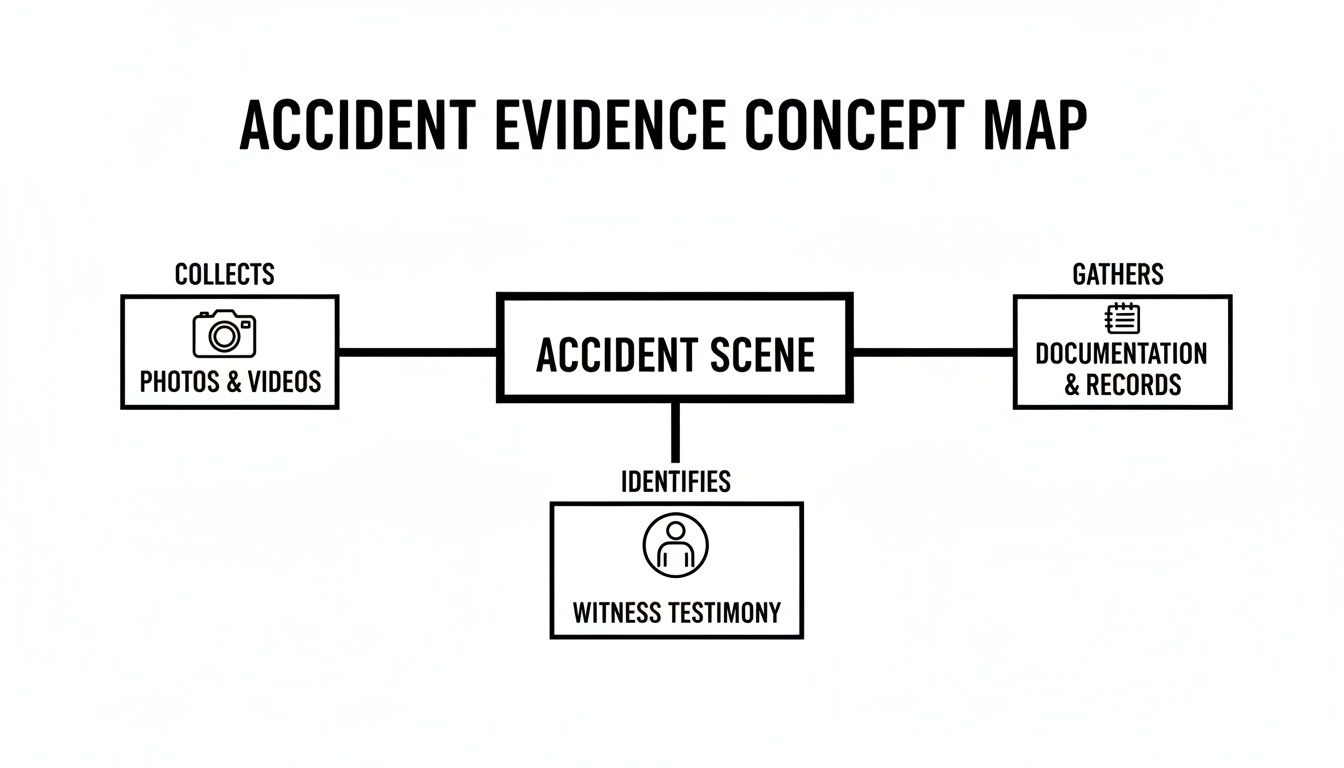
As this shows, a solid claim is built on photos from the scene, detailed notes, and witness accounts. This documentation is invaluable when you start making these important phone calls.
The reporting process can feel repetitive, but it’s vital to provide clear and consistent information to every party involved. I always advise my clients to keep a simple log: who you spoke to, the date and time of the call, and a summary of what was discussed. This small effort can save you from major headaches down the road.
As an attorney, I always tell clients to be completely honest about the facts but to avoid speculating about fault. Just state what happened from your perspective and let the evidence speak for itself. Your job is to report, not to assign blame.
This isn't an uncommon problem. In fact, rental car damage claims have shot up recently, with over 60% of them resulting from situations outside the renter's control, like being hit by another driver. The average repair bill that rental agencies charge comes out to $1,169 per claim, a number that really underscores why having the right coverage is so important, especially in a high-traffic area like Atlanta.
The unique rules governing these claims are why it’s so important to understand the differences between a standard wreck and one involving a rental or car-share vehicle. You can learn more about accidents involving car-sharing services in our detailed guide. Following these reporting steps correctly is your best defense for a smooth claims process after a rental car accident.
Understanding Liability and Damages in Georgia
Determining who is at fault is a central part of any claim after a rental car accident, and Georgia has specific rules for this. It's rarely a simple case of one driver being 100% to blame. Our state follows a legal principle called modified comparative negligence, which is a formal way of saying responsibility can be shared. You can read more about this on its Wikipedia page.
What does this mean for you? You can still recover money for your injuries and losses as long as you are found to be less than 50% responsible for the wreck. If a jury decides you were, say, 20% at fault, your final settlement is simply reduced by that percentage. However, if you are found to be 50% or more at fault, you are legally barred from recovering anything.
The Two Types of Damages You Can Claim
Once fault is established, the focus shifts to the losses you've suffered, legally known as "damages." In Georgia, damages fall into two main categories. Understanding both is important to pursuing the full compensation you deserve.
The first category covers your direct, out-of-pocket losses. These are called Economic Damages and are meant to make you financially whole again. They include anything with a clear price tag:
- Medical Bills: This covers everything from the ambulance ride and ER visit to ongoing physical therapy, surgeries, and prescriptions.
- Future Medical Care: If your injuries require long-term treatment, the projected cost of that future care is included.
- Lost Wages: This compensates you for the income you lost while unable to work during your recovery.
- Loss of Earning Capacity: If your injuries prevent you from returning to your old job or limit your future earning ability, this damage covers that long-term financial hit.
- Property Damage: This includes repairs to the rental vehicle and any personal items damaged in the crash.
The second category is for intangible losses that don't come with a receipt but are just as real. These are known as Non-Economic Damages and are intended to compensate you for the human cost of the accident:
- Pain and Suffering: This addresses the physical pain and discomfort you've endured because of your injuries.
- Emotional Distress: This covers the psychological impact, such as the anxiety, depression, or PTSD that often follows a traumatic crash.
- Loss of Enjoyment of Life: If your injuries keep you from hobbies, activities, or family life you once enjoyed, you can be compensated for that loss.
For example, if a severe back injury from the accident means you can no longer play catch with your kids or go for your morning run, that is a very real loss. Documenting how your daily life has changed is just as important as keeping track of your medical bills.
The Impact of Total Loss Vehicles on Your Claim
Thoroughly documenting all your damages is especially important when a vehicle is declared a total loss. Recently, the frequency of total loss declarations in the U.S. has climbed, hitting a record 22.8% in early 2025. This trend is driven by modern cars—including many rentals—being packed with advanced electronics that make repairs incredibly expensive. For a deeper dive, you can explore the full report on vehicle repair costs.
This situation can leave you without a vehicle for an extended period while insurers sort out the valuation. The costs of a long-term rental replacement can add up fast, becoming a significant part of your economic damages claim. Knowing your rights under Georgia's laws ensures you can pursue fair compensation for every aspect of your loss after a rental car accident.
When to Speak With an Atlanta Injury Attorney
You might be tempted to handle the claim from your rental car accident yourself, especially if the damage looks minor. But I can tell you from experience, these cases are almost never that simple.
You're not just dealing with the other driver. Suddenly you're caught in a web between their insurer, your own, and the rental car company—and none of them have your best interests at heart.
Knowing when to call for legal help is probably the most important decision you'll make. A dented bumper with no injuries? You likely don't need me. The moment someone gets hurt, however, that calculation changes completely.
Clear Signs You Need an Attorney
Some situations are immediate red flags. They signal that you need a legal professional to protect your rights, because trying to manage them alone often leads to a settlement that falls far short of covering your actual losses.
It’s time to call an attorney if any of this sounds familiar:
- You or a passenger suffered an injury. Any injury at all—from whiplash to something more severe—means medical bills and possible long-term costs. A good attorney makes sure those future needs are built into your claim from the start.
- There’s a dispute over who was at fault. If the other driver is blaming you, or their insurance company is trying to pin partial fault on you to reduce their payout, you need an advocate to set the record straight.
- The insurance adjuster is giving you the runaround. If you’re facing endless delays, getting lowball offers that feel insulting, or just can't get a straight answer, it's a clear sign the insurer isn't taking you seriously.
- The rental company is hitting you with surprise fees. Agencies will sometimes try to bill you for vague "administrative costs," "loss of use," or diminished value. An attorney can scrutinize these charges and fight back against anything that's unfair.
How a Lawyer Manages Your Case
Bringing a lawyer on board doesn’t automatically mean you’re going to court. In fact, most personal injury cases are resolved through negotiation. Your lawyer’s job is to take over all the stressful parts so you can focus on getting better.
We handle every phone call and email with the insurance adjusters, who are trained professionals in minimizing what they pay. We organize the mountain of paperwork, gather important evidence like accident reconstruction analysis, and build a powerful, fact-based case for you.
From my experience, the moment an attorney gets involved, the tone of the conversation with insurance companies changes. They know they can no longer use their usual delay tactics or lowball offers. That shift in dynamics is often what it takes to get them to negotiate in good faith.
We also know how to account for every single loss. A huge financial strain that people often overlook is the cost of a replacement vehicle. In early 2025, the average time a car was in the shop after an accident was 16.7 days—that’s a long time to be paying out-of-pocket for a rental. We fight to make sure the at-fault party's insurance covers these extended costs.
What to Expect from a Consultation
Most reputable personal injury attorneys, including my firm, work on a contingency fee basis. Put simply, this means you pay absolutely nothing unless we win your case. There are no upfront costs or hourly bills to worry about.
It all starts with a free consultation to go over the details of your rental car accident. This is a no-pressure, confidential conversation meant to help you understand your legal options.
If you’re not sure what your next step should be, I encourage you to schedule a free case evaluation with our team. We'll help you find the clarity you need to move forward.
Common Questions About Atlanta Rental Car Accidents

After a rental car accident, questions are inevitable. The situation is instantly more involved than a standard wreck because you're dealing with the rental company, their insurance, and your own. I've handled countless cases like these in Atlanta, and a few key questions always come up.
My goal here is to provide direct, clear answers to those common concerns. Understanding your position is the first step toward taking back control.
What Happens if I Did Not Buy the Rental Company's Insurance?
This is the number one worry I hear, but declining the rental company's coverage doesn’t automatically leave you exposed. Your personal auto insurance policy often extends liability coverage to a rental vehicle. A quick call to your agent is always the best way to confirm the exact details.
Many credit cards also offer rental car insurance as a perk, as long as you used that card for the rental. This is usually secondary coverage, which means it kicks in after your primary auto policy pays out. It's fantastic for covering deductibles or other gaps.
Make sure to report the accident to both your personal insurer and your credit card company to understand all the benefits available to you.
Can I Be Sued Personally After the Accident?
Yes, being sued personally is a possibility. This typically happens when you are at fault for the crash, and the total damages—medical bills, lost income, and vehicle repairs—exceed your liability insurance limits. The injured party can then file a lawsuit to go after your personal assets for the difference.
This is exactly why knowing your policy limits before an accident is so important. If you are sued, an experienced attorney can defend you and negotiate a settlement, aiming to keep it within your policy limits to shield your personal finances.
A key takeaway: Liability protection isn't just about paying for someone else's damages; it's about protecting your own financial future. Always ensure your coverage is adequate for your level of risk.
What if the Other Driver Was Uninsured or Fled the Scene?
A wreck is stressful enough, but when the other driver is uninsured or it's a hit-and-run, it adds another layer of frustration. This is precisely why Uninsured/Underinsured Motorist (UM/UIM) coverage exists in Georgia.
This is a provision in your own auto policy that essentially steps into the shoes of the at-fault driver’s missing insurance. It is designed to cover your:
- Medical bills and ongoing treatment
- Lost wages if you're unable to work
- Pain and suffering
To make a UM/UIM claim, you must file a police report. This is a non-negotiable step for almost every insurer. After handling the immediate safety and legal steps, you'll also need to address vehicle damage. While you might be tempted to look up a DIY Bumper Cover Replacement for what seems like a minor issue, it's vital to notify the rental company and your insurer immediately. An attorney can be invaluable in a rental car accident involving a hit-and-run, ensuring you receive the full benefits you've paid for under your policy.
If you've been injured and are struggling to understand what to do after a wreck, you don't have to do it alone. At Jamie Ballard Law, we're here to answer your questions and help you understand your rights. Contact us for a free, no-obligation case evaluation to get the guidance you need. https://jamieballardlaw.com