After an accident, it’s easy to focus on the tangible losses—the stack of medical bills, the missed paychecks. But pain and suffering lawsuits are designed to account for the very real, yet invisible, human cost of an injury. I'm here to explain how these claims address the physical pain, the emotional trauma, and the sheer disruption to your life that can’t be itemized on a receipt.
These claims provide a legal avenue to seek compensation for the total impact of an injury, not just the financial fallout. Understanding how pain and suffering lawsuits work is the first step toward getting the support you deserve.
What Pain and Suffering Really Means in an Injury Claim

When we, as Atlanta personal injury attorneys, use the term "pain and suffering," we aren't just talking about the initial shock of the accident. We're referring to the entire spectrum of physical and emotional harm that follows. Think of it like an iceberg: the medical bills are the visible tip, but the massive, unseen portion underneath is the pain and suffering.
To build a strong case, it's helpful to understand how Georgia law breaks these damages down into two distinct categories.
Physical Pain and Suffering
This is the most straightforward component. It covers the actual, physical hurt your body endures because of the injury. It starts at the moment of impact but continues through your entire recovery process, including discomfort from surgeries, physical therapy, and other treatments.
Examples of physical pain and suffering include:
- Chronic back pain that turns sitting at a desk into a daily ordeal.
- Nerve damage that makes simple tasks like buttoning a shirt impossible.
- Persistent headaches that linger long after a concussion has supposedly healed.
- Permanent scarring or disfigurement that serves as a constant, physical reminder of the incident.
This part of a claim acknowledges that an injury isn't a single event; it's an ongoing source of physical limitation and discomfort.
Mental Pain and Suffering
Just as significant is the emotional and psychological toll an accident takes. This is often the most overlooked part of an injury's aftermath, but it can be every bit as debilitating as a physical wound.
Mental pain and suffering is the legal system's way of recognizing that an injury's impact goes far deeper than the skin. It recognizes the anxiety, fear, and loss of joy that can follow a traumatic event.
This broad category covers a wide range of emotional harm, such as:
- Anxiety and Fear: Developing a fear of driving after a car crash or anxiety in public places after a slip and fall.
- Depression and Grief: The emotional weight of dealing with a permanent disability or the loss of a loved one.
- Loss of Enjoyment of Life: Being unable to play with your children, participate in hobbies you once loved, or engage in social activities.
- Humiliation or Embarrassment: The emotional distress caused by scarring or a permanent limp.
Together, these two components create a complete picture of how an injury has altered your life. When pursuing a claim for your injuries, our goal is to tell the full story of your losses—both the seen and the unseen. To understand what this entails, you can learn more about the elements of personal injury claims in Georgia.
How a Value Is Placed on Pain and Suffering in Georgia
One of the first questions I hear from clients is, "How can you possibly put a dollar amount on my suffering?" It’s a fair and deeply personal question. While no amount of money can erase trauma, the civil justice system provides a way to assign a monetary value to these non-economic damages as part of your claim.
There isn't a magical, one-size-fits-all calculator. Instead, insurance companies and legal teams generally use two established methods to create a reasonable starting point for negotiations in pain and suffering lawsuits.
The Multiplier Method
The most common approach is the Multiplier Method. This technique uses your tangible, economic damages—like medical bills and lost wages—as a baseline.
Think of your economic damages as the foundation of a house. The pain and suffering component is built on top of that foundation. The more severe and life-altering the injury, the larger the structure we can build upon it.
Here’s how it works:
- Calculate Total Economic Damages: First, we add up all your quantifiable financial losses. This includes every medical bill, prescription cost, therapy session, and dollar of lost income.
- Assign a Multiplier: Next, a number between 1.5 and 5 (and sometimes higher in catastrophic cases) is assigned based on the severity of your injuries and the impact on your life.
- Multiply: The total economic damages are then multiplied by this number to arrive at a potential value for your pain and suffering.
A minor sprain with a quick recovery might get a multiplier of 1.5. In contrast, a permanent spinal cord injury requiring lifelong care and causing chronic pain could warrant a multiplier of 5 or more. The key is demonstrating the long-term consequences of the injury.
The Per Diem Method
Another approach, though less common in Georgia for serious cases, is the Per Diem Method. The term "per diem" is Latin for "per day," and this method works exactly as it sounds. It assigns a daily dollar amount to your suffering.
This value is often based on what you would have earned at your job each day. The logic is that enduring daily pain is at least as demanding as going to work.
The calculation is straightforward:
- A daily rate (e.g., $200 per day) is multiplied by the number of days you experienced pain, from the date of the accident until you reach what doctors call maximum medical improvement (MMI). MMI is the point at which your condition has stabilized and further recovery is not expected.
This method is typically better suited for shorter-term injuries where a clear recovery timeline exists. It becomes less practical for injuries with permanent or lifelong effects, where the "end date" of suffering is unknown.
Two Common Methods for Valuing Pain and Suffering
Both the Multiplier and Per Diem methods serve as important starting points for valuing your claim. The right approach depends entirely on the unique facts of your case.
| Method | How It Works | Best For |
|---|---|---|
| Multiplier Method | Total economic damages (medical bills, lost wages) are multiplied by a factor of 1.5 to 5+ based on injury severity. | Cases involving significant, long-term, or permanent injuries where the impact on quality of life is substantial. |
| Per Diem Method | A daily rate is assigned for each day of suffering, from the accident date until Maximum Medical Improvement (MMI) is reached. | Shorter-term injuries with a clear and definable recovery period. |
Ultimately, choosing a strategy is less about picking one over the other and more about using them as tools to build a compelling argument for the true value of your suffering.
Which Method Is Used for Your Claim?
In Georgia, no law mandates one method over the other. We often analyze both approaches to establish a reasonable negotiation range. An experienced attorney can assess the specifics of your case—the severity of your injury, the length of your recovery, and the overall disruption to your life—to determine the most appropriate valuation strategy.
These calculations provide the concrete data needed to support and justify the value of your injury claim. You can find general information on different types of legal damages at helpful resources like the Cornell Law School's Legal Information Institute.
Georgia Laws That Impact Your Injury Claim
When you’re pursuing a pain and suffering claim, it's not just about proving your losses. You also have to follow the specific legal rules here in Georgia that will shape your case. Think of them as the official rulebook for any injury claim—knowing them helps you understand what's possible and what roadblocks you might encounter.
Let's break down three of the most important Georgia laws that will directly affect your claim.
The Deadline to File: The Statute of Limitations
Georgia has a strict time limit for filing a personal injury lawsuit, known as the statute of limitations. For most cases, like those from a car crash or a slip and fall, you have just two years from the date you were injured to file.
This isn't a suggestion; it's a hard deadline. If you miss that two-year window, the court will almost certainly throw your case out, and you'll lose your right to seek compensation, no matter how strong your evidence is. For a more detailed look at this important deadline, you can learn about the statute of limitations for personal injury in Georgia and the rare exceptions that exist.
Shared Fault: Georgia's Modified Comparative Negligence Rule
What happens if the other side claims you were partially to blame for your own injuries? Georgia has a specific rule for this exact scenario, called modified comparative negligence. You can find it in the state code at O.C.G.A. § 51-12-33.
This rule impacts your case in two major ways:
- Your compensation is reduced by your percentage of fault. If a jury awards you $100,000 but finds you were 10% responsible, your award gets cut by that 10%, leaving you with $90,000.
- There is a 50% bar to recovery. This is the key part. If you are found to be 50% or more at fault, you are completely barred from recovering any money at all.
This "50% rule" is a make-or-break issue in many Georgia injury cases. Even if the other driver was clearly negligent, if a jury decides your share of the blame was equal to or greater than theirs, you lose.
Because of this law, you can bet the insurance company will do everything it can to shift as much blame as possible onto you. It's a common tactic to either lower their payout or avoid paying anything at all.
Are There Caps on Pain and Suffering Damages?
I get this question a lot: Does Georgia limit the amount of money a jury can award for pain and suffering? The good news is that for most standard personal injury cases—car wrecks, truck accidents, premises liability claims—there are no caps on pain and suffering damages.
The Georgia Supreme Court has ruled that placing arbitrary caps on these non-economic damages is unconstitutional. A jury has the full authority to award whatever amount it finds fair and just based on the evidence of your physical pain and emotional distress.
It is important to note this doesn't apply to all types of damages. Punitive damages, which are meant to punish a defendant for especially reckless behavior, do have legal caps in Georgia. But for the core compensatory damages that make up your injury claim, there is no legal ceiling.
Building a Strong Case with the Right Evidence
In any personal injury claim, your personal story is the heart of the case, but solid evidence is its backbone. You live with the reality of your injuries every day, but insurance adjusters and juries need tangible proof to understand the full scope of your losses. Building a persuasive case means methodically gathering documentation that paints a clear, undeniable picture of how the accident has shattered your life.
Think of it like building a bridge. Your testimony is one pillar, but to carry the weight of your claim, you need other supports. Each piece of evidence—from a doctor's report to a photo of your scarred arm—acts as another pillar, reinforcing your story and making it unshakable. Without this support, even the most genuine claim can collapse under scrutiny.
Creating a Record of Your Physical and Medical Journey
The foundation of any injury claim is official medical documentation. This evidence provides an objective, professional account of your injuries, treatment, and prognosis. It elevates your claim from a simple "he said, she said" dispute to one grounded in medical fact.
Key medical documents to collect include:
- Complete Medical Records: This is more than just the initial ER report. It includes every note from your primary care physician, specialists, physical therapists, and surgeons. These records create an official timeline of your injury and treatment.
- All Medical Bills and Receipts: Every bill, from the ambulance ride to prescription co-pays, documents the financial cost of your injury. This provides a hard-dollar baseline for calculating the tangible damages your injury has caused.
- Photos and Videos: Visual evidence is incredibly powerful. Take clear photos of your injuries immediately after the accident and continue documenting them as they heal (or fail to heal). Pictures of bruising, stitches, casts, or scarring convey the severity of your pain in a way words simply cannot.
Documenting the Emotional and Daily Impact
Beyond medical charts, the most compelling evidence often comes from documenting the day-to-day human cost of the injury. This is where you illustrate the "suffering" component of your claim, showing how your life has been fundamentally altered.
Your daily experience is a story that needs to be told. A personal pain journal transforms subjective feelings into a consistent, credible record of your suffering, making the invisible visible to others.
Here's how to capture this side of your story:
- A Personal Pain Journal: Keep a daily log detailing your physical pain levels, emotional state, and the specific ways your injuries interfere with your life. Note when you couldn't sleep, had to miss a family event, or struggled with simple tasks like tying your shoes. You can find helpful templates and guides in our online resources for injury victims.
- Notes from Therapists or Counselors: If you are seeing a mental health professional for anxiety, PTSD, or depression stemming from the accident, their professional notes provide important documentation of your mental anguish.
- Statements from Those Who Know You Best: Testimony from family, friends, and colleagues can be incredibly persuasive. They are the ones who truly see the "before and after" and can speak to the changes in your personality, mood, and ability to participate in life. As part of the discovery process, gathering sworn testimony is very important. This may involve issuing or responding to a sample deposition notice to collect these vital witness statements.
In the United States, nearly 400,000 personal injury claims are filed each year, and about 95% are settled before trial according to some sources. This high settlement rate shows just how important strong, organized evidence is for a successful negotiation. A well-documented case gives you the leverage you need to secure a fair outcome, often without ever stepping foot in a courtroom.
The Typical Timeline of a Personal Injury Claim
Following a personal injury claim can feel overwhelming, especially when you don't know what to expect. Understanding the roadmap from start to finish can make the process far less intimidating. Here is a clear, step-by-step breakdown of how a typical claim progresses.
The journey almost always starts long before a lawsuit is even considered. Once you have received necessary medical care and we have gathered all the important evidence, our first move is to send a formal demand letter to the at-fault party’s insurance company. This isn't just a simple letter; it’s a detailed legal document that lays out the facts, describes your injuries, and presents the full value of your claim—including a specific, calculated amount for your pain and suffering.
This demand letter officially kicks off the negotiation phase. The insurance adjuster will review our package and come back with a counteroffer. Be prepared: this initial offer is almost always a lowball figure, far less than what your case is truly worth. This back-and-forth is a completely normal part of the process. Our job is to fight for you, pushing back against their tactics until they present a fair settlement offer.
When Negotiations Stall: Filing a Lawsuit
So, what happens if the insurance company digs in its heels and refuses to be reasonable? This is when we shift from negotiation to litigation. We file a formal lawsuit with the court.
Filing a lawsuit doesn't automatically mean your case is headed for a dramatic courtroom trial. In fact, the opposite is often true. The act of filing suit signals that we are serious and fully prepared to go the distance, which frequently motivates the insurer to get serious about negotiating.
Once the suit is filed, the case enters a phase called discovery. Think of it as a formal, court-supervised process for putting all the cards on the table. Both sides are required to exchange information and evidence.
Key parts of discovery include:
- Interrogatories: Written questions sent to the other party, which they must answer under oath.
- Requests for Production: Formal requests for documents. We might ask for a company’s vehicle maintenance logs, while they will certainly request your medical records.
- Depositions: Out-of-court testimony given under oath. We will question the defendant, and their lawyers will have the opportunity to question you.
This infographic shows the foundational work that must happen before we even get to these legal stages.
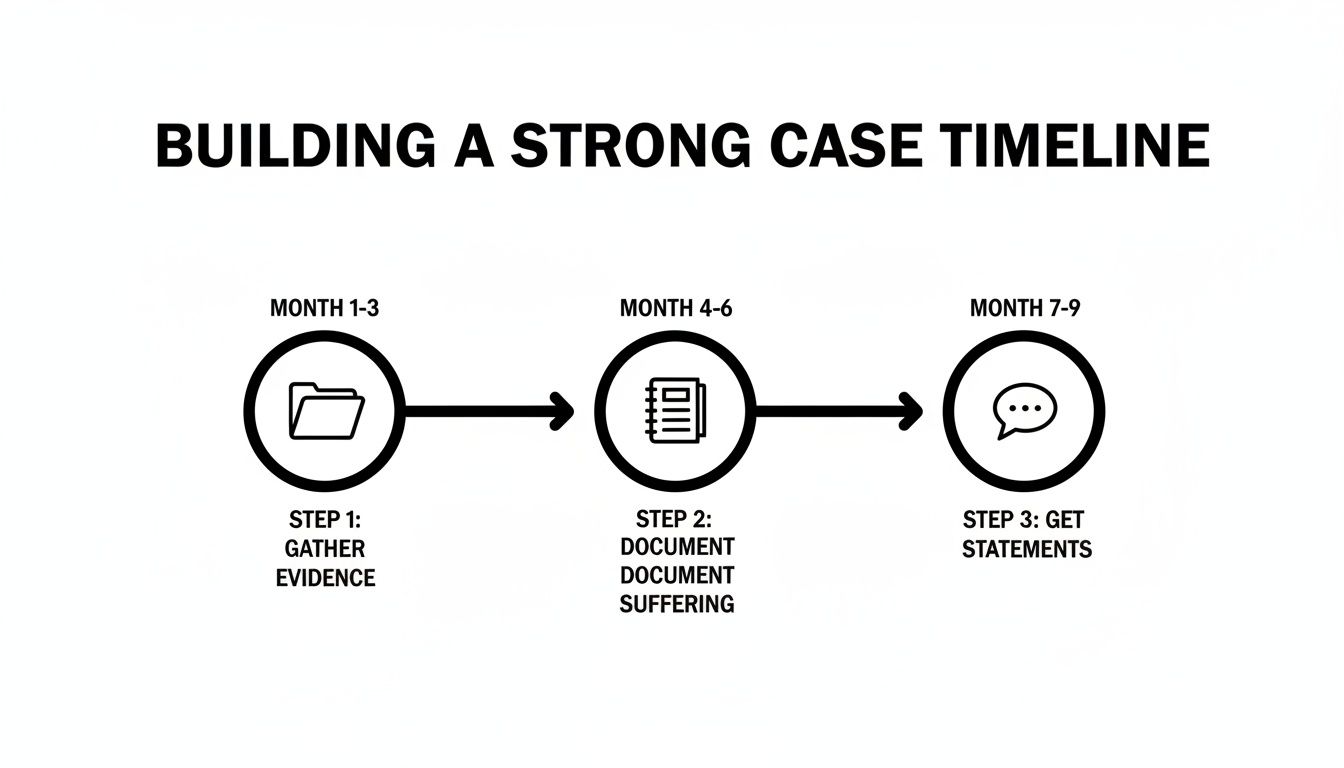
As you can see, gathering solid evidence, thoroughly documenting your suffering, and securing witness statements are the building blocks for a strong case at every step that follows.
Reaching a Resolution Through Mediation or Trial
Even after a lawsuit is underway, a settlement remains the most probable outcome. Cases often proceed to mediation, which is a structured settlement conference. A neutral, third-party mediator works with both sides to find common ground and facilitate an agreement. For a closer look at these steps, you can review our detailed guide on the car accident lawsuit process in Atlanta.
The reality is that the vast majority of personal injury claims—around 95%—are resolved before they ever see the inside of a courtroom. If a fair settlement still proves elusive, the final step is to present your case to a judge or jury. They will listen to all the evidence and make the final decision. This entire timeline is designed to ensure every personal injury case is meticulously prepared to achieve a just resolution, whether at the negotiation table or in court.
How Insurance Companies Try to Reduce Your Claim

When you're dealing with a personal injury claim, you have to remember one thing: insurance companies are not on your side. They are for-profit businesses, and their main goal is to protect their bottom line. That means paying out as little as possible on every claim, including yours.
The insurance adjuster might sound friendly and concerned on the phone, but their job is to minimize what the company pays you. They are trained negotiators who deal with cases like yours every single day. Knowing their playbook is your first line of defense.
The Quick Lowball Offer
One of their most common tactics is the fast settlement offer. Don't be surprised if an adjuster calls you just days after the accident with what sounds like a reasonable amount of money to close your case right then and there.
This is a calculated move. They’re betting that you'll take the money before you really know how bad your injuries are or what your future medical needs will cost. Once you cash that check, you lose your right to seek any more compensation, even if your condition gets much worse down the road.
Disputing the Severity of Your Pain
Another go-to strategy is to challenge how serious your injuries are or to question whether the accident even caused them. The adjuster will likely argue that your pain isn't as severe as you say or that it's really from a pre-existing condition.
They'll try to prove it by:
- Requesting your entire medical history: They are digging for any old injury or condition they can use to blame your current pain on something else.
- Using surveillance: It’s not uncommon for insurers to hire private investigators to follow you. They hope to get photos or videos of you doing something that contradicts what you've claimed about your injuries.
- Twisting your medical records: They'll cherry-pick a doctor's note saying you're "improving" while conveniently ignoring the part that describes permanent limitations or ongoing pain.
It's a fundamental truth that insurance companies profit by collecting premiums, not by paying claims. Their tactics are designed to create doubt and pressure you into accepting less than you deserve.
Delay Tactics and Recorded Statements
Insurance companies know that dragging things out creates financial pressure. The more frustrated and desperate you get, the more likely you are to accept a low offer just to be done with it. They might delay by requesting excessive paperwork, going silent for long periods, or constantly changing the adjuster on your case.
They will also almost always ask you for a recorded statement. It sounds routine, but it’s a trap. Adjusters are trained to ask leading questions designed to get you to say something that undermines your claim. Rest assured, anything you say in that recording can and will be used against you to devalue your pain and suffering lawsuit.
Your Top Questions About Georgia Injury Claims
After an accident, it’s natural to have a lot of questions. Here are some of the most common ones I hear from my clients in Atlanta about pain and suffering lawsuits, answered clearly and directly.
Can I Still Claim Pain and Suffering If I Was Partially at Fault?
Yes, in many situations, you absolutely can. Georgia operates under what’s called a "modified comparative negligence" rule. This legal standard means you can still recover damages as long as you are found to be less than 50% at fault for what happened.
Keep in mind, though, that your total compensation will be reduced by whatever percentage of fault is assigned to you. For example, if a jury awarded you $100,000 but decided you were 20% responsible for the incident, your final award would be reduced to $80,000. If you’re found 50% or more at fault, Georgia law bars you from recovering anything at all.
Is There a Cap on Pain and Suffering Damages in Georgia?
For the vast majority of personal injury cases, like those involving car accidents, there is no cap on pain and suffering damages in Georgia. The Georgia Supreme Court has ruled that these caps are unconstitutional, empowering a jury to award an amount they believe is fair based on the evidence.
It’s easy to confuse these damages with punitive damages, which are meant to punish a defendant for exceptionally reckless or willful misconduct. Punitive damages do have caps under Georgia law. If you want to dig deeper into the different types of damages, the Cornell Law School's Legal Information Institute offers some great background information.
The key takeaway is that in a standard Georgia injury claim, your recovery for physical pain and emotional distress is not limited by an arbitrary legal ceiling.
How Long Do I Have to File a Lawsuit in Georgia?
The clock starts ticking the moment you're injured. In Georgia, the statute of limitations for most personal injury claims is just two years from the date of the incident. This is an unforgiving deadline.
If you fail to file a lawsuit within that two-year window, you will almost certainly forfeit your right to seek compensation forever. While a few very specific, rare exceptions exist, you should never count on them. Acting quickly is the only way to ensure your legal rights are protected. Missing this deadline can permanently bar your claim, no matter how strong your case is.
What Is My Pain and Suffering Claim Really Worth?
This is the question on everyone's mind, but the honest answer is: it depends. No two cases are identical, and the value of a claim is shaped by several important factors:
- The Severity of Your Injuries: The impact of a broken arm is valued very differently than a permanent spinal cord injury.
- The Length of Your Recovery: A longer, more difficult recovery period involving ongoing pain and treatment generally increases the claim’s value.
- The Impact on Your Daily Life: How has this affected you? Your inability to work, play with your kids, or enjoy your favorite hobbies is a major component of the claim.
- The Strength of Your Evidence: Solid proof is everything. Well-organized medical records, a detailed pain journal, and credible witness testimony are all essential.
Ultimately, the value is hammered out through tough negotiations with the insurance company or, if they refuse to be fair, decided by a jury at trial. An experienced attorney can analyze all these moving parts to give you a realistic, informed assessment of what your pain and suffering lawsuit could be worth.
At Jamie Ballard Law, I believe your only job after an injury should be to focus on healing. If you have more questions or need a fighter in your corner to secure the fair compensation you deserve, I'm here. We offer a free, no-obligation case evaluation to go over your situation. Contact us 24/7 to get the help you need.