If you're dealing with the aftermath of a car wreck, my goal is to give you straightforward, helpful information based on my experience as an Atlanta personal injury attorney. Securing a fair car accident settlement is not about winning a lottery; it's a process to get a negotiated agreement meant to cover your losses after a crash caused by someone else's carelessness.
In short, a settlement is financial compensation for your injuries and property damage. Let me walk you through what that means for you.
What a Car Accident Settlement Really Is

Think of a settlement like repairing a historic home after a fire. A proper resolution doesn't just patch the holes; it aims to restore the home's value and integrity. In the same way, your settlement should aim to restore you to your pre-accident financial and personal state.
Understanding what a fair settlement should cover is the first step. It’s about making you whole again by addressing every single loss you’ve suffered—calculating both the tangible bills you can see and the personal impacts that are harder to put a number on.
The Two Pillars of Compensation
A settlement is built on two main types of damages. Getting familiar with these categories helps you understand what you can rightfully claim in your case.
- Economic Damages: These are the tangible, out-of-pocket costs with clear monetary values. They are the most straightforward part of a claim and include things like medical bills, lost wages from time off work, and future medical expenses. You can find more information about these types of damages on informative sites like the Legal Information Institute.
- Non-Economic Damages: This category covers the personal, non-financial impacts of the accident. These losses are just as real but are more subjective, covering things like physical pain, emotional distress, and loss of enjoyment of life.
Now, let's break down exactly what these damages cover.
Understanding Your Potential Compensation
This table outlines the two primary categories of damages that a comprehensive settlement should address.
| Type of Damage | What It Covers | Examples |
|---|---|---|
| Economic | All direct financial losses resulting from the accident. These are the measurable, out-of-pocket costs. | Medical bills (past & future), Lost wages, Property damage, Physical therapy, Prescription costs |
| Non-Economic | The intangible, personal suffering caused by the accident. These are non-financial but very real impacts. | Pain and suffering, Emotional distress, Loss of consortium, Scarring or disfigurement, Loss of enjoyment of life |
By accounting for both types of damages, you ensure your settlement reflects the true and total cost of the accident.
While every case is unique, it's helpful to have a general idea of what others have received. As of 2025, the average car accident settlement involving injuries in the United States is approximately $30,416. This figure can change significantly based on injury severity, the clarity of fault, and insurance policy limits.
A common mistake is focusing only on current medical bills. A strong settlement also accounts for future needs, like ongoing physical therapy or potential surgeries, ensuring you aren't left with unexpected costs down the road.
The goal of any personal injury claim is to secure compensation that truly reflects the full scope of your losses. For a deeper dive into specific accident types, this guide to a rear end collision settlement covers nuances for one of the most common crash types. By understanding both economic and non-economic damages, you can better advocate for a fair resolution.
Key Factors That Determine Your Settlement Value

Without a doubt, the first question on every client's mind is, "What is my claim actually worth?" While there's no magic formula that spits out an exact number, the value of a car accident settlement is built on a foundation of specific, provable factors.
Think of it like building a house. Each piece of evidence—every medical bill, every pay stub, every doctor's note—is a brick. The more bricks you have, and the stronger they are, the more solid your case for fair compensation becomes.
Medical Evidence: The Foundation of Your Claim
The single most important element of any injury claim is the strength of your medical evidence. Insurance adjusters won't take your word for it; they demand concrete proof. Every doctor's appointment, prescription, and physical therapy session creates an undeniable paper trail that validates your injuries.
This documentation accomplishes two things:
- It draws a direct, unbroken line from the crash to your physical harm.
- It establishes the severity of your injuries, which is vital for calculating both your current and future medical needs.
For example, a traumatic brain injury requires extensive records to demonstrate its long-term impact on your ability to work and live your life. You can learn more by exploring our resources for an Atlanta traumatic brain injury attorney.
The duration and nature of your recovery also heavily influence the final number. Following medical advice and looking into tips for speeding up recovery not only helps you heal but also strengthens your claim.
Lost Income and Future Earning Ability
A serious car wreck doesn't just leave you with medical bills; it can rob you of your paycheck. A proper settlement must account for every dollar you've lost. This goes far beyond just the few days you missed work right after the accident.
We look at two distinct types of income loss:
- Past Lost Wages: This is straightforward. It’s the money you’ve already lost because you were physically unable to work, calculated using pay stubs and employment records.
- Loss of Future Earning Capacity: This is more involved. If your injuries permanently limit your ability to do your old job or force you into a lower-paying role, this part of the claim compensates you for that long-term financial hit.
Pain and Suffering Explained
This is often the most confusing part of a settlement for people. "Pain and suffering" is the legal term for the real-world physical pain and emotional trauma you've been forced to endure. It's a genuine loss, even though it doesn't come with an itemized bill.
So, how do you put a number on it? Insurance companies frequently use a "multiplier" method. They take your total economic damages (medical bills + lost wages) and multiply it by a number, usually between 1.5 and 5. That multiplier is determined by the severity of your injuries and the impact on your life.
For example: Let's say you have $10,000 in medical bills from a minor neck sprain that heals in a few weeks. The adjuster might use a multiplier of 1.5, valuing your pain and suffering at $15,000. But if you suffered a shattered leg requiring surgery and months of painful rehab, the multiplier could easily be a 4 or 5, reflecting that immense disruption.
Liability and Insurance Policy Limits
Finally, two practical realities can cap what you ultimately receive. The first is liability—or, how clear it is that the other driver was 100% at fault. If fault is shared or disputed, it can reduce your settlement value.
The second is the other driver's insurance policy limits. No matter how severe your damages are, an insurance company will not pay a penny more than the maximum coverage limit on the policy. This creates a hard ceiling on what you can recover directly from the insurer, making it an important factor in managing expectations for your car accident settlement.
The Car Accident Settlement Process Step by Step
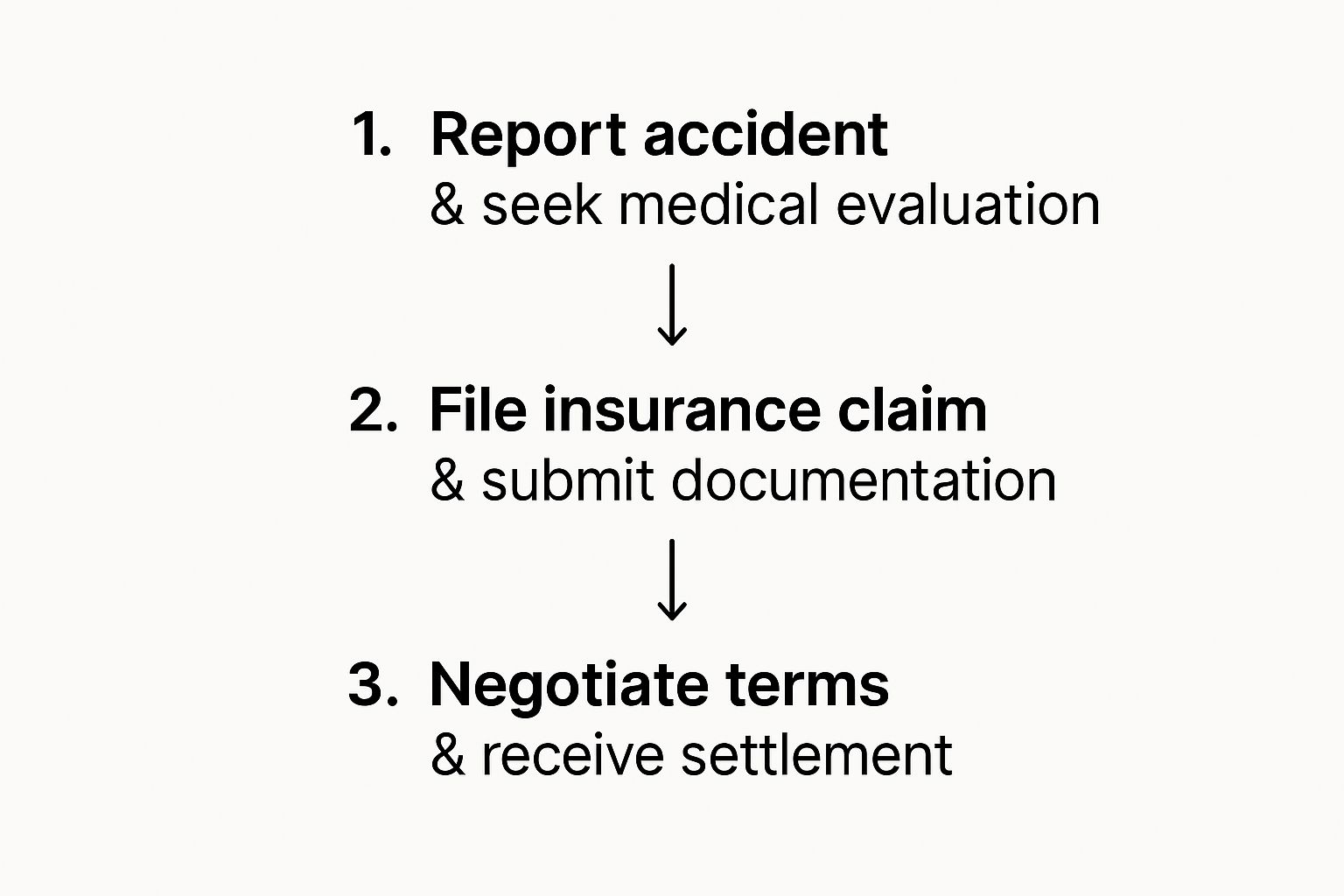
After a car crash, the road from the accident scene to getting compensation can feel like a puzzle. Understanding the steps involved clears up the confusion. A typical car accident settlement doesn’t just happen overnight; it’s a structured process that starts the moment of impact and only ends when the money is in your account.
From my experience helping people here in Atlanta, I can tell you that having a clear roadmap makes all the difference. Knowing what’s coming next reduces stress and helps you make smarter decisions for both your health and your claim.
This visual breaks down the core stages of the car accident settlement process.
As you can see, the whole thing flows logically from the crash and initial medical care to the final resolution. Every step builds on the last, which is why a strong start is so important.
Step 1: Immediate Actions and Filing Your Claim
The process kicks off the second the accident happens. Your first priority is always your health and safety. That means getting checked out by a doctor, even if you feel fine. Many serious injuries don’t show symptoms right away.
It's also essential to report the crash. In Georgia, you must call law enforcement. The police report they create at the scene becomes a cornerstone piece of evidence for your claim. You can review the requirements for reporting an accident on the Georgia Department of Public Safety website.
Once your immediate medical needs are handled, the next move is to officially open a claim with the at-fault driver's insurance company. This is the formal starting line for your settlement journey.
Step 2: Investigation and Building Your Case
As soon as you file, the insurance company assigns an adjuster to your case. Their job is to investigate what happened, figure out who was at fault, and calculate the extent of your damages. They’ll look at the police report, photos, and any witness statements you have.
At the same time, you or your attorney will be building your own file. This means gathering every medical bill, record, pay stub showing lost wages, and repair estimate for your car. Meticulous documentation is the backbone of a successful claim.
Step 3: The Demand Letter and Negotiations
Once your doctors determine you’ve reached Maximum Medical Improvement (MMI)—meaning your medical condition has stabilized as much as it’s going to—it's time to send a demand letter. This is a formal, detailed package sent to the insurance adjuster that lays out:
- The facts of the accident
- A full summary of your injuries and all medical treatment
- A complete list of your economic damages (medical bills, lost income)
- A clear justification for your non-economic damages (pain and suffering)
- The total settlement amount you are demanding
This letter is what gets the negotiations started. The adjuster will almost always come back with a counteroffer that’s far lower than what you asked for. This is where the real work begins, with back-and-forth arguments supported by evidence until, hopefully, you meet at a fair number.
Step 4: Reaching an Agreement and Finalizing the Settlement
If negotiations go well, you’ll reach a verbal agreement with the adjuster. Right after that, the insurance company will send you a release form. This is a legally binding document where you agree to give up all future rights to sue for this accident in exchange for the settlement amount.
It is absolutely vital to have an attorney review this document before you sign it. Once you sign, the case is closed forever. After the insurer gets the signed release, they will issue the settlement check, and the car accident settlement process is officially over. If you can’t reach an agreement, the next step might be to explore the lawsuit process for a car accident, which is a much more formal legal battle.
Common Mistakes That Weaken Your Settlement Claim
Getting a fair car accident settlement isn’t just about what you do right—it's also about avoiding the common mistakes that can sink your claim. I’ve seen it time and time again: simple, honest missteps that hand an insurance company all the ammunition it needs to slash or deny the compensation you deserve. Protecting your claim's value starts with sidestepping these predictable traps from day one.
Insurance adjusters are professional negotiators, and their primary job is to minimize payouts. They are trained to find gaps in your story, inconsistencies in your medical care, or any statement they can twist. Understanding their playbook is your first line of defense.
Giving a Recorded Statement Unprepared
Soon after a crash, you can bet the at-fault driver's insurance adjuster will call. They'll sound friendly, even helpful, and they will ask for a recorded statement about what happened. This is a key moment where your claim’s value hangs in the balance.
- Don't: Give them a statement right away. Adjusters use leading questions designed to get you to say things that imply fault or downplay your injuries. Seemingly innocent phrases like "I'm doing okay" or "I guess I'm fine" will be used against you later.
- Do Instead: Politely decline to provide a recorded statement until you’ve spoken with an attorney. You are not legally obligated to give one. If you absolutely must, be prepared and understand that every single word matters.
Leaving Gaps in Your Medical Treatment
When it comes to post-accident medical care, consistency is everything. Insurance companies hunt for any reason to argue that your injuries aren't as severe as you claim, and a gap in treatment is their favorite piece of evidence.
If you wait weeks to see a doctor or start skipping physical therapy, the insurer will argue that your injuries must not have been that serious. They might even claim your pain is from an unrelated event that happened during that treatment gap.
- Don't: Delay medical care or miss appointments. "Toughing it out" or assuming the pain will just go away is a costly mistake.
- Do Instead: See a doctor immediately after the accident and follow their treatment plan to the letter. Attend every single appointment and follow through on all referrals. This builds an unbroken medical record that proves your injuries are real and directly linked to the crash.
Data from the National Highway Traffic Safety Administration shows just how serious traffic incidents are, reinforcing why consistent medical documentation is so important.
These statistics highlight that accidents remain a major public health issue. Your top priority must be treating your injuries properly and documenting the entire process.
Posting on Social Media After the Accident
It’s second nature to share life updates online, but after an accident, your social media accounts become a treasure trove for insurance investigators. They will actively search your profiles for any photos, videos, or comments that contradict your injury claims.
- Don't: Post anything about the accident, your recovery, or even your daily activities. A photo of you at a friend's cookout or on a short walk can be used to argue you aren't really in pain or that your life hasn't been significantly affected.
- Do Instead: Set all your social media profiles to private immediately. Better yet, just stop posting until your case is over. Ask friends and family not to post photos of you or tag you. Remember, anything you post can and will be used against your claim for a fair car accident settlement.
How Georgia Law Affects Your Accident Claim

The value of a car accident settlement isn't pulled out of thin air. It’s directly influenced by Georgia's specific laws. Think of them as the rulebook that governs your claim—understanding them is important because they set the legal boundaries for what you can recover.
Two laws, in particular, have an enormous impact: how fault is divided and the deadline you have for taking legal action. These aren’t just technicalities; they are foundational rules that can make or break your ability to get the compensation you deserve.
Georgia's Modified Comparative Fault Rule
One of the first questions people ask is, "What if I was partly at fault for the crash?" Georgia law answers this with a system called modified comparative fault.
This rule allows you to recover damages even if you share some responsibility for the accident, but only up to a certain point. As long as your share of the fault is less than 50%, you can still file a claim. However, if you are found 50% or more responsible, Georgia law bars you from recovering anything.
It’s easier to see how this works with a quick example:
- Let’s say you’re awarded $100,000 for your injuries and other losses.
- After reviewing the evidence, a judge or jury determines you were 20% at fault—maybe you were driving just a few miles over the speed limit.
- Your $100,000 award would be reduced by your 20% share of fault ($20,000), leaving you with a final recovery of $80,000.
This system ensures you aren't completely shut out from compensation when another driver was primarily responsible for your injuries, but it also holds you accountable for your part.
The Clock Is Ticking: The Statute of Limitations
The other major rule you absolutely must know is the statute of limitations. This is a strict legal deadline for filing a lawsuit. If you miss this deadline, you lose your right to pursue your claim in court forever, no matter how strong your case is.
In Georgia, the deadline for most personal injury cases, including car accidents, is two years from the date of the incident. This is laid out in the Official Code of Georgia Annotated O.C.G.A. § 9-3-33. You can learn more about how the statute of limitations for personal injury in Georgia applies and why it's so important.
While two years might sound like a long time, building a strong case and negotiating with insurance companies can eat up months. It’s always best to act quickly to protect your legal options.
Interestingly, even as Americans drive more, safety is on the rise. Recent data shows that car accident death rates per 100,000 people have dropped by an incredible 55% since 1937, falling from 30.8 to 13.8 today. You can find more on these trends in these car accident statistics.
These laws are far more than just legal jargon; they are the rules of the road for your car accident settlement.
Frequently Asked Questions About Settlements
After a wreck, your mind is probably racing with questions. It’s completely normal. In my Atlanta practice, I’ve heard just about every concern imaginable from people trying to understand this process. Getting straight answers is the first step toward feeling in control again. This FAQ is designed to do just that—tackle the most common questions about car accident settlements head-on.
We’ll cover everything from timelines to taxes and what to do when the other driver has no insurance. My goal here is to give you the practical, clear information you’re looking for right now.
How Long Does a Car Accident Settlement Take to Finalize?
This is always the first question, and the most honest answer is: it depends. There’s no magic number or standard timeline. A straightforward case with minor injuries and clear fault might wrap up in a few months.
But many cases take much longer, sometimes a year or more. A few key factors almost always extend the timeline:
- Severity of Your Injuries: If you need surgery or long-term physical therapy, we can't settle until you reach what doctors call Maximum Medical Improvement (MMI). MMI is the point where your medical condition has stabilized. Settling before you hit MMI is a huge mistake—you won’t know the final cost of your medical care, and you can’t go back and ask for more money once the case is closed.
- Disputes Over Fault: When the insurance companies can't agree on who caused the crash, everything slows down. An investigation becomes necessary, digging into police reports, traffic camera footage, and witness accounts to prove liability.
- Negotiation Delays: The back-and-forth with the insurance adjuster is a process. Insurers almost never accept a first demand. They will often use delay tactics, hoping you’ll get frustrated enough to accept a lowball offer just to be done with it.
Patience is your biggest asset here. Rushing to a fast settlement almost always means leaving money on the table that you are owed.
Do I Have to Pay Taxes on My Settlement Money?
Another big concern is whether Uncle Sam will take a slice of your settlement. For the most part, the answer is no, but there are a few important exceptions to know about.
The Internal Revenue Service (IRS) is clear that money received as compensation for physical injuries and physical sickness is generally not taxable income. That means the part of your settlement covering medical bills and pain and suffering is typically tax-free.
However, some parts of a settlement can be taxed. For instance, compensation paid specifically for lost wages may be subject to income taxes. And if your settlement includes punitive damages (which are rare and meant to punish the defendant for extreme negligence), that portion is almost always taxable.
It’s always a good idea to run this by a tax professional who can advise on your specific situation.
What Happens If the At-Fault Driver Has No Insurance?
It’s a nightmare scenario: you’re hurt, your car is smashed, and you discover the driver who hit you is uninsured. Fortunately, this doesn’t have to mean you’re left with nothing. This is exactly why Uninsured/Underinsured Motorist (UM/UIM) coverage exists.
UM/UIM is part of your own auto insurance policy. It’s designed to step in and cover your losses when the at-fault driver either has no insurance or not enough insurance.
Here’s how it works in practice:
- Uninsured Motorist (UM): If the other driver has no liability insurance, you file a claim against your own UM policy. It basically stands in for the missing insurance, covering your medical bills, lost income, and pain and suffering up to your policy limits.
- Underinsured Motorist (UIM): If the at-fault driver has insurance but their policy limits are too low to cover your total damages, your UIM coverage can bridge the gap. For example, if your total damages are $75,000 but the other driver’s policy maxes out at $25,000, you could claim the remaining $50,000 from your UIM policy.
In Georgia, insurers are required to offer you UM/UIM coverage, and I can’t recommend it enough. It's one of the most important financial protections you can have.
Will My Case Have to Go to Court?
A lot of people are terrified that filing a claim means they'll end up in a stressful, public court battle. The reality is that the overwhelming majority of personal injury cases never see the inside of a courtroom.
Most cases—well over 90% of them—are resolved through a negotiated car accident settlement directly with the insurance company.
Filing a lawsuit is a strategic move, not the first step. It's typically used when an insurer simply refuses to make a fair offer. Sometimes, just filing the suit is enough to bring them back to the table with a much better number. The goal is always to get you a fair result without the time, expense, and stress of a trial.
At Jamie Ballard Law, we believe that an informed client is an empowered client. If you have been injured in an accident and have more questions, we are here to provide the answers you need. For a free, no-obligation evaluation of your case, please visit us at https://jamieballardlaw.com.