Understanding how to prove medical negligence is the first step toward seeking accountability after a medical error. It’s more than just being disappointed with a treatment result; the law requires you to show four specific things: a duty of care was owed, that duty was broken, this failure directly caused your injury, and you suffered real harm as a result. This guide is here to provide helpful information on this process.
This article will break down the four core elements required for a successful medical malpractice case.
The Four Core Elements of Medical Negligence
When you trust a medical professional with your health, you have a right to a reasonable standard of care. However, a negative outcome does not automatically mean negligence occurred. Instead, you must be able to demonstrate each of the four distinct pillars that separate an unfortunate medical event from a valid legal claim.
Let's look at what each of these elements means for you.
Duty of Care
First, we have to show that a doctor-patient relationship existed. This is the legal foundation that establishes the provider had a professional responsibility—a "duty of care"—to treat you according to the accepted medical standards for their field.
In most situations, this is the easiest part to prove. If you made an appointment, were admitted to a hospital, or consulted a specialist who agreed to treat you, that professional relationship is formed and the duty of care is established.
Breach of Duty
This is the heart of the negligence claim and where the "standard of care" becomes so important. A breach happens when a healthcare provider's actions fall below what a reasonably skilled and careful professional in the same specialty would have done in a similar situation.
Medicine is about following established, safe protocols, not about guaranteeing perfect results. A breach is a failure to follow those protocols.
Common examples include:
- Failing to diagnose a condition that another competent doctor would have identified.
- Making a preventable surgical error.
- Prescribing the wrong medication or an incorrect dosage.
- Neglecting to order necessary diagnostic tests.
Sometimes, a medical device is at the center of the claim. In those cases, proving fault might mean looking into its development, where processes like medical device verification and validation are meant to ensure safety. A breakdown in that process can be a clear breach of duty.
This infographic helps visualize how the four elements work together to form a solid claim.
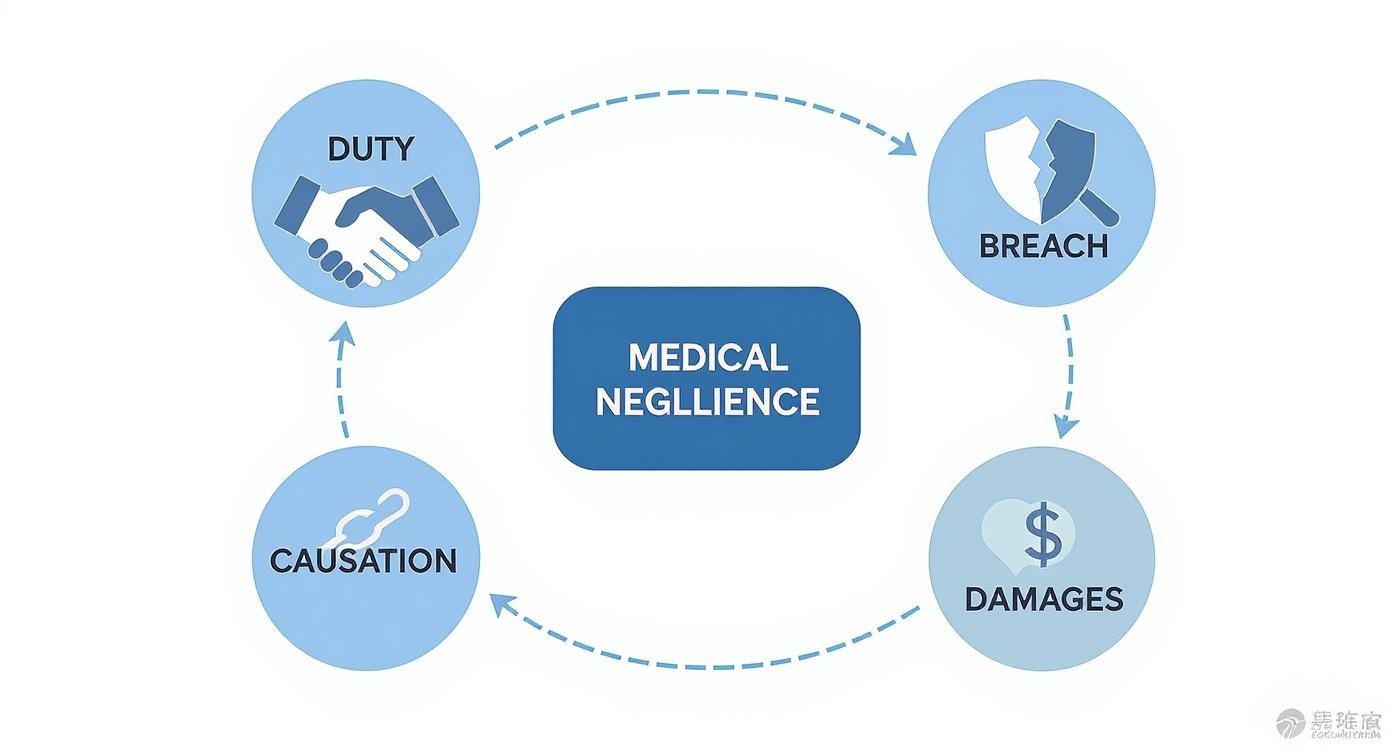
As you can see, each element must connect to the next. Without all four, the claim falls apart.
To help clarify these ideas, the table below provides a simple breakdown of the four elements.
The Four Elements of Medical Negligence at a Glance
| Element | What It Means for Your Case | Real-World Example |
|---|---|---|
| Duty of Care | You must show a professional doctor-patient relationship existed. | You schedule an appointment, the doctor sees you, and they provide a diagnosis and treatment plan. |
| Breach of Duty | The provider failed to meet the accepted standard of care. | A radiologist misreads an X-ray, failing to spot an obvious fracture that other radiologists would have seen. |
| Causation | The provider's specific failure directly caused your injury. | Because the fracture was missed, your bone healed improperly, requiring corrective surgery. |
| Damages | You suffered tangible and intangible losses due to the injury. | You incurred bills for the second surgery, lost wages from missed work, and endured significant pain and suffering. |
Understanding this table gives you a clear, high-level view of the legal ideas involved in a medical negligence case.
Causation
Next, you have to connect the dots. It’s not enough to show a mistake was made; you must prove that the provider's specific failure was the proximate cause of your harm. In other words, your injury would not have happened but for their negligence.
For example, if a surgeon accidentally leaves a sponge inside a patient and a severe infection develops, the line of causation is direct and clear.
But if a doctor misdiagnoses a minor skin condition and the patient later suffers a heart attack due to a pre-existing, unrelated heart condition, proving causation would be nearly impossible.
Damages
Finally, you must show that you suffered actual harm, or damages, because of the injury caused by the breach. These are the real-world consequences you’ve had to endure, both financially and personally.
Damages are typically divided into two categories:
- Economic Damages: These are the calculable financial losses. Think medical bills for corrective procedures, lost income from being out of work, and the cost of future care or physical therapy.
- Non-Economic Damages: This category covers the immense personal toll, including physical pain and suffering, emotional distress, and the loss of your ability to enjoy life's activities.
Sorting through these legal terms can feel like a lot. For more detailed definitions, our firm’s online legal dictionary is a useful tool. By understanding these four pillars, you get a much clearer picture of what it takes to prove medical negligence.
Building Your Case with Strong Documentation
Once you understand the four core elements, the next step in learning how to prove medical negligence is gathering the right proof. A strong claim is built on a foundation of solid, undeniable documentation. This is more than just collecting a pile of papers; it's about systematically assembling the evidence that tells your story in a way that can’t be ignored.
This paper trail is what turns your personal experience into legal evidence. It establishes a clear timeline and paints a detailed picture of what happened, how it happened, and the real-world impact it’s had on you.
Beyond the Basic Medical Records
Everyone knows medical records are important, but their true power is in the small details. You need to formally request your complete file from every single facility, clinic, and provider that treated you. Federal law gives you the right to these records, so don’t hesitate to ask for everything.
Once you have the files, it’s time to dig deeper. Look past the summary pages for these key documents:
- Physician's Notes and Orders: These are the doctor's real-time thoughts, initial diagnoses, and the specific instructions they gave to the nursing staff. They often reveal the "why" behind their decisions.
- Lab Results and Imaging Reports: This is the objective data—the blood work, X-rays, and MRI scans—that should have guided your doctor's actions.
- Hospital Admission and Discharge Summaries: These documents bookend your hospital stay, outlining why you were admitted and what your condition and prognosis were when you left.
- Medication Administration Records (MARs): This log is a minute-by-minute account of every dose of medication you received, including who administered it and precisely when.
Accuracy here is non-negotiable. Meticulous records are the backbone of a strong case, which is why experts are so focused on preventing documentation errors in healthcare from the start.
Uncovering Other Powerful Evidence
Your medical file is just one piece of the puzzle. Other, less obvious documents can be just as powerful in building a clear narrative. Many people overlook these sources, but they often contain revealing information that can strengthen your claim.
Make a point to gather these items:
- Billing Statements: An itemized bill can show every single procedure, test, and consultation you were charged for, sometimes uncovering actions that aren't clearly detailed in the medical notes.
- Correspondence: Keep every email, text, or patient portal message you exchanged with the provider's office. These communications can prove what you reported about your symptoms and exactly when you reported it.
- Photographs and Videos: If your injury is visible—think a surgical wound that got infected or the physical signs of a worsening condition—visual proof can be incredibly persuasive to a judge or jury.
"Your personal journal is often one of the most compelling pieces of evidence. It provides an authentic, day-by-day account of your pain, emotional distress, and the real-world impact the negligence has had on your daily life."
The Power of a Personal Journal
While official documents are essential, never underestimate the impact of your own words. Keeping a detailed journal is one of the best tools you have for demonstrating the "damages" element of your claim.
Start a journal as soon as you can and try to be consistent. Every day, make a quick note of:
- Your Physical Symptoms: Describe your pain on a scale of 1-10. Note any new symptoms that pop up and any physical activities you can no longer do.
- Emotional and Mental State: Document feelings of anxiety, depression, or frustration that stem from your condition and the difficult recovery process.
- Life Interruptions: Log every missed day of work, family event you had to skip, or hobby you’ve been forced to give up.
This personal record is what connects the cold medical facts to your human experience, painting a complete picture of your suffering. For more guidance on what to document, you can find helpful checklists and information in our firm's online resources.
By carefully assembling both official records and your own personal documentation, you take a major step forward in your ability to prove medical negligence.
The Role of Medical Experts in Your Claim

When you're trying to figure out how to prove medical negligence, one piece of the puzzle is more important than any other: the testimony of a qualified medical expert. Frankly, it's nearly impossible to move a case forward without one.
This isn't just about getting a second opinion. It's about bringing in a specialist who can authoritatively translate complicated medical facts into a clear, understandable narrative for a judge and jury. Their main job is to establish the "standard of care"—what a reasonably competent healthcare professional in the same specialty should have done under the same circumstances. This expert opinion creates the benchmark we use to measure the defendant's actions.
Why an Expert Witness Is Non-Negotiable
In Georgia, like most states, the law requires an expert’s input from the very beginning. Before a lawsuit can even be filed, an "affidavit of merit" must be secured. This is a sworn statement from a qualified medical expert who has reviewed your records and confirms there’s a reasonable basis to believe negligence took place.
Think of this affidavit as the key that unlocks the courthouse door. It's a legal safeguard designed to filter out unsupported claims. Without it, your case stops before it starts.
A medical expert’s role goes much deeper than just signing a document. They perform several vital functions:
- Deep Dive into Records: They will meticulously comb through every medical record, lab result, imaging scan, and physician's note to pinpoint exactly where and how the standard of care was violated.
- Define the Standard: They clearly articulate what a competent doctor would have done in that specific scenario, providing a sharp contrast to what actually happened.
- Connect the Dots: Importantly, they draw a direct, causal line from the healthcare provider’s mistake to the harm you suffered. This is the bedrock of proving causation.
- Provide Clear Testimony: They will offer their professional opinion in depositions and, if the case goes to trial, explain their findings in a persuasive way that a jury can easily grasp.
Finding the Right Medical Expert
Not just any doctor can serve as an expert. The law is specific: the expert must have credentials that are equal to or greater than the healthcare provider you are suing. For instance, if your claim is against a board-certified orthopedic surgeon, your expert must also be a board-certified orthopedic surgeon with relevant, hands-on experience.
The credibility of your expert is everything. Courts and juries give more weight to professionals who are:
- Actively Practicing: An expert who currently sees patients or teaches in the relevant medical field is far more persuasive than someone who retired years ago.
- Highly Credentialed: Board certifications, publications in peer-reviewed medical journals, and academic positions at respected institutions all build authority.
- Experienced in Legal Settings: A good expert witness knows how to present complicated information clearly and withstand aggressive cross-examination from the defense team.
Finding this person is a specialized task. An experienced Atlanta medical malpractice lawyer will have networks of vetted medical experts across dozens of specialties to find someone with the precise expertise and credibility your case demands.
A medical expert does more than just state an opinion. They act as a translator, breaking down dense medical terminology and complex procedures into a clear, understandable narrative that shows exactly what went wrong and why it constitutes negligence.
How Experts Analyze Your Case
Let's say your case involves a delayed cancer diagnosis. An expert oncologist, after reviewing your file, might find that your primary care doctor saw early red flags on a scan but failed to act.
The expert would then testify that a reasonably competent physician, upon seeing those specific indicators, would have immediately ordered follow-up testing. They would explain why those indicators were so significant, how the delay allowed the cancer to advance, and how earlier treatment would have likely led to a much better outcome. This transforms a confusing medical timeline into a clear story of cause and effect.
Ultimately, the expert's analysis is what separates a valid negligence claim from a simple unfortunate medical outcome. It provides the objective, authoritative voice needed to prove that your injury wasn't just bad luck, but the direct result of a provider's failure to do their job. This professional opinion is a cornerstone of how to prove medical negligence.
Connecting the Mistake to Your Injury
Showing that a healthcare provider made a mistake is only half the battle. The other, and often more challenging, part is proving their specific error is what directly caused your injury. This legal principle is called causation, and it's where a lot of medical negligence cases are won or lost.
You have to draw a clear, unbroken line from the doctor's action (or inaction) to the harm you suffered. It's not enough that a mistake happened around the same time your condition worsened. The defense team will likely argue your injury was inevitable or caused by something else entirely.
Cause-in-Fact: The "But-For" Test
First, you have to establish what lawyers call "cause-in-fact." The easiest way to wrap your head around this is to ask the "but-for" question: "But for the doctor’s mistake, would I have suffered this specific injury?" If the answer is "no," you've likely established cause-in-fact.
Let's take a real-world example. A radiologist misreads your chest X-ray and doesn't report a suspicious nodule. Six months down the road, you're diagnosed with advanced lung cancer.
- Cause-in-Fact: But for the radiologist's failure to flag that nodule, your cancer would have been diagnosed and treated six months earlier. That delay is directly linked to the harm—the cancer's advancement and a much tougher prognosis.
This is the foundational link for your entire causation argument.
Proximate Cause: Was the Harm Foreseeable?
The second piece of the puzzle is "proximate cause." This concept asks whether your injury was a foreseeable result of the provider’s mistake. It’s a legal check to make sure a defendant isn't held liable for some bizarre, unpredictable outcome that no reasonable person could have anticipated.
In most medical negligence cases, this is pretty straightforward. It is entirely foreseeable that:
- A surgical error during a gallbladder removal could damage a nearby nerve.
- Giving a medication to a patient with a known allergy will cause a severe reaction.
- Failing to monitor a patient's vitals after surgery could lead to a preventable crisis.
This screenshot from Wikipedia’s page on legal causation helps visualize how these two tests work together to create a solid link between an action and an outcome.

As the chart shows, "cause-in-fact" is the initial factual connection. "Proximate cause" then acts as a legal filter to determine if holding the defendant responsible is fair. You need both.
Proving causation isn't just about blaming someone for a bad outcome. It's about presenting solid evidence that a specific failure to meet the standard of care was the direct and foreseeable cause of a specific harm.
The numbers on patient harm are significant and show why this matters. The World Health Organization reports that roughly 1 in every 10 patients is harmed while receiving health care. Medication errors alone impact about 1 in 30 patients. You can read more about these startling patient safety facts from the WHO.
Countering Common Defense Arguments
Be prepared for the defense to challenge you on causation at every turn. Their entire strategy is to create doubt and point to other potential causes for your injury. A common tactic is blaming a pre-existing condition.
For instance, they might claim a patient's diabetes—not the surgeon's mistake—was the real reason a surgical wound got infected and wouldn't heal correctly.
To fight this, your legal team and medical expert must build a rock-solid timeline. They will dig into your medical records and use expert testimony to prove your condition was stable before the incident, and that the provider’s specific error is what kicked off the chain of events leading to your new or worsened injury.
In the end, forging this unbreakable link is one of the most technical and important steps in proving medical negligence.
Calculating and Demonstrating Your Losses
Once you’ve established a medical provider was negligent and that their mistake directly caused you harm, the final piece of the puzzle is to show the full scope of your losses. In legal terms, we call these "damages."
This isn't just about handing over a stack of medical bills. The goal is to paint a complete picture of how the injury has affected your life—financially, emotionally, and physically. Getting this part right is absolutely necessary to securing fair compensation.
The Two Types of Damages You Can Pursue
When building a case, we organize losses into two main categories: economic and non-economic damages. Both are essential for showing the true impact of the negligence.
Economic damages are the tangible, out-of-pocket financial costs you've paid or will have to pay because of the injury. These are the numbers we can add up with a calculator.
They typically include:
- Past and Future Medical Bills: This covers everything from the initial corrective surgery and hospital stays to ongoing needs like physical therapy, prescriptions, and medical equipment.
- Lost Wages and Earning Capacity: If the injury kept you out of work, we calculate those lost wages. If it resulted in a permanent disability that limits your ability to earn a living down the road, we calculate that future loss as well.
- Rehabilitation Expenses: Costs for things like occupational therapy, vocational retraining to find a new line of work, or home modifications (like installing a wheelchair ramp) all fall under this category.
On the other hand, non-economic damages compensate you for the intangible, but deeply personal, suffering you’ve been forced to endure. These losses don’t come with a price tag, but they are often the most devastating.
Documenting Intangible Harm
Proving non-economic harm requires a different approach. Since you can't produce a receipt for pain and suffering, we have to show its effects on your life through clear, consistent documentation.
The single most powerful tool for this is often a personal journal. It provides a real-time, authentic account of your daily struggles, connecting the dry medical facts to the very human experience of pain, emotional distress, and the loss of life's simple joys.
Here’s how you can effectively document these intangible losses:
- Maintain a Daily Journal: Each day, write down your pain levels on a scale of 1 to 10. Make notes on how the injury affects your sleep, your mood, and your ability to do things you once took for granted, like walking the dog or playing with your kids.
- Statements from Loved Ones: Testimony from family, friends, and coworkers can be incredibly compelling. They see the changes firsthand—how your personality has shifted, activities you’ve had to abandon, and the strain it has put on your relationships.
In the most tragic cases, the losses can be immense. For instance, one Georgia case resulted in a $25 million verdict for parents whose unborn child was lost due to the mismanagement of preeclampsia. That verdict accounted for both their economic costs and their profound intangible suffering, showing just how seriously the courts can take this kind of harm.
Our guide on personal injury claims provides more information on how different types of damages are valued in Georgia.
By meticulously documenting every single loss—from the smallest co-pay receipt to the most personal journal entry—you create an undeniable record of the true cost of the negligence. This detailed proof is the final, essential element needed to prove medical negligence.
Common Questions About Proving Negligence

If you're just starting to look into how to prove medical negligence, it’s completely normal to feel overwhelmed with questions. This is a detailed area of law, and the rules and timelines in Atlanta can be confusing.
We've compiled answers to some of the most common questions we hear. Our goal is to give you clear, straightforward information so you can decide what to do next.
Is There a Time Limit to File a Claim in Georgia?
Yes, and the deadlines are incredibly strict. In Georgia, the law that sets this deadline is called the statute of limitations. You generally have two years from the date your injury happened or was discovered to file a medical malpractice lawsuit.
Miss this deadline, and you almost certainly lose your right to seek compensation forever.
It gets more involved, though. There's another rule called the statute of repose, which creates an absolute final deadline. This gives you a maximum of five years from the date of the actual negligent act, no matter when you found out about the injury.
So, if you discovered the harm six years after the fact, the statute of repose would prevent you from filing a claim. There are a few rare exceptions for cases involving minors or when a foreign object is left inside a patient’s body. For the specific legal language, you can review the state’s official code, O.C.G.A. § 9-3-71.
Can I Still Sue If I Signed a Consent Form?
Absolutely. A signed consent form is not a blank check for a doctor to act negligently. When you sign that form, you're simply acknowledging the known and disclosed risks of a medical procedure.
For instance, you might accept that any surgery comes with a small, unavoidable risk of infection.
A consent form does not protect a healthcare provider from liability if they perform their duties negligently. It only covers the expected risks of a procedure, not preventable mistakes that fall below the standard of care.
If your injury was caused by a preventable error—like a surgeon operating on the wrong limb or an anesthesiologist giving the wrong dose of medication—your consent form is irrelevant. Those aren't accepted risks; they are clear acts of negligence.
What if I'm Not Sure Who Is Responsible?
That’s a very common situation. In a hospital, you’re often treated by a whole team of professionals—doctors, nurses, surgeons, and technicians. Figuring out exactly who made the key mistake can seem impossible from the outside.
Don’t worry, that’s not your job to figure out alone. A key part of the legal process is the "discovery" phase. This is where an attorney investigates to identify every single person or entity that could be responsible.
This might include:
- The surgeon who performed the procedure.
- The anesthesiologist who was monitoring you.
- A nurse who failed to follow proper post-op instructions.
- The hospital itself for issues like understaffing or using faulty equipment.
An experienced lawyer will dig deep, taking sworn testimony (depositions) from everyone involved to pinpoint exactly who contributed to your harm.
Do I Have to Go to Court to Prove My Case?
Not necessarily. The truth is, the vast majority of medical negligence claims are settled before they ever see the inside of a courtroom.
When you build a strong, well-documented case from the very beginning, you put immense pressure on the provider’s insurance company. They often choose to negotiate a fair settlement rather than take their chances with a jury.
The process typically unfolds this way:
- Investigation: All your medical records are gathered and reviewed by an independent medical expert.
- Negotiation: The findings are presented to the insurance company and settlement discussions begin.
- Resolution: If they make a fair offer, your case is resolved.
Of course, going to trial is always an option if the insurer refuses to be reasonable. But the goal of all the early prep work is to build a case so compelling that a trial isn't needed. Knowing how to prove medical negligence effectively is what drives a successful outcome, whether that happens in negotiations or in court.
If you believe a medical error has harmed you or a loved one, you don't have to manage this involved process by yourself. The team at Jamie Ballard Law is here to help you understand your rights. Contact us today for a free, no-obligation case evaluation at https://jamieballardlaw.com.