If you've been injured in Atlanta and are trying to figure out what your claim might be worth, learning how to calculate damages is the first step. A personal injury claim is built from two very different kinds of losses: economic and non-economic. Getting a firm grasp on both is the only way to arrive at a fair value for what you've endured.
Understanding the Building Blocks of Your Claim
The aftermath of a serious accident isn't just about the initial crash. The effects can spread into every corner of your life, and the law acknowledges this. That's why you can seek compensation for the tangible, out-of-pocket costs and the very real human impact the injury has had on you.
Let's start with the straightforward part: your economic damages.
These are the specific, provable financial losses you've suffered because someone else was negligent. Just think of them as anything that comes with a receipt, a bill, or a pay stub.
Your economic damages will almost always include:
- Medical Treatment: This is a big one. It covers everything from the ambulance ride and ER visit to surgery, hospital stays, prescriptions, and all your follow-up care.
- Lost Wages: If your injuries kept you out of work, the income you lost is a key part of your claim. This also extends to any future loss of earning capacity if you can't go back to your old job or can't work at all.
- Rehabilitation Costs: This bucket includes expenses for physical therapy, occupational therapy, and any other specialized care needed to get you back on your feet.
- Property Damage: In a car wreck, this is simply the cost to repair your vehicle or, if it's totaled, its replacement value.
Now for the other side of the coin: non-economic damages. These are meant to compensate you for the personal toll the injury took. These losses don't have a price tag, but they're often the most significant part of an injury's true cost.
The legal system recognizes that an injury is more than just a stack of medical bills. It's about the pain, the stress, and the disruption to your daily life, which are all legitimate parts of your claim.
This category covers things like physical pain, emotional distress, anxiety, depression, and loss of enjoyment of life. Because you can't put a dollar amount on suffering, calculating these damages is much more subjective. But it's absolutely necessary for making sure you're compensated for the full reality of what you've been through.
As Cornell Law School's Legal Information Institute explains, damages are meant to restore you to the position you were in before the harm occurred—covering both your financial and personal losses.
Here's a quick way to think about the two main categories.
Economic vs. Non-Economic Damages at a Glance
| Damage Category | What It Covers | How It's Valued |
|---|---|---|
| Economic Damages | Medical bills, lost income, property damage, and other out-of-pocket costs. | Calculated by adding up receipts, invoices, and pay stubs. Objective and provable. |
| Non-Economic Damages | Pain and suffering, emotional distress, loss of enjoyment of life, and other personal harms. | Subjectively assessed, often using a multiplier based on the severity of the injury and its impact. |
Knowing the difference is the first step, but remember, time is a factor. There are strict deadlines for filing a claim in Georgia. Make sure you understand the statute of limitations to protect your right to compensation. A clear understanding of both damage types is essential when you want to accurately learn how to calculate damages.
Totalling Your Economic Damages with Proof
When we start calculating damages, the most concrete and defensible place to begin is with your tangible losses. These are your economic damages, and they serve as the financial foundation of your entire personal injury claim.
Think of it as building a house—your economic damages are the solid slab everything else is built on. Every single line item will be scrutinized by insurance adjusters and defense attorneys, so meticulous organization and complete documentation are absolutely essential. This part of your claim isn't about feelings; it's about cold, hard facts. You need a receipt, a bill, or a pay stub for every dollar you claim.
Gathering Your Medical Expense Documentation
For most people, medical costs are the largest part of their economic damages. The goal here is to create an undeniable paper trail that documents your entire treatment journey, from the moment of the accident onward. If you leave something out, you're leaving money on the table.
Start a dedicated file for every single piece of medical paperwork. This must include:
- Emergency Services: The bill for the ambulance and any immediate care you received at the scene.
- Hospital and ER Bills: This covers the initial emergency room visit, hospital stays, surgeries, and all related facility fees.
- Doctor's Appointments: Invoices from your primary care physician and specialists like orthopedists or neurologists.
- Prescription Medications: Keep every pharmacy receipt for pain medication, antibiotics, or any other drugs you were prescribed.
- Medical Equipment: The costs for crutches, a wheelchair, braces, or any other durable medical equipment.
- Rehabilitation Costs: Every bill from physical therapy, occupational therapy, or chiropractic care sessions is important.
To get a complete total, you must account for all medical expenses, including potential future treatment. Using tools to estimate typical healthcare procedure costs can help project what future care might involve, which is especially important for injuries requiring long-term treatment.
This infographic shows how the process flows, starting with identifying the harm.
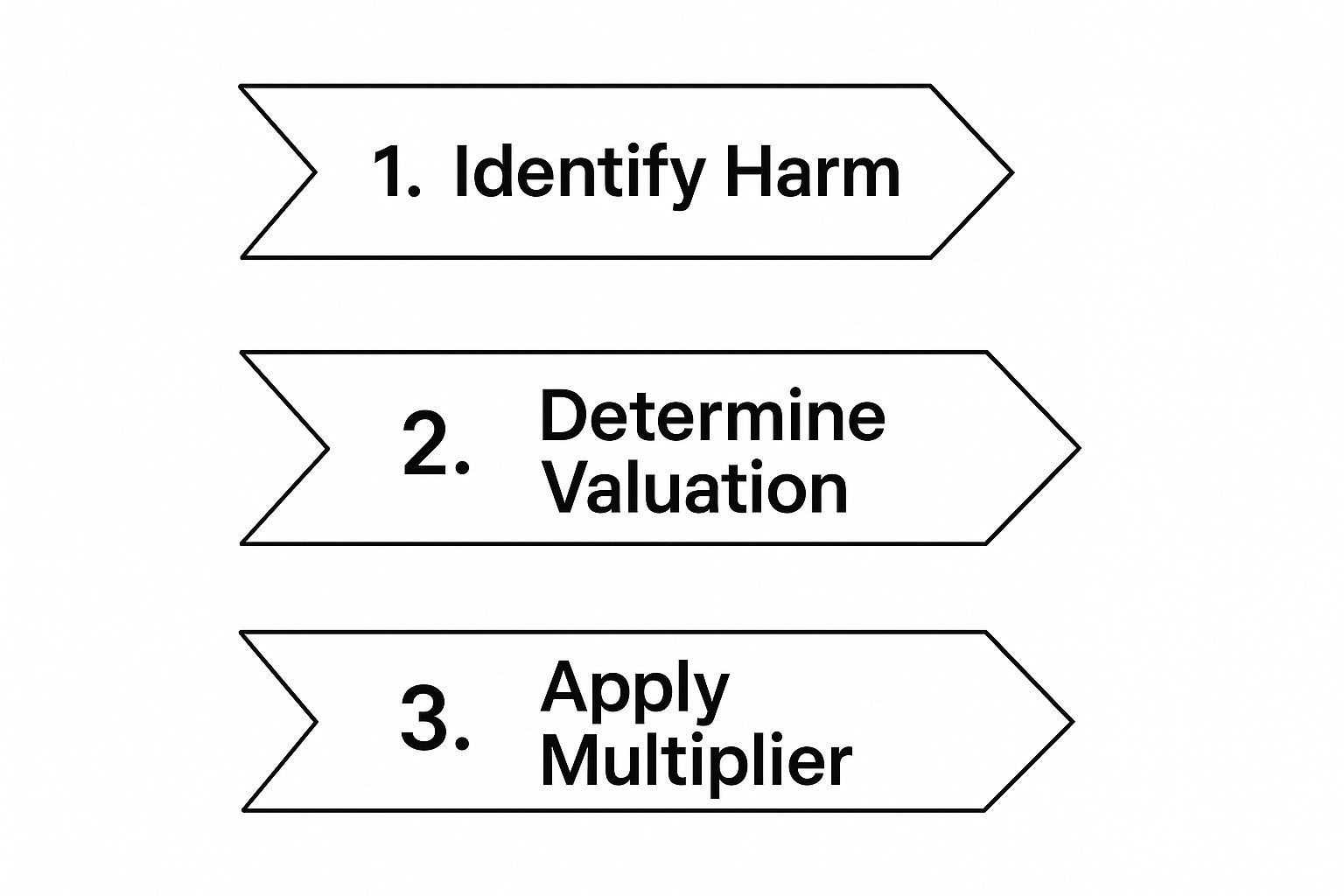
As you can see, the valuation begins by identifying the harm—your economic damages—before moving on to more subjective parts of the claim.
Calculating Your Lost Income and Earning Capacity
The income you lost while recovering is another major economic damage. If your injuries kept you out of work, whether for a week or a year, you are entitled to compensation for that lost pay.
To prove this loss, you will need:
- Pay Stubs: Collect pay stubs from before the accident to establish your average rate of pay.
- Employer Letter: A formal letter from your employer verifying your job title, salary or hourly wage, and the specific dates you couldn't work because of your injury.
- Tax Returns: Past tax returns help demonstrate a consistent earning history. This is particularly useful if you're self-employed or have a variable income.
For severe or permanent injuries, we also have to calculate the loss of future earning capacity. This is the income you would have earned over the rest of your career if the injury hadn't happened.
This calculation is involved and often requires input from vocational experts and economists to project future earnings, promotions, and benefits that are now out of your reach. We can explore how this applies in different types of personal injury claims to see how the specifics change.
By diligently collecting every bill and documenting every lost dollar, you create an objective, powerful summary of your financial losses. This figure is the starting point for all settlement negotiations and is fundamental to calculating your damages fairly.
Placing a Value on Pain and Suffering

After you've carefully tallied every bill and lost wage, you're left with the question we hear from nearly every client in our Atlanta office: how do you put a dollar amount on pain? This is where we move from hard math to a more subjective valuation. Knowing how to calculate damages for pain and suffering is about translating your personal experience into a number the legal system can understand.
There’s no price tag on what you’ve been through. But there are established methods that attorneys and insurance companies use to arrive at a reasonable figure for these non-economic losses. These methods create a starting point for negotiations and help frame the impact of your injuries in financial terms.
The two most common approaches are the Multiplier Method and the Per Diem Method. Each provides a different lens for viewing your suffering, and knowing both is key.
The Multiplier Method Explained
The Multiplier Method is the most widely used approach in personal injury claims. It’s a pretty straightforward concept: your total economic damages—the sum of your medical bills and lost income—are multiplied by a number, usually between 1.5 and 5.
That multiplier isn't just picked out of a hat. It's tied directly to the severity and long-term impact of your injuries. A lower multiplier, maybe a 1.5 or 2, might apply to an injury that healed quickly with no lasting effects. A higher multiplier, like a 4 or 5, is reserved for catastrophic injuries that cause permanent disability, disfigurement, or chronic pain.
Several factors will push that multiplier up:
- Severity of the Injury: A fractured spine will command a much higher multiplier than a sprained wrist.
- Length of Recovery: A long, painful recovery involving multiple surgeries and extensive physical therapy justifies a higher number.
- Permanent Impairment: If the injury leaves you with a permanent limp, chronic pain, or the loss of a bodily function, the multiplier will be significantly higher.
- Impact on Daily Life: Can you no longer play with your children, enjoy hobbies, or perform daily tasks without pain? This "loss of enjoyment of life" is a powerful factor.
- Emotional and Psychological Trauma: Documented anxiety, depression, or PTSD from the accident also increases the multiplier.
For example, let's say a car accident on Peachtree Street results in $50,000 in economic damages (medical bills and lost work). If the injuries were serious—requiring surgery and leaving the victim with a permanent limp and ongoing pain—a multiplier of 4 might be appropriate. That would result in $200,000 for pain and suffering ($50,000 x 4).
This method links the subjective pain directly to the objective financial costs, creating a logical basis for the final figure.
The Per Diem Approach
Another way to value suffering is the Per Diem Method. "Per diem" is just Latin for "per day." This approach assigns a daily dollar amount for every day you experienced pain and suffering, starting from the date of the accident until you reach what doctors call "maximum medical improvement."
What's a fair daily rate? It's often tied to your daily earnings. The logic here is that enduring a day of pain is at least as difficult as going to work for a day.
So, if you earned $200 per day at your job, you could argue for a per diem rate of $200. If your recovery took 150 days, the calculation for your pain and suffering would be:
150 days x $200/day = $30,000
This method is most effective for shorter-term injuries where the endpoint of the suffering is clear. For injuries that cause permanent or lifelong pain, the Multiplier Method is generally a more suitable and effective way to capture the full extent of the long-term impact. The choice depends entirely on the specifics of your case.
For more information on how different damages are categorized, you can review this general overview from the U.S. Government Publishing Office which discusses compensation for injuries or sickness. Ultimately, a deep understanding of these valuation methods is a core part of learning how to calculate damages for your personal injury claim.
The Role of Punitive Damages in Georgia
While economic and non-economic damages are about making you whole again, there's a third category that serves an entirely different purpose. Punitive damages aren't designed to compensate you for your losses. Instead, their goal is to punish the at-fault party for truly appalling behavior and to send a message that it won't be tolerated.
Make no mistake, these damages are not awarded lightly in Georgia.
A judge or jury reserves them for cases where a defendant’s actions showed "willful misconduct, malice, fraud, wantonness, oppression, or that entire want of care which would raise the presumption of conscious indifference to consequences." That’s a high legal bar. In plain English, it means the person who hurt you didn't just make a mistake—they acted with extreme recklessness or intentionally caused harm.
What Kind of Behavior Justifies Punitive Damages?
To get a feel for this, let's contrast a couple of scenarios. A driver who gets distracted and runs a red light has been negligent. But a driver who slams three shots of whiskey, gets behind the wheel with a blood alcohol level twice the legal limit, and causes a catastrophic wreck? That's a different story. The second driver's actions could easily be seen as a conscious indifference to the lives of others.
Here are a few real-world examples that could trigger a punitive damages award:
- A commercial trucking company that knowingly falsifies inspection logs to keep a dangerously unmaintained truck on the road.
- A drunk driver with a history of DUIs who causes a fatal head-on collision.
- A manufacturer that discovers a product has a dangerous defect but covers it up to protect profits, leading to consumer injuries.
In these situations, the conduct is so outrageous that a jury might decide the defendant needs to be hit with a financial penalty. The idea is to make it sting enough to deter them—and anyone else—from ever doing something similar again. This is especially true in heartbreaking situations like wrongful death cases, where the conduct leading to the loss was particularly egregious.
Georgia’s Cap on Punitive Damages
It's important to have realistic expectations about this type of award. Georgia law actually puts a limit on how much can be awarded in punitive damages in most personal injury claims.
As the Georgia Code § 51-12-5.1 states, the cap is generally set at $250,000. So, even if a jury feels the defendant’s actions warrant millions in punishment, the final judgment is typically reduced to this legal limit.
But there's a huge exception to this rule. The $250,000 cap is thrown out the window if the defendant acted with a specific intent to cause harm or—and this is a big one—was under the influence of alcohol or drugs.
This is an important distinction. In a drunk driving case, for example, that cap disappears. A jury is then free to award a much larger sum to reflect the sheer recklessness of the defendant's choices. Because these claims are so rare and legally involved, proving you're entitled to punitive damages is one of the final, and most challenging, considerations when you calculate damages.
How Georgia's At-Fault Rules Affect Your Settlement

It's one of the first questions we get from clients in Atlanta: "What happens if the insurance company says I was partly to blame?" This isn't just a minor detail; it's a major part of calculating damages in Georgia. Our state has a specific rule that can slash—or completely wipe out—your settlement.
Georgia operates under a system called modified comparative negligence. In plain English, this rule acknowledges that accidents are rarely 100% one person's fault. The law allows blame to be shared, but there's a very important catch.
If a jury decides you were partially responsible for the accident, your total compensation gets reduced by your percentage of fault. Insurance adjusters love to use this, as it's a direct path to lowering what they have to pay you.
How Your Percentage of Fault Impacts Your Payout
Let's walk through a real-world scenario. Say you were in a wreck on I-285. A jury determines your total damages—covering medical bills, lost income, and pain and suffering—come to $100,000. But, they also find that you were 20% at fault for the crash.
Under Georgia's law, your final award is cut by your share of the blame.
- Total Damages: $100,000
- Your Fault: 20% (which is $20,000)
- Your Final Recovery: $80,000
That $20,000 reduction comes straight out of your pocket. You can see why the other side will work hard to pin as much fault on you as they possibly can.
Here’s the most important part of this law: if you are found to be 50% or more responsible for the accident, you are legally barred from recovering any damages. You get zero.
This "50% bar" is precisely why determining fault in an accident is so foundational to any personal injury claim. Insurance companies are well aware of this cutoff and will do everything they can to push the blame past that halfway mark.
Shifting Blame and Involved Calculations
This rule isn't just for car accidents; it applies in more situations, too, like when calculating business-related losses. For instance, when an expert is figuring out lost profits after an incident, they might use the 'Yardstick/Benchmark' method. They'll look at a similar, undamaged business that saw a 10% growth in a year, while your business's profit fell by 15%. That gap helps quantify the loss.
Because your percentage of fault can completely change the outcome, building a strong case that minimizes your share of the blame is everything. Every single piece of evidence, from traffic camera videos to witness testimony, becomes a tool to protect the full value of your claim and ensure you know how to calculate damages fairly.
Frequently Asked Questions About Damage Calculations
When you're trying to figure out what your claim is worth, a lot of questions pop up. It's natural. We hear them all the time from our clients here in Atlanta, so let's clear up a few of the most common ones.
Is There an Average Settlement for a Personal Injury Claim?
This is easily the number one question we get, and the honest answer is no. There's really no such thing as an "average" settlement because no two accidents are the same.
The value of your claim is tied directly to the specific facts of your case. We look at the severity of your injuries, the total cost of your medical treatment, how much work you've missed, and how the accident has impacted your day-to-day life. A minor fender-bender with a quick recovery might settle for a few thousand dollars, while a catastrophic injury case could be worth millions.
Do I Have to Pay Taxes on My Settlement Money?
For the most part, you don't. The IRS generally does not consider compensation for physical injuries and the related emotional distress to be taxable income.
However, there are exceptions. Any portion of your settlement that is specifically for lost wages or punitive damages is usually taxable. This is why how your settlement is structured matters.
Key Takeaway: The part of your settlement for physical injuries is typically tax-free. The portion for lost wages is not. It’s always smart to run this by a financial advisor to understand your specific situation.
How Long Will It Take to Get My Settlement?
The timeline can really vary. A straightforward case where the other party is clearly at fault might settle within a few months, especially if you know how to file a car accident claim in Atlanta. On the other hand, a case that ends up in court could easily take a year or more to resolve.
Several steps have to happen, and each one takes time:
- First, we have to gather all the evidence—every medical record, bill, and proof of lost income.
- Next come the back-and-forth negotiations with the insurance company.
- If they won't make a fair offer, we may need to file a lawsuit and go through the litigation process.
No matter how long it takes, getting the calculations right from the start is what ensures a fair outcome. Fully understanding how to calculate damages gives you the best shot at getting what you deserve.