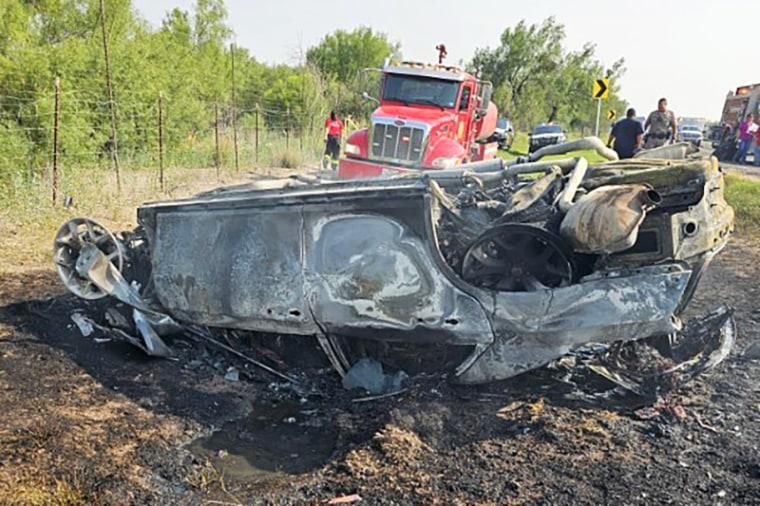
When another driver hits your car and disappears, you're left dealing with the aftermath—shock, anger, and a mountain of questions. As an Atlanta personal injury attorney, I've seen firsthand how disorienting this is. If you're wondering what happens with a hit and run, the answer unfolds on two separate tracks. First, a police investigation kicks off to find the responsible driver. At the same time, you'll begin a process to get compensation for your damages.
Your Immediate Steps After a Hit and Run Accident
The moments after a hit-and-run are chaotic. Your first impulse might be to chase the fleeing car, but your absolute priority is your safety and the safety of anyone else in your vehicle. Resisting that urge is the first important step in taking control of the situation.
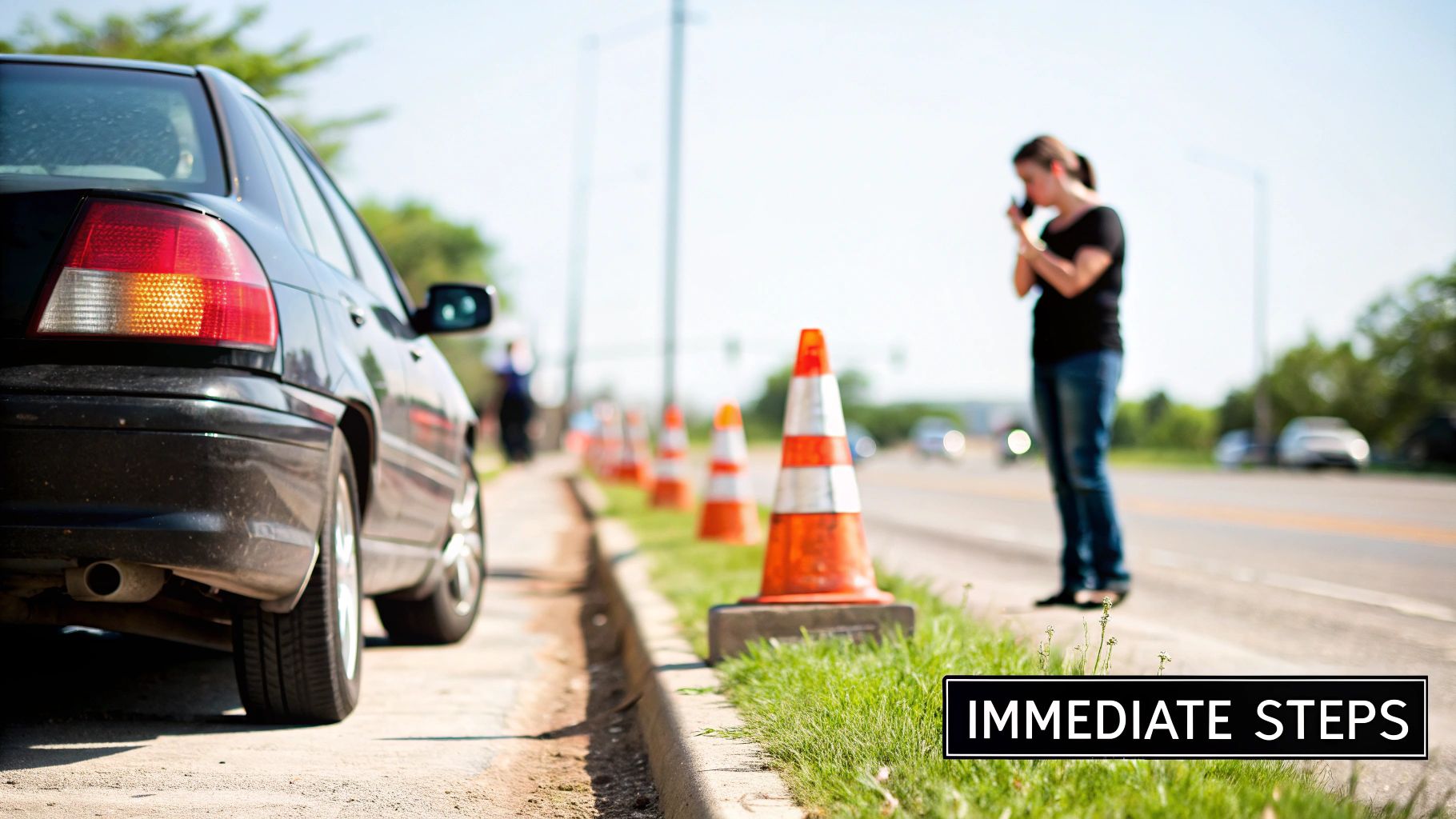
If you can, pull your car over to a safe spot away from traffic, turn on your hazard lights, and take a moment to breathe. Check yourself and your passengers for injuries. Adrenaline is a powerful painkiller, and you might not realize you're hurt right away.
Staying Safe and Gathering Information
Once you're in a safe location, your focus needs to shift to documenting everything. Every small detail you can remember is a clue for law enforcement and a vital piece of evidence for your insurance claim.
Think of yourself as the primary witness to a crime—because that's exactly what you are. The more specific your notes, the better. Try to write down or record everything you can remember about the other vehicle while the memory is still sharp.
- Vehicle Details: What was the car's make, model, and color? Did you notice any unique features like a broken taillight, bumper stickers, or existing damage?
- License Plate: Even a partial license plate number can be a huge break for the police. Jot down any letters or numbers you saw.
- Driver Description: If you caught a glimpse of the driver, note their gender, approximate age, hair color, or anything else that stood out.
- Time and Location: Record the exact time the accident happened and be as specific as possible about the location—the street, the nearest intersection, and the direction the other driver was headed.
For a clear, step-by-step guide on what to prioritize, this checklist can help keep you focused during a stressful time.
Quick Checklist for Hit and Run Victims
A simple guide to the essential actions you should take right after a hit-and-run to ensure your safety and protect your claim.
| Priority | Action | Why It Is Important |
|---|---|---|
| #1 | Check for Injuries | Your health is the top priority. Adrenaline can mask pain, so a self-check is essential. |
| #2 | Call 911 | This creates an official police report, which is needed for any insurance claim or legal action. |
| #3 | Record Vehicle Details | Even a partial license plate or a unique sticker can help police identify the fleeing driver. |
| #4 | Take Photos of the Scene | Document your vehicle's damage, the location, and any debris from multiple angles. |
| #5 | Talk to Witnesses | Get names and contact information from anyone who saw what happened. They can confirm your story. |
| #6 | Seek Medical Attention | A medical evaluation creates an official record of any injuries, linking them directly to the crash. |
Following these steps methodically will help you stay in control and build a strong foundation for the next stages of your case.
These initial actions provide the foundation for both the criminal investigation and your future insurance claim. Clear, timely information is your most powerful tool in this situation.
This documentation can truly make or break your case. While the process can feel overwhelming, taking these steps puts you back in the driver's seat. If you have questions about what to do next or how to start your claim, you can get in touch with our team for guidance. Following these steps is the first move toward understanding exactly what happens with a hit and run case as it progresses.
How Police Investigate a Hit and Run
Once you’ve filed a police report, the focus shifts squarely to finding the driver who fled. If you're wondering what happens with a hit and run case, think of it as a puzzle. The details you provide—a partial license plate, the car's color, even the direction it was headed—are the important first pieces law enforcement needs to start their search.
The first few hours are often the most important. Officers will typically start by canvassing the immediate area for any evidence that can back up your account and help identify the other vehicle.
The Search for Clues and Evidence
Police officers have a well-established playbook for tracking down a driver who has left the scene. It’s a mix of old-school detective work and modern tech, all aimed at building a complete picture of the event to identify the vehicle and its driver.
Common investigative steps include:
- Reviewing Surveillance Footage: Officers will immediately check for cameras on nearby businesses, traffic lights, and residential doorbells that might have captured the collision or the fleeing car.
- Interviewing Witnesses: They’ll talk to anyone you identified at the scene and may knock on doors in the neighborhood to find others who saw or heard something.
- Issuing a BOLO Alert: A "Be On the Lookout" alert is broadcast to other officers in the area, providing the vehicle's description to make it easier to spot.
- Checking with Local Body Shops: Police often notify auto repair and body shops to be on the lookout for vehicles brought in for repairs that match the description of the hit-and-run car.
The information you provide in that initial police report is the bedrock of the entire investigation. Accurate, detailed notes about the car, the driver, and the direction of travel can dramatically increase the odds of finding the person responsible.
Leveraging Technology and Databases
Beyond what they find at the scene, police rely heavily on various databases and technological tools. For example, even a partial license plate number can be run through a state database to generate a list of possible matches. In some hit-and-run cases, a GPS car tracker's route history can provide irrefutable data about a suspect vehicle's movements.
These efforts intensify in cases involving serious injury or death. Hit-and-run accidents make up a significant portion of traffic fatalities in the U.S., with pedestrians and cyclists being the most vulnerable. This reality is why these investigations are taken so seriously.
Understanding this process helps manage your expectations. Finding the driver isn't always quick or easy, and sometimes, despite everyone's best efforts, they are never identified. But by reporting the incident quickly and providing detailed notes, you give law enforcement the best possible chance to solve the case and hold the driver accountable for what happens with a hit and run.
Legal Consequences for Fleeing the Scene in Georgia
Once police identify and locate the driver who fled, the case shifts from investigation to prosecution. For victims, understanding what happens with a hit and run driver in the eyes of the law is often the first step toward a sense of justice. In Georgia, leaving the scene of an accident isn't just a traffic ticket—it’s a serious crime with significant consequences.
The legal penalties hinge entirely on the damage done. Georgia law creates a sharp divide between accidents causing only property damage and those resulting in physical injury or death. This single factor determines whether the driver faces a misdemeanor or a felony, and the punishments are worlds apart.
Misdemeanor vs. Felony Charges
Think of the legal fallout as two very different roads. One is rocky and expensive; the other can lead straight to a prison cell. The driver chooses their path the moment they decide to speed away.
- Misdemeanor Hit and Run: If the accident only damaged another vehicle, a fence, or other property, the charge is typically a misdemeanor. While it’s the lesser of the two, a conviction still comes with a criminal record and harsh penalties.
- Felony Hit and Run: The situation becomes far more serious if someone is injured or killed. Fleeing the scene of an accident involving serious injury or a fatality is a felony, which brings life-altering consequences.
Often, a driver who flees is trying to hide another crime—like a DUI, driving on a suspended license, or having no insurance. In a moment of panic, they trade a lesser problem for a much, much bigger one.
Potential Penalties Under Georgia Law
According to the official Georgia Code § 40-6-270, the penalties are designed to be a powerful deterrent. A misdemeanor conviction can result in up to 12 months in jail and fines up to $1,000.
For a felony conviction where someone was seriously hurt, the penalties escalate dramatically:
- Prison Time: The driver faces between one and five years in state prison.
- Heavy Fines: Financial penalties increase, ranging from $1,000 to $5,000.
- License Suspension: A felony conviction triggers a mandatory suspension of their driver’s license.
A simple fender-bender that should have been a minor insurance matter can become a felony with prison time, crippling fines, and a permanent criminal record—all because the driver chose not to stop.
The danger is amplified by the fact that fleeing drivers are almost always speeding. Globally, road crashes claim about 1.19 million lives each year. Research from the World Health Organization shows that just a 1% increase in speed leads to a 4% increase in the risk of a fatal crash. This statistic underscores the recklessness of anyone who speeds away from a collision scene.
Knowing these penalties clarifies what happens with a hit and run from a criminal standpoint. It also highlights why holding these drivers accountable is so important for keeping our communities safe.
Getting Compensation Through Your Insurance Policy
Once you've handled the immediate safety concerns and the police have started their investigation, your mind will naturally turn to the financial fallout. A big part of figuring out what happens with a hit and run is dealing with the costs. While the police chase the criminal side of things, you're left staring at medical bills, repair shop estimates, and lost paychecks. This is where your own insurance policy becomes your most valuable asset.
Even if the driver who hit you is never found, you are not without options. Your auto insurance policy isn't just one thing; it's a bundle of different coverages, some of which are designed for this exact nightmare scenario. Think of it as a safety net you wisely put in place long before you needed it.
The Role of Uninsured Motorist Coverage
In a hit-and-run case, the most powerful tool in your insurance arsenal is Uninsured Motorist (UM) coverage. While this coverage is optional in Georgia, its value is immense. In simple terms, UM coverage steps into the shoes of the at-fault driver and pays for the damages they should have been responsible for.
Because a hit-and-run driver is legally treated as an "uninsured" driver, your UM coverage can be used to pay for:
- Medical Bills: This covers everything from the ambulance ride and ER visit to ongoing physical therapy or future surgeries.
- Lost Wages: If your injuries keep you out of work, UM is there to help replace that lost income.
- Pain and Suffering: This is compensation for the physical pain and emotional trauma you've endured because of the crash.
Filing a UM claim is a formal process. You'll need to notify your insurance company right away, give them the police report number, and provide proof of your losses—just like you would if you were filing against the other driver's insurance. To get a better handle on the steps involved, take a look at our guide on how to file a car accident claim in Atlanta.
The flowchart below shows how the legal consequences for a hit-and-run driver escalate depending on whether they caused property damage or an injury.
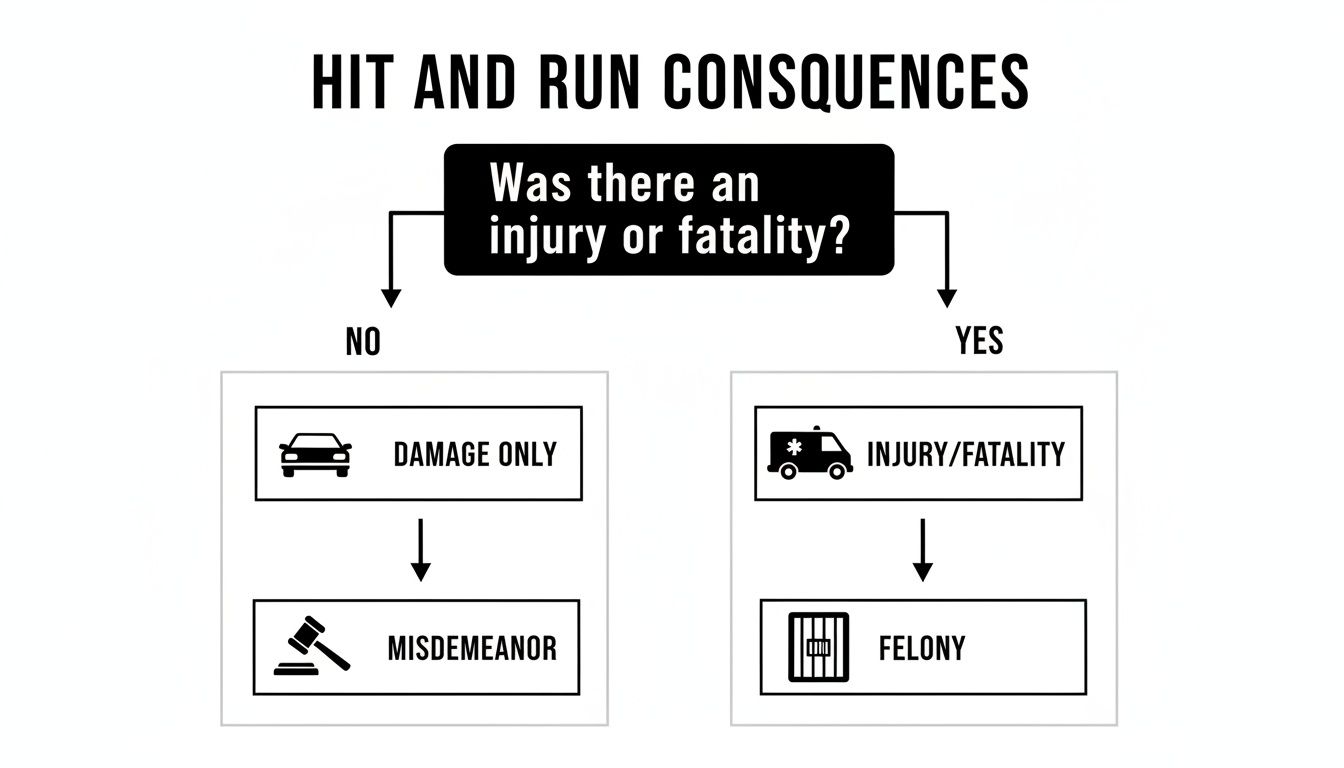
This visual makes it clear why UM coverage is so beneficial. When an injury is involved, the financial stakes shoot up dramatically, and you need a way to cover those significant losses.
Using Other Parts of Your Policy
Beyond your UM coverage, other parts of your policy can offer immediate financial help. These can often be accessed much faster while your larger, more involved UM claim is being processed.
Your insurance policy is a bundle of different coverages. Understanding what each one does allows you to use your policy to its fullest potential when you need it most.
Collision Coverage is the part of your policy that pays to fix or replace your car after a crash, no matter who was at fault. If you have it, you can file a claim to get your vehicle repaired immediately. You will have to pay your deductible upfront, but if the hit-and-run driver is ever caught and has insurance, your company can often recover that deductible for you. When trying to get compensation, it's also good to know the smaller details of your policy, like your insurance coverage for windshield replacement.
Medical Payments (MedPay) Coverage is another optional but extremely helpful coverage in Georgia. MedPay covers medical costs for you and your passengers up to a set limit, again, regardless of fault. It can pay for things like health insurance deductibles, co-pays, and ambulance fees right away, acting as a helpful financial bridge while your UM claim gets sorted out.
The National Safety Council estimated 44,680 motor vehicle deaths in 2024. For victims in Atlanta, the challenge is magnified because hit-and-run drivers are often never identified, forcing victims to lean on their own insurance. These cases disproportionately affect vulnerable people, as drivers who flee are often those least likely to have insurance, creating a compounding problem for those they injure. You can discover more insights about these car accident statistics and their impact on communities. Knowing these insurance options exist helps you understand what happens with a hit and run financially and how you can protect yourself.
Building a Stronger Case with Good Documentation
When it comes to understanding what happens with a hit and run, the strength of your insurance claim really boils down to one thing: evidence. You have to think of yourself as the lead detective on your own case. The more thorough you are, the clearer the picture you can paint for the insurance company, which makes it much harder for them to deny or undervalue your claim.
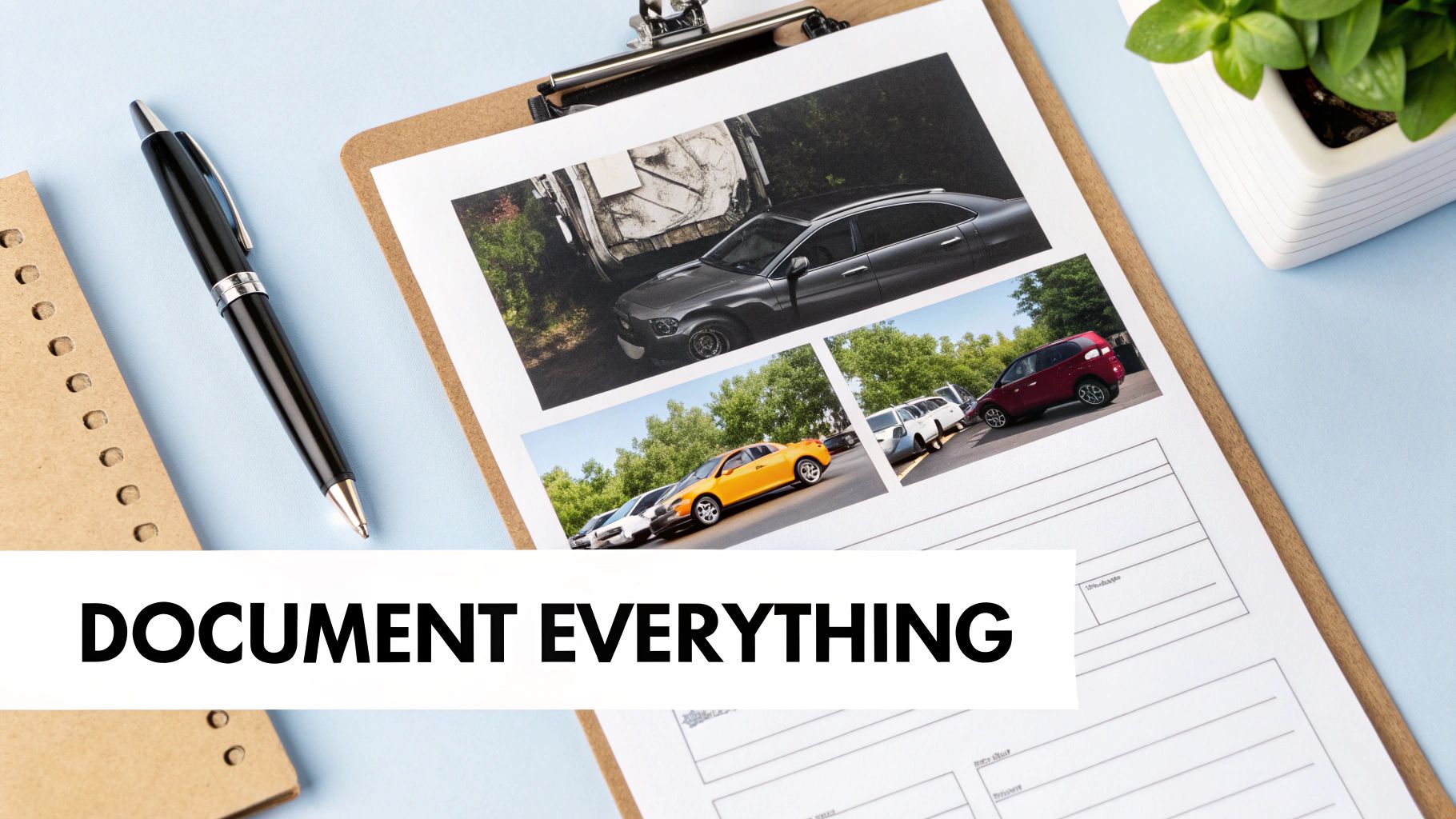
Right after a crash, your smartphone is your best friend. Start snapping photos and taking videos of everything. Get wide shots of the entire scene, then zoom in on the damage to your car. Don't forget the little things, like skid marks, broken glass on the road, or nearby street signs. If you have any visible injuries, document them immediately—bruises and cuts can fade, and photos are powerful proof.
Your Evidence Checklist
The minutes after an accident are chaotic, and it's easy to forget important details once the shock subsides. A quick checklist can keep you focused.
Make sure you gather these essentials:
- Photographic Evidence: You can never have too many photos. Document the damage to your car, the accident scene from multiple angles, and how your injuries look over the following days and weeks.
- Written Notes: As soon as you can, jot down every detail you remember. What did the car look like? What about the driver? What was the sequence of events? A voice memo on your phone works just as well.
- Witness Information: If anyone stopped to help or saw what happened, get their name and phone number. An unbiased account from a third party can be incredibly persuasive.
- Official Reports: Always get the police report number from the responding officer. You’ll need to request a full copy from the police department that handled the call, like the Atlanta Police Department, once it's available.
Pro tip: Create a dedicated folder—either a physical one or a digital one on your computer—for all accident-related documents. Keeping everything in one place saves a lot of headaches later.
Tracking Your Recovery with a Pain Journal
A hit-and-run causes more than just property damage and medical bills. The physical pain and emotional stress are very real losses, and you need a way to document them. This is where a "pain journal" comes in.
It doesn’t have to be anything fancy. Just use a simple notebook or a note-taking app to regularly track how you're feeling. Write down your pain levels, what activities you're struggling with, how it's affecting your sleep or your work, and the overall impact on your day-to-day life.
This journal tells the story of your recovery in a way that medical records can't. It gives the insurance adjuster a window into the human cost of the accident, strengthening your position when you discuss what happens next with your hit-and-run claim.
How a Personal Injury Lawyer Can Help Your Claim
Trying to manage an insurance claim while you're recovering from an accident is more than just an inconvenience—it can feel like a full-time job. It's one thing to understand what happens with a hit and run, but it's another thing entirely to deal with the endless paperwork, phone calls, and negotiations.
This is precisely where a personal injury lawyer steps in. Our role is to take that entire burden off your shoulders so you can focus on what matters: getting better. We become the single point of contact for the insurance company, handling every communication and shielding you from the tactics adjusters use to minimize what they pay.
Launching a Deeper Investigation
Police departments do what they can, but their resources are stretched thin. They simply may not have the time to chase down every lead. An experienced attorney can launch a separate, private investigation to supplement the official one, actively looking for evidence that might have been overlooked.
This process often includes:
- Locating Surveillance Footage: We canvass the area for cameras on nearby businesses, homes, and traffic lights that the police may have missed, then formally request the footage.
- Finding and Interviewing Witnesses: People don't always come forward right away. We can revisit the scene and use other methods to identify individuals who saw what happened and get their statements.
- Hiring Accident Reconstruction Experts: In more serious crashes, we bring in specialists who analyze the physical evidence to determine exactly how the collision occurred. This expert analysis can be helpful for strengthening your claim.
Ensuring Your Claim Covers Everything
One of the biggest mistakes you can make is accepting a quick settlement offer. These offers usually only cover immediate car repairs and your first round of medical bills. The true cost of a serious accident, however, unfolds over months or even years.
Our job is to build a comprehensive claim that accounts for every single loss you've suffered—and will suffer in the future.
An insurance company sees your claim as a file number and a stack of bills. We see your story. Our job is to make sure every chapter—past, present, and future—is fully accounted for in the final settlement.
This means we calculate not just your current expenses, but also potential future costs. This includes things like ongoing physical therapy, future surgeries, or even modifications to your home if you have a lasting disability. We also factor in lost wages if you can't return to work in the same capacity and compensation for your physical pain and emotional distress—damages that are very real but often overlooked.
You can learn more about the steps involved by exploring the car accident lawsuit process in more detail.
Working on a Contingency Fee Basis
Many people hesitate to call a lawyer because they're worried about the cost. It’s a completely valid concern, which is why our firm—like most personal injury firms—works on a contingency fee basis.
The arrangement is simple: you pay absolutely nothing unless we win your case and recover money for you. There are no upfront retainers or hourly bills. Our fee is a set percentage of the final settlement or verdict we obtain on your behalf.
This approach ensures that everyone has access to quality legal representation, regardless of their financial situation. A free consultation is the best way to understand your options. It's a risk-free conversation where you can get clear answers about what happens with a hit and run and how to move forward.
Common Questions About Hit and Run Accidents
After a hit and run, your mind is probably racing with questions. It's a stressful, deeply unfair situation, but getting clear answers is the first step toward regaining control. We've gathered some of the most pressing concerns we hear from our Atlanta clients to explain exactly what happens with a hit and run.
These are real questions from people who have been in your shoes. Let's get them answered.
Key Concerns for Hit and Run Victims
What if the Driver Who Hit Me Is Never Found?
This is the biggest fear for most hit and run victims, and thankfully, the answer is often better than people expect. You can still recover compensation even if the other driver vanishes.
The key is your own auto insurance policy, specifically your Uninsured Motorist (UM) coverage. This is the exact reason UM coverage exists—to protect you when an at-fault driver has no insurance or, in this case, can't be identified. It can cover:
- Your medical bills, including future treatment.
- Lost wages from time off work.
- Pain and suffering damages.
Your Collision coverage can also pay for vehicle repairs, and Medical Payments (MedPay) coverage can handle immediate medical costs. You have options.
How Long Do I Have to File a Hit and Run Claim in Georgia?
The clock starts ticking immediately, and you have different deadlines to watch. In Georgia, the statute of limitations for filing a personal injury lawsuit is generally two years from the date of the crash. This is a hard deadline you cannot miss. You can read more about the specific timelines on the statute of limitations for personal injury in Georgia.
Just as important, the deadline to notify your own insurance company to open a UM claim is much shorter. This timeframe is written into your policy documents. To protect your rights, you must report the accident to the police and your insurer right away.
Should I Speak to the Other Driver's Insurance if They Are Found?
If the police do find the hit-and-run driver, you need to be extremely careful. Their insurance adjuster will likely call you, but their job is not to help you—it is to protect their company by minimizing your claim.
They may ask for a recorded statement to try and catch you in a contradiction, or they might dangle a quick, lowball settlement before you even know the full extent of your injuries and medical needs. We always advise speaking with a personal injury lawyer before you say a word to the other driver’s insurer. Your attorney can handle all communication, making sure your words aren't used against you and shielding you from pressure to accept an unfair offer on what happens with a hit and run settlement.
At Jamie Ballard Law, we provide the clear answers and dedicated support you need to handle this process. If you're recovering from a hit-and-run in Atlanta, contact us for a free, no-obligation consultation to understand your rights. Let us help you move forward. https://jamieballardlaw.com