After an accident, you’re left dealing with physical pain, emotional stress, and a flood of questions. The most pressing one is often, "Do I really need a lawyer?" While a minor fender-bender might not require one, some situations absolutely make legal guidance essential. Understanding when to hire a personal injury lawyer can be the most important decision you make for your recovery. It's my goal to provide helpful information so you can make the best choice for you and your family.
Decoding the Right Moment for Legal Help
The path forward after an accident can seem foggy. You're trying to heal from your injuries while dealing with unexpected bills and calls from insurance companies. It's completely normal to feel overwhelmed and unsure what to do next. Many people right here in Atlanta wonder if their situation truly calls for legal help, often hesitating due to fears about cost or the belief they can handle it themselves.
But acting quickly is a huge part of protecting your rights. Evidence disappears, witness memories fade, and Georgia has strict deadlines for filing claims. For instance, understanding the statute of limitations for personal injury in GA is fundamental—miss that window, and you could lose your right to compensation entirely. You can find more information about these time limits from sources like the Georgia Code.
Key Signs You Need to Call an Attorney
Certain red flags are strong indicators that it's time to get a professional involved. Waiting too long puts you at a disadvantage, especially when the other side's insurance adjuster is already building their case against you.
Here are a few scenarios where you should seriously consider making that call:
- You suffered serious injuries. If your injuries require a hospital stay, surgery, or long-term care, the financial stakes are incredibly high. A good lawyer ensures your future medical needs are calculated and included in your claim.
- The insurance company is giving you the runaround. Are they delaying your claim, denying it without a solid reason, or pushing you to accept a quick, lowball settlement? That's a clear sign they aren't on your side.
- Fault is unclear or disputed. When it’s not obvious who caused the accident, or if the other party is trying to blame you, an attorney can step in to gather the evidence needed to prove liability.
The decision to seek legal help isn't just about money; it's about getting fair treatment. The personal injury legal market was valued at $57 billion in 2023 and continues to grow. This shows that more and more injured people are realizing that professional guidance is often necessary to level the playing field.
This decision tree infographic can help you visualize the key moments when getting a legal consultation is the smartest move.
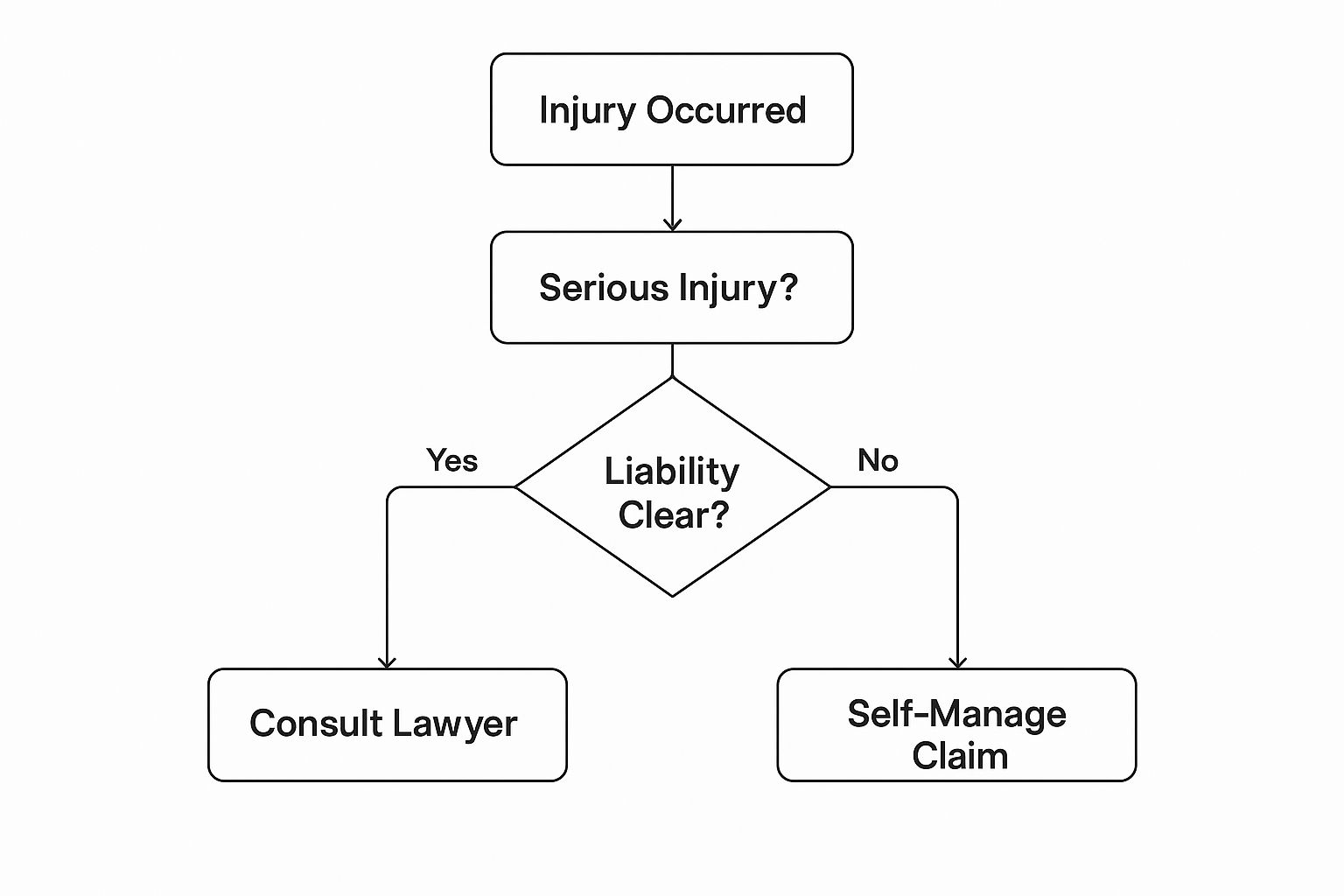
As the visual shows, factors like how badly you were hurt and whether fault is being disputed are primary indicators that it's time to talk to a lawyer.
To make it even clearer, here are some of the most common situations that should prompt you to at least schedule a free consultation.
Key Indicators You Might Need a Lawyer
| Situation | Why You Should Consider a Lawyer |
|---|---|
| Severe Injuries | High medical bills and long-term care costs require expert calculation to ensure you're fully compensated. |
| Disputed Fault | An attorney can investigate the accident and gather evidence to establish who was truly responsible. |
| Low Settlement Offer | Insurance companies often offer a fraction of what a claim is worth. A lawyer knows how to negotiate for a fair amount. |
| Insurance Bad Faith | If an insurer is unfairly denying, delaying, or underpaying your claim, you need a legal advocate. |
| Government Entity Involved | Claims against city, state, or federal agencies have unique rules and very short deadlines that are easy to miss. |
If any of these situations sound familiar, don't hesitate. A quick conversation with an experienced attorney can provide clarity and protect your right to fair compensation. Understanding when to hire a personal injury lawyer is about recognizing when the situation has become too much to handle on your own.
Common Scenarios That Demand Legal Help

Certain accidents are clear signals that you need professional legal advice. Knowing when to hire a personal injury lawyer often comes down to recognizing specific situations where handling the case yourself puts you at a severe disadvantage. Insurance companies and corporate legal teams have deep experience; you need an expert in your corner, too.
Take a serious car wreck on I-285 that results in major injuries and surgery. A lawyer’s role extends far beyond your immediate hospital bills. They project the true cost of your accident, factoring in future physical therapy, lost earning capacity, and the pain you’ve been forced to endure. They build a comprehensive picture of your needs, backed by medical and financial experts.
Accidents Involving Commercial Trucks
Truck accidents are an entirely different category of personal injury. A collision with a large commercial vehicle on a Georgia highway introduces elements that are absent in a typical car crash. These incidents are governed by strict federal regulations, which you can learn more about from the Federal Motor Carrier Safety Administration (FMCSA), and the trucking companies have aggressive legal teams ready to protect their interests from day one.
An experienced truck accident attorney knows precisely what evidence is important to prove negligence. This isn't just about what happened at the scene; it's about securing information that can disappear quickly, such as:
- The driver’s hours-of-service logbook to identify fatigue violations.
- Data from the truck’s electronic data recorder (“black box”), which logs speed and braking information.
- Vehicle maintenance records to uncover mechanical failures.
- The driver’s employment file and training history.
Without an attorney to demand this evidence, it becomes your word against a powerful corporation. A lawyer levels that playing field immediately.
Premises Liability and Slip and Fall Cases
Another common scenario is a slip and fall at a grocery store, restaurant, or apartment building. While it might seem straightforward, proving a "premises liability" case is challenging. The law requires you to show that the property owner was negligent in their duty to maintain a safe environment.
This means demonstrating that the owner knew, or should have known, about the hazard—like a wet floor without a sign or a broken handrail—and failed to take reasonable steps to fix it.
Proving a property owner's negligence is not straightforward. It requires a detailed investigation into maintenance logs, safety procedures, and even past incidents to establish a pattern of carelessness that led to your injury.
The need for skilled legal representation is growing. Employment for lawyers in the U.S. stood at around 1.3 million in 2023, with projections showing continued demand according to the Bureau of Labor Statistics. This trend reflects a broader public understanding of the value a professional advocate provides.
These examples show how a lawyer’s involvement can fundamentally change the outcome of various personal injury claims. Whether it's gathering technical evidence in a truck crash or establishing a property owner’s negligence, an attorney brings the focused expertise required to build a solid case. This allows you to focus on what matters most: your recovery.
What to Expect from the Insurance Adjuster

It won’t be long after your accident before the phone rings. On the other end will be an insurance adjuster from the at-fault party's company. You need to understand their role from the very first word they speak: their one and only job is to protect their company's bottom line.
That means their goal is to settle your claim for the lowest amount possible.
This isn't personal; it's just business. Adjusters are trained professionals, and their toolkit is full of tactics designed to get you to say something—anything—that can be used to weaken your case later on. They might sound friendly and genuinely concerned, but their objective is the polar opposite of yours.
Common Tactics Adjusters Use
Insurance adjusters don't improvise. They follow a well-established playbook of strategies. If you can spot these tactics, you can protect yourself from unintentionally damaging your own claim.
Here are a few common moves you can expect:
- Requesting a Recorded Statement: This is often the first thing they'll ask for. They'll frame it as a routine part of the process, but the real purpose is to lock you into a story. They will pick apart every word later, searching for tiny inconsistencies to use against you.
- Offering a Quick, Low Settlement: An offer might land in your lap just days after the crash. When bills are piling up, this can seem like a lifeline. It’s almost always a lowball offer, made before you even know the full extent of your injuries or what your total medical costs will be.
- Asking for Broad Medical Authorization: The adjuster will send you a form to sign that gives them access to your medical records. Be warned: these authorizations are often intentionally broad. They allow the insurer to dig through your entire medical history, looking for any pre-existing condition they can blame for your pain.
Remember, you are never obligated to provide a recorded statement to the other party's insurance company. You have the right to refuse and speak with a lawyer first.
How to Handle the First Call
When the adjuster calls, stay calm. Be polite, but also be brief. Stick to the absolute basic facts: your name, address, and the date and location of the accident. That’s it. Anything beyond that can wait.
It is perfectly fine—and smart—to tell the adjuster you aren't ready to discuss the details. Let them know you are still getting medical treatment and will not be giving any statements right now. This simple move puts you back in control of the conversation.
This is a key moment where you should consider when to hire a personal injury lawyer. Once you have an attorney, they take over all communication with the insurance company. The pressure is immediately off your shoulders. Your lawyer knows exactly how to handle these calls, providing only the necessary information without ever putting your case at risk. They are 100% on your side, and the adjuster knows it.
How a Lawyer Calculates Your Claim's True Value
One of the most valuable things a lawyer brings to the table is an accurate calculation of your claim's full value. This goes far beyond simply adding up your medical bills. In fact, knowing when to hire a personal injury lawyer often comes down to recognizing that an insurer’s quick settlement offer won’t even begin to cover the true, long-term impact of your injuries.
Let’s break down how a claim's real worth is determined. The entire calculation is based on two distinct categories of losses. Understanding both is important for seeing why a lawyer's assessment is so different from an insurance adjuster's.
Calculating Your Economic Damages
First, we tally up your economic damages. Think of these as the tangible, calculable losses—the things that have a clear price tag attached. They are the black-and-white numbers that form the foundation of your claim.
We meticulously document these costs by gathering every piece of paper and consulting with financial experts when necessary. These damages almost always include:
- All Current and Future Medical Bills: This covers everything from the initial ER visit and ambulance ride to surgeries, physical therapy, prescription drugs, and any anticipated future care your doctors recommend.
- Lost Wages and Reduced Earning Capacity: If your injuries kept you out of work, we calculate those lost paychecks. More importantly, if the injury impacts your ability to earn a living down the road, we work with vocational and economic experts to project that long-term loss.
- Property Damage: For vehicle accidents, this means the cost to repair or replace your car. You can check out our guide on how to file a car accident claim in Atlanta for more on this specific process.
Valuing Your Non-Economic Damages
This is where an experienced attorney’s judgment truly makes a difference. Non-economic damages cover the intangible, deeply personal impact the accident has had on your life. These losses don't come with a receipt, but they are just as real and often far more devastating.
These damages are meant to compensate you for:
- Pain and Suffering
- Emotional Distress and Mental Anguish
- Loss of Enjoyment of Life
- Permanent Scarring or Disfigurement
A quick settlement offer from an insurer almost never accounts for these profound, long-term personal losses. Their goal is to close the case cheaply and quickly, often before the full scope of your suffering is even known.
The legal field is well-equipped to handle these evaluations. To build the strongest case possible, it is important to document everything. For instance, the National Highway Traffic Safety Administration (NHTSA) provides clear guidelines on what information to gather after an accident.
This screenshot highlights the importance of collecting details like driver information, witness contacts, and officer details. Every piece of information helps your attorney build a stronger case for both your economic and non-economic damages.
An experienced attorney knows how to translate these human costs into a monetary value that reflects what you've truly lost. This careful, detailed approach is the key difference between what an insurer offers and what you actually deserve. It’s precisely why understanding when to hire a personal injury lawyer is so important.
Myths That Can Weaken Your Injury Case

Many people in Atlanta hesitate on the question of when to hire a personal injury lawyer. This delay often comes from common myths about the legal process itself. Unfortunately, these misconceptions can prevent you from getting the help you need and ultimately weaken your case before it even starts.
One of the biggest hurdles is the fear of cost. The truth is, most reputable personal injury attorneys operate on a contingency fee basis. This structure is simple: you owe nothing upfront. The lawyer’s fee is just a percentage of the settlement or award we secure for you. If we don’t win your case, you pay no attorney fees. Period. You can learn more about this fee arrangement from resources like the American Bar Association.
My Injuries Aren't "Serious Enough"
This is a dangerous assumption. Many people believe their injuries must be catastrophic to justify legal action, but that’s just not true. Some of the most debilitating injuries aren't immediately obvious after an accident.
A concussion, for example, can lead to lasting cognitive issues, while whiplash can result in chronic pain for years. If you downplay your injuries to an insurance adjuster or delay medical care, you hand the insurer a perfect excuse to argue your injuries weren't caused by the accident. Our Atlanta slip and fall attorneys frequently handle cases where a seemingly minor incident leads to significant, long-term complications.
Hiring a Lawyer Means Going to Court
The thought of a dramatic courtroom trial is enough to stop many people from making that first call. While our firm is always prepared to go to trial, the reality is that the vast majority of personal injury cases are settled long before then.
The overwhelming number of personal injury claims are resolved through settlement negotiations. A skilled attorney's job is to build such a strong case that the insurance company is motivated to offer a fair settlement to avoid the expense and uncertainty of a trial.
Understanding these truths removes the barriers that might keep you from exploring your legal options. These common myths almost always benefit one party: the insurance company. Don’t let misinformation stand between you and protecting your rights. Knowing the facts is the first step toward making an informed decision.
Your Questions About Hiring a Personal Injury Lawyer
After a crash, it's easy to feel overwhelmed. Your mind is probably racing with questions about what comes next, especially when it comes to getting legal help. I've heard just about every question there is from people here in Atlanta, and my goal is to give you the straightforward answers you need to move forward with confidence.
How Soon After an Accident Should I Contact a Lawyer?
The short answer is: immediately. There are two big reasons why you can't afford to wait.
- Evidence disappears fast. Surveillance cameras get taped over, skid marks wash away in the rain, and witnesses' memories start to fade almost instantly. An attorney can send preservation letters and get an investigator to the scene right away to lock down this proof before it's gone for good.
- Georgia has a strict deadline for filing a lawsuit, known as the statute of limitations. For most personal injury cases, you have just two years from the date of the injury to file. Two years sounds like a long time, but building a solid case takes time. You don't want to be scrambling at the last minute.
What Should I Bring to My First Meeting with a Lawyer?
The first consultation is always free, and it's really about us getting to know each other and the facts of your case. Don't stress if you can't find every single piece of paper.
Just bring what you have. The most helpful items include:
- The official police or incident report
- Any photos or videos you took of the scene, your vehicle, and your injuries
- Contact information for any witnesses who stopped to help
- Medical bills and records you've received so far
- Any emails, letters, or other communication from an insurance company
The goal of our first meeting is for me to understand what you're up against and for you to decide if I'm the right fit. We can always track down missing documents later.
Even if you've already talked to an insurance adjuster, it's not too late to hire a lawyer. We can take over all communications immediately, shielding you from their tactics.
What If the Insurance Company Blames Me for the Accident?
This is one of the oldest tricks in the book. Insurance companies use this tactic to scare people into accepting a lowball offer or dropping their claim entirely. Never take their assessment of fault at face value.
Georgia operates under a "modified comparative negligence" rule. This legal doctrine, explained in O.C.G.A. § 51-12-33, means you can still recover damages as long as you are found to be less than 50% at fault. Your final compensation is simply reduced by your percentage of fault. For example, if you are 20% at fault, you can still recover 80% of your damages.
An experienced lawyer knows how to fight back against unfair blame. We investigate the crash, gather independent evidence, and build a case to prove what really happened. This is a perfect example of when to hire a personal injury lawyer, because challenging a fault determination can be the difference between getting full compensation and getting nothing.
At Jamie Ballard Law, we understand the pressure you're under. If you have more questions or need an advocate who will stand up to the insurance companies for you, we are here to help. For a free, no-obligation case evaluation, visit us at https://jamieballardlaw.com.