If someone else’s carelessness turned your life upside down, you’re almost certainly dealing with a negligence case — even if no one has used that term with you yet. Car crashes, slip and falls, dog attacks, medical mistakes — they all flow from the same legal principle. When someone fails to act with basic reasonable care, and that failure hurts you, Georgia law gives you the right to hold them accountable. Understanding how negligence cases actually work — what you have to prove, what your claim is worth, and what can go wrong — is the first step toward getting the compensation you deserve.
What Negligence Actually Means in the Real World
It’s not about intent — it’s about reasonable care
Here’s something that surprises a lot of people: the driver who looked at their phone and ran a red light didn’t have to mean to hurt you for them to be legally responsible. Negligence cases don’t require proving someone wanted to cause harm. They only require proving that person failed to use the care a reasonable human being would have used in the same situation.
Think of it like this. When you get behind the wheel, Georgia law doesn’t expect you to be a perfect driver. It expects you to be a reasonably careful one — paying attention, following traffic laws, adjusting for weather and conditions. The moment someone falls below that standard and you get hurt because of it, you have the foundation of a negligence case.
How negligence differs from intentional harm
If someone punches you, that’s an intentional tort — battery. If someone’s distracted and knocks you down, that’s negligence. The difference matters legally because negligence doesn’t require any hostile intent. Most of the injury claims we handle at Jamie Ballard Law are negligence-based — because most accidents happen not because someone wanted to hurt you, but because they were careless in a way that caused real damage.
Why this is the heart of almost every personal injury claim
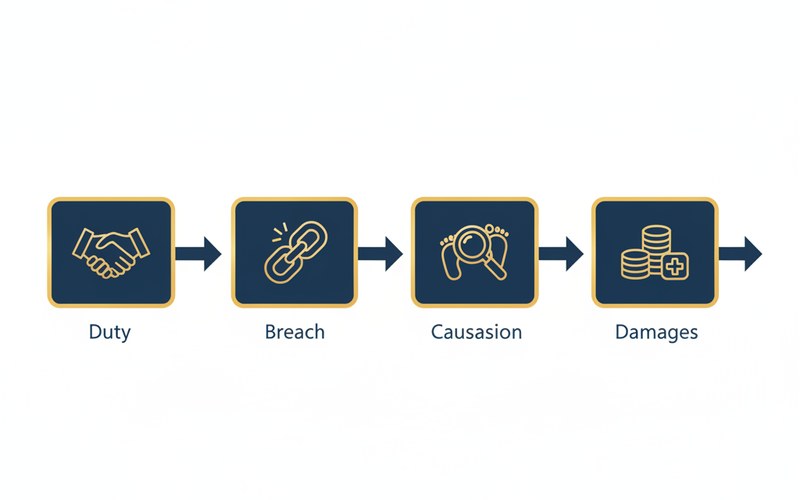
Whether your case involves a delivery driver who ran a stop sign, a grocery store that ignored a wet floor for two hours, a surgeon who operated on the wrong site, or a landlord who let a dangerous dog roam unleashed — the legal framework is almost always the same. Your attorney builds a negligence case by proving four specific elements. Miss any one of them, and the claim fails. Nail all four, and you have a strong path to full compensation.
Practical rule: You don’t need to prove the person meant to hurt you — only that they failed to use reasonable care and that failure caused your injury.
The Four Elements Your Attorney Has to Prove
Element 1 — Duty of care
The first question is: did this person owe you a legal duty? The answer is almost always yes, and it’s usually the easiest element to establish. Every driver on a Georgia road owes a duty of care to every other driver, passenger, cyclist, and pedestrian sharing that road. Every business that opens its doors to customers owes them a duty to maintain reasonably safe conditions. Every doctor who takes you on as a patient owes you the standard of care their specialty requires.
Courts have developed well-established rules for who owes a duty to whom in virtually every scenario. In most negligence cases, duty isn’t contested — the fight usually happens on breach and causation.
Element 2 — Breach of that duty
Breach is the specific failure — the thing the defendant did, or didn’t do, that fell below the required standard. A driver who was texting. A property owner who knew about a broken step for three weeks and never fixed it. A truck driver who falsified their logbooks and drove on no sleep. The breach is the core of your negligence case, and it’s where your attorney focuses the most effort.
Building proof of breach means gathering police reports, surveillance footage, maintenance records, employment records, and expert testimony. Every piece of evidence that shows the defendant knew or should have known about the danger — and failed to address it — strengthens this element of your claim.
Element 3 — Causation
This is where insurance companies love to attack. Causation requires showing two things: first, that the breach actually caused your injury (in legal terms: “but for” what the defendant did, would you have been hurt?); and second, that your injury was a foreseeable result of that breach (called proximate cause).
The defense will argue your injuries existed before the accident. They’ll argue something else caused your harm. They’ll find gaps in your medical timeline and build a story that the crash had nothing to do with your condition. Strong, continuous medical documentation starting from the day of the accident is your most powerful weapon against these arguments.
Element 4 — Actual damages
Even a clear-cut breach of a clear-cut duty isn’t enough if you weren’t actually harmed. Georgia courts require real, documented damages. That means medical bills, lost income, property damage, documented pain and suffering — something concrete that a jury can put a number on. “I was scared” isn’t enough on its own. “I was scared, suffered a panic disorder, and haven’t been able to return to work” — with medical records to back it up — is a very different story.
Georgia’s Specific Rules That Shape Every Negligence Case
Modified comparative fault — the 50% rule
Here’s something every Georgia injury victim needs to understand before they talk to an insurance adjuster: Georgia is a modified comparative fault state under O.C.G.A. § 51-12-33. That means if you’re partly responsible for what happened, your recovery gets reduced by your share of fault. If you’re 20% at fault and your damages are $100,000, you walk away with $80,000.
The problem is the cutoff. If you’re 50% or more at fault, you recover nothing. Zero. Insurance companies know this rule cold, and they use it aggressively. Their adjusters are trained to find anything — a lane change you made, a second before the crash, whether you had your seatbelt on — that they can use to push your fault percentage past that 50% threshold and kill your claim entirely. Your attorney’s job is to build evidence that keeps your fault percentage as low as possible.
Negligence per se — when breaking the law proves carelessness
Georgia courts recognize a doctrine called negligence per se. When a defendant violates a safety statute — a traffic law, a building code, an OSHA regulation — that violation can establish negligence automatically. You don’t need to separately prove the person was being careless. The fact that they broke the law is enough.
This matters enormously in real cases. A driver who ran a red light and hit you? The traffic violation establishes negligence per se. A property owner who violated the Georgia building code? Same result. An employer who violated OSHA safety standards? Negligence per se. Your attorney identifies every statutory violation the defendant committed and uses each one to strengthen the breach element of your claim.
Notice requirements in premises liability cases
In slip and fall negligence cases, Georgia requires proof that the property owner either caused the hazard, or knew about it and failed to fix it, or should have known about it through reasonable inspection. This “constructive knowledge” standard is why timing matters so much. A spill that happened thirty seconds before you fell is a much harder case than a spill that sat unaddressed for ninety minutes. Surveillance footage, maintenance logs, and employee testimony are critical. An attorney files a legal hold immediately to prevent that footage from being overwritten.
The two-year window — don’t let it close on you
Georgia’s standard statute of limitations for personal injury negligence cases is two years from the date of the accident under O.C.G.A. § 9-3-33. Miss that deadline and your case is gone — permanently, regardless of how strong it was. And the clock doesn’t always start where you’d expect it to. Claims against government entities have notice requirements as short as six months. Medical malpractice has its own tolling rules. For minors, the two years generally don’t start until age 18. Don’t guess — call an attorney as soon as possible after any injury.
Practical rule: Insurance adjusters are trained to push your fault percentage above 50% to zero out your claim. Never discuss fault with an adjuster before speaking with an attorney.
The Types of Negligence Cases We See Most in Georgia
Car and truck accidents
Motor vehicle collisions are the single most common source of negligence cases in Georgia, and the Atlanta metro area is one of the worst traffic environments in the country. Speeding, distracted driving, drunk driving, failure to yield, and running red lights are all textbook breaches of the duty every driver owes. Truck accident cases add a layer of complexity — federal FMCSA regulations govern hours of service, maintenance requirements, and driver qualifications, and violations of those federal rules can trigger negligence per se arguments as well as direct employer liability. You can learn more about trucker obligations through the FMCSA regulations portal.
Premises liability and slip and falls
Property owners have a duty to inspect their property and fix hazards — or at minimum warn visitors about them. When they don’t, and someone gets hurt, the result is a premises liability negligence case. Wet floors, broken parking lot surfaces, inadequate lighting in stairwells, and unmarked hazards all generate these claims. Georgia law distinguishes between invitees (people invited for a business purpose), licensees, and trespassers — each category carries different legal obligations for the property owner. Customers in a store are invitees and receive the highest level of protection.
Medical malpractice
Medical negligence cases are among the most technically demanding claims in personal injury law. To succeed, you must show that the healthcare provider deviated from the accepted standard of care for their specialty — not just that they made a mistake, but that a competent provider in the same specialty would have done something different. Georgia requires an expert affidavit to be filed with the complaint under O.C.G.A. § 9-11-9.1. Misdiagnosis, surgical errors, anesthesia mistakes, and medication errors are the most common forms we handle.
Dog bites and animal attacks
Georgia’s dog bite statute under O.C.G.A. § 51-2-7 holds owners liable when their animal attacks and they had prior knowledge of the dog’s dangerous propensities — or when the dog wasn’t properly restrained. “One bite rule” is a common oversimplification; Georgia courts look at the totality of the owner’s knowledge and control. If a landlord knew a tenant kept a dangerous dog and did nothing about it, the landlord may also share liability under a premises theory. An Atlanta dog bite attorney investigates every potential source of liability.

What Your Negligence Case Is Actually Worth
Economic damages — the calculable losses
Economic damages are the foundation of every negligence case settlement. These are documented, verifiable financial losses. Think of it as building a house — this is the concrete foundation everything else sits on. Your economic damages include:
- Past medical bills — every ER visit, imaging study, surgery, prescription, and therapy session from the accident through today
- Future medical costs — projected by medical experts for ongoing treatment, anticipated surgeries, and long-term care needs
- Lost wages — income you couldn’t earn while recovering, documented with employer records and pay stubs
- Lost earning capacity — if your injury permanently limits your ability to work, the difference between what you would have earned and what you now can is a separate, often very large, category of damages
- Property damage — vehicle repairs, replacement, and any personal property destroyed in the incident
Non-economic damages — the human cost
Beyond the receipts and pay stubs, your negligence case should also recover for the parts of your loss that don’t come with a price tag. Pain and suffering. The inability to pick up your child. The anxiety that hits every time you get in a car. Permanent scarring or disfigurement. The loss of a marriage because a catastrophic injury fundamentally changed who you are.
Georgia does not cap non-economic damages in standard personal injury cases — unlike some states. That’s meaningful. A jury in Fulton County can award whatever they believe is fair to compensate for what you’ve been through. The stronger your documentation of how the injury affected your daily life — daily journals, testimony from family members, consistent treatment records — the higher that number can go.
Attorneys typically use two calculation methods as a starting point. The multiplier method takes your total economic damages and multiplies them by a number between 1.5 and 5, based on severity. A broken arm that heals cleanly might get a 1.5 multiplier. A traumatic brain injury with permanent cognitive effects might get a 4 or 5. The per diem method assigns a daily rate to your suffering — often your daily wage — and multiplies by the number of days affected. Both are starting points for negotiation, not guarantees.
Punitive damages — when the conduct was especially bad
Standard negligence cases recover compensatory damages — money that makes you whole. But when the defendant’s conduct crossed the line into willful, wanton, or consciously indifferent territory, Georgia law allows punitive damages under O.C.G.A. § 51-12-5.1. A drunk driver who got behind the wheel knowing they were impaired. A company that knowingly sold a defective product. A landlord who was warned repeatedly about a dangerous condition and did nothing.
Georgia caps punitive damages at $250,000 in most cases, with exceptions for product liability and cases involving specific intent to harm. Even when punitive damages aren’t available, evidence of especially bad conduct often drives up the jury’s compensatory award.
| Injury Severity | Typical Economic Damages | Multiplier Range | Estimated Total Range |
|---|---|---|---|
| Minor (soft tissue, sprains) | $5,000 – $25,000 | 1.5 – 2x | $7,500 – $50,000 |
| Moderate (fractures, herniated discs) | $25,000 – $100,000 | 2 – 3x | $50,000 – $300,000 |
| Serious (surgery, significant disability) | $100,000 – $500,000 | 3 – 4x | $300,000 – $2M+ |
| Catastrophic (TBI, paralysis, wrongful death) | $500,000+ | 4 – 5x+ | $2M – $10M+ |
Practical rule: Georgia doesn’t cap pain and suffering damages in most personal injury cases — consistent medical treatment and detailed documentation of your daily limitations are the two biggest drivers of non-economic value.
Common Mistakes That Can Sink Your Negligence Case
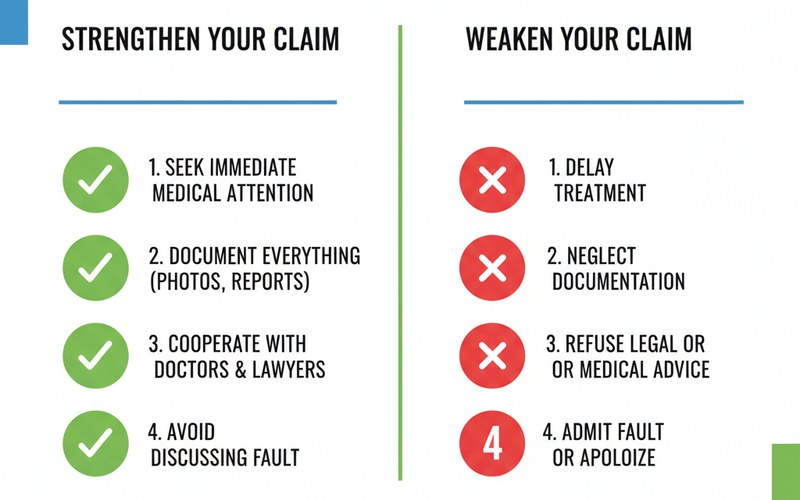
Delaying medical treatment
The single most damaging thing an injury victim can do is wait to see a doctor. Insurance adjusters are trained to look for this gap. A week between your accident and your first medical visit becomes their opening argument that you weren’t seriously hurt — or that something else caused your injury. Even if you feel okay, get evaluated within 24 hours. Adrenaline is a powerful painkiller. Whiplash, concussions, and internal injuries routinely don’t produce obvious symptoms until 48 to 72 hours after impact. The emergency room or urgent care visit the day of your accident is not just good medicine — it’s the foundation of your entire claim.
Accepting a quick settlement offer
Insurance companies move fast after accidents. Sometimes within days, an adjuster calls with a check — friendly, reasonable-sounding, and completely inadequate. Once you sign that release, the case is over. It doesn’t matter if your shoulder injury turns out to need surgery three months later. You already settled. The only time to consider a settlement is after you’ve reached maximum medical improvement and you fully understand the long-term cost of your injuries. A week of patience and a conversation with an attorney can mean tens of thousands of additional dollars. Don’t let urgency work against you.
Talking to the other side’s insurance company
The other driver’s insurance adjuster is not your friend. They’re a professional whose job is to reduce what the company pays out. They will call quickly, ask “how are you doing,” and use whatever you say to minimize your claim. Recorded statements are particularly dangerous. A casual “I’m okay” becomes evidence you weren’t seriously hurt. A slightly inconsistent account of the accident becomes a credibility problem at trial. The right answer when they call: “I have an attorney. Please contact them directly.” If you don’t have an attorney yet, say you’ll be getting one and will have them call back.
Posting on social media
Defense investigators actively monitor the social media accounts of claimants in active negligence cases. A photo at a family barbecue gets used to argue your injuries aren’t limiting your activities. A post saying you’re “feeling better” becomes a damages defense. Check-ins at the gym, vacation photos, anything that suggests normal activity — all of it can and will be used against you. Lock down your accounts the day of the accident and don’t post anything about your health, activities, or the incident until the case is completely resolved.
The Role of Evidence in Winning Negligence Cases
Why the first 48 hours matter most
Here’s what most people don’t realize: the evidence that wins negligence cases often disappears within days of an accident. Surveillance footage gets overwritten on 24- or 48-hour loops. Witnesses forget details or become hard to reach. Skid marks wash away in the rain. The physical conditions that existed at the time of a slip and fall get cleaned up before anyone documents them. The attorneys who get the best results are the ones who move fast — filing evidence preservation letters, hiring investigators, and locking down the scene before any of that disappears.
The types of evidence that matter most
In a car accident negligence case, the strongest evidence typically includes the police report, any dashcam or traffic camera footage, photos from the scene, witness statements, the at-fault driver’s phone records (obtainable through discovery if texting is suspected), and black box data from commercial vehicles. In a premises case, it’s surveillance footage, the incident report, maintenance logs, and prior complaints about the same hazard. In a medical case, it’s the complete medical record and an expert willing to testify that the standard of care was breached. The pattern is always the same: the more objective, documented evidence you have, the harder your claim is to deny.
Practical rule: Surveillance footage is often overwritten in 24–48 hours. The moment you hire an attorney, they can send a legal preservation demand — but only if they know about your case in time.
How the Negligence Case Process Works From Start to Finish
Investigation and demand
After you hire an attorney, the first phase is building the case. Your attorney preserves evidence, obtains all available records, identifies every liable party and every insurance policy in play, and retains whatever experts are needed — accident reconstruction, medical, vocational, economic. Once you’ve reached maximum medical improvement and the full picture of your damages is clear, your attorney drafts a detailed demand package. This document tells your story: the facts, the liability argument, the documented damages, and the settlement number you’re seeking. The majority of negligence cases resolve here, without a lawsuit.
Filing suit and discovery
When the demand isn’t met, your attorney files a complaint in the appropriate Georgia court. Discovery begins — both sides exchange documents, take depositions, and submit written interrogatories. Depositions are sworn testimony given before trial, and they lock everyone into their accounts. A witness who changes their story at trial faces immediate impeachment with the deposition transcript. Discovery in a serious negligence case typically takes six to twelve months. The Georgia Courts system processes thousands of civil cases through this stage each year.
Mediation — where most cases end
Georgia courts strongly encourage mediation before trial, and many judges require it. A neutral mediator works with both sides to find a number that avoids the risk and cost of a full trial. Your attorney prepares a detailed mediation brief laying out the strongest version of your case. Most negligence cases — easily 90% or more — settle at or before mediation. The cases that don’t settle go to trial, where a jury decides both liability and damages.
Trial — rare, but where leverage comes from
Fewer than 5% of personal injury negligence cases actually reach a jury verdict. But here’s the thing: every settlement negotiation happens in the shadow of what a trial would look like. An attorney with a proven trial record gets better results at every stage because the insurance company knows they’ll follow through. The State Bar of Georgia has attorney directories and resources if you’re researching legal counsel. The credible threat of trial is what makes fair settlement possible.
Practical rule: Most negligence cases settle — but only because both sides can predict what a jury would do. An attorney who has actually tried cases gets better settlements than one who hasn’t.
FAQ: Georgia Negligence Cases
| Question | Answer |
|---|---|
| What do I have to prove in a negligence case? | Four elements: duty of care, breach of that duty, causation linking the breach to your injury, and actual documented damages. All four are required. |
| What if I was partly at fault? | You can still recover as long as you were less than 50% at fault. Your award is reduced by your fault percentage under Georgia’s modified comparative negligence rule. |
| How long do I have to file? | Two years from the date of injury in most cases. Claims against government entities can be as short as six months. Don’t wait — contact an attorney immediately. |
| Does Georgia cap pain and suffering? | No cap in most personal injury negligence cases. Medical malpractice has specific rules. Punitive damages are generally capped at $250,000. |
| What is negligence per se? | When a defendant violates a safety law — a traffic statute, building code, or federal regulation — that violation can establish negligence automatically without additional proof of carelessness. |
| How much is my case worth? | Depends on medical costs, lost income, severity, and clarity of liability. An attorney can give you a realistic range after reviewing your specific facts and medical records. |
| Do I need to sue, or can I just settle? | Most cases settle without filing suit. Filing is a tool when the insurer won’t pay fairly — not a guarantee of trial. The majority of lawsuits also settle before reaching a jury. |
| What if the at-fault party has no insurance? | You may pursue them personally and invoke your own UM/UIM coverage. An attorney investigates all available recovery sources before recommending a strategy. |

Getting Full Compensation for Your Georgia Negligence Case
The law gives you real tools when someone’s carelessness changes your life. But negligence cases are only as strong as the evidence behind them, and the clock starts the moment the accident happens. Acting quickly, getting consistent medical care, and working with an experienced attorney are the three factors that separate full recovery from a lowball settlement. At Jamie Ballard Law, we handle negligence cases across Atlanta and throughout Georgia — building the evidence, fighting the insurance company, and taking cases to trial when that’s what it takes. Call (404) 885-8544 or contact us through our contact page for a free consultation.
About Jamie Ballard Law
Jamie Ballard Law is an Atlanta-based personal injury firm representing clients throughout Georgia, including Fulton, DeKalb, Cobb, and Gwinnett counties. The firm handles car accidents, truck accidents, slip and fall cases, medical malpractice, dog bites, wrongful death, and a full range of negligence cases. Jamie Ballard and his team pursue maximum compensation at every stage — from the initial investigation through trial. Free consultations, no fees unless we win.