When you're dealing with the immediate aftermath of a car wreck, everything can feel a bit chaotic. Fortunately, learning how to get an accident report online is a lot more straightforward than you might think. From my experience as an Atlanta personal injury lawyer, having this official report in hand is a vital first step toward getting things sorted out. It provides the clear, factual account you need.
Why Securing Your Accident Report Is a Priority
I’ve seen time and again how the official police report brings much-needed clarity to a stressful situation. This document is the foundation for your insurance claim and any potential legal action. It's the official, unbiased record of what happened, documented by the responding law enforcement officer.
Think of it as the authoritative story of the incident. It contains the key details needed to build a strong case.
- The officer’s narrative of how the accident occurred.
- Diagrams showing the final positions of the vehicles.
- Contact and insurance information for everyone involved.
- A record of any traffic citations issued at the scene.
Having this information is a game-changer. It ensures accuracy when you're speaking with insurance adjusters and provides the factual basis for any personal injury claims you may need to pursue.
The good news? Accessing these reports is more efficient than ever. States that use online databases have seen up to a 30% reduction in processing time compared to the old paper-and-mail methods.
This shift to digital means you can often get your report in a matter of days, not weeks. The average cost for an online accident report in the U.S. is usually between $10 and $25—a small price for such an important document.
This guide will walk you through the specifics, especially for those of us here in Georgia. Understanding how to get an accident report online is the first step toward protecting your rights and starting the process of recovery.
Finding the Right Place to Get Your Report
After a car wreck in Georgia, the first question is usually, "Where do I even find the official report?" The answer depends entirely on which law enforcement agency responded to the scene. The good news is, for most accidents in our state, the process is pretty straightforward.
Most reports filed by the Georgia State Patrol (GSP), along with many county sheriff’s offices and local police departments, are now consolidated into a central online portal. This system makes finding your specific document much easier than it used to be.
Georgia’s Centralized Online Portal
For most Georgians, the go-to resource is a website called BuyCrash.com. This is a third-party service that works directly with law enforcement agencies to make reports available to the public online. In my experience, it's almost always the quickest way for clients to get a copy of the report without leaving home.
Here is what the site's homepage looks like, where you'll start your search.
As you can see, the site prompts you to select the state and the specific law enforcement agency that created your report. This is a key first step to make sure you're searching the right database.
There are exceptions, though. If your accident happened within the Atlanta city limits, the Atlanta Police Department often handles its records separately. For those cases, you’ll probably have better luck going straight to the source on the official Atlanta Police Department website.
No matter which portal you use, the system is designed to give involved parties direct access. The goal is to get you the information you need without the hassle of an in-person trip. To start, you'll need a few key pieces of information handy.
For additional support and guidance after an accident, check out these helpful legal resources we've put together. Understanding how to get your accident report online is a vital first step in protecting your rights.
A Simple Walkthrough of the Online Request
Let's walk through what the online process actually looks like. Once you land on the correct portal, like BuyCrash, the system needs a few key details to find your specific report. This is where having your information organized ahead of time really pays off.
You don’t need a mountain of paperwork, just the right pieces of information.
- The exact date of the accident. This is the first filter the system uses to narrow things down.
- The last name of an involved driver. This helps distinguish your crash from all the others that happened on the same day.
- The report number, if you have it. This is the single fastest way to pull up the report, though it's not always mandatory.
Don't panic if you don't have the report number. Most online systems, including the one used by the Georgia Department of Transportation (GDOT), are designed with backups. You can usually search using the county where the collision occurred and the date.
Finding and Paying for Your Report
After the system locates the correct report, you’ll be asked to confirm you were actually involved in the incident. This is a standard privacy measure to make sure only authorized people can access these sensitive documents. The final step is payment. The fee is typically small, usually between $11 and $25.
This whole process is pretty straightforward, as the infographic below shows.
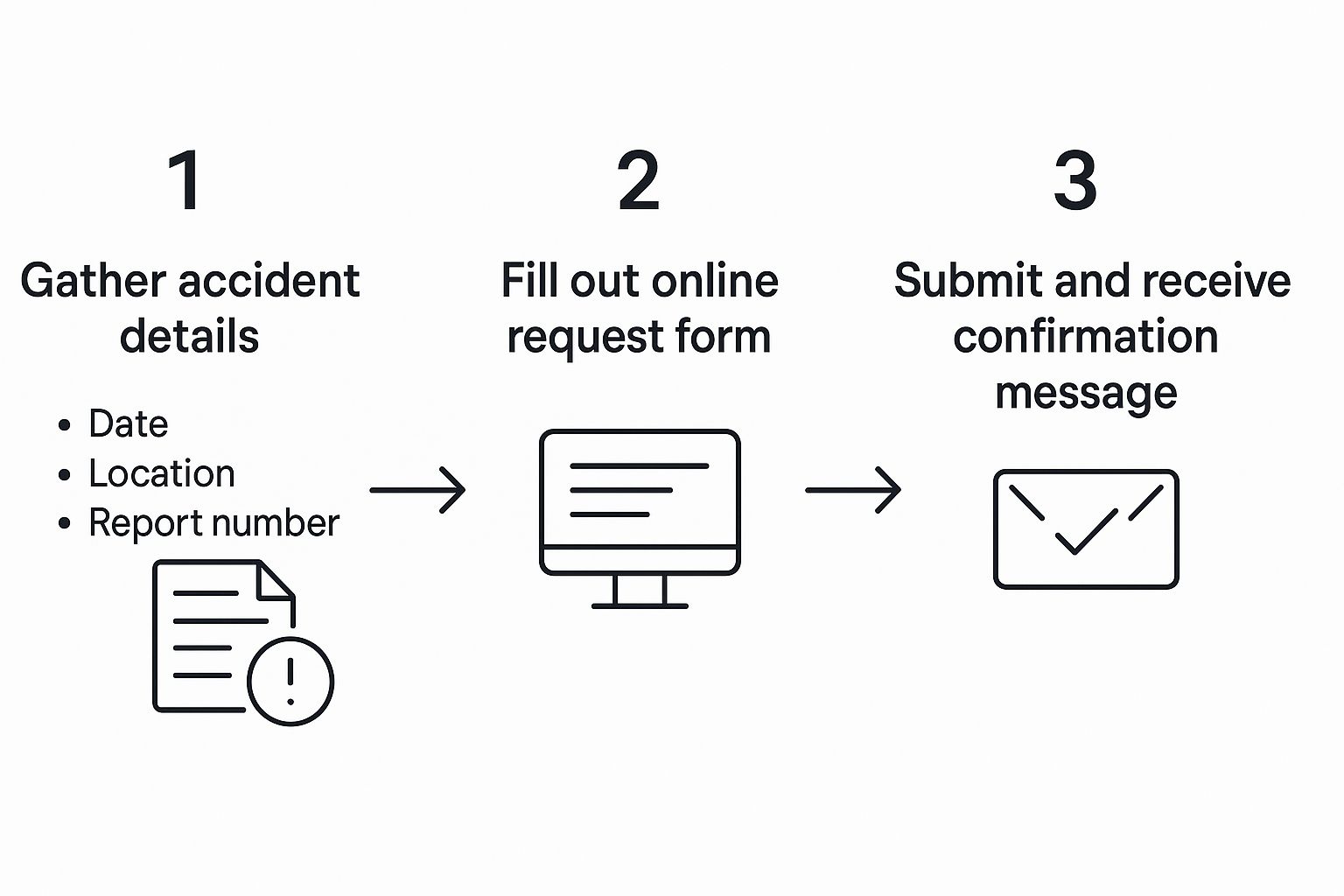
As you can see, it really boils down to three parts: gathering your details, filling out the form, and getting your confirmation. Once you've paid, you should get immediate access to a PDF of the official accident report.
My best advice? As soon as that PDF is available, download it. Save it somewhere safe on your computer, and for good measure, email a copy to yourself as a backup. It's a world away from the old method of waiting in a long line at the precinct. Knowing how to get an accident report online saves you a ton of time and puts an important document in your hands when you need it most.
Decoding the Details in Your Accident Report
Once you have the report, you’ll find it’s dense with codes, diagrams, and specific fields that may not be immediately clear. My clients often feel overwhelmed at first, but knowing what to look for makes all the difference in confirming its accuracy. This document is the official narrative of the collision, and every detail matters.
The report establishes the essential facts: the date, time, and precise location of the crash. It also identifies everyone involved—drivers, passengers, and witnesses—along with their contact information and, importantly, their insurance details.
Key Sections to Review
I always advise clients to focus on a few key areas immediately. These sections offer the clearest insight into the responding officer's initial assessment of what happened.
- The Narrative: This is the officer's written summary of their observations and the statements taken at the scene. It’s their story of the crash.
- The Diagram: Look for a hand-drawn sketch showing the positions of the vehicles, the points of impact, and the general layout of the roadway.
- Contributing Factors: This section uses codes or checkboxes to note factors like speeding, failure to yield, or distracted driving.
The need for these reports is a reflection of a grim reality. Annually, around 1.19 million people die in road traffic crashes worldwide, with millions more injured. Making reports accessible online is part of a global effort to improve safety and streamline the claims process. You can find more on these traffic statistics from the World Health Organization.
Remember, the accident report is the officer's initial assessment, not the final legal determination of fault. However, insurance adjusters rely heavily on this document to begin their investigation.
Understanding the report, from basic facts to specific codes, helps you anticipate how an insurer will approach your claim. If you encounter unfamiliar legal terms, our firm’s online legal dictionary can be a valuable resource. Getting the report is the first step; knowing what it says is the next.
What to Do If Your Report Is Not Online Yet
You've gone to the right website, entered all your information, and… nothing. It's a common scenario, and from my experience, it's usually not a cause for alarm.
The most frequent reason for the delay is that the report simply isn't finalized yet. It can take a responding officer several business days to a week to complete all the necessary paperwork, get it approved by a supervisor, and have it uploaded into the system.
If it’s only been a day or two since the accident, the best advice is to simply give it a few more days. The system isn't always instant. This digital reporting process is part of a much larger effort to improve accident documentation, which is necessary for tracking safety trends and making our roads safer for everyone.
Taking the Next Steps
Let's say a week has passed and you still can't locate your report. Before you start to worry, it’s time to take a couple of straightforward actions.
- Double-check your information. A simple typo is often the culprit. I've seen cases stalled because of a misspelled name or an inverted number in the report ID. Carefully re-enter the spelling of all names, the full report number, and the exact date of the crash.
- Contact the records division directly. If you've confirmed all your information is correct, your next move is to call the non-emergency records division of the law enforcement agency that responded to your accident.
When you call, have your case number and other details ready. They can look up the report's internal status and let you know if it's still being processed or if there's another issue. They can also tell you the best way to get a copy, which might mean you'll have to pick it up in person.
If you’re running into roadblocks or just feel overwhelmed by the process, please don’t hesitate to get in touch with our office for guidance. We help clients with this every day and can assist you in figuring out how to get an accident report online or directly from the agency itself.
Frequently Asked Questions About Online Accident Reports
I’ve guided hundreds of clients through the process of getting their official accident reports, and a few key questions always come up. It's completely normal to feel a bit lost, especially when you’re already dealing with the aftermath of a crash. Let's tackle some of the most common points of confusion.
The number one concern is almost always timing. People need their report, and they need it now.
How Long Until My Accident Report Is Available Online?
You can generally expect the report to appear online within 3 to 7 business days. This gives the officer time to finalize their notes, get the report approved by a supervisor, and have it uploaded into the system.
Keep in mind, this timeline isn't set in stone. If the collision involved serious injuries or required a more involved investigation, the officer will need more time to complete the paperwork. In those cases, the report will take longer to become available, so a bit of patience is key.
Who Can Legally Access an Accident Report?
For good reason, access to these documents is restricted to protect everyone’s privacy. You can’t just look up any report you want.
Under the law, only a handful of people and entities with a direct, legitimate interest can obtain a copy:
- Any driver or vehicle owner listed in the report
- Passengers who were injured
- The parents or legal guardians of a minor involved in the crash
- An authorized legal representative, such as an attorney
- Insurance companies connected to the involved vehicles or parties
You will always be asked to verify your connection to the incident before you can download the report. This is a very important step to keep sensitive information from falling into the wrong hands. For a deeper dive into data privacy, the International Association of Privacy Professionals (IAPP) offers excellent resources on US law.
What if I Find a Mistake in the Report?
Finding an error on your crash report can be frustrating, but it's often correctable.
If you spot a clear factual mistake—think a misspelled name, wrong license plate number, or incorrect insurance policy—you should contact the records division of the police department that filed the report. You can request a formal amendment to fix these objective errors.
But what if you disagree with the officer's narrative or their opinion on who was at fault? That’s a bit different. You typically can’t get an officer to change their subjective description of what happened. In this situation, your best move is to ask to add your own written statement as a supplement to the official file. This makes sure your version of events is formally on record, which can be very important for your claim.
If you're hitting roadblocks or feel like the insurance company is giving you the run-around, the team at Jamie Ballard Law is ready to step in. We offer free, no-obligation case evaluations to help you figure out your best path forward. Visit us at https://jamieballardlaw.com to get the experienced support you need.