If you've been injured here in Georgia, you’ve likely heard lawyers and insurance adjusters mention the "statute of limitations." So, what is the statute of limitations exactly?
Think of it as a legal countdown clock. The moment you're injured, that clock starts ticking. If you don't file a lawsuit before the timer hits zero, you almost always lose your right to seek payment—forever. This guide is designed to give you helpful information about this important legal deadline.
Your Guide to Georgia's Legal Deadlines
Here's a simple analogy. Imagine trying to solve a crime that happened 20 years ago. Witnesses' memories have faded, evidence is long gone, and the trail is cold. It would be nearly impossible to piece together the truth with any certainty.
The legal system sees old personal injury claims the same way. The statute of limitations exists to make sure lawsuits are filed while the evidence is still fresh and reliable. It sets a firm deadline to keep the process fair for everyone.
These laws aren't just about technicalities; they ensure disputes are handled when the facts are clear. This prevents defendants from living with the constant threat of a lawsuit years after an incident and allows the courts to work with the most accurate information possible.
Understanding the Core Purpose
At its heart, the statute of limitations is about fairness—to everyone involved. It’s not designed to penalize an injured person for waiting, but to preserve the integrity of the justice system itself.
For someone recovering from an injury, this deadline can feel like another source of pressure. But it’s also a powerful motivator to act quickly. The sooner you start building your case, the better your chances of gathering the strong evidence needed.
Some of these legal terms can be confusing. If you want simple definitions, feel free to explore our firm's legal dictionary for more clarity.
In essence, a statute of limitations is a law that sets the maximum time after an event within which legal proceedings may be initiated. When the period specified in a statute of limitations runs out, a claim can no longer be filed.
This guide will break down how these deadlines work specifically in Georgia personal injury cases. Knowing the timeframe that applies to your situation is one of the most important first steps you can take.
Ultimately, this timeline directly controls your ability to hold the at-fault party accountable. Failing to understand what a statute of limitations is can, unfortunately, close the door on your opportunity for justice for good.
Why These Legal Timelines Exist
It might seem unfair to put a clock on someone’s right to seek justice after an injury, but statutes of limitations serve important purposes for everyone in the legal system. At their core, these deadlines are about maintaining fairness and practicality.
For the person being sued (the defendant), these time limits provide a necessary point of finality. They prevent the endless threat of a lawsuit hanging over someone's head for years—or even decades—after an incident. This allows individuals and businesses to move forward with a sense of certainty.
Preserving the Integrity of Evidence
The single most important reason for these deadlines is the reliability of evidence. Think about it:
- Memories fade
- Witnesses move away or become unreachable
- Physical evidence like accident scene photos can be lost or destroyed over time.
By requiring claims to be filed within a reasonable period, the legal system ensures that cases are decided based on the freshest, most reliable information available, rather than on faded memories and incomplete evidence.
This principle helps keep the courts from getting bogged down with old, difficult-to-prove cases, which keeps the entire justice system running more efficiently for everyone. You can learn more about how different factors come together in various personal injury claims on our site.
Encouraging Prompt Action
For you, the injured person (the plaintiff), the statute of limitations actually encourages you to act while the details are still vivid in your mind. This works to your benefit, as a stronger case can be built when your recollection of events is clear and supporting evidence is easier to gather.
To fully understand the logic behind these time limits, it's helpful to first grasp what constitutes a cause of action, since the clock often starts ticking at that very moment.
Statutes of limitations have always aimed to balance the rights of all parties. In the United States, personal injury deadlines typically range from one to six years, depending on the state, while severe criminal offenses may have no time limit at all. This system shows how the law prioritizes different types of legal actions based on their nature. Understanding the why behind the deadline is key to appreciating its role in your case.
Key Personal Injury Deadlines in Georgia
In Georgia, the law sets different legal clocks depending on the specific type of injury claim you’re filing. Understanding which timeline applies to your case is the first step in protecting your right to payment. For most common personal injury cases, like a car wreck or a slip and fall, a standard deadline applies across the board.
But not all injury claims fit into the same box. Certain cases, particularly those involving medical malpractice or the tragic loss of a loved one (wrongful death), follow their own distinct timelines. It's also vital to know that any claim against a government entity—whether it's the City of Atlanta or a state agency—comes with much shorter notice periods that you must meet long before you can even think about filing a lawsuit.
Common Timelines for Injury Claims
Here in Georgia, the deadline you'll hear about most often is two years from the date of the injury. This two-year window covers a wide range of common incidents.
- Car, Truck, and Motorcycle Accidents: If you're hurt in a collision, the clock starts ticking on the day of the crash.
- Slip and Fall Incidents: For injuries on someone else’s property due to their negligence, that two-year period starts the day you fell.
- Dog Bites: The deadline to sue a dog's owner is also two years from the day the attack happened.
This visual helps put the personal injury deadline into perspective compared to other civil claims in Georgia.
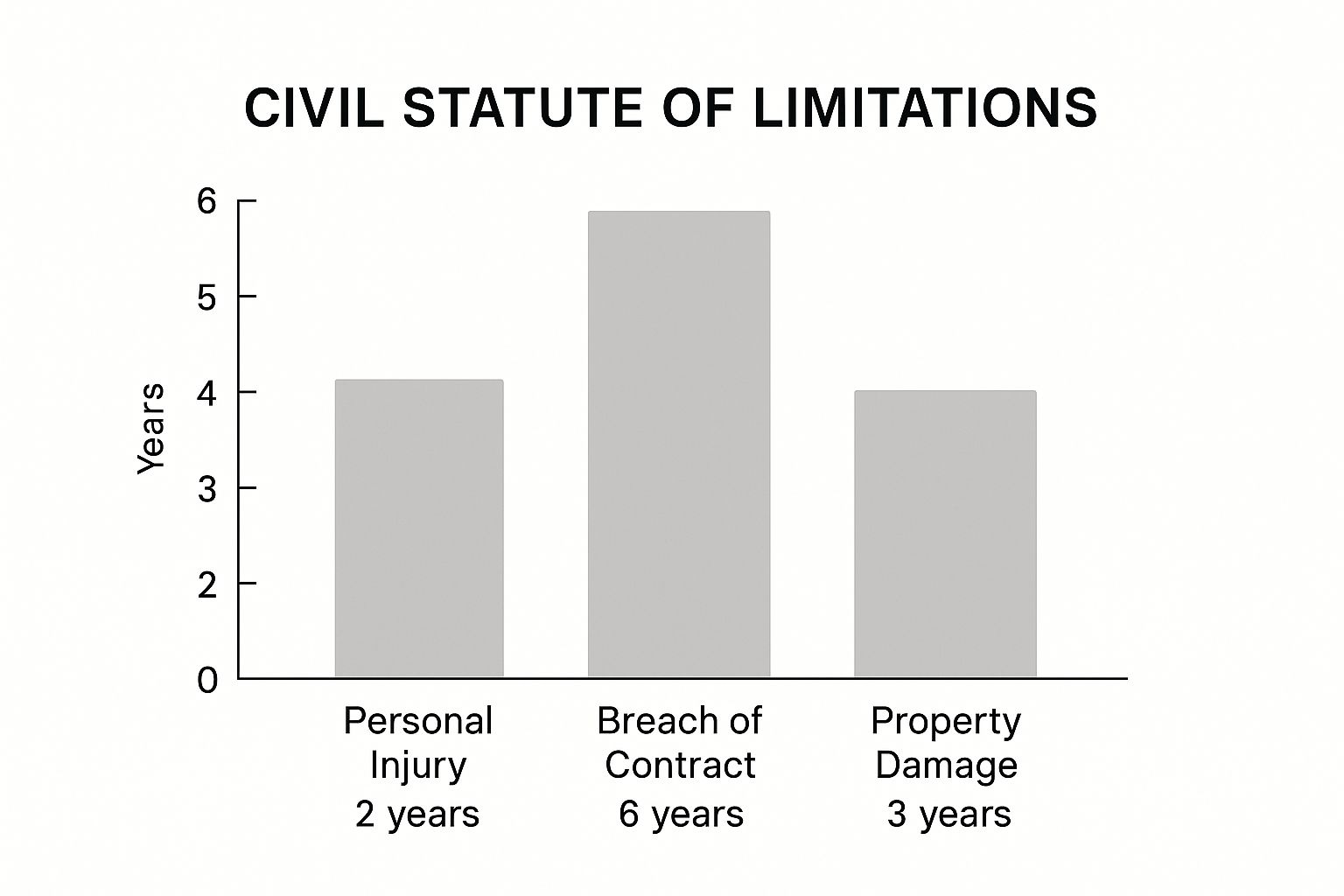
As you can see, personal injury claims get a much shorter window than disputes over property damage or broken contracts. This highlights just how important it is to act quickly.
To make it even clearer, here's a quick summary of the most common deadlines you'll encounter.
Georgia Statute of Limitations for Common Injury Claims
A summary of the standard legal deadlines for filing different types of personal injury lawsuits in Georgia, starting from the date of injury or discovery.
| Type of Claim | Standard Time Limit in Georgia |
|---|---|
| Personal Injury (e.g., car accident, slip & fall) | Two Years |
| Wrongful Death | Two Years |
| Loss of Consortium | Four Years |
| Medical Malpractice | Two Years (with a five-year ultimate limit) |
| Damage to Personal Property | Four Years |
| Claims Against a City Government | Six-Month Notice Required |
| Claims Against a County or State Government | One-Year Notice Required |
These timelines show why you can't afford to wait. The clock is already running.
Special Deadlines and Government Claims
Beyond the standard two-year rule, some situations come with their own unique timelines. For example, a claim for "loss of consortium"—which allows a spouse to seek payment for the loss of companionship after their partner is injured—also has a specific timeframe you must follow.
Perhaps the most urgent deadlines of all involve claims against government entities. Under Georgia law, you are required to give formal written notice of your claim (an ante-litem notice) to a city government within just six months and to a county or the state within one year.
If you miss this notice deadline, you permanently lose your right to file a lawsuit later, even if you are still well within the general two-year statute of limitations. These rules are strict and unforgiving.
You can learn more about how the general statute of limitations for personal injury in GA applies in different situations. Getting a handle on these distinctions is fundamental, because the answer to what is the statute of limitations can change dramatically based on who was responsible for your injury.
When the Countdown Clock Can Be Paused

While Georgia’s legal deadlines seem firm, the law accounts for real-life situations where applying them rigidly would be unjust. In these specific circumstances, the countdown clock on your claim can actually be paused.
This legal process is known as “tolling.” Tolling essentially freezes the statute of limitations, preventing it from running for a period of time. It ensures an injured person isn't unfairly penalized for circumstances outside their control.
The Discovery Rule
One of the most important tolling scenarios involves the “discovery rule.” This rule applies when you couldn't have possibly known you were injured right away. Think about a surgical error where a medical instrument is left inside a patient—the harm might not become apparent for months or even years.
Under the discovery rule, the clock doesn't start on the day the negligence occurred. Instead, it begins on the date the injury was discovered or reasonably should have been discovered through due diligence.
This is an important protection. It prevents the absurdity of a deadline expiring before a victim even knows they have a valid claim. The legal basis for tolling exceptions like this is outlined in the Official Code of Georgia Annotated (O.C.G.A.) § 9-3-90 et seq.
Other Common Tolling Situations
Beyond the discovery rule, Georgia law recognizes other specific conditions that can pause the clock. These exceptions are designed to protect individuals who are legally unable to file a lawsuit or have been deceived by the at-fault party.
A few of the most common tolling scenarios include:
- When the Injured Person Is a Minor: If a child under 18 is hurt, the statute of limitations is usually paused. The clock doesn’t start ticking until they reach their 18th birthday, giving them the opportunity to pursue their case as a legal adult.
- Mental Incapacity: If an individual was legally incapacitated (for example, in a coma or suffering from a severe mental disability) at the time of the injury, the deadline may be tolled until their capacity is restored.
- The Defendant Leaves the State: If the at-fault party moves out of Georgia to avoid being served with a lawsuit, the time they are gone may not count against the deadline.
- Cases of Fraud: If the defendant actively and fraudulently concealed their wrongdoing to prevent you from discovering you had a case, the clock might be paused until the fraud is uncovered.
These exceptions aren't automatic; they are highly dependent on the specific facts of each case. But understanding that they exist is vital to seeing how the statute of limitations is applied with fairness in mind.
Exceptions That Can Change Your Filing Deadline
The two-year clock on personal injury claims isn't always set in stone. The law understands that life happens and that rigid deadlines can sometimes lead to unfair outcomes. Two powerful legal principles, the "discovery rule" and “tolling,” can actually shift or even pause the standard time limit.
The Discovery Rule: When the Clock Starts Ticking
Think of it this way: what if you were harmed but didn't know it right away? A classic example is a botched surgery where a medical instrument is left inside a patient. The harm occurred on the day of the operation, but the patient might not feel any symptoms for months or even years. It wouldn't be fair for the filing deadline to expire before they even had a clue something was wrong.
That's where the discovery rule comes in. Under this rule, the statute of limitations clock doesn't start running until the date you discovered your injury, or the date you reasonably should have discovered it. This ensures you have a fair shot at justice once the full extent of the harm is known.
Tolling: Hitting the Pause Button on the Deadline
While the discovery rule adjusts the start date, tolling is different—it pauses the clock entirely after it has already begun to run. Imagine you hit "pause" on a movie. The timer stops, and it won't start again until you hit "play." Tolling works the same way for your legal deadline.
Georgia law allows the clock to be paused for several specific reasons:
- The Injured Person is a Minor: If a child under 18 is hurt, the statute of limitations is generally paused until they turn 18. This gives them the opportunity to decide for themselves whether to file a lawsuit once they become a legal adult.
- Mental Incompetence: If an injury is so severe that it leaves the victim legally unable to manage their own affairs, the clock may be tolled until their mental capacity is restored.
- Fraud by the At-Fault Party: If the person who caused your injury intentionally hides what they did or conceals the harm they caused, the deadline can be paused until their deception is brought to light.
Tolling is rooted in the principle of fairness. It ensures that the statute of limitations doesn't punish victims for circumstances completely beyond their control, like their age, legal capacity, or another person's dishonest actions.
The idea of putting time limits on legal claims is nothing new. It dates all the way back to ancient Roman law, where claims would simply expire after a certain period. Modern laws, like England’s Limitation Act of 1939, helped standardize these rules to provide more legal certainty—a system that U.S. states, including Georgia, have built upon. You can discover more about the modern evolution of these regulations.
These exceptions aren’t legal loopholes. They are built into the system to make sure justice is truly accessible. Understanding them is a key piece of the puzzle when answering the question, what is the statute of limitations in the real world.
What Happens If You Miss the Filing Deadline

Let's be direct: the consequences for missing the statute of limitations are almost always final and severe. This isn’t just a minor administrative hurdle; it’s a permanent barrier to getting justice for your injuries.
If you attempt to file a lawsuit even one day after the legal deadline has expired, you can expect the defense attorney to immediately file a motion to dismiss your case. In nearly every circumstance, the judge is legally obligated to grant that request.
Your case will be over before it ever really begins.
Your Rights Are Permanently Lost
Once a judge dismisses your case because the statute of limitations has run out, you permanently forfeit the right to seek payment from the at-fault party. It makes no difference how strong your evidence is or how devastating your injuries are.
The law is incredibly strict on this point. There are no do-overs because you didn't know the deadline or because you were waiting for an insurance company to make a fair offer. The deadline is absolute, and missing it slams the door on your claim for good.
The statute of limitations is a core legal principle designed to provide finality. As explained by the National Taxpayer Advocate, it ensures that legal disputes have a clear end point, preventing indefinite threats of litigation.
Understanding the full personal injury lawsuit process from start to finish helps put into perspective why hitting every single deadline is non-negotiable.
This unforgiving reality is exactly why you must get clear on what is the statute of limitations for your specific case and act well in advance. Protecting your legal rights hinges entirely on respecting this timeline.
Frequently Asked Questions (FAQ) About Georgia's Legal Deadlines
Legal timelines can be confusing. Here are straightforward answers to the most common questions we hear from clients in Atlanta about Georgia’s statute of limitations.
Does the Statute of Limitations Apply to Insurance Claims?
No, not directly. The statute of limitations is a court deadline for filing a lawsuit. Your insurance policy contains its own separate, contractual deadlines for how quickly you must report an accident and file a claim.
It's important to understand these are two different clocks. Waiting on an insurance adjuster to make a decision does not pause the legal deadline for a lawsuit. You must act to protect your right to sue before the statute of limitations expires, regardless of where your insurance claim stands.
Can the Deadline Be Extended by Agreement?
In rare circumstances, yes. Both parties can sign a formal written document, known as a tolling agreement, to pause or extend the filing deadline. This sometimes happens during settlement negotiations to allow more time to reach an agreement without the immediate pressure of a lawsuit.
However, a verbal promise or informal agreement is worthless here. For the extension to be legally binding, it must be a formal, signed contract.
What If My Injury Got Worse Over Time?
Generally, the clock starts ticking when the accident or injury-causing event occurs, not when your symptoms worsen. The law requires you to file a claim for all potential damages—past, present, and future—within that original time limit.
The primary exception is the "discovery rule," which applies only in limited situations where the injury was hidden and could not have been reasonably discovered when it happened. Understanding what the statute of limitations means for your specific case is the first step toward protecting your legal rights.
If you still have questions or are worried about an approaching deadline, the team at Jamie Ballard Law is here to help. We offer free, no-obligation case evaluations to provide clarity and guidance. Contact us 24/7 to make sure your rights are protected. https://jamieballardlaw.com