Definition of mitigating circumstances matters fast after a wreck, because what looks obvious at the scene often gets disputed once insurers, police reports, and defense lawyers start assigning blame. If you were hurt in Atlanta, you may already be hearing that the other driver was clearly at fault, but also that your own choices could affect what you recover. That tension is where this legal idea shows up in real life.
In personal injury cases, mitigating facts often become arguments about shared fault, damages, medical treatment, and whether your conduct gave the other side room to reduce payment. The legal meaning is broader than commonly understood, and in Georgia it can directly affect whether you recover anything at all.
After an Accident Is Someone Always 100% At Fault
A lot of injured people start with the same assumption. The other driver ran the light, the truck drifted into your lane, or the store left a spill on the floor. So the case should be simple.
Sometimes it is. Often it isn’t.
In practice, almost every serious injury claim turns into a fight over details. The insurer may agree their driver made the first mistake but still argue that you made the injuries worse, failed to react reasonably, or didn’t protect yourself. That’s one reason many people end up researching personal injury claims after they realize fault and compensation aren’t identical questions.
Where mitigating circumstances enter the picture
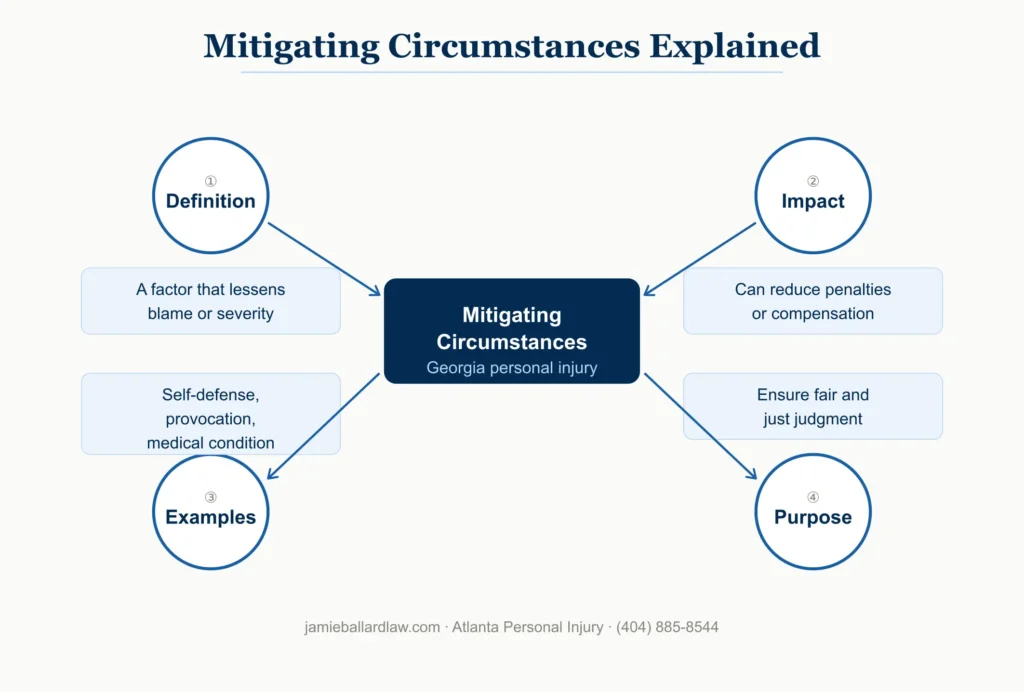
Mitigating circumstances are facts that don’t erase responsibility but may reduce how much blame the law assigns or how much money gets paid. In criminal court, people usually hear that phrase in sentencing. In civil injury cases, it often shows up in a different form.
For example, the defense may argue:
- You shared some fault because you were distracted, rushed, or standing in an unsafe place.
- You failed to reduce your damages because you delayed medical care or ignored treatment advice.
- A pre-existing condition explains part of your pain, not just the crash or fall.
That doesn’t mean those arguments are true. It means they are common.
Why the definition matters to your recovery
The phrase sounds academic, but the effect is practical. If the defense can persuade an insurer, judge, or jury that something about the situation lessens their side’s responsibility, your payout can drop.
A strong injury claim isn’t just about showing someone else was wrong. It’s also about stopping the other side from shrinking your damages with selective facts.
That is why understanding the definition of mitigating circumstances early helps. It changes how you document the accident, how you handle treatment, and how you respond when the insurer starts asking questions that seem harmless but aren’t.
A Plain English Definition of Mitigating Circumstances
The simplest definition of mitigating circumstances is this: facts that lessen blame, severity, or financial responsibility without fully excusing what happened.
That means the act still happened. The person may still be responsible. But the law may treat the situation as less severe than it first appeared.
A useful way to think about it is a traffic example. Say a driver swerves suddenly and causes a minor collision. If that driver swerved because a child ran into the street, the crash isn’t excused automatically. But the reason for the swerve may reduce how harshly their actions are judged.
What the term does and does not mean
Mitigating circumstances are not the same as a complete defense. They usually do not mean, “the person did nothing wrong.”
They usually mean something closer to this:
- Responsibility may be reduced
- Damages may be limited
- Context matters
- The outcome may change even if fault remains
Core idea: Mitigating circumstances don’t wipe away liability. They change how the law weighs it.
Mitigating versus aggravating
The easiest way to understand the term is to compare it with its opposite.
| Term | What it does |
|---|---|
| Mitigating circumstance | Makes conduct seem less blameworthy or reduces the amount owed |
| Aggravating circumstance | Makes conduct seem worse or supports a harsher outcome |
So if a driver made a poor split-second choice while reacting to danger, the defense may call that mitigating. If a driver was speeding, texting, and ignoring repeated warnings, those facts can make the conduct look worse.
Why plain English matters in injury cases
People often miss the issue because the wording sounds formal. But insurers use ordinary facts to build mitigation arguments all the time.
Examples include:
- You missed follow-up treatment
- You posted active photos after the collision
- You wore shoes the defense calls unsafe in a slip-and-fall case
- You gave a recorded statement with unclear wording
None of those facts automatically defeats a claim. But each can become part of a story the other side tells about why they should pay less.
That is why the plain English version matters more than the textbook one. If a fact gives the defense a reason to say, “Yes, but,” you’ve entered mitigation territory.
Criminal Law vs Personal Injury Cases How the Meaning Changes
This phrase is commonly encountered in crime shows. In that setting, mitigating circumstances usually come up after guilt has already been decided and the court is deciding punishment.
In the United States, approximately 50% of states have formally codified provisions allowing mental or emotional distress as a mitigating factor during sentencing, and that evidence generally must be supported by clinical or psychiatric evaluation showing impaired judgment or control. That is a sentencing issue. It asks whether punishment should be reduced.
Civil injury law uses the idea differently. The question isn’t prison time. The question is money, fault allocation, and whether the injured person receives full damages, reduced damages, or no recovery.
Why people mix the two up
The label is the same, but the legal job it performs changes.
In criminal cases, mitigation often helps the defendant argue for leniency. In personal injury cases, mitigation often becomes a tool the defense uses to reduce what they owe the injured person. That’s why the term can sound sympathetic in one setting and adversarial in another.
A related point of confusion happens with traffic offenses. Readers who want a quick primer on legal distinctions between DUI and DWI in Georgia often notice that criminal traffic language doesn’t map neatly onto civil injury claims. The same event can produce both kinds of cases, but the legal issues are different.
Mitigating circumstances in two different systems
| Aspect | Criminal Law Context | Personal Injury (Civil) Law Context |
|---|---|---|
| Main purpose | Reduce punishment | Reduce damages or shift fault |
| Who usually raises it | Defense for the accused | Defense for the at-fault party or insurer |
| Main question | Should the sentence be lighter? | Should the injured person recover less? |
| Common examples | Mental distress, lack of prior record, unusual personal circumstances | Shared fault, delayed treatment, pre-existing injury, failure to reduce losses |
| Result if accepted | Lower sentence or more lenient outcome | Lower settlement or verdict |
The practical shift that matters to injury victims
This difference changes how you should think about your own case. In a criminal matter, mitigation can be humanizing. In a personal injury claim, the same style of argument often targets your compensation.
The defense may accept that their insured caused the crash and still argue:
- Your actions contributed to the event
- Your injuries were not entirely caused by the event
- Your post-accident choices increased your losses
That means a civil claim is rarely just about proving the other side made a mistake. It also involves guarding against blame-shifting.
In injury litigation, mitigation is often where straightforward claims become contested ones.
Why this distinction affects case strategy
A criminal lawyer building a mitigation file might emphasize treatment records, family history, or emotional distress. A personal injury lawyer often studies those same categories differently. The question becomes whether the defense will use them to cut damages, and how to answer that fairly.
For example, if a trucking company says its driver had a mental health crisis, that may sound like context. In a civil case, it may also raise a different question. Why was that driver on the road at all? The same fact can reduce perceived blame in one argument and support negligence in another.
That is why words alone don’t decide these cases. The surrounding facts do.
How Mitigating Factors Affect Your Personal Injury Claim in Georgia
Georgia injury law gives mitigating arguments real teeth because fault isn’t all-or-nothing. Under O.C.G.A. § 51-12-33, Georgia applies modified comparative negligence. If the plaintiff is 50% or more at fault, recovery is barred. In civil litigation, mitigation can include the plaintiff’s contributory negligence or failure to mitigate damages to contributory negligence is a recognized factor — and it reduced payouts in 35% of U.S. auto claims in 2024.
That one rule shapes settlement talks in a major way. It gives insurers a reason to search for any fact that nudges your share of fault upward.

How defense lawyers use mitigation in Georgia cases
Defense lawyers usually don’t begin by denying everything. More often, they concede part of the claim and then trim around the edges.
They may argue:
- You were partly at fault for the collision
- You didn’t seek prompt care
- You ignored restrictions and made your condition worse
- You had earlier symptoms that explain current complaints
- Your wage loss is overstated because your records are incomplete
Each point is aimed at the same target. Lower the value of the case.
Common Georgia examples
A rear-end crash can still turn into a mitigation dispute if the defense says you stopped suddenly for no reason. A pedestrian claim may invite arguments that you crossed outside a marked crosswalk. A slip-and-fall case may draw claims that the hazard was open and obvious.
Those arguments don’t automatically win. But they shape negotiations from the first demand package forward.
Practical rule: Georgia cases are often won or lost in the gap between “they caused it” and “they owe all of it.”
Failure to mitigate damages is a separate issue
People often hear “mitigation” and think only about fault at the moment of impact. Georgia claims also involve failure to mitigate damages, which is about what happened afterward.
That can include allegations such as:
- Delaying medical treatment
- Skipping specialist referrals
- Not following discharge instructions
- Returning to activities that worsen the injury
The defense uses those points to say the initial accident may have hurt you, but part of the later damage was avoidable.
Medical billing can become part of that argument too. If treatment is ongoing and bills are being tracked through a provider claim, understanding topics like perfecting a medical lien in personal injury cases helps people see how records, balances, and recovery issues fit together in a lawsuit.
What usually works and what doesn’t
Some responses help. Some hurt.
What tends to help:
- Prompt medical evaluation that ties symptoms to the accident
- Consistent treatment records showing you followed recommendations
- Photos and witness statements that lock down the scene before memories fade
- Clear explanations for gaps in care, such as inability to travel or delayed referrals
What tends to hurt:
- Waiting too long to get checked without a good explanation
- Telling the insurer you’re fine before you know the injury pattern
- Posting activity online that can be framed out of context
- Assuming the police report settles every issue
Time also matters for legal deadlines. Georgia deadlines don’t stop because settlement talks are ongoing, so understanding the statute of limitations for Georgia personal injury claims is part of protecting a case while fault arguments are still being sorted out.
Real-World Accident Scenarios Involving Mitigation
Legal definitions make more sense when you place them inside everyday Atlanta accidents. These examples show how a claim can look strong at first and still draw mitigation arguments.

Multi-car crash on I-285
A driver gets hit from behind in heavy traffic and is pushed into the car ahead. From the injured person’s perspective, the case seems obvious. Another vehicle started the chain reaction.
The defense may still argue that the middle driver was following too closely, braked unpredictably, or had prior neck complaints. None of those points necessarily defeats the claim, but each can be used to lower the payout by arguing shared fault or a less direct injury connection.
Slip and fall in a retail space
A shopper falls on a wet floor near a store entrance and suffers a serious knee injury. The property owner may have known the floor was slick, or an employee may have failed to place a warning sign.
The defense often answers with a mitigation theme. They may say the person was looking at a phone, wore footwear they characterize as unstable, or ignored a condition that should have been visible. In premises cases, that fight often centers on who saw what, when, and whether the hazard was readily apparent.
A store can still be negligent even when the defense tries to turn ordinary customer behavior into a reason to pay less.
Truck collision involving driver mental health
A commercial truck drifts across lanes and causes a major crash. The company may later suggest the driver was experiencing a mental health event and ask the court to view that as a mitigating fact.
According to Cornell Law, intent and mental state are central factors in how courts assess culpability. NHTSA reported a 22% rise in Atlanta-area truck accidents linked to driver mental health crises, reaching 3,200 incidents. The same verified point notes that defense firms may use a driver’s PTSD diagnosis as a mitigator, while a plaintiff’s lawyer may reframe it as evidence that the trucking company allowed an unfit driver on the road.
That is a good example of how one fact can cut both ways. The defense calls it mitigation. The plaintiff may call it notice, poor supervision, or unsafe retention.
Pedestrian strike downtown
A pedestrian is hit while crossing at an intersection. The driver may have been distracted or failed to yield. Even so, the insurer may argue the pedestrian crossed late, wore dark clothing, or stepped outside the marked lines.
In this scenario, small facts become expensive. Signal timing, surveillance footage, body position after impact, and witness accounts can all influence whether the defense succeeds in reducing the claim.
Evidence Checklist What You Need to Gather for Your Case
Good cases are often built on ordinary records collected early. If mitigation becomes part of the defense strategy, documentation is what keeps a fair claim from turning into a blame-shifting exercise.
At the scene
- Photographs of vehicles, debris, skid marks, spills, lighting, and signage. These images can answer later disputes about visibility, speed, lane position, and whether a hazard was obvious.
- Names and contact information for witnesses. Independent witnesses often matter when the defense claims you acted carelessly.
- Your clothing and shoes. In slip-and-fall and pedestrian cases, the other side may focus on what you were wearing. Preserve the actual items if possible.
- A timeline note on your phone. Record the time, weather, pain symptoms, and what was said. Short notes made early can help refresh memory later.
Medical records and treatment proof
- Emergency room and urgent care records. These help connect symptoms to the event rather than to later causes.
- Follow-up records, imaging, and referrals. Consistent treatment makes it harder for the defense to argue that you failed to address the injury.
- Prescription records and work restrictions. These show how the injury affected daily life and whether you followed medical advice.
- Explanations for treatment gaps. If you couldn’t get an appointment, lacked transportation, or were waiting on a referral, document that.
If there is a gap in care, explain it with records, messages, or scheduling notes. Silence lets the defense write the story for you.
Communications and personal records
- The police report and claim number
- Texts, emails, and app messages about the accident
- Pay stubs or employer letters if you missed work
- Phone records if distraction is being alleged
- Social media restraint. Don’t assume a photo is harmless if it can be cropped or misread.
What not to do
- Don’t guess when speaking to an insurer.
- Don’t exaggerate symptoms.
- Don’t discard damaged items that may later become evidence.
- Don’t ignore appointments unless you have a documented reason.
A clean evidence file doesn’t just prove injury. It helps block mitigation arguments before they gain traction.
How an Experienced Attorney Protects You from These Arguments
A good injury lawyer does more than submit medical bills and ask for payment. The work starts with finding the facts the defense is likely to use against you, then testing whether those facts hold up.
That usually means reviewing the police report closely, comparing it with photos and witness statements, and looking for gaps in the insurer’s version of events. In vehicle cases, lawyers may use reconstruction evidence, download data when available, and examine timing, sightlines, and roadway conditions. In premises cases, they look for cleaning logs, surveillance footage, and prior notice issues.
The real job is anticipation
Strong representation often turns on seeing the mitigation argument before it gets packaged into a settlement denial. If the defense will say you delayed treatment, your lawyer should already have the scheduling records, referral timeline, and medical explanation. If the insurer hints you shared fault, your lawyer should be matching physical evidence against that story.
In criminal sentencing, substantiated mental health mitigation — documented through forensic evaluations and expert testimony — can reduce sentences by 25-35%, and that personal injury attorneys may use analogous methods in civil disputes, including forensic mitigation evaluations costing $5,000-$15,000, with the possibility of increasing plaintiff settlements by 15-20% in appropriate matters. The practical lesson isn’t that every case needs that expense. It is that targeted expert work can matter when the defense is building a reduction argument around mental state, causation, or damages.
For people who want to understand how claims move from investigation into formal litigation, this overview of the car accident lawsuit process in Atlanta helps place those defensive moves in context.
The best response to mitigation isn’t indignation. It’s evidence, timing, and a believable account that matches the records.
Frequently Asked Questions About Mitigating Circumstances
Can a pre-existing injury lower my settlement
It can affect value, but it does not automatically wipe out your claim. The core question is whether the accident caused a new injury, worsened an old one, or overlapped with prior symptoms. Good records matter here because the defense will often compare your before-and-after condition.
What’s the difference between contributory negligence and comparative negligence in Georgia
In plain terms, contributory negligence refers to the injured person’s own negligent conduct. Comparative negligence is the system the law uses to measure and apply that shared fault. Georgia uses a modified comparative negligence rule, which means your recovery can be reduced if you share blame, and barred if your fault reaches the legal cutoff discussed earlier.
If I apologized at the scene, can that be used against me
Sometimes. An apology may be interpreted as simple politeness, shock, or compassion. But if you said something that sounds like an admission, the insurer may try to use it that way. After an accident, it’s better to exchange information, cooperate with police, and avoid guessing or assigning fault in the moment.
Does missing one doctor appointment mean I failed to mitigate damages
Usually not by itself. People miss appointments for ordinary reasons. The problem starts when missed care becomes a pattern, or when there is no documentation showing why treatment stopped. Rescheduling promptly and keeping records of the reason helps.
Can the other driver’s mental health reduce what I recover
Sometimes the defense will try to use it that way. But in some cases the same evidence can support your claim by showing the company or driver should not have been operating under those conditions. The effect depends on how the facts are developed and presented.
If you were injured and you’re trying to understand how the definition of mitigating circumstances affects your case under Georgia law, Jamie Ballard Law offers resources that can help you sort through fault, evidence, medical issues, and the arguments insurers use to reduce claims.