Riding a motorcycle in Atlanta offers a sense of freedom that's hard to find anywhere else. But that freedom comes with serious risks. If you’ve been in a motorcycle accident in Atlanta, you know how quickly a great ride can become a life-changing event. This guide is here to provide you with straightforward, practical information for handling the aftermath. My goal is to offer helpful content, not a sales pitch, to give you a clear path forward after a serious Atlanta-area motorcycle crash.
The Harsh Reality of Riding in Atlanta
Cruising down the Downtown Connector or surface streets like Peachtree Road puts riders in a uniquely vulnerable position. Unlike a car, a motorcycle provides virtually no physical protection. When a collision happens, the rider takes the full force of the impact.
Atlanta's dense traffic and fast pace create a dangerous environment, even for the most experienced riders. All it takes is one distracted driver, one car changing lanes without checking a blind spot, or one person misjudging your speed. The consequences can be severe, impacting your health, your finances, and your family.
A Quick Look at the Local Dangers
It isn’t just your imagination—our roads are statistically more dangerous for motorcyclists. Before we get into the legal specifics, this table provides a snapshot of the risks riders face in our metro area.
Atlanta Motorcycle Crash Snapshot
| Statistic | Details |
|---|---|
| Statewide Crash Concentration | The Atlanta metro area consistently accounts for 39-42% of all motorcycle accidents in Georgia. |
| High Crash Volume | In a single recent year, Atlanta saw 1,655 motorcycle crashes, a rate far exceeding other parts of the state. |
| Primary Cause | Driver inattention and failure to yield the right-of-way are the leading causes of these collisions. |
| Injury Severity | Due to lack of protection, injuries are often serious, including traumatic brain injuries and spinal cord damage. |
These numbers paint a clear picture: riding in Atlanta requires constant vigilance, and when a crash does occur, the stakes are incredibly high.
The Atlanta region’s high crash rate is no anomaly. Data consistently shows our area is responsible for a huge portion of Georgia's total motorcycle accidents, typically between 39-42%. In one recent year alone, the Atlanta area had 1,655 crashes, a number inflated by our traffic density and congestion. You can see more in this in-depth review of Georgia motorcycle accident statistics.
Understanding this reality is the first step. Knowing what to do after an accident is what truly matters. This guide will walk you through the important steps, from the scene of the crash to understanding Georgia's specific laws.
My goal here is to provide a real-world resource for our local riding community. We'll cover:
- Common causes of crashes specific to Atlanta’s unique road conditions.
- Georgia's traffic laws that directly impact motorcyclists.
- Practical steps to take to protect your health and your legal rights.
This information is designed to help you make sense of your situation after an Atlanta motorcycle accident and empower you to take the right actions.
Your First Steps After a Motorcycle Wreck
The moments after a motorcycle wreck are a blur of confusion and adrenaline. It's tough to think straight when your body is pumping with fight-or-flight hormones that can easily mask serious pain. But what you do right here, right now, lays the foundation for your physical recovery and any future personal injury claim.
If you find yourself in one of the thousands of motorcycle accidents in Atlanta each year, this is your immediate action plan.
Your first and only priority is safety. If you can move, get yourself out of the flow of traffic. Find a safe spot on the shoulder of I-75, a nearby sidewalk—anywhere away from other vehicles. Then, call 911. Report the crash and make it clear you need paramedics on the scene.
Seek Immediate Medical Attention
Even if you think you just have some road rash or bruising, you absolutely must get checked out by a medical professional. Many severe motorcycle crash injuries, like internal bleeding or concussions, don't show obvious symptoms right away.
Getting a medical evaluation creates an official record that connects your injuries directly to the accident. This piece of paper becomes important evidence. If you wait days or weeks to see a doctor, the other driver's insurance company has an opening to argue your injuries happened somewhere else, not in the crash they're responsible for.
Officially Report and Document the Scene
When the police arrive—whether it's APD or the Georgia State Patrol—give them a straightforward, factual account of what happened. Do not guess, do not apologize, and do not admit fault. Stick to what you know for sure.
This is the point where a predictable set of risks on Atlanta's streets has unfortunately become a reality.
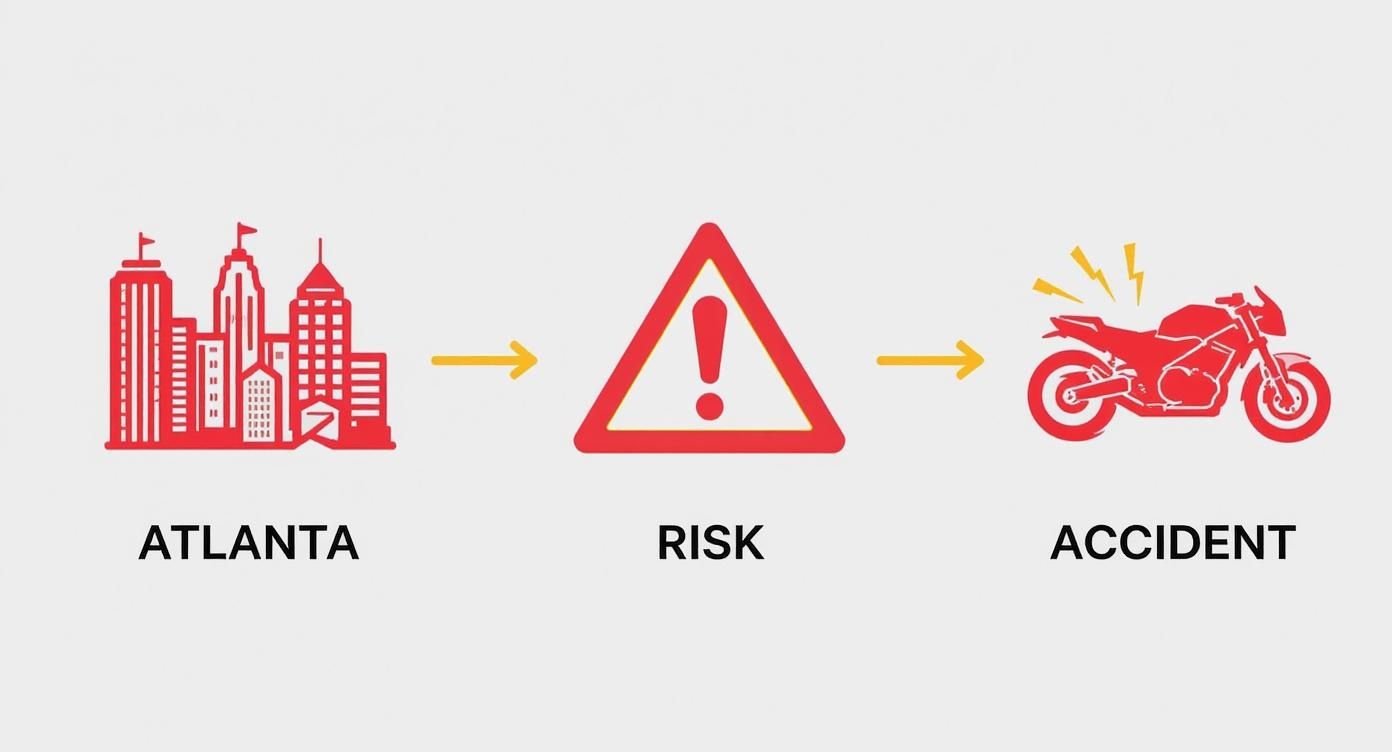
As you can see, the path from city traffic to a serious collision is a short one for riders, which is why documenting everything is so important.
While you're waiting for help, your smartphone is your best friend. Start gathering your own evidence.
- Take Photos and Videos: Get pictures of everything. The damage to your bike, the other vehicle, skid marks, traffic lights, street signs, and any visible injuries you have.
- Exchange Information: Get the other driver's name, phone number, address, driver's license number, and their insurance company and policy number. If anyone stopped to help or saw what happened, get their names and numbers, too. Witness testimony can be a game-changer.
- Record Your Own Notes: Open the notes app and type out everything you remember. The time, the location, the weather, what you were doing right before impact—every detail helps build a clear picture.
Be incredibly careful if the other driver's insurance adjuster calls you. Their job is to save their company money, not to help you. A common tactic is asking for a recorded statement. Never agree to this without speaking to an attorney first. They are trained to ask questions that can twist your words and be used to devalue or deny your claim.
Taking these actions at the scene is the best way to protect your health and your legal rights after a motorcycle crash in Atlanta.
Georgia Motorcycle Laws You Need to Know
When you're in a motorcycle accident in Atlanta, Georgia's specific traffic laws suddenly become the rulebook for your case. These aren't just suggestions to help you avoid a ticket; they are the foundation for how an insurance company or a court will determine who was at fault.
Understanding these rules is important because they set the standard for both you and the other driver. Let's break down the key regulations every Atlanta rider must know.
Georgia's Universal Helmet Law
The single most important law protecting riders is Georgia's universal helmet requirement. This is not optional—it’s mandatory for every single person on a motorcycle.
Georgia operates under a strict universal helmet law (O.C.G.A. § 40-6-315). It requires all operators and passengers to wear a helmet that meets Department of Transportation (DOT) standards. This is a primary enforcement law, which means a police officer can pull you over just for not wearing one. For more state-by-state specifics, the Governors Highway Safety Association is a great resource.
A violation can do more than just get you a fine. If you suffer a head injury in a crash without a DOT-approved helmet, the at-fault driver's insurance will almost certainly argue that you contributed to your own injury's severity. It doesn't bar you from filing a claim, but it can create a serious hurdle to getting fair compensation for that specific injury.
Lane Splitting Is Not Allowed
One of the most common questions we get is about lane splitting—riding between lanes of slow or stopped traffic. To be perfectly clear: lane splitting is illegal in Georgia.
Under state law, every motorcyclist is entitled to the full use of a lane. That same law says no other vehicle can deprive you of that full lane. It works both ways. You cannot legally share a lane side-by-side with a car or ride the line between lanes.
If you are hit while lane splitting, the other driver's insurance adjuster will almost certainly assign a large percentage of fault to you. Under Georgia's comparative negligence rules, this could dramatically reduce—or even completely eliminate—your ability to recover any money for your injuries.
Essential Motorcycle Equipment Requirements
Beyond helmets and lane rules, Georgia law also dictates the equipment your bike needs to be street-legal. Think of these requirements as your first line of defense, making you as visible and safe as possible for other drivers on the road.
Key equipment rules include:
- Headlights: Your motorcycle’s headlight must be on at all times, day or night, when you are on a public road. It's a simple, effective tool for visibility.
- Brakes: Your bike must have at least one functioning brake that you can operate by hand or foot.
- Mirrors: You are required to have at least one mirror that gives you a clear view of the road behind you.
- Handlebars: Handlebar height is regulated. The grips cannot be more than 15 inches above the operator's seat.
Following these regulations doesn't just keep you compliant; it strengthens your legal position if you're ever forced to deal with the aftermath of a motorcycle accident in Atlanta.
Here’s a quick reference table to keep these important laws top of mind.
Key Georgia Motorcycle Laws at a Glance
| Law (Georgia Code) | What It Means for Riders | Common Misconception |
|---|---|---|
| Helmet Law (O.C.G.A. § 40-6-315) | All riders and passengers must wear a DOT-approved helmet. No exceptions. | Believing that helmets are only required for riders under a certain age. This is false in Georgia. |
| Lane Occupancy (O.C.G.A. § 40-6-312) | You are entitled to the full lane, but this also means lane splitting is illegal. | Thinking that "lane filtering" (moving between stopped cars) is permitted. It is not. |
| Headlight Use (O.C.G.A. § 40-6-312(c)) | Your headlight must be on at all times while operating the motorcycle on any public road. | Assuming headlights are only necessary at night or in bad weather. In Georgia, it's a 24/7 rule. |
Knowing these statutes is the first step, but applying them to an accident claim is where things can get challenging. An insurance adjuster's job is to minimize their payout, and they will use any violation—real or perceived—against you.
How Fault Is Determined in Georgia
After the chaos of a crash clears, one question determines everything that comes next: "Who was at fault?" The answer is rarely black and white. For motorcycle accidents in Atlanta, Georgia uses a legal system to assign financial responsibility for the crash.
This system is called modified comparative negligence. It's not an all-or-nothing game. Instead, think of fault as a percentage that gets divided among everyone involved. The size of your percentage of fault has a direct and immediate impact on your ability to recover money for your injuries.
Georgia's 50% Bar Rule Explained
The most important part of this system is the “50% bar.” In simple terms, to recover any compensation from the other driver, you must be found 49% or less at fault for the collision. If an insurance company or jury decides your responsibility was 50% or more, you are legally barred from recovering a single penny.
Even if you are less than 50% at fault, your final compensation is reduced by your exact percentage of blame. Georgia law is very clear on this. For instance, if you are awarded $100,000 in damages but are found 20% at fault, that award is automatically cut by 20% ($20,000). You would walk away with $80,000. To see the legal language for yourself, you can review the specifics of Georgia's modified comparative negligence rule on the Justia Law website.
This is precisely why insurance adjusters fight so hard to shift even a tiny fraction of the blame onto the motorcyclist. Every percentage point they can assign to you is money their company doesn't have to pay.
Imagine a crash at a busy Atlanta intersection like Northside Drive and 17th Street. A car turns left directly into the path of a motorcyclist, causing a T-bone collision. While the car driver clearly failed to yield, their insurance company might claim the rider was going just a few miles over the speed limit. Their goal? To assign 10% or 20% of the fault to the rider, which directly reduces the value of their claim.
How Insurance Companies Assign Fault
Insurance adjusters don't just pull fault percentages out of thin air. They build a case, and their primary objective is to find any evidence suggesting you contributed to the accident. This is their strategy for minimizing their payout.
They will review several key pieces of evidence:
- The Official Police Report: This is almost always their starting point. They look for the officer’s notes on fault, who received a traffic ticket, and any statements from drivers or witnesses at the scene.
- Driver and Witness Statements: Adjusters will push for recorded statements from everyone. They are trained to ask leading questions designed to get you to accidentally say something that implies you were partially to blame.
- Photos and Videos of the Scene: This includes everything from pictures of the vehicle damage and skid marks to any available traffic camera footage or dashcam video from sites like Wikipedia.
- Vehicle Damage Analysis: The location and severity of the damage to your bike and the other vehicle can paint a clear picture of how the impact happened, including angles and speeds.
An adjuster will use any detail they can find—a minor traffic violation on your record, an apologetic "I'm sorry" you said at the scene out of politeness—to build an argument that you share the blame. Understanding how this process works is absolutely essential after any motorcycle accident in Atlanta.
Understanding Your Recoverable Damages
When you're dealing with the aftermath of a serious motorcycle crash, the conversation quickly turns to what you can recover for your losses. In legal terms, we call this "damages." And because a motorcycle offers zero protection in a collision, the damages are often significant, going far beyond just a totaled bike.
Think of the compensation you're owed as filling two separate buckets. Each bucket represents a different type of loss, and both are important to making you whole again.
Economic Damages: The Tangible Costs
The first bucket holds what we call economic damages. These are the straightforward losses—the ones that come with a bill, a receipt, or a pay stub. They are the direct, out-of-pocket financial hits you've taken because someone else was negligent.
- Medical Expenses: This is everything from the ambulance ride and ER visit to surgery, physical therapy, medications, and any future medical care your doctors say you'll need.
- Lost Income: If your injuries force you to miss work, you can recover those lost wages. This also includes your loss of future earning capacity if the crash leaves you unable to return to your old job or work at the same level.
- Property Damage: This covers the cost to repair your motorcycle or, if it's a total loss, the funds to replace it with a comparable bike.
Non-Economic Damages: The Personal Toll
The second bucket is for non-economic damages. These losses are just as real and devastating, but they don't come with an itemized bill. This is compensation for the profound, personal ways the crash has affected your life.
Calculating these damages is more involved, but they are an absolutely essential part of a fair settlement.
The vulnerability of a rider is a stark reality. National data from the NHTSA shows motorcyclists are about 29 times more likely than people in passenger cars to die in a crash and 4 times more likely to be injured. Common injuries include traumatic brain injuries (TBI), severe road rash that can lead to dangerous infections, and fractures to the legs and feet.
This extreme risk of injury is a huge factor in the value of non-economic damages. For instance, severe road rash is an incredibly painful injury that often requires agonizing treatments like skin grafts. You can learn more about seeking compensation for a road rash injury in our detailed guide.
This second bucket of damages covers:
- Pain and Suffering: This compensates you for the physical pain you've had to endure—and will continue to live with—because of your injuries.
- Emotional Distress: A serious wreck is a traumatic event. This damage category accounts for the anxiety, depression, fear, and even post-traumatic stress disorder (PTSD) that often follow.
- Loss of Enjoyment of Life: This addresses your inability to participate in the hobbies, activities, and simple daily routines that brought you joy before the crash.
Putting a number on these personal losses requires a deep understanding of how injuries from motorcycle accidents in Atlanta impact every corner of a person's life, well beyond the medical bills.
How a Personal Injury Lawyer Can Help
After one of the many motorcycle accidents in Atlanta, your focus needs to be on one thing: your physical recovery. The last thing you should be doing is battling an insurance company while you're trying to heal. This is where an experienced personal injury attorney comes in, taking the legal burden off your plate so you can focus on getting better.
Think of an attorney as your advocate. They handle every single phone call, email, and negotiation with insurance adjusters—professionals trained to minimize claim payouts. Instead of fielding constant pressure and confusing questions, all communication is routed through your lawyer. This protects you from saying something that could inadvertently hurt your claim.
Launching a Thorough Investigation
A successful claim is built on a foundation of solid evidence. While you recover, your legal team gets to work immediately, launching a full investigation into the crash.
This goes far beyond just reading the police report. We dig deep to build an undeniable case that the other driver was at fault. This process typically includes:
- Gathering Official Records: We immediately get our hands on the official police crash report, every medical record from every provider you've seen, and documentation of your lost wages from the Georgia Department of Labor.
- Securing Witness Statements: We track down and interview anyone who saw the accident. Getting their accounts locked in while memories are still fresh is important.
- Preserving Evidence: This might involve sending spoliation letters to the other party, a legal demand that prevents them from destroying key evidence like their vehicle's "black box" data.
- Hiring Experts: In some cases, we bring in accident reconstruction experts who use physics and engineering to scientifically prove exactly what happened and who was responsible.
This proactive evidence-gathering is a very important step that is nearly impossible for an injured person to manage on their own.
Calculating the True Value of Your Claim
One of the biggest mistakes an unrepresented rider makes is underestimating what their claim is actually worth. The insurance adjuster’s first offer is almost never a fair one, and it rarely accounts for the long-term impact of your injuries.
An attorney knows how to properly value every single aspect of your case, both the economic and non-economic damages. We work with medical and financial experts to calculate not just your current bills, but also the costs of future medical care, ongoing physical therapy, and any permanent disabilities. More importantly, we know how to place a fair value on your pain and suffering, emotional distress, and the loss of your ability to enjoy life.
Building a strong case is about more than just numbers; it’s about telling your story with credible evidence. A skilled lawyer pieces together every element—from medical opinions to expert analysis—to demonstrate the full impact the crash has had on your life.
This complete valuation ensures that negotiations begin from a position of strength, aimed at securing a settlement that truly covers all of your losses, not just the obvious ones. To understand our specific approach, you can learn about working with an Atlanta motorcycle accident lawyer on our main page.
Ultimately, a lawyer's job is to negotiate the best possible settlement. But we are also always prepared to take your case to court if the insurance company refuses to make a fair offer. That readiness to fight is what makes them take your claim seriously from day one. Having an attorney handle your motorcycle accident in Atlanta gives you the space to dedicate your energy to your recovery, knowing your legal rights are in good hands.
Atlanta Motorcycle Accident FAQs
The moments after a motorcycle crash are chaotic, and you’re going to have questions. Here are some of the most common ones we get from riders dealing with the fallout from motorcycle accidents in Atlanta.
How Long Do I Have to File a Claim in Georgia?
Georgia law gives you a two-year window to file a personal injury lawsuit. This clock, legally known as the statute of limitations, starts ticking on the day of your crash. Two years might seem like plenty of time, but it disappears fast when you're focused on healing.
Building a solid case means gathering evidence, tracking down witnesses, and fighting with insurance companies—all things that take time. It’s always smart to talk to an attorney long before that deadline gets close. You can learn more about this important timeline by reading about the statute of limitations for personal injury claims in Georgia.
What If I Was Not Wearing a Helmet?
Even if you weren’t wearing a helmet, you can absolutely still have a valid claim. Thanks to Georgia’s comparative fault rules, the driver who caused the crash can still be held liable. Be warned, though: the insurance company will definitely use this against you.
Their adjusters will argue your choice not to wear a helmet made your head injuries worse. This might reduce the compensation you get for that specific injury, but it does not stop you from recovering damages for your other injuries, like broken bones, internal damage, or road rash.
What If the Other Driver Was Uninsured?
It’s a scary scenario, and it happens more than you’d think. If the driver who hit you has no insurance—or not enough to cover the true cost of your injuries—you can often turn to your own policy for help.
This is exactly why Uninsured/Underinsured Motorist (UM/UIM) coverage exists. It’s an optional part of your own motorcycle insurance that kicks in to protect you when the at-fault driver’s coverage falls short or is non-existent. It’s your safety net.
We strongly advise every rider to pull out their policy now and check their UM/UIM coverage limits. In a city with as many drivers as Atlanta, it's one of the most important protections you can have.
Should I Accept the First Offer from Insurance?
Almost never. Insurance companies are businesses, and their first offer is a calculated guess at the lowest possible amount you might be desperate enough to accept. They’re banking on you taking a quick check before you realize the full scope of your injuries, medical bills, and lost income.
That initial lowball offer rarely considers future physical therapy, long-term lost wages, or the real value of your pain and suffering. Before you sign anything that gives up your rights, have an experienced attorney review the offer. It costs you nothing to be sure.
At Jamie Ballard Law, we know the physical, financial, and emotional weight a motorcycle wreck puts on you and your family. If you've been hurt, you don’t have to fight the insurance companies by yourself.
Contact us today for a free, no-obligation case evaluation to go over your rights and legal options. We work on a contingency fee basis, meaning you owe us nothing unless we win your case. Let us take on the legal battle so you can focus on what matters most—getting better. Visit us at https://jamieballardlaw.com to get started.