When you're injured on someone else’s property, finding a good premises liability lawyer in Atlanta is often the first step toward getting answers and figuring out what to do next. The legal idea behind it is pretty simple: property owners have a responsibility to keep their spaces reasonably safe for visitors. If they fail to do that and someone gets hurt, they can be held accountable.
What Premises Liability Means for You in Atlanta
Let's use a common scenario. Imagine a grocery store manager knows a freezer unit is leaking, leaving a slick puddle in the middle of an aisle. If the store does nothing—no cleanup, no wet floor sign—they've allowed a dangerous condition to exist. When a shopper slips, falls, and breaks an arm, the store owner is likely responsible for that injury because they neglected their duty of care.
That phrase, "duty of care," is the foundation of every premises liability case. It's the legal obligation property owners have to act with reasonable caution to prevent foreseeable harm to people on their property. This doesn't mean a property must be flawless or accident-proof, but it must be free from known dangers that could have been addressed.
Understanding a Property Owner's Responsibility
A property owner's legal duty generally involves a few key actions:
- Maintaining the property in a reasonably safe condition.
- Inspecting the property to identify potential hazards.
- Repairing dangerous conditions or giving adequate warning about them.
When an owner fails to meet these obligations, it's considered negligence. And that negligence is what builds the foundation of a premises liability claim. This legal concept is well-established, as detailed in this overview from Cornell Law School's Legal Information Institute.
The level of duty can change depending on whether a person is an invitee (like a customer), a licensee (a social guest), or a trespasser. Proving that the property owner breached the specific duty owed to you is the key to a successful claim.
The Financial Impact of Negligence in Atlanta
The consequences of a property owner's negligence aren't just physical—they are profoundly financial. In 2023, for instance, law firms in the Atlanta area secured over $150 million in personal injury verdicts and settlements. An astonishing $50 million of that came from premises liability claims alone.
This number reflects a growing trend of holding property owners accountable, especially in places like apartment complexes where safety issues are often ignored. You can find more insights on recent case outcomes to see how these cases are playing out.
Ultimately, if you were hurt because of an unsafe condition on someone's property—whether it was a slippery floor, a broken staircase, or inadequate security—you have rights. Speaking with an experienced premises liability lawyer in Atlanta can help you understand those rights and map out your next steps.
Common Ways Injuries Happen on Atlanta Properties
When most people hear "personal injury," they immediately think of a car wreck. The truth is, a staggering number of injuries occur on properties we visit every single day—grocery stores, apartment complexes, hotels, and parking garages. When a property owner’s failure to maintain a safe environment leads to serious harm, a premises liability lawyer Atlanta is often essential.
These incidents are rarely just freak accidents. They almost always trace back to a specific, preventable hazard that an owner either knew about or should have known about, yet failed to correct. Let’s walk through the most common scenarios we see right here in Atlanta that lead to premises liability claims.
Slip and Fall Accidents
This is the classic premises liability case, but it’s far more involved than a simple clumsy moment. For a slip and fall claim to be valid under Georgia law, we have to prove that a dangerous condition caused your fall and the property owner was negligent in their duty to fix it.
Picture a busy supermarket in Buckhead. Someone drops a glass jar of pasta sauce, and it shatters across the aisle. If an employee sees it and simply walks away—without putting up a "wet floor" sign or calling for cleanup—they have set the stage for a disaster. A few minutes later, a shopper rounds the corner, doesn't see the spill, and suffers a devastating fall.
Common causes we handle all the time include:
- Wet or Slippery Surfaces: Unmarked spills, freshly mopped floors, rainwater tracked in at the entrance, or a leaking freezer case.
- Uneven Ground: Cracked pavement in a parking lot, torn carpeting in a hotel hallway, or broken tiles in a retail store.
- Poor Lighting: Dimly lit stairwells, burnt-out bulbs over a walkway, or inadequate lighting in a parking deck that hides obvious trip hazards.
- Clutter or Debris: Inventory boxes left in aisles, tools left on a walkway, or fallen merchandise that creates an obstacle course for shoppers.
To build a strong case, we must show the owner had a reasonable opportunity to fix the hazard but failed to act. You can find more specifics in our detailed guide on Atlanta slip and fall injury claims.
Negligent Security Incidents
Property owners in certain areas have a legal duty to implement reasonable security measures to protect visitors from foreseeable criminal acts. When they cut corners on safety and someone is assaulted, robbed, or attacked, the property owner can be held liable. This is especially important for apartment complexes, hotels, shopping centers, and gas stations where crime is a known risk.
Consider an apartment complex in an area with a documented history of car break-ins and assaults. Despite this, management never repairs the broken security gate, fails to replace burnt-out lights in the parking lot, and doesn't install surveillance cameras. If a tenant is then attacked in that poorly lit parking lot, the property owner could be held responsible for creating an environment where crime was not just possible, but predictable.
In Georgia, a key element in these cases is proving the property owner had 'superior knowledge' of the risk—meaning they were aware of the danger, but the victim was not. This is often established by showing a history of similar crimes on or near the property.
Failures in security are a significant driver of premises liability lawsuits in Atlanta. Rising crime has fueled claims against property owners who don't take basic steps to protect people from foreseeable harm. A recent analysis revealed that 42% of negligent security lawsuits involved assault and battery, showing just how high the stakes are.
Common Premises Liability Claims in Atlanta
Understanding the link between an incident, its cause, and the legal principle is key. This table breaks down common scenarios to clarify how these cases work.
| Type of Incident | Common Cause | Key Legal Element |
|---|---|---|
| Slip & Fall | Spills, wet floors, debris | Owner had notice of the hazard but failed to warn or clean it up. |
| Negligent Security | Poor lighting, broken locks, no guards | The crime was foreseeable due to prior incidents on or near the property. |
| Dog Bite | Unleashed or uncontrolled animal | Owner's negligence in restraining a known aggressive dog or violating leash laws. |
| Trip & Fall | Uneven pavement, torn carpet | The defect was not "open and obvious," and the owner failed to repair it. |
| Stairwell Accident | Broken handrails, poor lighting | The stairs violated building codes or were not properly maintained. |
Each of these situations requires a different type of evidence, but they all share a common thread: an owner's failure to uphold their duty of care.
Dog Bites
Under Georgia law, dog owners are responsible for injuries their pets cause. If a dog bites someone due to the owner’s negligence in controlling the animal, the owner can be held liable for the victim's medical bills, lost wages, and pain and suffering. These attacks often happen on the owner's property but can also occur in public spaces like parks or sidewalks.
For example, a homeowner who knows their dog has aggressive tendencies and still lets it roam free in an unfenced front yard is acting negligently. If that dog runs onto the sidewalk and bites a jogger, the owner is directly responsible for the harm caused.
A case can also be built if the owner violated a local leash law, which is common in most Atlanta-area municipalities. The core of the claim is demonstrating that the owner's carelessness led directly to the injury. These incidents are traumatic, and an experienced premises liability lawyer Atlanta can help victims understand their rights and pursue the compensation they need to heal and move forward.
How Georgia Law Shapes Your Injury Claim
When you're hurt on someone else's property, your ability to recover compensation isn't just about what happened—it's about how Georgia law views the situation. These aren't just technicalities tucked away in a law book; they are the rules that determine whether you have a case and what it might be worth.
Two of the biggest factors in any premises liability claim are the deadline for taking legal action and how the law divides up responsibility for the accident. Let's break down what you need to know.
The Two-Year Countdown: Georgia's Statute of Limitations
In Georgia, the clock starts ticking the moment you get hurt. You have a strict two-year deadline, known as the statute of limitations, to file a lawsuit. If you miss that window, your right to seek compensation is almost certainly gone for good, no matter how clear-cut the property owner's fault was.
Two years might sound like a long time, but it flies by. Evidence gets lost, surveillance footage is deleted, and witnesses' memories fade. Acting fast is your best move. It gives your attorney the chance to preserve vital evidence and build the strongest possible case from day one. You can find more details in our guide on the statute of limitations for personal injury in GA.
How Visitor Status Affects Your Claim
A property owner's legal duty to you depends entirely on why you were there. Georgia law sorts visitors into three distinct categories, and the owner's responsibility changes for each one.
- Invitee: This is you when you're on a property for the owner's financial benefit—think a customer in a grocery store, a guest at a hotel, or a client at an office. Owners owe invitees the highest duty of care. They must proactively inspect their property for hazards and fix them or warn you about them.
- Licensee: This is a social guest, like a friend invited to a backyard BBQ. Here, the owner's duty is a bit lower. They have to warn you about known dangers but aren't required to search for unknown ones.
- Trespasser: This is someone on the property without permission. An owner's only duty is to not intentionally or recklessly cause them harm.
This visual breaks down the most common premises liability claims we handle right here in Atlanta.
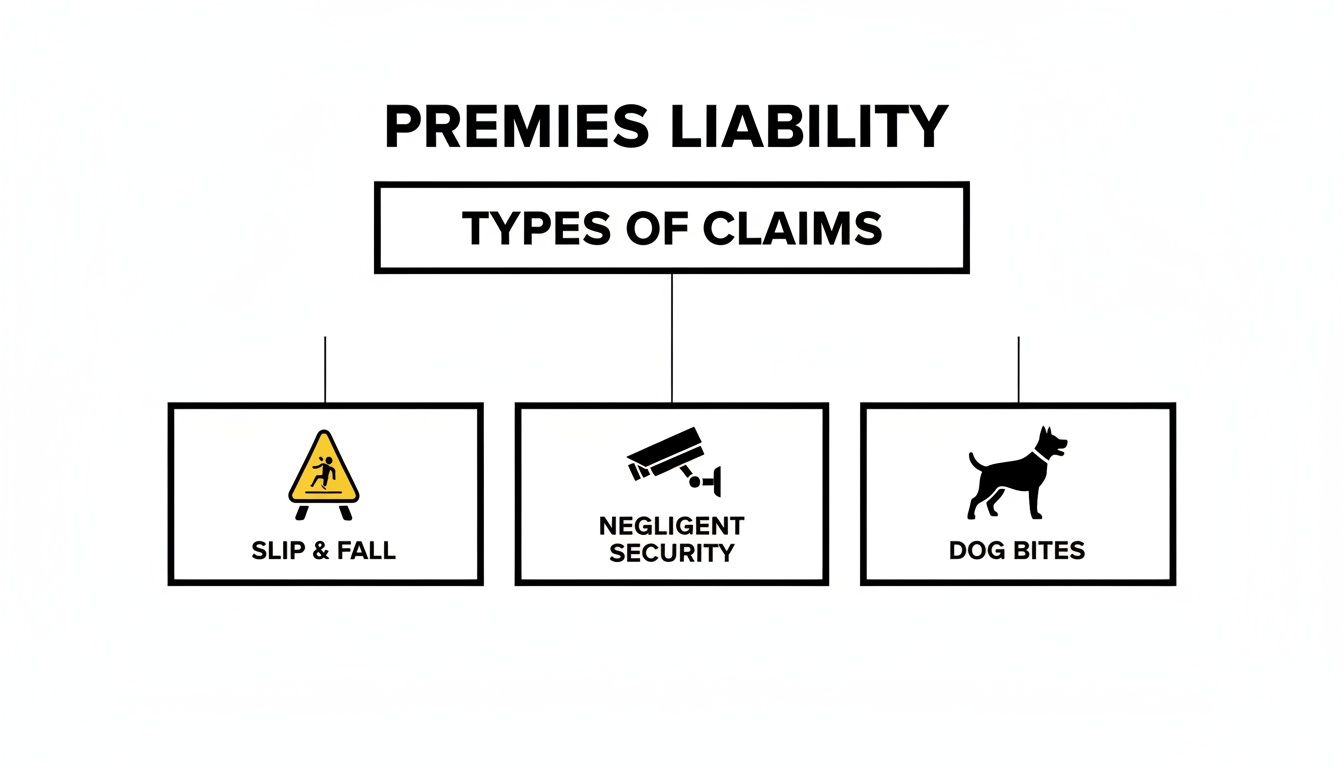
As you can see, slip and falls, negligent security incidents, and dog bites are the top reasons people find themselves needing a premises liability lawyer.
Georgia's Comparative Fault Rule
What happens if the property owner tries to pin some of the blame on you? Georgia has a specific rule for this called modified comparative fault. It means you can still recover money for your injuries as long as you are found to be 49% or less at fault.
Let's say you slipped on a puddle in a store aisle, and a jury determines your total damages are $100,000. But they also decide you were 20% at fault because you were looking at your phone. Your final award would be reduced by 20%, leaving you with $80,000. If, however, the jury finds you were 50% or more at fault, you get nothing.
Insurance companies love to use this rule to reduce or deny claims. It’s one of the main battlegrounds in these cases, and it's why having a skilled premises liability lawyer in Atlanta who knows how to fight back is so important.
Your Action Plan After an Injury on Someone's Property

The moments after an injury are chaotic and stressful. When you're in pain and disoriented, it’s tough to think straight. But what you do right away can dramatically affect both your health and your ability to get fair compensation later.
Having a clear plan helps you stay in control and protect your legal rights from the very start. This isn’t just about a potential lawsuit; it’s about creating an accurate, undeniable record of what happened. While you're focused on getting help, the property owner's insurance company is already starting its own investigation—and their goal is to pay out as little as possible. These steps help you build a solid foundation of evidence to support your side of the story.
Your Immediate Checklist
An accident scene is confusing, making it easy to forget what’s important. Use this practical, step-by-step guide to protect your well-being and your potential claim.
-
Seek Medical Attention Immediately
Your health is the #1 priority. Call 911 or have someone do it for you. Even if you think your injuries are minor, adrenaline can easily mask serious pain. A professional medical evaluation is important for your recovery, and it also creates an official record linking your injuries directly to the incident. Insurance companies love to see gaps in treatment—they’ll use them to argue your injuries weren't serious or were caused by something else. -
Report the Incident to the Property Owner or Manager
Before leaving the property, find the owner, manager, or whoever is in charge and tell them what happened. Insist that they file an official incident report and ask for a copy. This creates a formal record that an injury occurred on their property and documents the date, time, and circumstances right away. -
Document Everything with Your Phone
Your smartphone is your best evidence-gathering tool. Take photos and videos from every angle you can think of. Capture the specific hazard that caused your injury—the puddle, the broken stair, the burned-out lightbulb—as well as the wider area and any visible injuries. Videos are great for showing the full context of the scene. You can see how this evidence fits into the bigger picture in our general overview of personal injury claims.
Remember, conditions change fast. A spill is mopped up, a broken handrail is repaired, and a dark hallway gets a new lightbulb. Capturing the scene exactly as it was when you got hurt is a one-time opportunity you can't afford to miss.
Preserving Evidence and Information
Once you've handled your immediate medical needs and documented the scene, these last few steps are important for building a strong case.
-
Get Witness Information: If anyone saw what happened, get their name and phone number. An unbiased statement from an independent witness can be incredibly powerful because they have no financial stake in the outcome.
-
Preserve Physical Evidence: Don't overlook the clothes and shoes you were wearing. A torn shoe could prove how you tripped; stained clothing might show what you slipped on. Put these items in a sealed bag and do not wash or wear them again.
-
Avoid Giving Recorded Statements: The property owner’s insurance adjuster will probably call you very quickly. They might sound friendly and concerned, but their job is to get you to say something that weakens your claim. Be polite but firm. Decline to give any recorded statement until you've spoken with a premises liability lawyer Atlanta residents can trust.
How Your Lawyer Investigates and Builds a Strong Case
After an injury on someone else's property, clients often ask what a premises liability lawyer in Atlanta actually does. Think of us as your investigators and legal strategists. Our role is to prove why the incident happened, connecting the property owner's negligence directly to your injuries. This isn't just about filing paperwork; it's a methodical process designed to build an undeniable, fact-based narrative.
We don't just rely on your account of the events. Our job is to construct a fortress of evidence around it. We move quickly to preserve vital information that could otherwise be lost, building a case so solid that the insurance company cannot ignore its legal and financial exposure.
The Deep Dive Investigation
The first move is a comprehensive investigation. We act fast to secure evidence before it can be destroyed, misplaced, or overwritten. Time is of the essence—surveillance footage, for instance, is often erased within days.
Our investigative process includes:
- Securing Surveillance and Security Footage: We issue immediate legal demands—called spoliation letters—to the property owner, compelling them to preserve all video from security systems, doorbell cameras, or even employee cell phones. This footage provides an objective view of the incident.
- Obtaining Key Documents: We formally request internal records that can reveal a history of negligence. This includes maintenance logs, repair histories, internal incident reports, and staff schedules to identify who was on duty.
- Uncovering Prior Incidents: We research whether similar accidents or crimes have occurred on the property. This helps establish that the owner had notice, or should have had notice, of the hazardous condition.
Gathering Witness and Expert Accounts
Physical evidence tells one part of the story; human testimony fills in the rest. Eyewitnesses offer an unbiased perspective that can corroborate your account. We conduct detailed interviews to understand exactly what they saw and heard.
Some cases demand a more specialized voice. That’s when we engage experts to provide professional opinions that fortify your claim. If you were injured by a collapsed deck, for instance, we would retain a structural engineer. Their expert testimony can pinpoint specific building code violations, making the property owner's fault indisputable.
A common misconception is that a case is just one person's word against another's. In reality, a well-built case is a collection of evidence—from photos and documents to expert reports—that all point to the same truth: the property owner was negligent, and you were harmed as a result.
Calculating the Full Scope of Your Losses
One of our most important duties is calculating the true value of your claim, which extends far beyond your immediate medical bills. We assess the total impact the injury has had—and will continue to have—on your life.
This calculation includes:
- All Medical Expenses: This covers both past and future costs, including hospitalization, surgeries, physical therapy, medications, and any required long-term care.
- Lost Income and Earning Capacity: We document wages you have already lost. If your injuries are permanent, we also project the impact on your future ability to earn a living.
- Pain and Suffering: Georgia law allows compensation for physical pain, emotional distress, and the loss of enjoyment of life. These non-economic damages are a very real component of your recovery.
Finally, we take over all communications with the insurance companies. Their adjusters are trained to minimize payouts, but we understand their tactics. We manage the legal maneuvering and negotiations, freeing you to focus on your recovery. A skilled premises liability lawyer in Atlanta ensures your story is heard and your rights are protected at every turn.
Finding the Right Atlanta Lawyer for Your Situation
Choosing a legal partner after you’ve been injured is a deeply personal decision, and it’s easy to feel overwhelmed. When you’re looking for a premises liability lawyer in Atlanta, you aren’t just looking for someone with a law degree. You’re looking for a real advocate who gets what you’re going through and has the focused skill to fight for your case.
This isn't about picking the first name you see in a search. It's about making a deliberate choice to put your case in capable hands. The right attorney can make a world of difference in the outcome, turning a confusing and stressful process into a clear path toward fair compensation.
What to Look For in a Premises Liability Attorney
To help you make a clear-headed decision, we've put together a straightforward checklist. These are the key factors that separate a good lawyer from a great one for your specific needs.
- Specific Experience: Does the lawyer focus mainly on personal injury law? Even more importantly, do they have a deep, practical understanding of premises liability cases? This area of law comes with its own set of unique rules, and you absolutely want someone who knows them inside and out.
- A Strong Local Track Record: Ask about their history of successful outcomes right here in the Atlanta area. A lawyer who is familiar with Fulton County and DeKalb County courts, judges, and the opposing lawyers brings a local advantage to your case.
- Client-First Fee Structure: The firm must work on a contingency fee basis. This is a simple but powerful promise: you pay absolutely nothing unless they win your case. It ensures your interests are perfectly aligned and removes the financial barrier to getting expert legal help.
- Verified Reputation: What are past clients actually saying? Look for genuine reviews and testimonials. Honest feedback from people who have stood in your shoes is one of the best indicators of a firm's commitment and effectiveness. Many attorneys, like our team, also assist clients in nearby areas; you can see how we support victims by learning more about our work as a Smyrna premises liability lawyer.
Above all, the integrity of your legal representation hinges on ensuring compliance and ethics within the firm, safeguarding your case and interests. This commitment to professional standards is non-negotiable and provides peace of mind throughout the legal process.
Our entire approach is built on these principles. We offer free case evaluations so you can get answers without any obligation, and our no-win, no-fee promise means you can focus on healing, not on legal bills. With deep experience in Atlanta's legal landscape and a genuine commitment to our clients, we're ready to offer real guidance. When you need a premises liability lawyer in Atlanta, we are here to help.
Common Questions About Premises Liability Claims in Atlanta
After an injury, questions are inevitable. To give you some clarity, we’ve laid out answers to the most common concerns we hear from clients. Knowing these basics can help you understand your rights and what to expect as you move forward.
While every case has its own unique facts, these answers provide a solid starting point for understanding how Georgia law applies to injuries on someone else's property.
How Much Does It Cost to Hire a Premises Liability Lawyer?
This is often the first and most pressing question, and the answer usually comes as a relief. Like most personal injury firms, we handle these cases on a contingency fee basis.
Put simply, this means you pay zero upfront costs. Our fee is a set percentage of the settlement or verdict we recover for you. If we don’t win your case, you owe us nothing for our time. This structure levels the playing field, ensuring everyone can afford skilled legal help.
What Is My Premises Liability Case Worth?
No two injuries are identical, so calculating a case's value is a detailed process. The final compensation amount hinges on several key factors that we will thoroughly investigate and document.
These factors include:
- The severity of your injuries and whether they will have a long-term impact.
- The total cost of your medical care, including future treatments or therapy.
- Wages you've lost from being out of work and any damage to your future earning ability.
- The extent of your physical pain and emotional distress.
An experienced attorney pieces all this evidence together to build a comprehensive demand for fair compensation.
What If I Was Partially at Fault for the Accident?
This is a very common situation in premises liability cases. Georgia law uses a legal doctrine known as “modified comparative negligence” to sort this out. The rule, found in the Official Code of Georgia Annotated (O.C.G.A.) § 51-12-33, dictates that you can still recover damages as long as you are found to be 49% or less at fault.
For instance, if your total damages are $100,000 but a jury finds you were 10% responsible for the incident, your award would be reduced by that amount to $90,000. If, however, you are found 50% or more at fault, Georgia law bars you from recovering anything.
How Long Will My Case Take to Resolve?
The timeline for a premises liability claim varies widely. A straightforward case with undisputed evidence might settle within a few months.
On the other hand, involved cases—especially those with severe injuries or uncooperative insurance companies—can take a year or longer to resolve. If a lawsuit is necessary, the timeline extends. A dedicated premises liability lawyer in Atlanta will push the case forward as efficiently as possible without ever compromising your right to full compensation.
At Jamie Ballard Law, we know the physical, emotional, and financial toll an unexpected injury takes. You don't have to go through this process alone. We offer a free, no-obligation case evaluation to listen to your story and explain your legal options. Contact us today to see how we can help you get back on your feet. Learn more at https://jamieballardlaw.com.