The moments after a motorcycle accident Atlanta GA can be a chaotic blur. Adrenaline surges, and thinking straight becomes difficult. However, the steps you take right there on the scene can have a significant impact on your physical recovery and your ability to secure fair compensation later.
Your Immediate Actions at the Scene of the Crash
If you've just been in a wreck, your world is spinning. Assuming you’re physically able, there’s a clear protocol to follow that protects your health and your legal rights. It all boils down to three things: secure the scene, get help, and start documenting what happened.
This simple guide breaks down the most important steps to take right after a motorcycle accident in Atlanta.
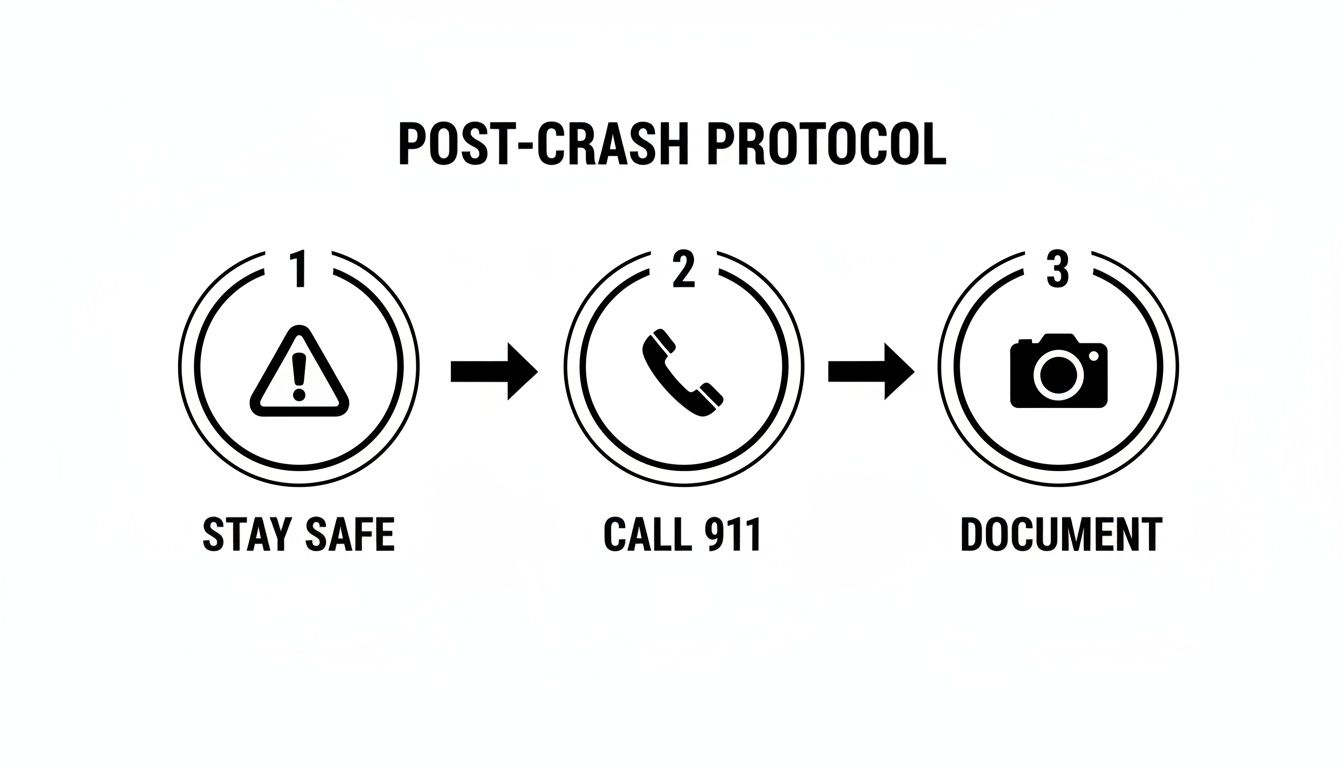
Think of it this way: safety first, then call for official backup, and finally, gather the proof. This is the foundation of a strong response.
Assess Your Safety and Call for Help
Your well-being is everything. Before you even think about your bike or the other driver, check yourself for injuries. If you're seriously hurt, don't move. Just wait for paramedics to arrive.
If you can move without causing more harm, get yourself out of the road. Active traffic lanes are the last place you want to be. Move to a sidewalk or shoulder to avoid a secondary collision.
Once you’re in a safer spot, call 911 immediately. This is an essential step, even if the crash seems minor. A police report creates an official record, and having paramedics check you out is a good idea—adrenaline can easily mask serious injuries.
Document Everything at the Scene
If your injuries allow it, your smartphone is now your most important tool. Visual proof is incredibly powerful, and this is your one chance to capture it.
Take photos and videos of absolutely everything. I mean everything:
- The damage to your motorcycle from every possible angle.
- The damage to the other vehicle(s) involved.
- The entire accident scene, including traffic signs, signals, and where the vehicles ended up.
- Road conditions like potholes, gravel, or wet pavement that might have contributed.
- Any visible injuries you have, like road rash, cuts, or bruises.
This documentation freezes the moment in time. It’s invaluable when memories get fuzzy or the other driver’s story changes.
Gather Key Information
Next, you need to exchange information with the other driver. This is a business transaction, not a debate. Do not apologize, and don't admit any fault. Stick to the facts.
A common mistake I see riders make is getting into an argument about who caused the crash. At the scene, your only job is to be a fact-gatherer. We'll sort out who was at fault later.
Make sure you get these details from the other driver:
- Full name and phone number
- Insurance company and policy number
- Driver’s license number
- Vehicle make, model, and license plate number
If anyone saw what happened, get their name and phone number. An independent witness can completely change the outcome of a case.
To make this easier during a stressful time, here's a quick checklist you can reference.
On-Scene Accident Checklist
This table is a quick reference guide for the most important actions to take immediately following a motorcycle crash. Keep it handy.
| Action Item | Why It Matters |
|---|---|
| Move to Safety | Prevents further injury from passing traffic. |
| Call 911 | Creates an official police report and ensures you get a medical evaluation. |
| Photograph Everything | Provides undeniable visual evidence of the scene, damages, and injuries. |
| Get Driver's Info | Essential for filing an insurance claim and any future legal action. |
| Find Witnesses | An impartial account of the crash can be valuable for proving fault. |
| Don't Admit Fault | Admitting fault can be used against you, even if you weren't to blame. |
| Seek Medical Attention | Documents your injuries and diagnoses issues adrenaline may be hiding. |
Having this list in your head—or saved on your phone—can help you stay focused when it matters most.
Unfortunately, situations like these are all too common here. Atlanta's motorcycle accident problem is serious, with our metro area seeing a shockingly high number of crashes. Between 2015 and 2023, the Atlanta region was the site of roughly 37-42% of all motorcycle wrecks in Georgia. These steps are your first line of defense in a city where riders are constantly at risk.
Get Medical Attention and File an Official Report
After any motorcycle wreck, your first instinct might be to just shake it off and get back on your feet, especially if you feel okay. But the adrenaline surging through your body can be a powerful mask for serious injuries. What seems like a minor ache could be internal damage or a concussion that won't show symptoms for hours, maybe even days.
This is why getting a medical evaluation right away is so important. It's not just about your health—which is always priority number one—it’s about creating a direct, time-stamped link between the crash and your injuries. That medical record is the kind of hard proof insurance companies can't easily dismiss.
You Can't Afford to "Tough It Out"
I’ve seen it a hundred times: a rider tries to "tough it out" and avoids the doctor. That's a mistake. When you delay medical care, you hand the insurance adjuster an easy argument. They'll claim your injuries weren't that bad, or worse, that something else must have caused them after the crash.
Don't give them that opening. Head to an ER, an urgent care clinic, or your family doctor as soon as you can.
Be exhaustive. Tell them about every single pain, scrape, or odd feeling, no matter how small it seems. This ensures your medical file is complete and accurate from the very beginning. From painful road rash to a slight headache, get it documented.
Following your doctor's orders is just as important as the initial visit. If they tell you to go to physical therapy or see a specialist, you have to do it. Any gaps in your treatment history look like a red flag to an insurer, suggesting you weren't truly hurt.
Why the Official Police Report is So Powerful
Think of the police report as the official story of the accident. It’s a neutral, third-party account that lays the groundwork for your entire claim. Without it, you’re left in a "he said, she said" battle that's tough to win.
The responding officer will document the essentials:
- The Basics: Date, time, and precise location of the crash.
- Who Was Involved: Names, contact details, and insurance info for everyone there, including witnesses.
- The Officer's Narrative: A summary of how the accident happened based on physical evidence and statements.
- Scene Diagram: A sketch showing where the vehicles were and the point of impact.
- Citations: A record of any traffic tickets issued, which is often a strong indicator of fault.
How to Get Your Atlanta Accident Report
Getting a copy of the official report is usually a simple process. Where you get it depends on where the crash occurred.
Accidents within Atlanta City Limits:
- You'll request the report from the Atlanta Police Department. The easiest way is often through their online portal, which typically uses a service like BuyCrash.com.
Accidents on Interstates or State Highways:
- These are handled by the Georgia State Patrol (GSP). You can get the report by submitting a request through the Georgia Department of Public Safety website.
Unfortunately, these reports are needed far too often. The statistics are grim. Motorcyclist fatalities in Georgia jumped by 29% from 139 to 179 deaths between 2017 and 2020. The cost is staggering, too, with related hospital and ER visits topping $230 million. Securing the official report after a motorcycle accident Atlanta GA is a key first step in protecting your rights.
Understanding Georgia's Motorcycle Laws and Your Claim
When you're in a motorcycle crash, the other driver's fault is just one piece of the puzzle. Georgia has its own specific rulebook for riders, and knowing how those rules impact your claim is absolutely important. These aren't just legal technicalities; they can make or break your ability to get fair compensation.
Three state laws come up in almost every motorcycle accident case I handle: Georgia's rule on shared fault, its mandatory helmet law, and the non-negotiable deadline for filing your claim.
Georgia’s Rule on Shared Fault
Georgia operates under a legal doctrine called modified comparative negligence. In plain English, this means you can still recover money even if you were partially to blame for the crash, but your compensation will be reduced by your percentage of fault.
Let's say a car makes an illegal left turn in front of you, but the investigation shows you were going a few miles over the speed limit. A jury might decide you were 20% responsible. If your total damages were calculated at $100,000, your final recovery would be reduced by that 20%, leaving you with $80,000.
The line in the sand here is 50%. If you are found to be 50% or more at fault, Georgia law bars you from recovering anything at all. This is a go-to defense for insurance companies trying to zero out a claim.
The Helmet Law and How Insurers Use It
Georgia law is straightforward: O.C.G.A. § 40-6-315 requires all motorcycle riders and passengers to wear a federally approved helmet. While this is a safety law, insurance adjusters often try to weaponize it against you.
An adjuster might argue that your head injury is your own fault because you weren't wearing a compliant helmet. This is often a misleading tactic, especially if your primary injuries were to your legs, arms, or back—places a helmet would never protect. It’s a strategy designed to shift blame and pressure you into taking a lowball offer. Don't fall for it. They must prove a direct link between the lack of a helmet and your specific injury.
The Two-Year Deadline You Cannot Miss
This is the most unforgiving rule of all. Georgia law gives you a strict window of time to file a personal injury lawsuit, known as the statute of limitations. For more information on this, check out the Georgia Code section on limitations of actions for personal injury.
For nearly all personal injury cases stemming from a motorcycle wreck, you have exactly two years from the date of the crash to file a lawsuit.
There are almost no exceptions. If you miss that deadline:
- You forfeit your right to sue the at-fault driver.
- The court will dismiss your case, no questions asked.
- You will have no legal path to recover compensation for your medical bills, lost wages, or pain and suffering.
Insurance companies know this deadline by heart. They may intentionally drag out negotiations, giving you false hope while the clock is ticking down. This is why it's vital to act quickly and understand your timeline from day one. Understanding these Georgia-specific laws is fundamental to building a strong case after being hurt in a motorcycle wreck. If you have questions about how these rules apply to your situation, an experienced Atlanta motorcycle accident lawyer can give you the clarity you need.
Communicating With Insurance Companies After the Crash
Not long after a motorcycle accident Atlanta GA, your phone is going to ring. It will be an insurance adjuster from the other driver's company, and you need to understand their one and only goal: protecting their company’s bottom line. Their job is to settle your claim for as little money as possible.
When they call, what you say—and more importantly, what you don't say—can make or break your case. The adjuster will likely sound friendly, even concerned. Don't be fooled. This is a fact-finding mission, and they are listening for any word they can twist to devalue or deny your claim.
The Recorded Statement Trap
One of the first things the adjuster will request is a recorded statement. Let me be clear: you are under no legal obligation to give one to the other driver's insurance company. I tell every client to refuse.
Why? Because adjusters are trained to ask leading questions. They'll get you to unintentionally downplay your injuries or misstate a minor detail that they can later use against you.
For example, a simple question like, "How are you doing today?" can be a trap. If you respond with a polite "I'm fine," they'll document it as proof your injuries aren't serious. A recorded statement just hands them the ammunition they need. Your best move is to politely decline and state that you'll provide necessary information in writing.
It's a common tactic: they'll pressure you by saying they need a recorded statement to process your claim. This is not true. Your best response is to say that you aren't comfortable providing a statement at this time.
What to Share and What to Keep to Yourself
While you should always refuse a recorded statement, you will need to provide some basic details. It’s a delicate balance. The key is to stick to the cold, hard facts of the crash. Avoid opinions, apologies, or any speculation about what happened.
Information you CAN provide:
- Your full name and contact information
- The date and location of the accident
- The type of motorcycle you were riding
- The name of the responding law enforcement agency
Information you should NOT provide:
- Details about your injuries: Just say that you are under medical care. You don't know the full extent of your injuries yet, and you shouldn't guess.
- Your opinion on fault: Never admit fault, even partially. Don't say "I'm sorry" or try to explain what you think happened. Let the police report and the evidence do the talking.
- A release for your medical records: Do not sign a blanket medical authorization. This gives the insurer free rein to dig through your entire medical history, looking for a pre-existing condition they can blame for your pain.
Knowing what adjusters are looking for is half the battle. To better understand their tactics, it helps to be aware of the common insurance claim denial reasons they often use.
Reporting the Crash to Your Own Insurer
You do have a contractual obligation to report the accident to your own insurance carrier in a timely fashion. When you make that call, the same rules apply: facts only. Avoid detailed discussions about your injuries or who was at fault.
This is also the perfect time to ask about coverages on your own policy that can provide immediate help. Two important ones in Georgia are:
- Medical Payments (MedPay) Coverage: This optional coverage pays for your medical bills up to your policy limit, no matter who was at fault. It can be a lifesaver for covering co-pays and deductibles right away.
- Uninsured/Underinsured Motorist (UM/UIM) Coverage: If the driver who hit you has no insurance or not enough to cover your damages, your own UM/UIM policy can cover the shortfall.
The claims process can feel overwhelming, but understanding the basics is helpful. The steps are very similar for bikes and cars, so for a deeper dive, you can learn more about how to file a car accident claim in Atlanta on our website.
What Kind of Compensation Can You Recover After a Crash?
When you're injured in a motorcycle accident Atlanta GA, the aftermath is more than just a wrecked bike. You're facing a stack of medical bills, lost paychecks from being unable to work, and the heavy physical and emotional weight of your recovery. To get a fair settlement that covers everything you've lost, you first have to understand what you're legally owed.
In Georgia, the law breaks down compensation—legally called "damages"—into two key categories. The first covers your measurable, out-of-pocket financial costs. The second addresses the profound, personal impact the wreck has had on your life.
Calculating Economic Damages
Economic damages are the tangible, calculable losses from your accident. These are the costs with a paper trail, like receipts, invoices, and pay stubs. It’s all about adding up the direct financial hit you've taken.
This category includes:
- Past and Future Medical Bills: This isn't just the first emergency room visit. It covers every ambulance ride, hospital stay, surgery, physical therapy session, prescription, and any future medical care you'll need down the road.
- Lost Wages: If you missed work, you can recover that lost income. We calculate what you would have earned if the accident had never occurred.
- Diminished Earning Capacity: If your injuries mean you can't return to your previous job or earn the same living, you can seek damages for this long-term financial setback.
- Property Damage: This covers the cost to repair your motorcycle or its fair market value if it was totaled. It also includes damage to your helmet, riding gear, and anything else you had with you.
These costs pile up fast, so keeping meticulous records of every expense is beneficial.
Valuing Non-Economic Damages
Non-economic damages are different. They compensate you for the very real, but intangible, human suffering the crash inflicted. There is no invoice for pain or a bill for PTSD, but these losses are just as significant—often more so.
Valuing non-economic damages is where experience really matters. An insurance company will always try to downplay your suffering. We have to show them how the accident truly changed your day-to-day life.
This category is designed to cover the human toll of the crash:
- Pain and Suffering: This is for the physical pain, chronic discomfort, and overall suffering your injuries have forced you to endure.
- Emotional Distress: Riders often experience severe anxiety, depression, fear of riding, and even post-traumatic stress disorder (PTSD) after a serious wreck. You can find helpful resources about this at the National Institute of Mental Health.
- Loss of Enjoyment of Life: If your injuries stop you from enjoying hobbies, activities, or the simple pleasures you once did—like going for a weekend ride through the North Georgia mountains—you deserve compensation for that loss.
Traumatic brain injuries are a common and devastating outcome of motorcycle wrecks. If you've suffered any head trauma, understanding the long-term impact is vital for your case. You can find more information on the unique challenges and legal strategies from a concussion injury attorney in Atlanta. As you begin this process, it helps to understand the tools involved, like knowing how to create a well-structured personal injury demand letter.
Types of Compensation in a Georgia Motorcycle Accident Claim
To help you see the full picture, here’s a quick breakdown of the different types of damages you can pursue after a crash.
| Type of Damage | What It Covers |
|---|---|
| Economic Damages | |
| Medical Expenses | All treatment costs—past, present, and future—related to your accident injuries. |
| Lost Income | Wages, salary, and benefits you missed out on while recovering from the crash. |
| Loss of Earning Capacity | Future income you will lose because your injuries limit your ability to work. |
| Property Damage | The cost to repair or replace your motorcycle, helmet, riding gear, and other items. |
| Non-Economic Damages | |
| Pain and Suffering | Compensation for the physical pain and mental anguish you've experienced. |
| Emotional Distress | For conditions like anxiety, depression, insomnia, and PTSD caused by the trauma. |
| Loss of Consortium | For the negative impact your injuries have had on your relationship with your spouse. |
| Loss of Enjoyment of Life | Compensation for being unable to participate in hobbies and activities you once loved. |
Securing full and fair compensation means accounting for every single loss—both the ones you can see on a bill and the ones you feel every day. The goal is to obtain a settlement that truly makes you whole again after a traumatic motorcycle accident Atlanta GA.
Common Questions After a Motorcycle Accident in Atlanta
After a motorcycle wreck in Atlanta, your mind is racing. Questions about insurance, fault, and the entire legal process can be overwhelming. Here are straightforward answers to the questions I hear most often from riders who were in your shoes.
What if the At-Fault Driver Has No Insurance?
It's a sinking feeling—learning the driver who hit you is uninsured. Your immediate thought is probably, "How am I going to cover all these medical bills and repairs?" The good news is, you likely have a direct path to recovery through your own motorcycle insurance policy.
This is precisely why Uninsured/Underinsured Motorist (UM/UIM) coverage is so important. While it's optional in Georgia, this coverage steps into the shoes of the at-fault driver's non-existent insurance. Your UM policy will cover your medical expenses, lost income, and pain and suffering, up to your policy's limits. Filing a UM claim does not negatively impact your premiums, because the accident wasn't your fault.
Can I Still File a Claim if I Wasn't Wearing a Helmet?
Yes, you can. Georgia has a universal helmet law (O.C.G.A. § 40-6-315), but failing to wear one doesn't automatically bar you from recovering compensation. It's on the insurance company to prove a direct link between the lack of a helmet and the specific injuries you sustained.
For instance, if you suffered a shattered leg and significant road rash, a helmet—or lack thereof—is completely irrelevant to those injuries. The insurance adjuster might try to leverage the helmet issue to devalue your claim, but it's often a tactic. Don't let them bully you.
How Long Does a Motorcycle Accident Case Take?
This is the classic "it depends" answer, and while frustrating, it’s the honest one. No two cases are identical. The timeline for a motorcycle accident claim hinges on a few key variables:
- Injury Severity: More serious injuries mean longer treatment and recovery. We never settle a case until we have a complete picture of your current and future medical needs. This process can take several months or even over a year.
- Liability disputes: If fault is clear-cut, things move faster. If the other driver denies responsibility, the investigation and negotiation phases will naturally take longer.
- The Insurer's Attitude: Some insurance carriers negotiate reasonably. Others will drag their feet and fight you on every point, often forcing the case toward a lawsuit.
A straightforward case with minor injuries might wrap up in a few months. A detailed case involving serious harm could easily take one to two years, particularly if we have to file a lawsuit to get you fair compensation.
What Does "Contingency Fee" Mean?
Hiring an attorney on a contingency fee basis means you pay zero upfront costs. We know you're already dealing with medical bills and time off work. The last thing you need is a legal bill on top of it.
Here’s how our contingency fee arrangement works:
- We advance all the costs required to build and pursue your case, from hiring investigators to paying for expert witness reports.
- Our legal fee is a pre-determined percentage of the total settlement or verdict we secure for you.
- If we don't win your case, you owe us absolutely nothing.
This model ensures our interests are 100% aligned with yours: getting you the maximum possible recovery for your injuries. It allows you to access top-tier legal help with no financial risk.
If you have more questions or just need someone to look at the facts of your crash, my team at Jamie Ballard Law is ready to listen. We provide a free, no-pressure case evaluation to help you map out your next steps. Visit us at https://jamieballardlaw.com or call us 24/7 for the support you deserve.