Hit by a City, County, or MARTA Vehicle in Georgia: The Ante Litem Notice Deadline
An ante litem notice is a written claim you must send to a Georgia government before you can sue it. If a city vehicle hit you, the deadline is six months from the crash. Counties and the state allow 12 months. Miss the deadline, and the claim can be lost, even with time left on the two-year lawsuit clock. The notice must include specific details, and city claims must state a dollar amount. Transit authorities like MARTA follow their own rules. Here is what each deadline requires and how to protect your claim.
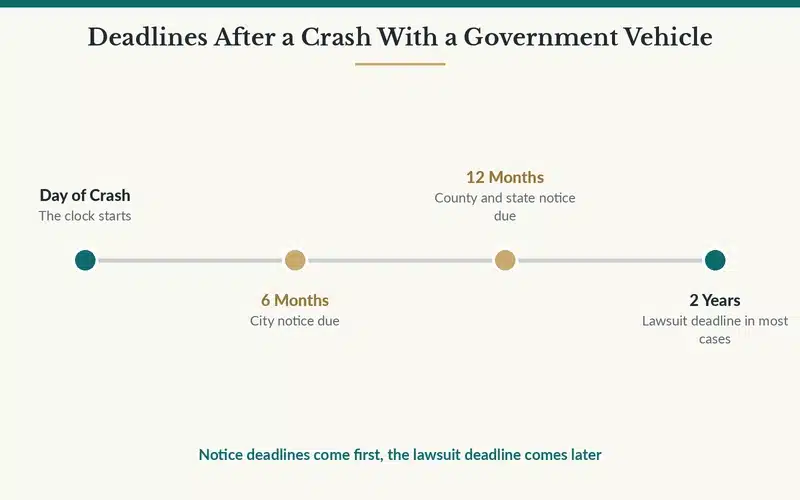
- City vehicles: written notice within 6 months under O.C.G.A. § 36-33-5
- County vehicles: claim presented within 12 months under O.C.G.A. § 36-11-1
- State vehicles: notice within 12 months under the Georgia Tort Claims Act
- MARTA and other authorities: separate rules, so act as early as possible
Why Claims Against the Government Work Differently
A crash with a city truck feels like any other crash. The injuries are the same. The legal path is not.
With a private driver, you file a claim with their insurer. With a government, you often deal with a risk management office or a self-insured fund. Different people handle the claim, and different rules control it. Those rules start with the notice. Governments have protections that private drivers do not.
Sovereign Immunity in Plain Terms
Sovereign immunity is an old rule that protects governments from lawsuits. Georgia has waived that protection in specific situations, including many vehicle crashes. Those waivers come with conditions. The ante litem notice is one of the most important conditions.
Think of the waiver as a door the legislature opened. The notice is how you walk through it. Skip the notice, and the door stays shut, no matter how clear the fault.
What “Ante Litem” Means
The phrase “ante litem” is Latin. It means “before the lawsuit.” The notice tells the government about your claim before you file in court. It gives the government a chance to investigate and settle. If you skip it or send it late, a court may dismiss the case.
Courts take this requirement seriously, and the government’s lawyers raise it in almost every case. Judges have dismissed claims with real injuries because the notice arrived late. Others failed because the notice went to the wrong office. The rule can feel harsh, but it is applied often.
Why the Deadline Comes So Early
Most Georgia injury claims have two years before a lawsuit must be filed. Government notice deadlines are much shorter. A city claim needs notice within six months. Many people learn about this rule only after the window closes.
Six months passes quickly after a crash. The first weeks go to doctor visits and car repairs. Then come work problems and insurance calls. By the time someone thinks about a lawyer, half the window may already be gone. An ante litem notice should be on your mind from the first week.
Practical rule: If a government vehicle was involved, assume the shortest deadline applies until you confirm otherwise.
The Deadline for Each Type of Government
The right deadline depends on who owned the vehicle or controlled the property. Identifying the correct government is the first job.
That is not always obvious. A truck with a city logo may belong to a contractor. A bus may belong to a county, a school district, or a transit authority. The police report, vehicle markings, and records requests help sort it out. When the answer is unclear, the ante litem notice should go to every possible owner.
Cities: Six Months and a Dollar Amount
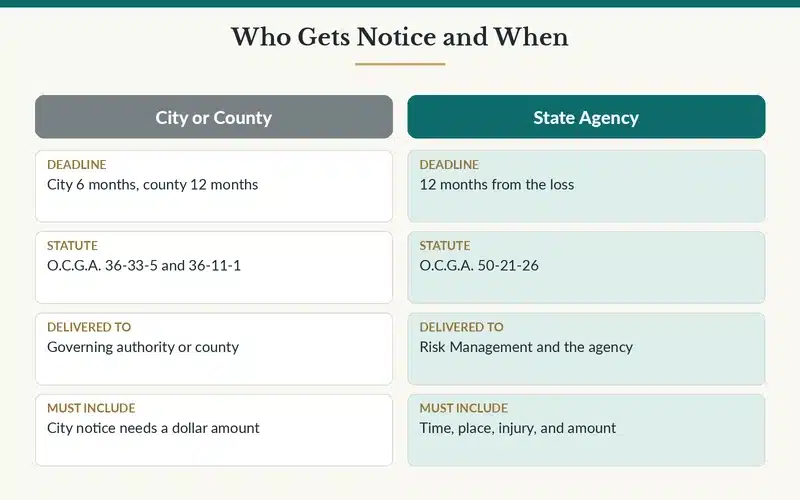
Under O.C.G.A. § 36-33-5, claims against a city need written notice within six months. The notice must state the time, place, and extent of the injury. It must also describe the negligence. The description of the injury must include the specific dollar amount you are seeking.
The six-month clock starts on the day of the crash. It does not wait until you learn the vehicle was city owned. After the city receives the notice, it has 30 days to act on it. The statute of limitations is paused while the claim is pending without action.
Counties: Twelve Months
Claims against a county must be presented within 12 months under O.C.G.A. § 36-11-1. The statute says late claims are barred. County crashes often involve sheriff’s vehicles, public works trucks, or county buses.
Georgia courts have sometimes accepted a county notice that substantially complies with the statute. That is not a reason to be casual. A careful, complete notice avoids the argument entirely.
The State: Twelve Months Under the Tort Claims Act
The Georgia Tort Claims Act covers state agencies and state employees. Under O.C.G.A. § 50-21-26, notice is due within 12 months. That clock runs from when the loss was or should have been discovered. Crashes with state patrol cars or state transportation trucks usually fall here.
State notices follow strict delivery rules. If a lawsuit is filed later, the complaint must attach a copy of the notice and the delivery receipt. Missing those exhibits can lead to dismissal if not cured within 30 days.
Transit Authorities Like MARTA
Transit authorities do not fit neatly into the city, county, or state boxes. In Foster v. Georgia Regional Transportation Authority (2015), the Georgia Supreme Court addressed this. It held that a regional transit authority was not a city, so city notice rules did not help the passenger. MARTA is a public authority created by its own law. Which notice rule governs a MARTA claim should be checked on day one.
The safe approach is simple. Send a complete ante litem notice as early as possible, well inside six months. Sending early costs nothing. Sending late can cost everything. You can find agency contact details on the MARTA website, but delivery rules should still be confirmed.
Here is a quick reference for each deadline.
| Government Type | Notice Deadline | Who Receives It | Statute |
|---|---|---|---|
| City | 6 months from the crash | Mayor or chair of the city council or commission | O.C.G.A. § 36-33-5 |
| County | 12 months from the claim arising | The county governing authority | O.C.G.A. § 36-11-1 |
| State agency | 12 months from discovery of the loss | Risk Management Division, plus the agency | O.C.G.A. § 50-21-26 |
| Transit or other authority | Depends on the authority’s law | Depends on the authority’s law | Confirm early |
| Lawsuit filing | Usually 2 years from the crash | The proper court | O.C.G.A. § 9-3-33 |
What the Notice Has to Say
An ante litem notice is not a casual letter. Courts read these notices closely. Missing details can sink an otherwise strong claim.
Required Details for City Claims
A city notice should state when and where the crash happened. It should describe your injuries and how the city’s driver was negligent. It must include a specific dollar amount. The law treats that amount as an offer to settle. If the case later goes to court, you are not bound by that number.
Choosing the amount takes some thought. Too low, and it may anchor settlement talks. A number that is too high can look unserious. The amount should reflect your medical bills, lost income, and pain, plus expected future care.
Required Details for State Claims
A state notice must name the agency involved. It must state the time, place, and nature of the loss. It must state the amount of loss claimed and the acts that caused it. The law asks for these details to the extent you know them at the time.
That flexibility helps when treatment is ongoing. You may not know your final bills yet. A good notice gives the best estimate available and explains the basis for it.
Delivery Matters as Much as Content
City claims must be served on the mayor or the chair of the city council or commission. Delivery can be personal or by certified mail or statutory overnight delivery. State claims go to the Risk Management Division of the Georgia Department of Administrative Services. A copy also goes to the agency involved. Keep every receipt.
What Happens After the Notice Is Sent
The government reviews the claim and may investigate. It may ask for records or offer to settle. City governments have 30 days to act on a claim. State claims cannot go to court until the claim is denied or 90 days pass. Many claims settle during this stage.
Practical rule: Send the notice in a way that creates proof of delivery. Without the receipt, you may not be able to prove you sent it.
Insurance Limits on Government Vehicle Claims
Even when notice is perfect, government claims have caps. Knowing them helps you plan the whole claim.
The Local Government Motor Vehicle Waiver
Georgia waives immunity for local governments when their employees negligently use covered vehicles. Under O.C.G.A. § 36-92-2, the waiver has dollar limits. For crashes since 2008, the limit is $500,000 per person and $700,000 per occurrence. Property damage has a separate $50,000 limit.
These caps apply to the government’s liability for the crash. They do not reduce what your injuries are actually worth. They limit how much one source will pay. Other sources, like your own coverage, may cover the rest.
When Your Own Coverage Fills the Gap
Serious injuries can exceed those limits. Your own uninsured or underinsured motorist coverage may help.
The cap applies per person and per crash. In a bus crash with many riders, the per-occurrence limit gets shared. That makes early action even more important when several people are hurt. Medical payments coverage can cover early bills. Reviewing your own policy early shows how much protection you really have.
Your own insurer may need notice too. Many policies require prompt reporting of any crash. If you plan to use uninsured motorist coverage, tell your insurer early. That protects a second source of recovery while the government claim moves forward.
Claims Against the Employee Personally
Government employees often have their own protections when acting on the job. Georgia law generally shields public employees for certain official acts. In many vehicle cases, the claim runs against the government entity instead. Who gets named depends on the facts and the type of government. That choice should be made carefully before any deadline passes.

Common Situations That Trigger the Deadline
Government vehicles are everywhere in metro Atlanta. Many crashes involve one without the injured person realizing it at first.
Unmarked vehicles make this harder. Some city and county employees drive plain cars or their own cars on official business. A crash with an employee on the job can still involve the government. Asking the right questions early reveals that connection.
City Trucks and Police Cars
Sanitation trucks, water department vans, and police cruisers are city vehicles in most cities. A crash with any of them can trigger the six-month ante litem notice rule. Check the police report for the vehicle owner. It usually lists the registered owner and any insurance carrier. Our guide on how to obtain records from police explains how to get it.
Buses and Transit Vehicles
School buses, county buses, and MARTA buses each belong to different public bodies. A rider, a pedestrian, or another driver can be hurt. Each claim may follow a different notice rule.
Passengers on a bus have their own concerns. A sudden stop can throw riders into poles or seats. Those injuries count even without a collision. A transit rider who is hurt this way should treat the notice deadline just as seriously. Our page on Atlanta pedestrian accident claims covers crashes involving people on foot.
Road Defects and Public Property
Government claims are not limited to vehicles. A dangerous pothole, a broken traffic signal, or a hazard on public property can also involve a government. Different immunity rules apply to those claims. The notice deadline still matters.
Road defect cases also depend on who maintains the road. A state highway, a county road, and a city street each belong to a different government. That ownership question decides both the deadline and the recipient.
Crashes Outside Atlanta
Every Georgia city follows the same six-month statute. That includes Smyrna, Marietta, Sandy Springs, and Decatur.
City limits can be confusing in metro Atlanta. A road may cross several cities and unincorporated county land in a few miles. The exact crash location helps determine which government was responsible. An address from the police report usually answers that question. Our page on suing a government in Smyrna covers one local example.
Practical rule: Look at the police report for the vehicle owner. “City,” “County,” or an agency name means a notice deadline is running.
Mistakes That Can Sink a Government Claim
Most failed government claims fail for simple, avoidable reasons. These are the mistakes I see most often.
None of them involve weak injuries or unclear fault. They are paperwork problems. That is what makes them so frustrating, and so preventable with an early start.
Waiting for the Insurance Company to Mention It
Adjusters for a government entity have no duty to remind you about the ante litem notice. Some will keep talking with you as the deadline passes. Friendly conversations do not replace written notice. Only a proper notice protects the claim.
Sending Notice to the Wrong Place
A letter to the police department or the driver’s supervisor is usually not enough. Each statute names who must receive the notice. Sending it to the wrong person can mean it legally never arrived.
Leaving Out the Amount or Key Details
City notices without a specific dollar amount can fail. Vague descriptions of the injury can draw challenges too. Every required element should appear clearly in the notice itself.
Do not rely on attachments to carry the key facts. Put the date, place, injuries, negligence, and amount in the body of the letter. Attachments can support the notice, but the notice should stand on its own.
Practical rule: Friendly calls with a government adjuster do not stop the clock. Only a proper written notice does.
How a Lawyer Handles Government Claims
These claims leave little room for error. Here is how I approach them for injured people across Atlanta.
The first meeting focuses on dates. When did the crash happen, and who owned the vehicle? From there, I work backward from the shortest possible deadline. Everything else, including medical records and settlement value, builds on that foundation. A timely ante litem notice comes first, every time.
Identifying the Right Government Fast
I start by confirming who owned the vehicle and who employed the driver. Police reports, vehicle markings, and records requests answer that question. Sometimes a short call to the agency confirms ownership the same day. The answer sets the deadline and the delivery rules.
Practical rule: When in doubt about who owns the vehicle, send notice to every possible government. Extra notices cost nothing.
Drafting a Notice That Holds Up
I prepare the notice with every required detail. I also include supporting facts that help the government evaluate the claim quickly. For city claims, that includes a carefully chosen dollar amount. I send it by a method that creates proof, then calendar every follow-up date.
If the vehicle owner is unclear, I send notice to every government that might be responsible. Extra notices do no harm. A missing one can end the claim. That belt and suspenders approach is standard in my office.
Planning for the Lawsuit Deadline
After notice, the government has time to respond. State claims cannot be filed in court until the claim is denied or 90 days pass. The two-year deadline under O.C.G.A. § 9-3-33 still applies. Learn more in our guide to the statute of limitations. You can also see how I handle Atlanta car accident claims.
Watch: A MARTA Bus Crash in Atlanta
This Atlanta News First report covers a crash involving a MARTA bus that injured five people.
Frequently Asked Questions About Ante Litem Notice
| Question | Answer |
|---|---|
| What is an ante litem notice? | A written claim sent to a Georgia government before you can sue it. |
| How long do I have after a city vehicle crash? | Six months from the crash under O.C.G.A. § 36-33-5. |
| What about county or state vehicles? | Twelve months for counties and for state claims under the Tort Claims Act. |
| Does my notice need a dollar amount? | City notices must include one. State notices must state the amount of loss claimed. |
| What if I was hit by a MARTA bus? | Transit authorities follow their own rules. Confirm the deadline right away. |
| Can I still sue if I miss the notice deadline? | Often not. Courts regularly dismiss claims with late or missing notice. |
| Who should receive a city notice? | The mayor or the chair of the city council or commission, delivered personally or by certified mail. |
| Is there a cap on what I can recover? | For local government vehicles, usually $500,000 per person and $700,000 per occurrence. |
Protecting Your Claim With a Timely Ante Litem Notice
A government vehicle crash starts a shorter clock than most people expect. A timely, complete ante litem notice keeps your right to recover alive. Jamie Ballard Law helps injured people across Atlanta meet these deadlines. If you need an ante litem notice sent, call (404) 885-8544 or contact the office online.
About Jamie Ballard Law
Jamie Ballard Law is an Atlanta personal injury firm led by attorney Jamie Ballard. The firm represents people hurt in car crashes, truck wrecks, falls, and other accidents across metro Atlanta. Jamie handles each case personally, from the first call through settlement or trial.