“That Injury Was Already There”: How a Preexisting Condition Works in a Georgia Injury Claim
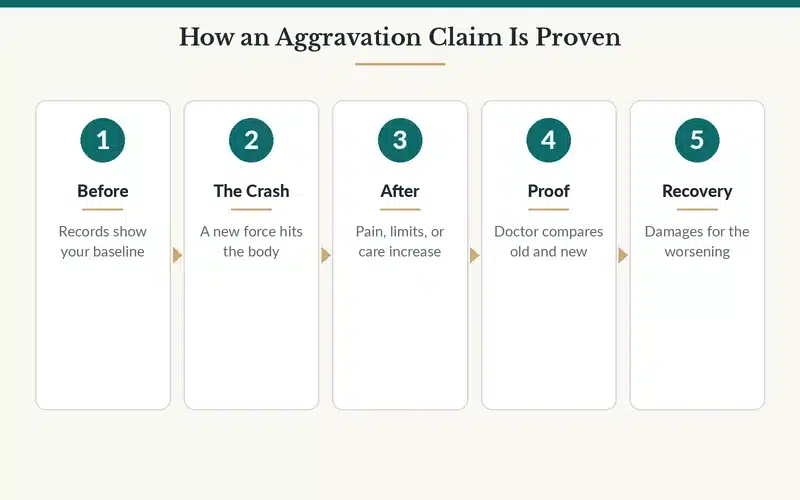
A preexisting condition does not stop you from recovering after a crash or fall in Georgia. If the accident made an old problem worse, the person at fault is responsible for that worsening. The law calls this aggravation. Insurance adjusters often hear about a prior injury and treat it as a reason to deny or cut the claim. That is usually an overreach. The real question is how much the accident changed your condition. Proving that difference takes the right records, a clear before and after picture, and honest answers about your history.
- The rule: worsening a preexisting condition is a recoverable injury in Georgia
- What you recover: the added harm the accident caused, not the old condition itself
- The evidence: records from before and after, plus your doctor’s comparison
- The mistake to avoid: hiding or guessing about your medical history
Why Adjusters Bring Up Your Medical History
Few arguments are more common in injury claims. A preexisting condition gives the adjuster an easy story to tell. An adjuster learns you had back pain years ago. Suddenly every new symptom gets blamed on that old problem. Understanding why they do this helps you respond calmly.
The Easiest Way to Lower a Claim
Blaming a prior injury lets an insurer argue the crash caused nothing new. If that works, they pay little or nothing. It costs them only a records request. That makes it one of the first moves in many claims.
The argument also plays on fear. Many people assume a preexisting condition disqualifies them. They accept a low offer because they think they have no other choice. Knowing the actual rule takes that pressure away.
The Questions That Set It Up
It often starts with a friendly call. The adjuster asks, “Have you ever hurt your neck or back before?” Next comes, “Have you ever seen a chiropractor?”
Then comes a request to sign a broad medical release. Each step builds a file aimed at your past, not the crash.
None of these questions are illegal. You can answer them honestly and still protect yourself. The key is knowing why they are asked, and not guessing when your memory is unclear.
Why Almost Everyone Has Something in Their History
Most adults have some old injury, wear and tear, or prior visit. A sports injury in high school still shows up. So does a doctor visit for back stiffness after moving furniture. Having a history is normal. It is not proof that the crash did no harm.
In fact, people with a prior injury are often hurt more by the same impact. A back that has already been through surgery has less room to absorb force. That reality supports your claim. It does not weaken it.
Practical rule: A past injury is a fact to explain, not a secret to hide. Hidden history does far more damage than honest history.
What Georgia Law Says About Aggravated Injuries
Georgia law focuses on what the accident actually caused. That includes making an existing condition worse. Two ideas work together here.
You Recover for the Harm the Accident Caused
Georgia allows recovery for damages that are the legal and natural result of a wrongful act. That principle appears in O.C.G.A. § 51-12-9. When a crash worsens an old injury, that worsening is a natural result. The at-fault party owes compensation for it.
That compensation can cover added medical care, more pain, and new limits. It can include lost work caused by the flare. It can also include the fear and frustration of losing ground you worked hard to gain. Our guide to pain and suffering settlement amounts explains how those losses get valued.
The Eggshell Plaintiff Rule in Plain Terms
Lawyers often describe this with the eggshell plaintiff rule. The idea is simple. A careless person takes the injured person as they find them. If you were more fragile than average, the harm is still theirs to answer for. They cannot argue that a healthier person would have walked away.
Picture two drivers in the same rear-end crash. One has a healthy spine. The other had a neck fusion five years ago. The second driver may need another surgery. The at-fault driver cannot pay only for what the first driver suffered.
What the Defense Gets to Argue
The defense does have a fair point to make. A defendant pays only for the harm their conduct caused. Georgia courts have approved jury instructions on preexisting conditions for that reason, as in Garner v. Driver (1980). So the jury may separate old symptoms from new ones. Your job is to show where that line falls.
How Juries Split Old and New Harm
Juries do not need perfect math. They look at the evidence and make a fair estimate. Sometimes the old condition explains part of your pain. The jury then awards damages for the part the crash added. Clear records make that estimate fairer to you.
Settlement talks follow the same logic. Adjusters estimate how a jury would split old and new harm. When your evidence draws that line clearly, the estimate moves in your favor. When it is fuzzy, they assume the worst about your history.
When the line is hard to draw, doctors help. They can describe what your condition likely would have looked like without the crash. That forecast gives the jury a starting point for the added harm.
New Injury, Aggravation, or Unrelated Condition
Every claim with a history falls into a few basic categories. Here is how each one usually plays out.
| Situation | What It Means | What You Can Recover |
|---|---|---|
| New injury | The crash caused a problem you never had before | Full damages for the new injury |
| Aggravation of an old injury | The crash made an existing condition worse or active again | Damages for the worsening, including added pain and care |
| Unrelated old condition | The old problem continued with no change from the crash | Nothing for that condition alone |
| Silent condition made painful | Changes on imaging that never hurt until the crash | Often full damages for the new symptoms |
| Mix of new and old | Some injuries are new, others are worsened | Damages for each, separated by the evidence |
Practical rule: Your claim is about change. Show the jury where you were before, and where the accident left you.
Silent Conditions and What Imaging Really Shows
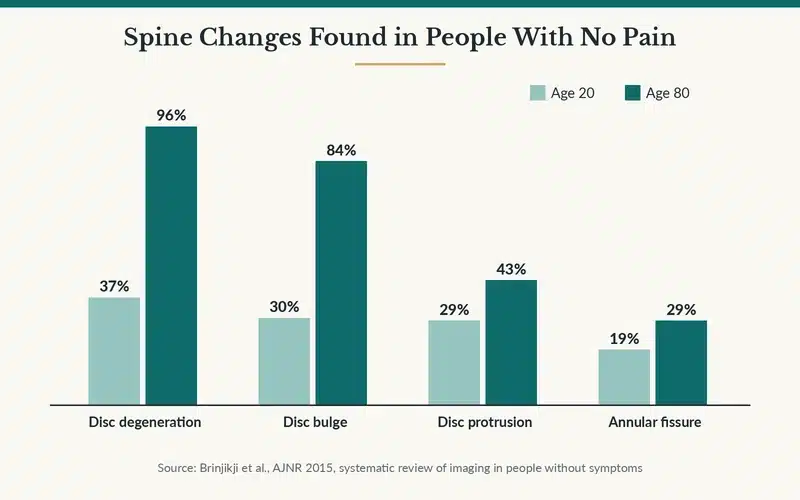
One of the most useful facts in these cases comes from medical research. Many people have changes in their spine that never cause pain.
Spine Changes Are Common in People With No Pain
A large research review in the American Journal of Neuroradiology looked at imaging of people without back pain. Disc degeneration appeared in 37 percent of 20 year olds. By age 80, it appeared in 96 percent. You can read the full study at the National Library of Medicine.
Disc bulges followed the same pattern. They showed up in 30 percent of 20 year olds without pain. By age 80, the figure reached 84 percent. In other words, these findings are a normal part of aging for most people.
Why This Matters for Your Claim
Adjusters love the word “degenerative” on an MRI report. They argue the findings prove an old, natural problem. Some denial letters quote that single word as if it settles everything. It does not, and Georgia juries are allowed to hear why. The research shows those findings are common in people who feel fine. What matters is whether you had symptoms before the crash. If you did not, the crash is the likely trigger.
A radiologist’s report describes what the image shows. It does not say when changes started or whether they hurt. Many reports use “degenerative” as a routine label. That word alone does not answer the legal question.
When a Silent Condition Becomes Painful
Many people learn about a preexisting condition only after a crash. An MRI ordered for new pain reveals old disc changes. That does not make the pain old. A condition that never hurt, then hurts constantly after impact, has been changed. That change is the injury.
Practical rule: “Degenerative” describes an image. It does not describe your life before the crash. Your history does.
Common Conditions That Get Aggravated
Certain conditions come up again and again. Each can be made worse by the force of a crash or fall:
- Degenerative disc disease in the neck or lower back
- Arthritis in the knees, hips, or shoulders
- Prior surgeries, such as a spinal fusion or knee repair
- Old fractures or sports injuries
- Past concussions or headaches
- Anxiety or depression made worse by the trauma
The National Library of Medicine’s back pain guide explains several of these conditions in plain terms.
Aggravation in Falls and Other Accidents
The same rule applies outside car crashes. A fall in a store can worsen arthritic knees or an old shoulder injury. A property owner who left a hazard in place still answers for that worsening. Our page on Atlanta slip and fall claims covers how those cases work.
Building the Before and After Picture
Aggravation claims are won with comparison. When a preexisting condition is involved, the question is never whether you were perfect before. It is how much worse you are now. The stronger your before and after evidence, the harder it is to blame the past.
Records From Before the Accident
Old records often help more than people expect. They may show you finished treatment years ago. They may show only mild, occasional symptoms. A long stretch without any care is powerful evidence that the condition was stable.
Even records with some prior care can help. They show how often you were treated and how severe it was. If you saw a doctor twice a year before and weekly after, the change speaks for itself.
Pharmacy records can help too. If you stopped taking pain medicine years ago, that shows stability. If you started again after the crash, that shows change. Small details like this add up.
Records From After the Accident
New records should describe symptoms clearly and consistently. Tell each provider about your history and how things changed. A note like “patient reports no neck pain for five years before the crash” is gold. Ask your doctor to record that comparison.
Be careful with the words you use. “My back has always been bad” sounds like nothing changed. Compare that with “My back bothered me a few times a year, and now it hurts daily.” That version tells the truth more clearly. Both may be honest, but only one shows the change.
Your Doctor’s Opinion on the Difference
A treating doctor can compare old and new imaging. They can explain what changed and why the crash fits. That opinion often decides these cases. Without it, the jury is left guessing.
Old imaging is especially valuable. If you had an MRI before the crash, get a copy. A side by side comparison can show a new herniation or a larger bulge. That kind of evidence is hard for the defense to explain away.
Witnesses Who Knew You Before
Family, friends, and coworkers see your daily life up close. Their view often captures changes that never show up in a chart. They can describe what you did before and what you cannot do now. Maybe you played with your kids, worked overtime, or gardened every weekend. Their stories make the change real for a jury.
Photos and videos help as well. A picture of you hiking last summer says a lot. So does a video of you dancing at a wedding. Everyday images like these show your baseline in a way medical records cannot.

Practical rule: Tell every new doctor about your old injury and how the crash changed it. That one sentence protects your claim.
Mistakes That Hurt Preexisting Condition Claims
Many aggravation claims are damaged by choices made early, often with good intentions. A preexisting condition only becomes a real problem when it is handled poorly. Avoiding these mistakes keeps the focus on the accident.
Leaving Out Your History
Some people skip old injuries on intake forms. They worry it will hurt their claim, or they simply forget an old visit. The insurer usually finds the records anyway. Then the omission looks like dishonesty. Being upfront is always the stronger choice.
The same goes for depositions and court papers later. An honest answer about a prior injury rarely sinks a case. A false answer can. Credibility is the one thing you cannot rebuild once it is lost.
Guessing About Old Treatment
People often guess when asked about past care. They want to be helpful, so they fill in blanks with rough dates. “Maybe I saw someone in 2018” turns into an adjuster’s main theory. If you do not remember, say so. Then let the records answer the question.
Forgetting About Earlier Claims
Insurers share claim history through industry databases. If you had an earlier injury claim, the adjuster will likely find it. Mention it when asked, even if it was minor. An old claim that surfaces later looks worse than one you disclosed.
Signing a Broad Medical Release
Insurers may ask for authorization to pull years of records from every provider. Some requests reach back ten years or more. A broad release can expose unrelated history. Relevant records can be gathered and shared in a controlled way instead. Our guide on dealing with insurance adjusters covers these requests.
You also have a right to see your own records first. The U.S. Department of Health and Human Services explains how to request them. Reviewing them before the insurer does lets you prepare honest explanations.
Downplaying How Much Worse It Got
People with chronic pain often minimize their symptoms. They are used to toughing it out. That habit can hide the real change after a crash. Describe the difference honestly: more pain, less sleep, new limits.
Practical rule: Do not downplay a flare because you are used to pain. Describe exactly what got worse and how often.
How a Lawyer Handles a Preexisting Condition
These cases reward careful preparation. Here is how I approach them for clients in Atlanta.
A claim involving a preexisting condition often takes a little longer to build. The extra time goes into records and medical opinions. That work usually pays off in a fairer result.
Gathering the Full Medical Timeline
I collect records from before and after the accident. Then I build a timeline that shows the baseline and the change.
That timeline lists every visit, test, and treatment on one page. It shows quiet years, flare ups, and the jump after the accident. Adjusters and jurors understand a picture like that quickly. It turns a stack of records into a clear story. Knowing the history first means no surprises from the insurer.
Sometimes the records reveal a strong baseline the client forgot about. A clean checkup a year before the crash can be powerful. Other times they reveal issues we need to address openly. Either way, we plan around the truth.
Getting the Right Medical Opinions
I ask treating doctors to compare old and new findings. When needed, I consult specialists who can explain imaging to a jury. The goal is a clear, honest explanation of what the crash did.
Neck injuries are a common example. The National Library of Medicine notes that neck problems often involve both old wear and new strain. A good medical opinion sorts out which part belongs to the crash.
Answering the Adjuster’s Argument Directly
When an adjuster says your injury was already there, I respond with evidence.
That response usually includes three things. First, the records showing your baseline before the accident. Second, the records showing what changed afterward. Third, a medical opinion tying the change to the accident. Put together, those pieces leave little room for the old injury excuse. Some insurers flatly refuse to pay. Our guide on suing an insurance company after an auto accident explains the options. Learn more about how I handle Atlanta car accident claims.
Watch: How Disc Degeneration Develops
This video from University of Colorado Medicine explains degenerative disc disease and disc pain.
Frequently Asked Questions About Preexisting Conditions
| Question | Answer |
|---|---|
| Can I still recover if I had a preexisting condition? | Yes. Georgia allows recovery when an accident worsens an existing condition. |
| What is the eggshell plaintiff rule? | A careless person takes the injured person as found, fragile or not. |
| The adjuster says my injury was already there. What now? | Ask what records support that. Then compare your before and after records. |
| My MRI says degenerative. Does that end my claim? | No. Degenerative findings are common in people with no pain at all. |
| Should I tell my doctor about old injuries? | Yes. Explain the old problem and how the crash changed it. |
| Do I have to give the insurer all my old records? | Not blanket access. Relevant records can be shared in a controlled way. |
| Does this rule apply to slip and fall cases too? | Yes. A property owner answers for worsening an old injury, just like a driver does. |
| Will my settlement be lower because of my history? | Sometimes. Strong comparison evidence keeps the focus on the new harm. |
Proving What a Preexisting Condition Claim Is Really About
A preexisting condition is part of your story, not the end of it. The question is always what the accident changed. Jamie Ballard Law helps people across Atlanta prove that change with real records. If an adjuster is blaming a preexisting condition, call (404) 885-8544 or reach out online.
About Jamie Ballard Law
Jamie Ballard Law is an Atlanta personal injury firm led by attorney Jamie Ballard. The firm represents people hurt in car crashes, truck wrecks, falls, and other accidents across metro Atlanta. Jamie handles each case personally, from the first call through settlement or trial.