Slip and fall settlements without surgery in Georgia are more common than most people realize — and they can still result in meaningful compensation. You don’t need to go under the knife to have a serious, documented injury. Soft tissue damage, fractures, herniated discs, ligament tears, and nerve injuries can all produce real pain, missed work, and lasting limitations without requiring a single surgical procedure. Slip and fall settlements without surgery in Georgia depend on your documented medical treatment, the strength of the liability case, and how consistently you treated. This guide explains what drives value in these claims.
Why People Assume Non-Surgical Claims Are Worth Less
Insurance adjusters push this idea hard. They see “no surgery” and immediately offer a lowball number — sometimes as little as one to two times your medical bills. The reasoning is that surgery equals serious injury, and no surgery means a minor one.
That logic is wrong, and experienced Georgia injury attorneys know how to counter it.
Surgery Is Not the Measure of Suffering
A torn rotator cuff that doesn’t require surgery still causes months of physical therapy, restricted range of motion, and ongoing pain. A herniated disc treated conservatively still limits what you can lift, how long you can sit, and whether you can return to your previous job. A fractured wrist without surgery still means six to eight weeks in a cast and weeks of rehabilitation.
The absence of surgery does not mean the absence of impact on your life. Georgia law compensates all damages — not just the ones tied to a surgical procedure.
Practical rule: If an insurance adjuster tells you your claim is worth less because you didn’t have surgery, that is a negotiating tactic — not a legal standard.
What Actually Determines Settlement Value
In Georgia slip and fall settlements without surgery, value is driven by four things: the extent and duration of your treatment, the consistency of your care, your documented limitations, and the clarity of the liability case against the property owner. We’ll walk through each one.
What Georgia Law Says About Slip and Fall Liability
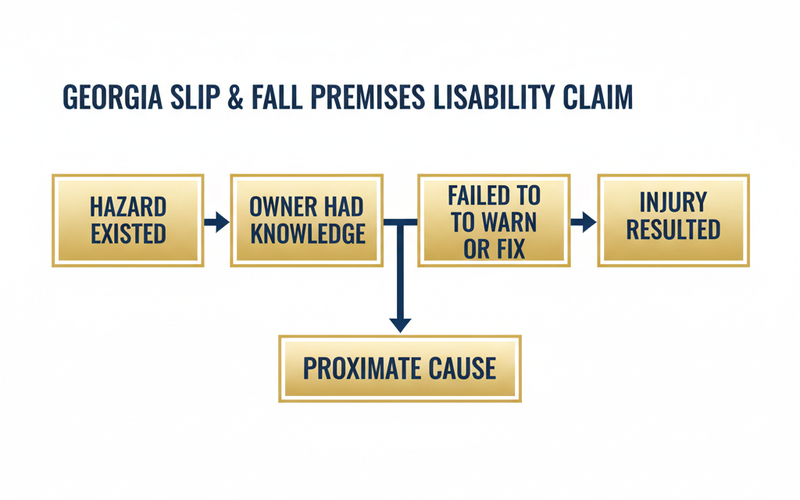
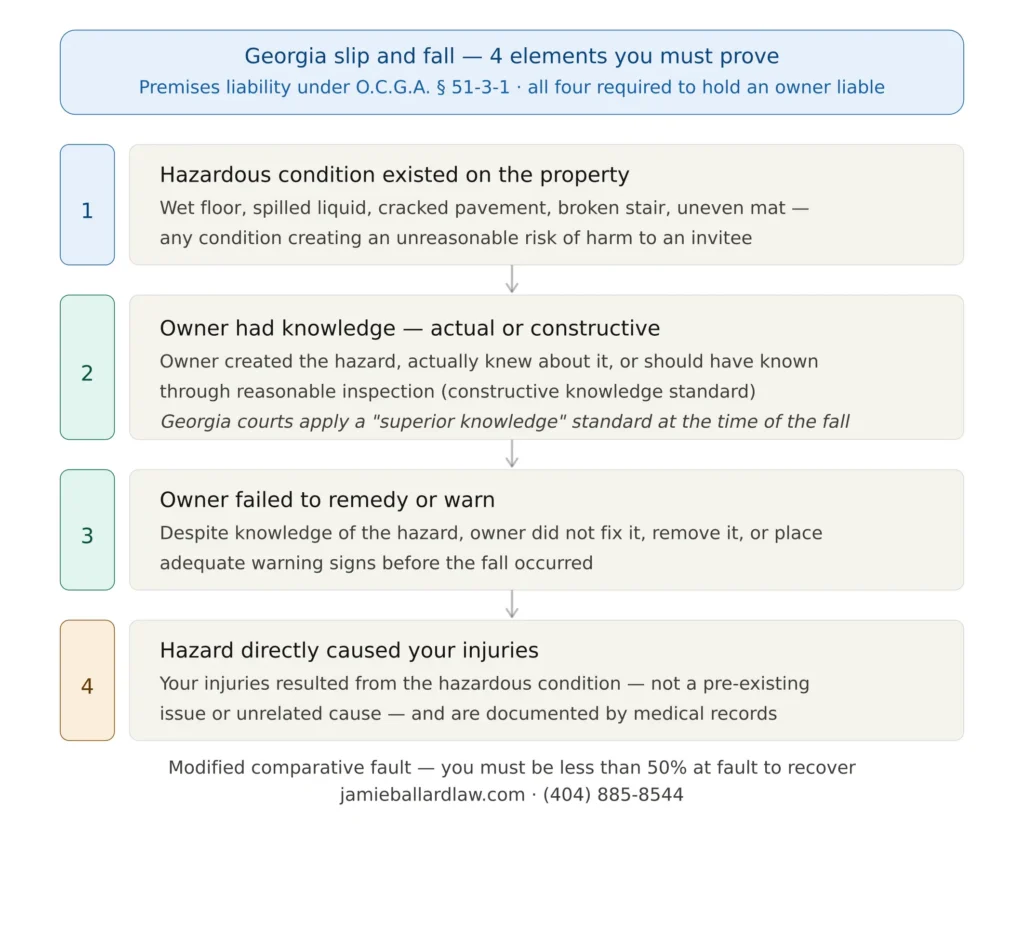
Georgia’s premises liability law requires property owners to maintain reasonably safe conditions for people who have a legal right to be on the property. Under O.C.G.A. § 51-3-1, an owner or occupier of land must exercise ordinary care to keep the premises safe for invitees — customers, guests, and others invited onto the property for business or social purposes.
Proving the Property Owner Knew About the Hazard
The biggest hurdle in Georgia slip and fall cases is knowledge. You must show that the property owner either created the hazard, knew about it, or should have known about it through reasonable inspection. Georgia courts apply a “superior knowledge” standard — the owner must have had greater knowledge of the danger than you did at the time of the fall.
Comparative Negligence in Georgia
Georgia follows a modified comparative negligence rule. According to the U.S. Occupational Safety and Health Administration, slip, trip, and fall incidents are among the leading causes of serious workplace and premises injuries nationwide — making liability standards in states like Georgia especially important. If you are found to be 50% or more at fault for the accident, you recover nothing. If you are less than 50% at fault, your damages are reduced proportionally. This is why the facts around your fall — where you were walking, whether there were warning signs, what you were doing — matter so much to the value of your claim.
For more on how Georgia’s negligence rules affect your case, the State Bar of Georgia offers plain-language resources on premises liability that injury victims can reference.
Practical rule: In Georgia, being 49% at fault still lets you recover. Being 50% at fault means you get nothing. That 1% line is worth fighting over — and it’s exactly what insurance adjusters try to push you past.
Average Slip and Fall Settlement Amounts Without Surgery in Georgia
There is no single number that applies to every case. But understanding the ranges helps you evaluate whether an offer you’ve received is reasonable.
Minor Soft Tissue Injuries
Sprains, strains, and bruising with a short treatment course of four to eight weeks typically settle in the range of $10,000 to $30,000 in Georgia. These cases resolve quickly, and the medical documentation is limited. Insurance companies treat them as nuisance claims and offer early settlements — often before you know the full extent of your injuries.
Moderate Injuries — Fractures, Disc Injuries, Ligament Damage
Cases involving fractures treated without surgery, herniated discs confirmed by MRI, or ligament tears documented by imaging typically settle in the range of $35,000 to $150,000 in Georgia, depending on treatment duration, impact on work, and age and health of the injured person. These are the cases where having a skilled personal injury attorney in Atlanta makes the largest measurable difference in outcome.

Severe Non-Surgical Injuries
Traumatic brain injuries without surgical intervention, severe spinal injuries managed conservatively, or permanent nerve damage can produce settlements of $200,000 to $500,000 or more even without a single surgery. The severity of impact on daily life — not the treatment method — is what drives the number at this level.
What Reduces a Non-Surgical Settlement
- Gaps in medical treatment (insurance companies argue the injury wasn’t serious)
- Pre-existing conditions affecting the same body part
- Documented comparative negligence on your part
- Weak liability evidence — no witnesses, no security footage, no incident report
- Delayed reporting of the fall to the property owner
| Injury Type | Typical Treatment | Georgia Settlement Range (No Surgery) |
|---|---|---|
| Soft tissue (sprain, strain) | PT, chiropractic, 4–8 weeks | $10,000 – $30,000 |
| Fractured wrist / ankle (no surgery) | Cast, PT, 8–12 weeks | $25,000 – $75,000 |
| Herniated disc (conservative care) | MRI, injections, PT, 3–6+ months | $50,000 – $150,000 |
| Torn ligament (no surgery) | Bracing, PT, injections | $35,000 – $100,000 |
| TBI (concussion, non-surgical) | Neurologist, cognitive therapy | $75,000 – $300,000+ |
| Permanent nerve damage | Neurology, pain management | $100,000 – $500,000+ |
Practical rule: Settlement ranges are only useful as a starting point. The actual value of your case depends on facts specific to your fall, your injuries, and the property owner’s liability exposure.
How to Build a Strong Non-Surgical Slip and Fall Claim
The single biggest factor in a non-surgical case is documentation. Without it, your claim is your word against the property owner’s insurer. With it, you have leverage.
Photograph Everything at the Scene
The hazard that caused your fall — a wet floor, cracked pavement, broken stair, uneven mat — may be repaired or cleaned up within hours. Photos taken immediately after the fall are often the only permanent record of what caused it. If you are physically able, photograph the hazard, the surrounding area, and any warning signs (or lack thereof) before you leave the property.
Report the Fall and Get a Written Record
Always report a slip and fall to the property manager or store manager on the day it happens. Ask for a copy of the incident report. If they refuse to give you one, write down the date, time, who you spoke to, and what they said. That paper trail matters when the insurer tries to claim they had no notice.
Seek Medical Attention Immediately
Go to an urgent care, emergency room, or your primary care physician the same day if possible — and no later than 24 to 48 hours after the fall. Delayed treatment creates a gap that insurance adjusters use to argue your injuries weren’t caused by the fall or weren’t serious. Every day you wait is a point the insurer will use against you.
Follow Your Treatment Plan Consistently
Insurance companies pull medical records and look for gaps. If your doctor recommends physical therapy twice a week and you attend once a week, the adjuster notes that as evidence the injury isn’t as serious as claimed. Consistency of treatment is one of the most powerful signals of injury severity in a non-surgical case — because without a surgery to point to, your treatment record becomes your primary evidence.
Document How the Injury Affects Your Daily Life
Keep a pain journal. Write down what you can’t do that you could do before — activities with your children, exercising, sleeping through the night, lifting things at work. Courts and juries understand human impact. A written record of that impact, created contemporaneously, is far more compelling than a general statement made months later at deposition.
Practical rule: Start a notes app entry the day after your fall. Write two to three sentences about your pain and limitations every day for the first month. That journal becomes evidence.
What Happens During the Claims Process
Understanding the timeline helps you avoid making costly mistakes while your case is open.
The Demand Letter
Once your treatment reaches maximum medical improvement (the point at which your condition has stabilized), your attorney prepares a demand letter. This document lays out the facts of the fall, the liability theory, your complete medical records, your total bills, your lost wages, and a demand figure. For moderate non-surgical cases, demand letters in Georgia typically open at two to four times the total medical bills plus lost income.
Negotiation and Counter-Offers
The insurer responds with a lower number. Your attorney counter-offers. This back-and-forth typically takes two to six weeks. Most Georgia slip and fall settlements without surgery resolve without filing a lawsuit — but having an attorney who has tried cases to verdict gives you leverage in that negotiation that an unrepresented claimant simply does not have.
Georgia’s Statute of Limitations
You have two years from the date of the fall to file a lawsuit in Georgia under Georgia’s statute of limitations for personal injury claims. Miss that deadline, and you lose the right to sue — no matter how strong your case is. Don’t wait.

For an overview of the most common slip and fall mistakes that hurt your claim’s value, this breakdown from New York injury attorney Arkady Frekhtman on top slip and fall mistakes covers principles that apply across states.
Special Cases That Affect Non-Surgical Settlement Value
Falls at Grocery Stores or Retail Chains
Grocery stores, big-box retailers, and chain restaurants have experienced claims teams and aggressive defense attorneys. They also have surveillance footage — which can help or hurt your case. If you fell at a Walmart, Kroger, Home Depot, or similar chain in Georgia, assume they have video of the incident. Your attorney needs to issue a litigation hold letter immediately to preserve that footage before it’s overwritten, which typically happens within 30 to 60 days.
Falls on Government Property
Falls on property owned by a Georgia city, county, or the state government involve different rules. You must file an ante litem notice — a formal pre-suit notice — within six months of the injury for county or municipal claims, or within 12 months for state claims. Miss that window and your claim is barred, regardless of merit. If your fall happened in a government-owned building, parking lot, or sidewalk, contact an attorney immediately.
Falls Involving Pre-Existing Conditions
If you had a prior back injury, knee problem, or hip issue before your fall, the insurance company will use that against you. Georgia’s eggshell plaintiff doctrine protects you here — a defendant must take you as they find you. If a hazardous condition aggravated a pre-existing condition and caused new damage or accelerated deterioration, you are entitled to compensation for that aggravation. A clear medical opinion distinguishing the pre-existing condition from the new injury is essential in these cases. The CDC’s falls data confirms that older adults with pre-existing conditions face the highest injury severity in slip and fall incidents — which supports both the liability argument and the damages claim.
Practical rule: Pre-existing conditions do not bar your Georgia slip and fall claim. They require better medical documentation — not a different outcome.
How Insurance Companies Fight Non-Surgical Slip and Fall Claims
Knowing the defense playbook helps you and your attorney prepare for it.
The Independent Medical Examination Tactic
After you file a claim, the property owner’s insurer may request that you submit to an Independent Medical Examination (IME) — performed by a doctor they choose and pay for. These exams are rarely independent in practice. IME doctors frequently minimize injury severity, attribute symptoms to pre-existing conditions, or recommend discharge from treatment earlier than your own physician does.
In Georgia, you are generally not required to submit to an IME in a personal injury case the way you are in a workers’ compensation claim. Your attorney can advise you on your rights before you agree to anything the insurer requests.
The Recorded Statement Trap
Shortly after your fall, the property owner’s insurance adjuster will call and ask for a recorded statement. They will be friendly, conversational, and reassuring. Do not give one without speaking to an attorney first. Adjusters are trained to ask questions that seem innocent but can lock you into answers used to reduce your settlement later — “Would you say the pain is mild, moderate, or severe?” asked in week one locks you into a description before your injuries have fully manifested.
Practical rule: You have no obligation to give a recorded statement to the property owner’s insurance company. Politely decline until you have legal representation.
The Low Early Offer
Many insurers make a fast, low offer — sometimes within days of the fall — before you know the full extent of your injuries, before you’ve completed treatment, and before you’ve spoken to an attorney. Accepting that early offer typically releases all future claims. If your herniated disc later requires injections, months of physical therapy, or becomes a chronic condition, you cannot go back for more. Never accept a first offer without knowing your total damages.
Disputing Causation
Even with clear liability, insurers frequently argue that your injuries weren’t caused by this fall. They order your prior medical records looking for any mention of back pain, knee issues, or neck problems — and argue the fall simply aggravated a pre-existing condition that would have progressed anyway. Georgia’s eggshell plaintiff doctrine addresses this, but you need a physician who can articulate clearly that the fall caused a new injury or materially worsened a previously stable condition.
Working With a Georgia Slip and Fall Attorney
You are not required to hire an attorney to pursue a slip and fall claim in Georgia. But the data is consistent — represented claimants recover significantly more than those who negotiate alone.
What an Attorney Actually Does for Your Case
A Georgia personal injury attorney handles the evidence preservation, the liability investigation, the medical record collection, the demand letter, and the negotiation — while you focus on getting better. They also know what the case is worth based on comparable Georgia verdicts and settlements, which gives them the credibility to push back against lowball offers with specific numbers, not just frustration.
For a wrongful death arising from a fall, or a case involving traumatic brain injury caused by a fall, the complexity increases significantly and representation becomes even more important. The U.S. Department of Justice notes that injury victims who navigate legal claims without representation are at a consistent disadvantage in settlement negotiations.
Contingency Fees — No Upfront Cost
Georgia personal injury attorneys work on contingency. You pay nothing unless you recover. The fee is a percentage of the settlement — typically 33% pre-lawsuit and 40% if the case goes to trial. If the case resolves for nothing, you owe nothing. This means there is no financial barrier to getting proper legal help after a slip and fall — regardless of your income, employment status, or health insurance situation.
Practical rule: The contingency fee model means your attorney only gets paid if you do. Their incentive is exactly aligned with yours: maximize your recovery.
Frequently Asked Questions — Slip and Fall Settlements Without Surgery in Georgia
| Question | Answer |
|---|---|
| Can I get a significant settlement without surgery? | Yes. Many Georgia slip and fall settlements without surgery range from $35,000 to $150,000+ for moderate injuries, depending on documentation and liability. |
| How long does a non-surgical slip and fall claim take? | Most settle within 6 to 18 months. Cases with clear liability and strong medical records resolve faster. |
| What if my injuries appeared days after the fall? | Delayed onset is common with soft tissue and spinal injuries. See a doctor as soon as symptoms appear and document that the fall caused them. |
| Do I need an attorney for a slip and fall claim? | You don’t legally have to, but studies consistently show represented claimants recover 3 to 4 times more than unrepresented ones on the same type of injuries. |
| What if the store says I was partially at fault? | Georgia’s comparative negligence rule reduces your recovery proportionally. If you’re under 50% at fault, you still recover. An attorney can argue your fault percentage down. |
| Can I still recover if I didn’t report the fall at the scene? | Yes, but it hurts your case. Document and report as soon as possible, and gather witness information if available. |
| How does pain and suffering factor into a non-surgical settlement? | Pain and suffering typically represents the largest portion of a slip and fall settlement. In Georgia, there is no cap on non-economic damages in most personal injury cases. |
| What if the property was poorly lit or had no warning signs? | That strengthens your liability case significantly. Property owners have a duty to warn of known hazards. No warning sign is evidence of negligence. |
What Your Slip and Fall Settlement Could Actually Look Like in Georgia
Slip and fall settlements without surgery in Georgia are real, they are meaningful, and they are worth pursuing — but only if you treat consistently, document thoroughly, and work with an attorney who understands how to counter the “no surgery, no value” argument from day one. Jamie Ballard Law has recovered significant settlements for Georgia slip and fall victims without a single surgery involved. Call (404) 885-8544 or visit the contact page for a free consultation — and find out what your case is actually worth.
About Jamie Ballard Law
Jamie Ballard Law is an Atlanta-based personal injury firm representing injured Georgians in slip and fall accidents, car crashes, wrongful death claims, and premises liability cases. The firm serves clients across Atlanta and the surrounding metro area, fighting to recover maximum compensation for every client — surgical or not.