When you get hurt on someone else's property, figuring out what to do next can feel like a lot to handle. A helpful premises liability attorney in Atlanta is your advocate, the person who helps you hold negligent property owners accountable when they fail to keep you safe. From a slip and fall in a grocery store to an injury caused by inadequate security, these cases are about basic fairness. When a property owner’s carelessness causes real harm, they should be held responsible for the damage they've caused.
What Exactly Is Premises Liability in Georgia?
Think of it this way: if you invite a guest to your home, you have a basic responsibility to warn them about a loose floorboard you’ve known about for weeks. Georgia’s premises liability law applies that same commonsense idea to businesses and property owners across Atlanta. It's the legal principle that says they are accountable when their failure to maintain a safe environment leads to someone getting hurt.
This isn't about looking for someone to blame. It's about responsibility. When a store manager mops a floor but fails to put up a 'wet floor' sign, or a parking garage owner neglects to fix broken lights in a dark stairwell, they create foreseeable dangers. If you're injured because of that kind of negligence, you need guidance from a premises liability attorney in Atlanta to clarify your rights.
The Core Concept: Duty of Care
At the heart of every premises liability claim is a legal concept called "duty of care." This is the official obligation a property owner has to protect visitors from predictable harm. The level of that duty changes based on why you're on the property, but for customers and invited guests, the owner has an active duty to find and fix potential hazards.
To build a successful case, your attorney generally needs to prove four things:
- The property owner owed you a duty of care.
- The owner breached that duty through unreasonable action or inaction.
- That failure directly caused your injury.
- You suffered actual damages, like medical bills and lost wages, as a result.
A key question in most Georgia cases is whether the property owner had "superior knowledge" of the hazard. This means they knew—or reasonably should have known—about the danger when you, the visitor, did not.
Getting a handle on these foundational ideas is the first step. For a deeper dive into legal terms, our firm offers a helpful legal dictionary to translate the jargon often used in personal injury cases.
How Common Are These Incidents?
You might be surprised at how often these injuries happen. Premises liability incidents are the second-most common type of civil lawsuit in the country, right behind car accidents.
Data from the Bureau of Justice Statistics shows that 17% of these cases stem directly from poorly maintained or hazardous properties. And in a staggering 75% of these claims, the defendant is a business—not an individual homeowner. This is exactly why victims need skilled legal representation to level the playing field.
The law exists to make sure businesses that open their doors to the public take reasonable steps to protect people. When they don't, a dedicated premises liability attorney in Atlanta can help you secure the compensation you need to recover and move on.
How Georgia Law Defines a Property Owner's Duty
When you get hurt on someone else’s property, the strength of your case boils down to one simple question: why were you there? Georgia law is very specific about this, and a property owner’s legal responsibility—their "duty of care"—is determined entirely by your status as a visitor.
Think of it like being invited to a party. The law sorts visitors into three distinct categories, and the owner’s obligations are different for each one. This classification is the first thing a skilled premises liability attorney in Atlanta will establish.
The Three Types of Visitors in Georgia
Figuring out which group you belong to is the foundation of any premises liability claim. It sets the legal standard for what the owner should have done to protect you.
-
Invitees: This is someone invited onto a property for the owner's financial benefit. Invitees get the highest level of protection under the law. Think of a shopper at Ponce City Market or a fan at a Braves game at Truist Park. Property owners must actively inspect their premises for dangers, fix them, and warn you about any potential hazards they know about or should know about.
-
Licensees: A licensee is a social guest—someone on the property for their own reasons, but with the owner's permission. A friend you invite over for a cookout at your home in Virginia-Highland is a perfect example. The owner's duty is lower here. They only have to warn a licensee of known dangers, not actively look for hidden ones.
-
Trespassers: A trespasser is on a property without any permission. Property owners owe almost no duty to a trespasser, except to avoid willfully or wantonly injuring them once they know they are there.
This flowchart shows exactly how an owner's duty can lead to negligence and, unfortunately, an injury.
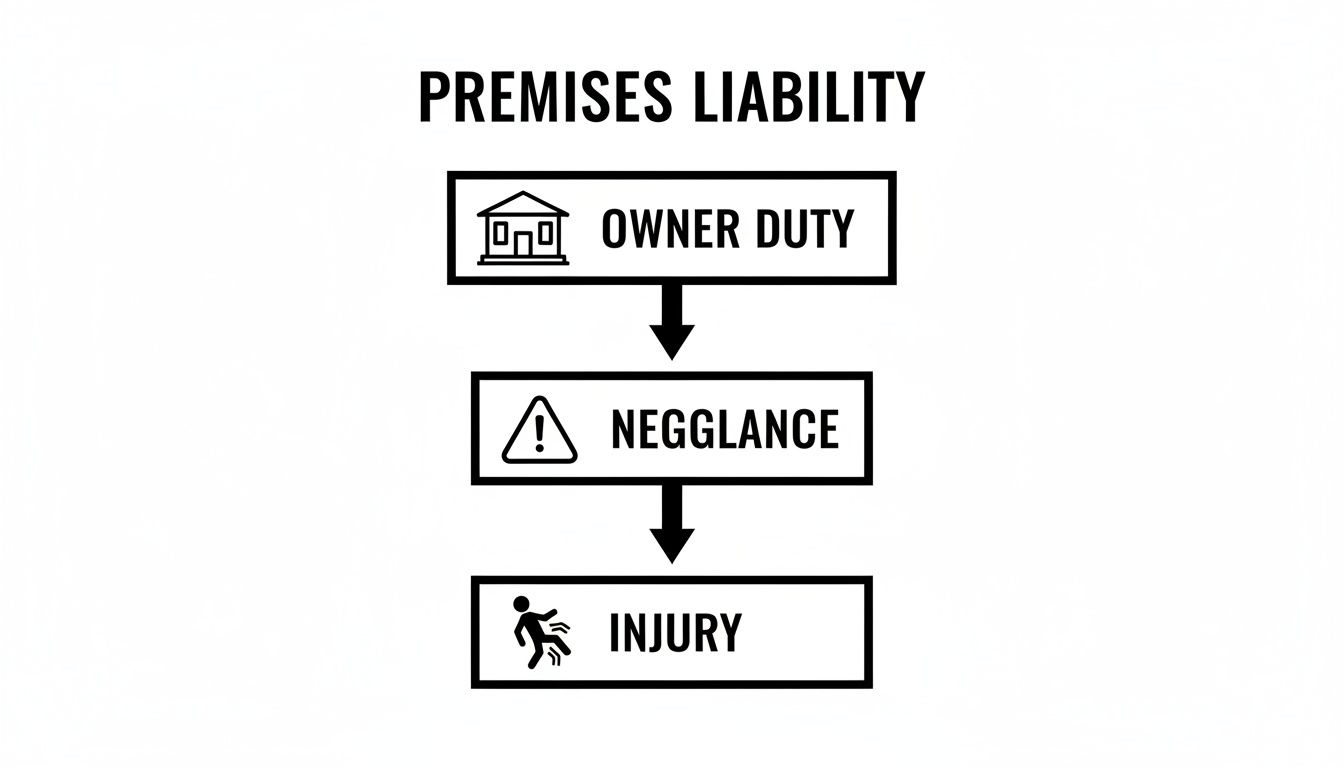
As you can see, a breach of that duty is the link between the owner's responsibility and the harm you suffered.
Proving What the Owner Knew
Once your visitor status is clear, the next hurdle is proving the owner was negligent. In Georgia, this comes down to showing the owner had actual or constructive knowledge of the dangerous condition that hurt you.
- Actual Knowledge is straightforward: the owner or their employees knew the hazard existed. For example, a grocery store employee sees a spill in an aisle and just walks away.
- Constructive Knowledge is more nuanced. It means the hazard was there for so long that the owner should have known about it if they were being reasonably careful. A rickety staircase railing that’s been loose for months fits this description perfectly.
Georgia law, specifically O.C.G.A. § 51-3-1, requires property owners to exercise "ordinary care" to keep their premises safe for invitees.
In plain English, "ordinary care" means taking the same precautions a reasonably sensible person would under the same circumstances.
Recent decisions from the Georgia Supreme Court have made it more likely for these cases to go before a jury instead of being thrown out by a judge early on. While it's true that only about 5% of personal injury cases ever reach a trial, this shift gives injured people more leverage to negotiate fair settlements. An experienced lawyer who stays current on recent legal trends in Georgia premises liability can use this to build a much stronger case for you.
Ultimately, your visitor status and the evidence proving the owner’s knowledge are the building blocks of a successful claim. A sharp premises liability attorney in Atlanta knows exactly how to gather the proof—from security footage and incident reports to maintenance logs—to hold the negligent property owner accountable.
Common Premises Liability Claims We See in Atlanta
Legal concepts like "premises liability" can feel pretty abstract until you see them in the real world. When someone in Atlanta needs to call our firm, it's never about a legal theory—it's because something specific, painful, and tangible just happened to them.
These incidents are an everyday reality across our city, from restaurants in Midtown to big-box stores in the suburbs. Looking at the most common types of cases helps connect the dots between a property owner's negligence and the injury you're now dealing with.

Slip and Fall or Trip and Fall Incidents
This is the classic scenario everyone pictures, and for good reason—it’s incredibly common. A "slip and fall" is just what it sounds like, usually involving a slick surface. A "trip and fall" is caused by an obstacle or uneven ground. These are not minor tumbles; we've seen them result in broken bones, traumatic brain injuries, and life-altering spinal cord damage.
Examples of property owner negligence we often see include:
- Failing to mop up a spilled drink or fix a leaking freezer case at the grocery store.
- Leaving boxes, electrical cords, or merchandise cluttering an aisle where people have to walk.
- Ignoring cracked pavement in a parking lot, a gaping pothole, or torn carpeting in a hotel lobby.
In every case, the important question is whether the owner knew (or should have known) about the danger and did nothing to fix it or at least warn people. If this happened to you, knowing the details matters. You can learn more about how an Atlanta slip and fall attorney builds these specific claims.
Negligent or Inadequate Security
Property owners have a responsibility to take reasonable steps to protect visitors from foreseeable crimes. When they drop the ball and someone gets robbed, assaulted, or worse, it’s called negligent security. This is a huge issue in places like apartment complexes, parking garages, hotels, and ATM vestibules.
In Georgia, an owner’s duty to provide security is often triggered by a history of similar crimes on or near the property. If they know about a pattern of criminal activity, they can't just throw their hands up and ignore it.
Examples of inadequate security usually involve:
- Poor Lighting: Criminals love dark corners. Unlit parking lots or stairwells are an open invitation for an attack.
- Broken Locks and Gates: A security gate at an apartment complex that’s always stuck open is a clear failure of duty. So is a broken lock on a hotel room door.
- Lack of Security Guards: In high-crime areas or at large events, the absence of visible security personnel can be considered negligent.
- Dummy Surveillance Cameras: Installing cameras that don’t record gives a false sense of security and does nothing to deter crime or help catch perpetrators.
These cases require a deep-dive investigation to prove the owner’s failure to provide proper security directly led to the harm you suffered.
A Closer Look at Common Injury Scenarios
While falls and poor security are the big ones, a property owner's negligence can show up in many other ways. The table below breaks down a few common situations we handle and what owner negligence looks like in each.
| Scenario | Location Example | Example of Owner Negligence |
|---|---|---|
| Dog Bites | A neighbor's yard, public park | Letting a known-aggressive dog run loose without a leash, violating local ordinances. You can find more about these at the State of Georgia's Department of Agriculture site. |
| Swimming Pool Accidents | Apartment complex, hotel, public pool | Failing to install or maintain a self-latching gate and proper fencing, leading to a child's injury. |
| Elevator/Escalator Failure | Office building, shopping mall | Neglecting required maintenance, causing an elevator to drop suddenly or an escalator to stop abruptly. |
| Falling Merchandise | Home improvement or warehouse store | Stacking heavy items improperly on high shelves, causing them to fall and strike a shopper below. |
| Faulty Stairwells | Commercial building, apartment complex | Failing to repair a broken handrail or maintain uniform step height, causing a serious fall. |
Anytime an unsafe condition on someone else's property causes an injury, it’s worth exploring your legal options. Recognizing these patterns is the first step toward understanding your rights. If you believe your injury was preventable, an experienced premises liability attorney in Atlanta can help you figure out the best path forward.
Your First Steps After an Injury on Someone Else's Property
The moments immediately following an injury on another person's property are often confusing and disorienting. However, the actions you take in this important window can significantly impact your physical recovery and your ability to secure compensation. From a legal standpoint, a well-documented premises liability case begins the second the incident occurs.
Following a clear, methodical process isn't about being confrontational; it's about protecting your rights and preserving important evidence before it disappears.

An Actionable Checklist for Right After an Accident
To maintain focus during a stressful event, follow this step-by-step guide. Each action is designed to protect your health and the integrity of your potential claim.
1. Get Medical Help Immediately
Your health is the first priority. Seek a medical evaluation without delay, even if you believe your injuries are minor. Serious conditions like internal bleeding or traumatic brain injuries may not present immediate symptoms. Prompt medical attention creates an official record that directly links your injuries to the time and place of the incident—an important piece of evidence.
2. Report the Incident to the Property Owner or Manager
Before leaving the premises, formally notify the manager, owner, or other responsible party of what happened. Request that they file a formal incident report and ask for a copy for your records. State the facts clearly and concisely. Do not speculate on the cause or admit any fault.
3. Document the Scene Thoroughly
If you are physically able, use your smartphone to take extensive photos and videos of the scene.
- Capture the Hazard: Photograph the specific condition that caused your injury—a wet floor, a broken handrail, poor lighting, or an icy walkway.
- Show the Surroundings: Take wide-angle shots to provide context, paying special attention to the absence of any warning signs or barriers.
- Photograph Your Injuries: Document any visible cuts, bruises, or swelling you sustained.
This visual evidence is often invaluable, as hazardous conditions are frequently cleaned up or repaired shortly after an accident occurs.
According to the Centers for Disease Control and Prevention (CDC), falls are a leading cause of injury in the United States. Documenting the scene is your best tool to prove that a preventable hazard, not just clumsiness, was the cause.
4. Collect Witness Information
If anyone else observed the incident, ask for their name and contact information (phone number or email). Independent witness testimony can corroborate your account and counter any attempts by the property owner to dispute the facts.
5. Preserve Key Physical Evidence
The clothing and shoes you were wearing at the time of the incident are physical evidence. Store them in a safe place and do not wash them. The soles of your shoes, for instance, may hold residue from a substance you slipped on, which can be analyzed to prove your claim.
6. Be Cautious with Insurance Adjusters
You may be contacted quickly by the property owner's insurance company. Their objective is to minimize the company's financial liability. Politely decline to provide a recorded statement or sign any documents until you have consulted with an attorney. Anything you say can be used to undermine your claim later.
Taking these steps helps build a strong foundation for your case. If you have questions about your situation, contact our team for a free case evaluation. A knowledgeable premises liability attorney in Atlanta can advise you on the path forward.
How an Attorney Builds Your Case for Fair Compensation
When you hire a premises liability attorney in Atlanta, we begin a methodical process designed to build a powerful case. It’s not about finding one single piece of evidence; it’s about systematically assembling a clear and undeniable picture of the property owner’s negligence. The goal is to prove exactly what happened, why it happened, and what you need to recover.
Our first move is a deep-dive investigation. Evidence can vanish quickly, so we work immediately to preserve it. This involves sending formal legal notices to the property owner, demanding they hold onto important items like surveillance footage, maintenance logs, or internal incident reports. We also move fast to find and interview witnesses while their memories are sharp, capturing firsthand accounts of the hazardous conditions that led to your injury.
The Four Pillars of a Negligence Claim
Every successful premises liability case is built on four legal pillars. Our job is to construct a solid argument for each one, leaving no room for doubt.
- Duty: First, we establish that the property owner owed you a legal duty of care. As discussed, this is usually straightforward if you were a customer or invited guest (an “invitee”).
- Breach: Next, we prove the owner breached that duty. Evidence is key here. We might use maintenance records to show they ignored a faulty staircase for months or use witness testimony to confirm a spill was left uncleaned for far too long.
- Causation: We then draw a direct line from the owner's failure to your injury. The evidence must show that but for their negligence, you would not have been hurt.
- Damages: Finally, we document the full scope of your losses—the physical, financial, and emotional harm you’ve suffered as a result.
Together, these elements form the legal foundation required to hold a negligent property owner accountable.
Gathering the Right Evidence
Building these pillars requires a broad range of evidence. Think of it like a puzzle—each piece strengthens the overall picture of what happened. We typically rely on a combination of proof.
- Official Reports: Any incident report filed with the property manager and any police reports called to the scene.
- Visual Documentation: Your photos and videos are a starting point. We then formally request all surveillance footage from the property owner.
- Expert Testimony: In some cases, we bring in experts. A safety engineer can testify about building code violations, or a security consultant can explain why an apartment complex’s safety measures were inadequate.
Accountability for property owners is growing. In 2023, Atlanta-area law firms secured over $150 million in personal injury verdicts and settlements, with a significant $50 million from premises liability cases alone. This trend highlights the importance of holding owners responsible for unsafe conditions. You can read more about these Atlanta premises liability outcomes.
Calculating Your Full Damages
Fair compensation means accounting for every single loss, not just the obvious medical bills. A thorough medical record review is fundamental to this process. It helps us understand the full extent of your injuries and project the total cost of your recovery.
Damages are generally separated into two categories:
- Economic Damages: These are your tangible, out-of-pocket financial losses. They include all past and future medical bills, lost wages from time off work, and any reduction in your future earning capacity.
- Non-Economic Damages: These compensate for the intangible but very real human toll of the injury. This includes your physical pain and suffering, emotional distress, and the loss of enjoyment of life.
We carefully calculate both types of damages to ensure our settlement demand reflects the true scope of what you’ve lost. While most cases are resolved through skilled negotiation, we prepare every case as if it will go to trial. This meticulous preparation gives you leverage and shows the insurance company we are serious about getting you the justice you deserve. A skilled premises liability attorney in Atlanta is your partner, handling every detail so you can focus on what matters most: your recovery.
Common Questions About Atlanta Premises Liability Claims
After you’ve been hurt on someone else’s property, it’s only natural for your mind to race with questions about what to do next. Getting clear, direct answers is the first step toward feeling in control again. We've put together this FAQ to tackle the most pressing concerns we hear from people across Atlanta, breaking down your rights and the legal road ahead.
How Long Do I Have to File a Premises Liability Lawsuit in Georgia?
This is easily one of the most important questions, and for good reason—the clock is ticking. In Georgia, the deadline to file most personal injury lawsuits, including premises liability claims, is generally two years from the date the injury happened.
This deadline is called the statute of limitations, and it’s codified in Georgia Code § 9-3-33. It is an absolute cutoff. If you file a lawsuit even a single day after that two-year window slams shut, the court will almost certainly throw out your case. You lose your right to seek compensation forever. While a few rare exceptions might apply, it’s always safest to act long before that deadline is on the horizon. For a deeper dive into this timeline, you can learn more about the statute of limitations for personal injury in Georgia on our site.
What if I Am Blamed for Part of the Accident?
Don't be surprised if the property owner or their insurance company tries to shift some of the blame onto you. It’s a standard defense tactic. Fortunately, Georgia law has a specific rule to address this exact scenario: modified comparative negligence.
Under O.C.G.A. § 51-12-33, you can still recover compensation as long as a court finds you were less than 50% at fault for what happened. Your final compensation award is simply reduced by whatever percentage of fault is assigned to you.
- For example: Imagine a jury awards you $100,000 but decides you were 10% at fault—maybe you were glancing at your phone when you slipped. Your award would be reduced by that 10%, leaving you with $90,000.
- The Cutoff: However, if you are found to be 50% or more at fault, you are legally barred from recovering any money at all.
A skilled attorney’s job is to build a strong case and gather the evidence needed to push back against unfair claims of fault, protecting your right to a fair recovery. There are many personal injury lawyer SEO strategies firms use to get their message out, but defending clients against unfair blame is where the real work happens.
How Much Does It Cost to Hire a Premises Liability Attorney?
The financial stress that follows an injury is a massive burden. The good news is that you don't need money upfront to get expert legal help. Nearly all personal injury attorneys, including our firm, work on a contingency fee basis.
Here’s what that means for you:
- You pay zero attorney's fees to get started.
- We advance all the costs required to build and pursue your case, from hiring expert witnesses to paying court filing fees.
- Our payment is a pre-agreed percentage of the settlement or verdict we win on your behalf.
- If we don’t win your case, you owe us absolutely nothing in attorney’s fees.
This model levels the playing field, ensuring everyone has access to top-tier legal representation regardless of their financial situation. Most firms also offer a free, no-obligation case evaluation to help you understand your options from the very beginning.
What Kind of Compensation Can I Recover?
The entire point of a premises liability claim is to secure financial compensation—known legally as damages—to cover every single loss you’ve suffered. These damages are generally split into two main categories.
Economic Damages: These are your tangible, out-of-pocket financial losses. Think of things you can add up with a calculator: all past and future medical bills, lost wages from being unable to work, diminished earning capacity if you can't return to your old job, and other related expenses.
Non-Economic Damages: These are designed to compensate you for the very real, but less tangible, human cost of the injury. This includes physical pain and suffering, emotional distress and trauma, permanent scarring or disfigurement, and the loss of enjoyment of life.
In very rare situations where a property owner's conduct was especially reckless or showed a conscious disregard for the safety of others, a jury may also award punitive damages. These aren't meant to compensate you for a loss but to punish the defendant and send a clear message that such behavior won't be tolerated. A meticulous premises liability attorney in Atlanta will document every one of your losses to build a comprehensive demand for the full compensation you deserve.
If you've been injured on someone else's property and still have questions, the team at Jamie Ballard Law is here to help. We offer a free, no-pressure case evaluation to listen to your story, explain your rights, and help you figure out the best path forward. Visit us at https://jamieballardlaw.com to get started.