Back injury settlements workers compensation usually becomes urgent the moment you get home from work, sit down, and realize the pain is not easing up. In Atlanta, I see the same pattern over and over. A warehouse worker twists while lifting. A nurse feels a sharp pull helping a patient. A driver spends weeks loading and unloading until the ache turns into something worse. Then the questions hit fast. Who pays for treatment? How do checks start? Should you trust the adjuster? And what is a fair workers comp back injury settlement in Georgia?
If that is where you are right now, start with this: do not guess, do not wait, and do not treat this like a minor strain until someone with authority writes it down. A back injury claim is only as strong as the record you build from day one. The insurer already has a process. You need one too.
Your First Steps After a Workplace Back Injury
Marcus works in Fulton County. He lifted a heavy item, felt a hot stab in his lower back, and tried to finish the shift. By that night, he could barely get out of bed. The next morning, he did what many good workers do. He told himself he would “see how it feels.”
That is a mistake.
Report it fast and report it clearly
In Georgia, your first move is simple. Tell your employer the injury happened at work. Do it right away and do it in a way that can be tracked. Email is good. Text can help. A written incident report is better.
Keep it plain:
- State what happened: “I hurt my back lifting inventory on the loading dock.”
- State when it happened: Give the date and approximate time.
- State what you felt: Sharp pain, radiating pain, numbness, spasms, stiffness.
- State that you need medical care: This matters.
Do not give a speech. Do not speculate. Do not say, “It’s probably nothing.” Insurers love those words.
Get medical treatment through the authorized channel
Georgia workers’ comp cases often turn on one practical issue early. Did you treat with an authorized doctor? Your employer should have a posted panel of physicians. If there is a valid panel, use it.
If you skip that and run to your own doctor without understanding the setup, you can create an avoidable fight over bills and causation.
Look for:
- The posted panel at work: Often in a break room, HR area, or another employee notice space
- The authorized clinic or physician listed by the employer
- Written directions from HR or the carrier
If your employer never gave you the panel, never posted one, or sent you in circles, document that too.
Practical advice: After every conversation with a supervisor, HR, or adjuster, send a short follow-up email confirming what was said. That creates a timeline before memories change.
Know the form that starts formal action
A lot of workers hear about the WC-14 only after problems start. That form is used to request a hearing or take formal action before the Georgia State Board of Workers’ Compensation. You may not need it on day one. You absolutely need to know it exists if checks are delayed, treatment is denied, or your injury is disputed.
Useful official resources include the Georgia State Board of Workers’ Compensation and the U.S. Department of Labor workers’ compensation overview.
Build your file before the insurer builds theirs
Start a folder today. Paper, digital, or both.
Put in it:
- Incident report copies
- Emails and texts with work
- Work restrictions
- Doctor visit summaries
- Prescription receipts
- A pain and symptom journal
That last one matters more than people think. Write down what you cannot do. Sleeping. Driving. Bending. Sitting through dinner. Picking up your child. Those daily limits often explain your case better than a stack of billing records.
How Workers Comp Back Injury Settlements Are Calculated
Most injured workers think settlement numbers come out of thin air. They do not. The insurance company is looking at categories, records, work status, medical opinions, and future risk. You should be doing the same.
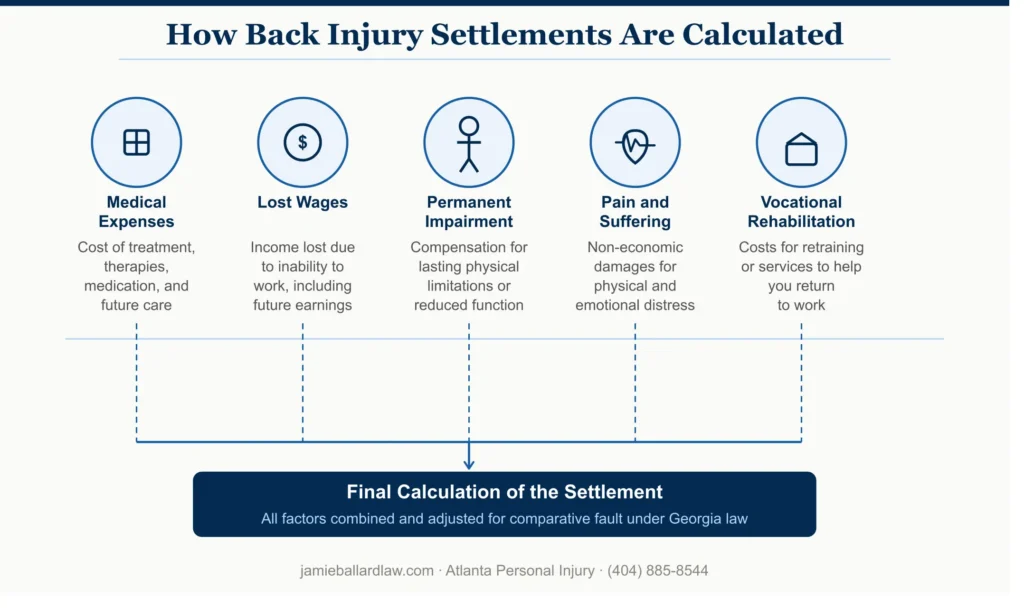
Start with the three big building blocks
In Georgia, a back injury settlement usually rests on three core parts.
-
Medical care
This includes authorized treatment tied to the work injury. Office visits, imaging, therapy, injections, medications, and in some cases surgery. -
Lost wage benefits
If your doctor takes you fully out of work, that can trigger weekly income benefits. If you return on restricted duty at lower pay, partial wage benefits may be part of the picture. -
Permanent partial disability
Once you reach Maximum Medical Improvement, often called MMI, the treating doctor may assign an impairment rating. That rating can affect settlement value because it represents lasting physical loss.
If legal terms are tripping you up, a plain-English workers comp legal dictionary can help you decode the language adjusters and forms use.
What the data says about back injury value
For a grounding point, the National Safety Council reported an average workers’ compensation claim for a lower back injury of $39,328, including $17,643 for medical care and $21,685 for indemnity benefits like lost wages. The same reporting notes that 9% of cases exceeded $60,000, especially when surgery or significant disability was involved according to this Lawyers.com summary of workers comp back injury settlement data.
That does not mean your case is “worth the average.” A mild strain and a surgical disc injury are different claims. Treat averages as context, not a price tag.
What pushes the number up or down
Settlement value usually moves based on facts, not sympathy.
Factors that often matter:
- Type of back injury: A strain is not the same as a disc injury with nerve symptoms.
- Treatment path: Conservative care and surgery are valued differently.
- Time out of work: Longer disability usually means higher exposure for the insurer.
- Work restrictions: Permanent lifting, bending, or standing restrictions change the case.
- Credibility of the medical record: Clean, consistent records help. Gaps hurt.
- Future medical risk: If there is a real chance you will need more treatment later, closing medical benefits becomes more expensive for you and more valuable in negotiation.
Georgia math is not the whole story
Workers’ comp is not a pain-and-suffering case against your employer. That surprises a lot of people. The settlement conversation is usually tied to wage benefits, medical exposure, permanency, and future care. That is why the strongest demand packages are evidence-heavy, not emotional.
Bottom Line: A fair number usually appears only after treatment develops the record. If you settle before your diagnosis, restrictions, and prognosis are clear, you are negotiating blind.
A simple way to think about it
Ask these questions:
- What has the insurer already paid or likely must pay?
- How long will wage exposure continue if the claim stays open?
- What does the medical record say about future treatment?
- Is the doctor assigning permanent restrictions or impairment?
- Would you be giving up open medical benefits that may matter later?
That forms the core of settlement analysis in Georgia.
Gathering Medical and Vocational Evidence That Matters
The cases that settle well are usually the cases that are documented well. Pain matters, but proof moves value.

Your treating doctor and the insurer doctor are not the same thing
Your treating physician follows your condition over time. That doctor sees your complaints, imaging, progress, setbacks, and restrictions in sequence. That longitudinal view often tells the complete story.
The insurer’s Independent Medical Exam, or IME, is different. It is often a one-time evaluation used to challenge treatment, disability status, causation, or permanency. Some IMEs are fair. Some are built to narrow the claim.
If an IME says you are fine but your treating records show repeated muscle spasm, reduced range of motion, radiating symptoms, and failed conservative care, that conflict has to be addressed directly. Ignoring it is a mistake.
Objective evidence changes the conversation
Insurers dispute back claims because back pain can sound subjective. Your job is to make the file less subjective.
The strongest evidence often includes:
- MRI findings: Imaging can support disc issues, nerve involvement, or other structural injury.
- Consistent exam findings: Reduced range of motion, weakness, sensory changes, positive testing.
- Work restriction notes: Lifting, sitting, standing, climbing, twisting, or driving limits.
- Treatment chronology: Physical therapy, injections, medications, referrals, and response.
- A Functional Capacity Evaluation: This can measure what you can and cannot physically do in a work setting.
Why impairment ratings matter
An impairment rating can become a major influential factor in a back case. Average workers’ comp settlements for a back injury, a 10-15% whole person impairment rating, common after a spinal fusion, can translate to 50-100 weeks of compensation payments. The same source notes that securing objective evidence like MRIs and Functional Capacity Evaluations is essential, and claims involving surgery can result in payouts two to three times higher than those involving only conservative care.
That is why I tell clients not to obsess over the adjuster’s early opinion. The adjuster is reacting to the file in front of them. Change the file, and you often change the negotiation.
Vocational evidence can make a mediocre file strong
A lot of people stop at medical records. That leaves money on the table.
If your injury keeps you from returning to the kind of work you have always done, vocational evidence matters. A vocational expert can explain how your restrictions affect actual job options in the Atlanta market. Not fantasy jobs. Real jobs.
Examples:
- A delivery worker with permanent lifting limits may no longer fit the job they spent years doing.
- A construction worker with bending and climbing restrictions may be employable in theory but not in their actual field.
- A worker with chronic sitting intolerance may struggle in office-based alternatives too.
Practical advice: If the record says “light duty,” push for detail. How much lifting? How much standing? How much sitting? Vague restrictions help insurers. Specific restrictions help workers.
Lump Sum Payout or Weekly Checks Which Is Right for You
Many injured workers become trapped here. They are tired of dealing with adjusters, tired of delayed approvals, and tired of uncertainty. Then the insurer offers one check to make the case disappear.
Sometimes that is the right move. Sometimes it is expensive surrender dressed up as relief.

The Primary Tradeoff in Georgia
A lump-sum settlement gives you money now and usually closes the claim. That often means you are giving up future medical coverage tied to the back injury.
A structured result with open medicals may leave some benefits running or preserve medical treatment while paying disability benefits in a more limited way. For some workers, that is the safer path.
That is the issue. Not whether the check looks good this week. Whether it still looks good if your back worsens later.
Lump-Sum vs. Structured Settlement in Georgia
| Feature | Lump-Sum Settlement | Structured Settlement with Open Medicals |
|---|---|---|
| Money now | Usually provides immediate access to funds | Usually less immediate cash freedom |
| Future medical treatment | Often closed out | May stay open depending on terms |
| Dealing with insurer later | Usually ends | May continue for treatment issues |
| Risk if condition worsens | Falls more on you | More protection if future care is needed |
| Budget pressure | Higher, because one payout must last | Lower if benefits continue in part |
| Best fit | Stable prognosis and clear future plan | Uncertain medical future or ongoing treatment |
Ask these questions before you sign anything
- Has your doctor finished the workup?
- Are surgery, injections, or long-term pain management still on the table?
- Do your restrictions affect your old job permanently?
- Can you manage a lump sum carefully if weekly checks stop?
- Would keeping medical open protect you better than more money now?
A lot of workers focus on the settlement amount and ignore the rights they are giving up. That is backwards. The rights are the primary value.
Effective Strategies for Your Settlement Negotiation
The first settlement offer is often a test. It is not a verdict on your case.
If the insurer thinks you are tired, behind on bills, or unclear about your medical future, the offer usually reflects that. A weak response invites another weak offer. A disciplined response changes the tone.
Do not negotiate from pain. Negotiate from paper.
The insurance company values what it can point to in the file. You need a demand that ties together:
- the diagnosis,
- the treatment path,
- the work restrictions,
- the wage loss,
- the impairment evidence,
- and the future medical risk.
A strong demand package is organized. It includes the records that matter most. It does not ramble. It does not exaggerate. It shows why closing the case now shifts meaningful future risk from the carrier to you.
Use recognized cost benchmarks intelligently
According to the National Safety Council workers’ compensation cost data, the average cost for spine-related injuries in 2022-2023 was $90,043. The same data point is useful in negotiation because a 12% impairment rating could translate to a base award of nearly $50,000 before future medical costs or lost earning capacity projections are added.
That does not mean every spine case should settle at that figure. It means insurers know spine injuries can be expensive, and your demand should force them to deal with the actual risk in your file instead of pretending your claim is a routine strain.
Good negotiation habits that work
- Wait for enough medical development: Settling too early helps the insurer more than it helps you.
- Reject vague numbers: Ask how they reached the offer. Make them explain.
- Anchor with evidence: Records, restrictions, impairment, and future treatment plans should drive the response.
- Know your floor: Decide what terms you will not accept before the phone rings.
- Push back on selective reading: Adjusters often quote the best note for them and ignore the rest of the chart.
Bottom Line: Patience usually increases influence in a back injury claim, especially when the medical picture is still evolving.
Watch for common insurer tactics
Georgia insurers often try some version of the same playbook:
- They act friendly while delaying authorization.
- They suggest your pain is pre-existing.
- They overvalue one “improved” office note.
- They push settlement before MMI.
- They assume financial pressure will do their negotiating for them.
Your answer is not outrage. Your answer is a better record and a firmer position.
If you need help assembling that record, options can include handling it yourself, using a union representative if available, or getting direct legal help. One Atlanta option for legal support in work-related back claims is Jamie Ballard Law, which handles evidence gathering, negotiations, and claim disputes.
Common Pitfalls That Can Damage Your Back Injury Claim
Most bad workers’ comp outcomes do not come from one dramatic mistake. They come from a string of small, preventable errors that give the insurer room to argue.

The mistakes I see most often
- Giving a casual recorded statement: Adjusters ask open-ended questions for a reason. If you guess, minimize symptoms, or speak loosely about prior aches, they may use it later against you.
- Missing treatment appointments: Gaps in care invite the argument that you were not hurt that badly.
- Posting on social media: A smiling photo at a cookout can be twisted into “full recovery,” even if you were in pain the whole time.
- Ignoring work restrictions: If your doctor says no lifting and you go move furniture, expect trouble.
- Treating the nurse case manager like your advocate: Be polite, but understand the role. The carrier is managing cost and control.
Small details become big arguments
Back claims are especially vulnerable to causation fights. A worker says, “My back had bothered me before, but this job made it worse.” That may be true. If it is not documented carefully, the insurer may twist it into “pre-existing and unrelated.”
That is why precision matters.
Say:
- what changed,
- when it changed,
- what work activity triggered it,
- and how your function dropped afterward.
Do not fill in gaps with assumptions. Stick to what you know.
Pay attention to deadlines too
Workers often focus on medical treatment and lose track of filing and litigation timelines. That can be expensive. If your case starts drifting toward denial, delay, or a third-party claim tied to the same event, learn the applicable deadlines early. This plain-language guide on the Georgia statute of limitations for injury claims is a good reference point.
Practical advice: If a document, phone call, or medical note annoys you, save it. The most useful evidence is often the thing people almost throw away.
When to Call an Atlanta Workers Compensation Attorney
Some workers’ comp claims stay straightforward. Back injury claims often do not.
If your claim is accepted quickly, treatment is approved, checks arrive on time, and you heal without lasting limits, you may not need much help. But that is not the pattern I usually see with work-related back injuries.
Call when one of these red flags shows up
- The insurer disputes how the injury happened
- Your checks are late or missing
- The authorized doctor is minimizing your symptoms
- The insurer sends you to an IME that does not match your treating records
- Surgery is being discussed
- You are being pushed back to work before you can safely do the job
- Your employer says the injury is “really old” or “not from work”
Legal help matters most when the case turns factual
Once the claim becomes a fight about causation, restrictions, MMI, or settlement structure, legal help stops being optional for many workers. It becomes practical.
The goal is simple. You focus on treatment and daily life. Someone else handles filings, negotiations, medical record assembly, and pushback when the carrier starts trimming the claim.
Frequently Asked Questions About Back Injury Claims
How long should I wait before discussing settlement
Usually until the medical picture is developed enough to make an informed decision. If you still do not know whether you need injections, surgery, permanent restrictions, or future care, you are usually too early.
Can I settle if I never had surgery
Yes. Surgery is not required for a valid back injury claim. But the records still need to show diagnosis, treatment, restrictions, and work impact in a way the insurer cannot easily dismiss.
What if my back was not perfect before the work injury
That does not automatically defeat the claim. The issue is often whether work caused a new injury or made an existing condition worse. Accurate medical history and precise job-duty evidence are essential here.
Should I take the first offer if I need money now
Usually no. Financial pressure is real, but a rushed settlement can leave you paying for future treatment yourself. Before signing, ask what rights you are giving up and whether the amount fairly reflects that loss.
What if my employer says there is light duty
Get the actual job details and compare them to your restrictions. “Light duty” is not a magic phrase. If the work still violates your restrictions, that needs to be addressed directly.
Can a work back injury involve another claim besides workers’ comp
Sometimes, yes. If someone other than your employer or coworker caused the incident, a separate claim may exist. That depends on the facts and should be reviewed carefully.
If your injury has turned into arguments over treatment, checks, causation, or settlement terms, getting specific advice can save you from an expensive mistake. Jamie Ballard Law is one Atlanta resource for reviewing a work-related back injury claim, explaining Georgia options in plain English, and helping you make a smart decision about back injury settlements workers compensation.