Walmart slip and fall settlements in Atlanta can range from a few thousand dollars to well over $500,000, depending on how well your case is built. If you were injured at a Walmart in Georgia, understanding what these settlements actually look like — and what drives their value — can help you make smarter decisions about your claim. Walmart handles thousands of premises liability claims every year. That means they have experienced adjusters and legal teams working against you from day one. Knowing the process, the evidence requirements, and the realistic outcome ranges puts you in a far stronger position before you ever speak to an insurer.
Walmart faces more than 5,000 lawsuits annually across the United States — that averages over 20 per day. Georgia cases follow the same pattern: wet floors, cluttered aisles, broken fixtures, and poor lighting are the most common hazards. The company almost always prefers to settle rather than go to trial. Trials are expensive, unpredictable, and public. But “prefers to settle” does not mean “will settle fairly.” Without an attorney documenting your injuries, preserving surveillance footage, and proving the store’s actual or constructive notice of the hazard, Walmart’s team will minimize or deny your claim.
This guide breaks down real Walmart slip and fall settlement examples, explains what factors determine value, and walks you through the exact steps Atlanta injury victims need to take to protect their rights. Whether your fall happened yesterday or weeks ago, the information here applies directly to your situation in Georgia.
What Makes a Walmart Slip and Fall Case Valid in Georgia?
Georgia premises liability law requires you to prove four things to win a slip and fall settlement from Walmart. Every element matters, and missing even one can collapse your claim entirely.
| Element | What You Must Prove | Common Evidence |
|---|---|---|
| Duty of Care | Walmart owed you a duty as an invited customer | Receipt, loyalty card, store entry record |
| Breach of Duty | They failed to maintain a reasonably safe environment | Maintenance logs, inspection records, prior complaints |
| Causation | Their breach directly caused your fall and injuries | Surveillance video, incident report, witness statements |
| Damages | You suffered actual measurable harm | Medical records, bills, lost wage documentation |
The hardest element to prove is almost always notice — showing that Walmart knew or should have known about the hazard. Georgia courts distinguish between actual notice (an employee saw the spill) and constructive notice (the spill was there long enough that a reasonable inspection would have caught it). Surveillance footage showing a spill sitting for 20+ minutes with no employee response is often the difference between a strong case and a dismissed one. Learn more about how slip and fall claims work in Atlanta before you speak to any insurer.
Real Walmart Slip and Fall Settlement Examples
These are actual reported outcomes from Walmart slip and fall cases across the United States. Georgia cases follow similar patterns. Settlement amounts depend heavily on injury severity, quality of evidence, and legal representation.
Case 1 — $475,000 | Wet Floor, No Warning Sign (Florida, 2019)
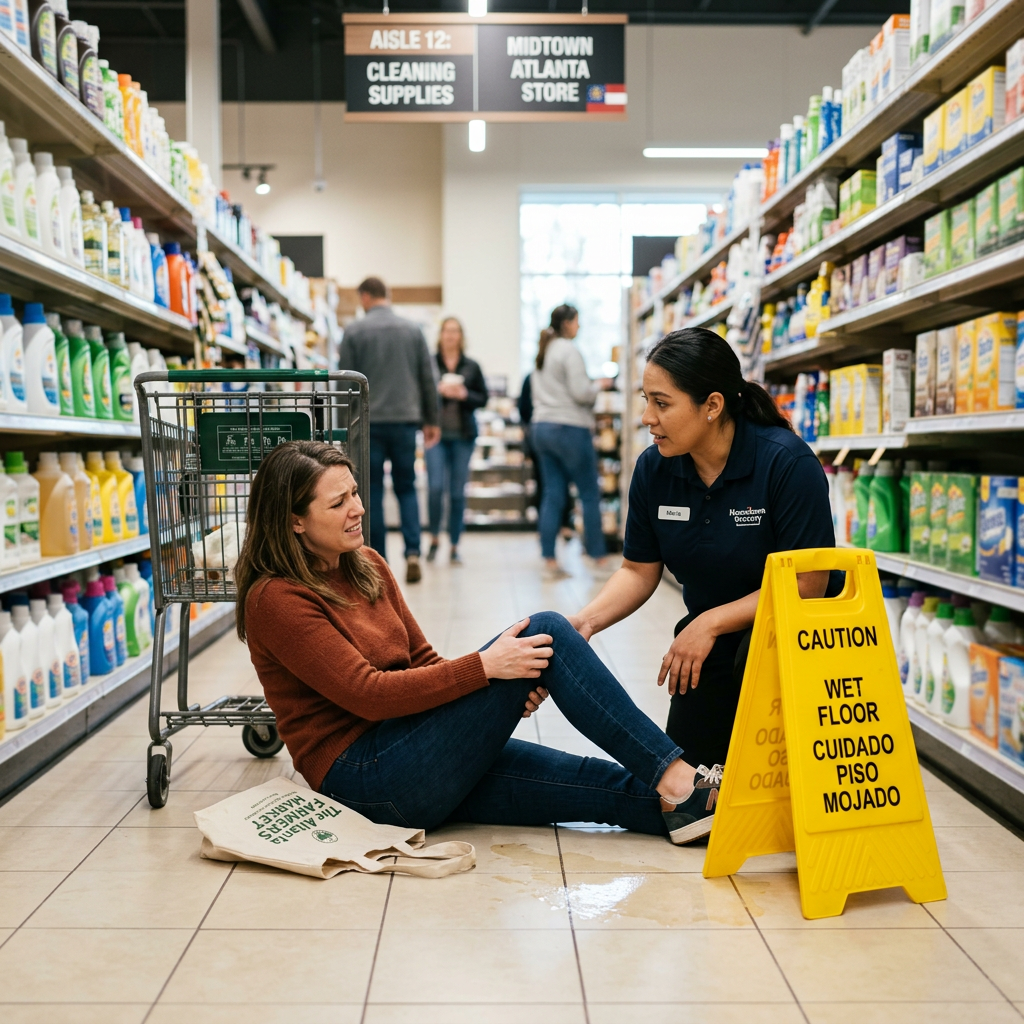
A customer slipped on a wet floor in the grocery section of a Florida Supercenter. The floor had been wet for over 20 minutes. No warning sign was placed. Walmart employees were aware of the spill but took no action.
- Surveillance footage confirmed the 20-minute gap between spill and fall
- No “wet floor” cone was visible in any frame
- Plaintiff suffered a fractured hip requiring surgery and months of physical therapy
- Case settled pre-trial for $475,000
Key takeaway: The timeline of employee awareness was the deciding factor. If employees knew about the hazard and ignored it, Walmart’s negligence becomes very difficult to defend.
Case 2 — $385,000 | Unattended Merchandise Spill (Texas, 2018)
A shopper slipped on spilled merchandise left on an aisle floor in a Houston store. The issue wasn’t just the spill — it was Walmart’s failure to follow its own inspection protocols. The store had no documented aisle checks for the three hours before the accident.
- Maintenance logs showed zero documented inspections in the relevant timeframe
- Plaintiff’s attorney used Walmart’s own internal safety procedures against them
- Injuries included a torn ACL and multiple lumbar injuries
- Settlement reached for $385,000
Key takeaway: Walmart’s internal policies can be used as evidence. If they have a policy requiring inspections every hour and the logs show none happened, that’s constructive notice by their own standards. A skilled Atlanta personal injury attorney knows how to subpoena those records.
Case 3 — $250,000 | Broken Floor Display (Georgia)
An Atlanta-area Walmart customer tripped over a broken display fixture that had partially collapsed into the aisle. The fixture had been in that condition for at least two days based on employee testimony. The plaintiff was 58 years old and suffered a severe wrist fracture requiring surgery.
- Two employees confirmed they were aware of the broken fixture
- No repair order had been submitted and no barrier had been placed
- Medical bills exceeded $60,000
- Settled for $250,000 after demand letter and pre-suit negotiation
Key takeaway: Known hazards that go unaddressed for days — not just hours — carry significant legal weight. Georgia courts take a serious view of ongoing negligence. This is exactly the type of case where premises liability law in Georgia works strongly in the plaintiff’s favor.
Case 4 — $180,000 | Parking Lot Ice (Midwest, 2020)
A customer fell on an icy patch in the parking lot. Walmart argued the ice was a “natural accumulation” and therefore not their responsibility. The plaintiff’s team successfully argued Walmart had both the means and the duty to address the hazard before the store opened.
- Weather records showed freezing temperatures the night before
- No ice treatment had been applied before the store opened at 6 AM
- Plaintiff suffered a fractured pelvis
- Settled for $180,000
Key takeaway: Outdoor hazards like ice, standing water, and broken pavement are still Walmart’s responsibility. The “it’s natural” defense fails when evidence shows they had advance notice of the condition and did nothing. Understanding how to preserve evidence from the scene immediately after a fall is essential to these cases.
Case 5 — $95,000 | Spill Near Checkout (Alabama, 2021)
A customer slipped on a liquid spill near a checkout lane. The injuries were real but moderate — soft tissue damage, no surgery required. The case settled for $95,000. This outcome shows that even moderate-injury cases have real value when liability is clear.
- Surveillance confirmed a 15-minute window between spill and fall
- Plaintiff required 8 weeks of physical therapy
- Lost wages documented at approximately $12,000
- No prior incidents at this location weakened the punitive argument
Key takeaway: You don’t need catastrophic injuries to have a valid claim. Documented medical treatment, lost wages, and clear liability evidence can produce a meaningful settlement even in “smaller” cases.
Case 6 — Low Settlement | Lack of Evidence (Cautionary Example)
A customer claimed she slipped on a wet floor at a Georgia Walmart. Her injuries were moderate. But she did not report the incident to a manager, did not photograph the scene, and surveillance footage had already been overwritten by the time her attorney sent a preservation letter — three weeks after the fall.
- No incident report was filed at the time of the fall
- No witnesses were identified
- Surveillance footage was gone — legally preserved only for 30 days at most locations
- Case settled for under $15,000 — far below what it may have been worth
Key takeaway: Time is your biggest enemy in these cases. The longer you wait, the more evidence disappears. Sending a letter of preservation immediately is one of the most important steps your attorney can take on day one.
What Factors Determine Your Walmart Slip and Fall Settlement Value?
No two Walmart slip and fall settlements are identical. These are the factors Atlanta attorneys weigh when estimating a case’s value:
| Factor | Impact on Settlement Value |
|---|---|
| Severity of injuries | Fractures, surgeries, and permanent injuries = higher value |
| Medical bills | Higher documented costs support higher demands |
| Lost income | Missed work and reduced earning capacity add to damages |
| Surveillance footage | Visual proof of hazard duration is extremely powerful |
| Incident report filed | Creates official record at time of fall |
| Prior complaints about same hazard | Suggests ongoing negligence and supports punitive claims |
| Your percentage of fault | Georgia modified comparative negligence — your award reduces by your % of fault |
| Quality of legal representation | Experienced attorneys consistently recover more than unrepresented victims |
Georgia uses a modified comparative negligence standard. If you were partially at fault — say, you were looking at your phone — your settlement is reduced by your percentage of fault. If you are found 50% or more at fault, you recover nothing. Walmart’s adjusters will try to assign as much fault to you as possible. This is why having a Georgia attorney experienced with premises negligence cases matters so much from the start.
The Walmart Claims Process — What to Expect in Atlanta
Understanding the claims process helps you avoid the mistakes that quietly destroy cases. Here’s how these cases typically move from fall to settlement.
Step 1 — Immediate Actions at the Scene
- Report the fall to a store manager and insist an incident report is filed — ask for a copy
- Photograph the hazard, the area around it, your injuries, and any missing warning signs
- Get names and contact info from any witnesses
- Do NOT sign anything Walmart hands you before speaking to an attorney
Step 2 — Medical Attention Within 24–48 Hours
See a doctor immediately — even if you feel “okay.” Adrenaline masks pain, and injuries like herniated discs or soft tissue damage often don’t present fully for 24–72 hours. A medical record that links your injuries to the fall is non-negotiable for any Walmart slip and fall settlement. Gaps in treatment give Walmart’s adjusters an opening to argue your injuries weren’t serious or weren’t caused by the fall.
Step 3 — Attorney Engagement and Evidence Preservation
Contact an Atlanta slip and fall attorney as soon as possible. One of the first things they’ll do is send a spoliation letter demanding Walmart preserve all surveillance footage, maintenance logs, inspection records, and incident reports. Walmart stores typically overwrite surveillance footage on a rolling 30-day cycle. Once it’s gone, it’s gone. According to Nolo’s premises liability guide, acting quickly to preserve evidence is one of the most critical steps in any slip and fall claim.
Step 4 — Demand Letter and Negotiation
Once your medical treatment is complete (or your condition has stabilized), your attorney prepares a detailed demand letter. This document outlines the facts, the evidence, your damages, and the settlement amount demanded. Walmart’s Claims Management Inc. (CMI) handles these negotiations. They are professional, they are experienced, and they will make a low initial offer. Expect multiple rounds of negotiation. The Cornell Law School Legal Information Institute provides a clear overview of premises liability standards that apply nationally.
Step 5 — Settlement or Litigation
Most Walmart slip and fall cases in Atlanta settle before trial. If Walmart refuses to offer fair compensation, your attorney files suit. Filing often moves negotiations — Walmart knows that Georgia juries can and do return large verdicts for injured plaintiffs when the facts are strong. The Georgia Trial Lawyers Association is a resource for understanding plaintiff rights in the state.
How Long Does a Walmart Slip and Fall Settlement Take in Georgia?
| Stage | Typical Timeframe |
|---|---|
| Medical treatment / reaching MMI | 3 – 12 months |
| Demand letter preparation | 2 – 6 weeks after MMI |
| Negotiation with Walmart CMI | 1 – 4 months |
| Litigation (if filed) | 6 – 18 additional months |
| Total average timeline | 6 months – 2 years |
Georgia’s statute of limitations gives you two years from the date of your fall to file a personal injury lawsuit. Don’t let this deadline create a false sense of urgency that pushes you into a quick, low settlement — but don’t ignore it either. Starting the process early protects your evidence and your rights.
Frequently Asked Questions — Walmart Slip and Fall Settlements
| Question | Answer |
|---|---|
| Does Walmart settle slip and fall cases out of court? | Yes — the vast majority of cases settle before trial. Walmart prefers predictable outcomes over jury risk. |
| How much does a Walmart slip and fall settlement pay in Georgia? | Ranges vary widely — from under $20,000 for minor cases to $500,000+ for serious injuries with strong evidence. |
| How long do I have to file a claim after a fall at Walmart in Georgia? | Two years from the date of the incident under Georgia’s personal injury statute of limitations. |
| Will Walmart’s insurance company contact me directly? | Yes — and you should not speak with them without an attorney present. They are not on your side. |
| What if I was partially at fault for the fall? | You can still recover under Georgia’s modified comparative negligence rule, as long as you were less than 50% at fault. |
| Do I need a lawyer for a Walmart slip and fall claim? | Statistically, represented plaintiffs recover significantly more than those who negotiate alone. Walmart’s team is experienced — you should be too. |
When to Call an Atlanta Slip and Fall Attorney
If you suffered any of the following in a Georgia Walmart, call an attorney before you speak to any insurance representative:
- Any injury requiring a doctor visit, urgent care, or ER
- A fracture, torn ligament, herniated disc, or head injury
- Time missed from work due to your injuries
- Any pressure from store employees or managers to sign documents immediately after the fall
- Contact from Walmart’s Claims Management Inc. (CMI) or their insurance carrier
The consultation is free. And at Jamie Ballard Law, there are no fees unless you win.
Your Next Step After a Walmart Slip and Fall in Atlanta
A Walmart slip and fall settlement doesn’t happen by accident — it’s the result of preserved evidence, documented injuries, and skilled negotiation. The cases that recover the most share one thing in common: the victim acted quickly and got legal help early. Jamie Ballard Law has helped Atlanta injury victims hold large corporations accountable for unsafe conditions. Call 404-885-8544 for a free case evaluation, or visit the contact page to get started today. Don’t wait — your evidence window is closing.
About Jamie Ballard Law
Jamie Ballard Law is an Atlanta-based personal injury firm founded by attorney Jamie Ballard, a Howard University School of Law graduate with over 10 years of experience fighting for injured Georgians. The firm handles car accidents, slip and fall injuries, premises liability, truck accidents, and wrongful death cases across Atlanta, Marietta, Smyrna, Mableton, and surrounding areas. Jamie Ballard Law operates on a contingency fee basis — clients pay nothing unless the firm wins their case.