A sample demand letter for a personal injury car accident gives you a concrete picture of what your attorney sends to the insurance company when it’s time to negotiate your settlement. The demand letter is one of the most important documents in your case — it sets the tone, establishes your damages, and signals to the insurer whether they’re dealing with a prepared attorney or an easy target. Understanding what a strong demand letter looks like, what it must include, and what separates an effective demand from a weak one can help you evaluate your own representation and know what to expect. This guide walks through a sample demand letter for a personal injury car accident in Georgia, section by section.
What a Personal Injury Demand Letter Is — and What It Does
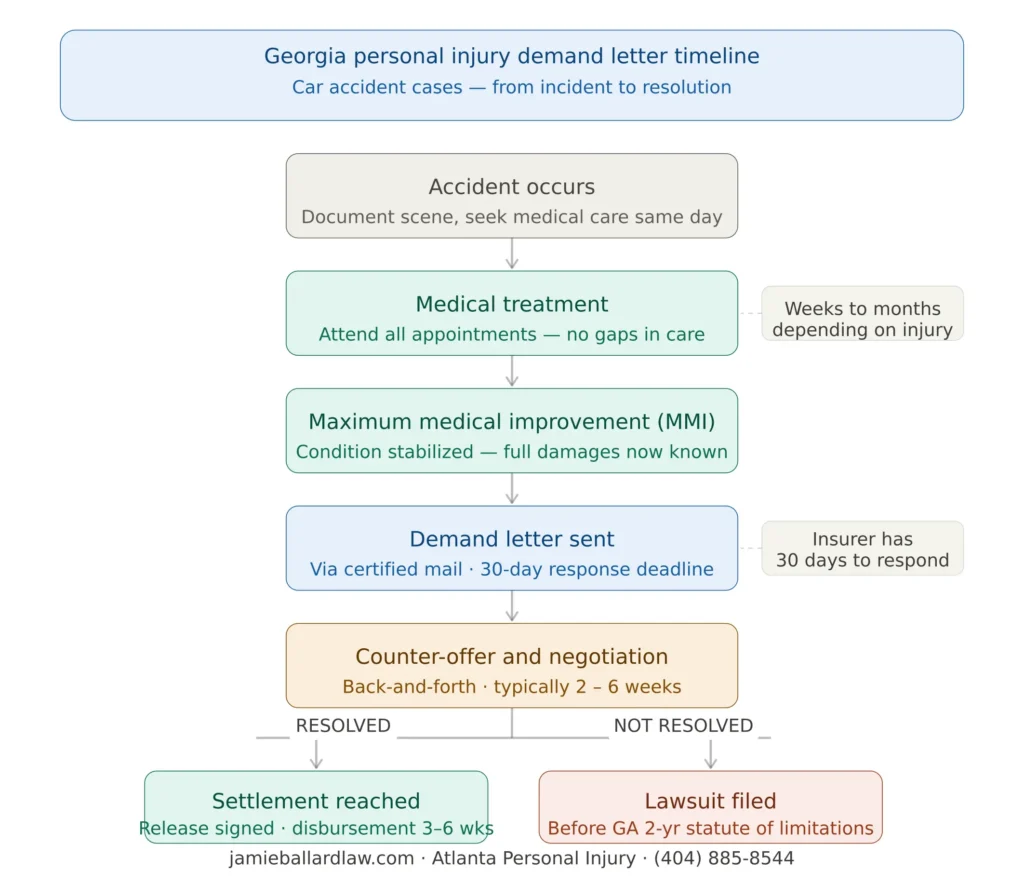
A demand letter is a formal written communication from your attorney to the at-fault driver’s insurance company. It is sent after your medical treatment is complete — or has reached maximum medical improvement — and it demands a specific dollar amount to resolve your claim without filing a lawsuit.
Why the Demand Letter Matters So Much
The demand letter does several things simultaneously. It presents your version of the facts in a way the insurer cannot easily dispute. It establishes the full extent of your injuries and treatment. It calculates your economic damages — medical bills, lost wages, future costs — and frames your non-economic damages — pain, suffering, and life impact. And it puts the insurer on notice that failure to respond reasonably will result in litigation.
A weak demand letter invites a lowball counter-offer. A strong one narrows the gap between your demand and the insurer’s position from the start.
Practical rule: The demand letter is not just a formality — it is your opening argument. Insurance adjusters evaluate demand letters the way judges evaluate briefs. Presentation, completeness, and specificity all affect what number comes back.
When Is a Demand Letter Sent?
In Georgia car accident cases, your attorney typically sends the demand letter after you have completed treatment or reached maximum medical improvement — the point at which your condition has stabilized. Sending it too early, before your damages are fully known, risks undervaluing your claim. Sending it too late, after the Georgia two-year statute of limitations is close, creates unnecessary pressure. The timing is a strategic decision your attorney makes based on your specific circumstances.
The Structure of a Sample Demand Letter — Personal Injury Car Accident
Every strong Georgia personal injury demand letter follows a clear structure. Here is what each section contains and why it matters.
Section 1 — Header and Addressee Information
The letter opens with the date, the insurance company’s name and claims address, the adjuster’s name, the claim number, and the insured’s name and policy number. It is typically sent via certified mail with return receipt requested — creating a paper trail that proves the insurer received it and starts the clock on their response obligation.
A sample opening looks like this:
DATE: [Date]
VIA CERTIFIED MAIL — RETURN RECEIPT REQUESTED
[Insurance Company Name]
Attn: [Adjuster Name], Claims Examiner
[Address]
RE: Your Insured: [Defendant Name]
Claim No.: [Claim Number]
Date of Loss: [Accident Date]
Our Client: [Client Name]
Section 2 — Statement of Facts
This section describes the accident in factual, chronological terms. It establishes where the accident occurred, what time of day, road conditions, how the collision happened, and why your client was not at fault. The goal is a clear, concise narrative the adjuster cannot easily reframe. The facts should be supported by the police report, photos, and witness statements referenced in the letter.
A sample facts section reads like this:
On [Date], at approximately [Time], our client [Name] was traveling northbound on [Road] in [City], Georgia when your insured, [Defendant], failed to stop at a red light at the intersection of [Road] and [Cross Street] and struck our client’s vehicle on the driver’s side door. The responding officer, [Officer Name] of the [Department], cited your insured for failure to obey a traffic control device. A copy of the incident report is attached hereto as Exhibit A.

Section 3 — Liability Analysis
This section explains, in legal terms, why the defendant is liable for your injuries. It references the applicable Georgia negligence standard, the specific conduct that caused the accident, and any evidence — citations, admissions, witness accounts, traffic camera footage — that supports liability. This is where your attorney makes clear that fault is not in dispute and that the only question is how much the insurer will pay.
Section 4 — Description of Injuries and Treatment
This is the medical narrative — the chronological story of your injuries from the date of impact to maximum medical improvement. It names every treating provider, summarizes what each found and treated, lists every imaging study and diagnostic result, and describes the procedures, therapies, and medications you received. Nothing is left out. A sample demand letter for a personal injury car accident that omits treatment details loses leverage immediately.
Sample language:
As a direct result of the collision, our client sustained a herniated disc at L4-L5, a Grade II cervical strain, and a fractured left wrist. Our client was transported by ambulance to [Hospital], where emergency imaging confirmed the above injuries. Our client was subsequently treated by Dr. [Name] at [Practice], completing a course of physical therapy consisting of 24 sessions over five months. An MRI obtained on [Date] confirmed persistent disc herniation with radiculopathy. Our client reached maximum medical improvement on [Date]. All medical records and billing statements are attached as Exhibits B through F.
Section 5 — Itemized Damages
This is the financial accounting of your claim — every dollar you are owed, listed and documented. Economic damages are presented first, then non-economic. Georgia has no cap on compensatory damages, which means this section sets the floor of your demand.
| Damage Category | Sample Amount | Documentation |
|---|---|---|
| Emergency room & hospitalization | $18,400 | Billing statements, EOB |
| Orthopedic specialist visits | $6,200 | Provider billing records |
| Physical therapy (24 sessions) | $9,600 | PT billing records |
| Diagnostic imaging (MRI, X-ray) | $4,800 | Radiology billing |
| Medications | $1,100 | Pharmacy receipts |
| Lost wages (8 weeks) | $12,000 | Employer letter, pay stubs |
| Property damage | $7,500 | Repair estimate/total loss |
| Total Economic Damages | $59,600 | |
| Pain and suffering | $89,400 | Pain journal, physician narrative |
| Total Demand | $149,000 |
Practical rule: Every line in the damages table must be supported by attached documentation. Unsupported figures are reduced or rejected on the first counter-offer. Your attorney’s file should be airtight before the letter goes out.
How Pain and Suffering Is Calculated in a Georgia Demand Letter
Non-economic damages — pain, suffering, emotional distress, loss of enjoyment of life — are the largest component of most Georgia personal injury settlements. But they require explanation and justification, not just a dollar figure.
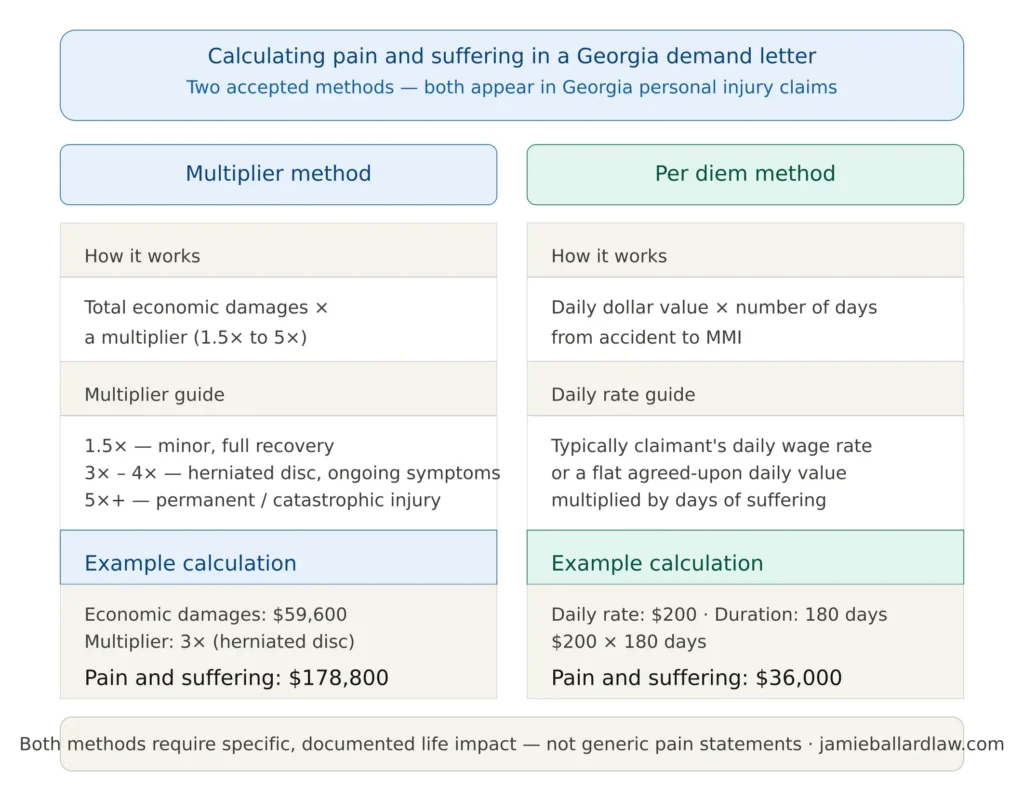
The Multiplier Method
The most common approach in Georgia personal injury car accident demand letters is the multiplier method. Total economic damages are multiplied by a factor — typically 1.5x to 5x — based on injury severity, treatment duration, permanency, and life impact. A soft tissue injury with full recovery might use a 1.5x multiplier. A permanent herniated disc with ongoing radiculopathy might use 3x to 4x. A catastrophic injury with permanent disability might reach 5x or more.
The Per Diem Method
An alternative approach assigns a daily dollar value to the pain and suffering — often the claimant’s daily wage — and multiplies it by the number of days from the accident to maximum medical improvement. This method works well when treatment is lengthy and the daily impact on the client’s life is well-documented through a pain journal and physician notes.
What Makes Non-Economic Damages Persuasive
The demand letter should include specific, concrete descriptions of how the injury affected daily life — not generic statements about pain. Did the client miss their child’s graduation? Stop being able to coach their daughter’s soccer team? Lose the ability to perform their job? Sleep through the night? Each specific, documented impact increases the persuasive weight of the non-economic damages section.
Practical rule: “Pain and suffering” is not a vague add-on. It is the story of how an injury changed a person’s life. The more specific and documented that story, the harder it is for the insurer to minimize it.
Section 6 — The Demand Paragraph and Response Deadline
This is where the letter closes with the specific dollar amount you are demanding and a deadline for the insurer’s response — typically 30 days. The language is direct and non-negotiable in tone, even though negotiation is exactly what follows.
Sample closing language:
Based on the foregoing facts, the established liability of your insured, and the documented damages set forth above, we hereby demand the sum of ONE HUNDRED FORTY-NINE THOUSAND DOLLARS ($149,000.00) in full and final settlement of all claims arising from the incident of [Date]. We request your response within thirty (30) days of receipt of this letter. Failure to respond within this period or to offer a reasonable settlement may result in the filing of a civil action in the appropriate Georgia court without further notice.
Why the Deadline Matters
The 30-day response window does two things. It creates urgency on the insurer’s side and prevents indefinite delay. And it starts a clock that your attorney monitors — if the insurer ignores it or stonewalls, that becomes part of the litigation narrative about bad faith claims handling. Georgia law provides remedies for insurers who act in bad faith, including potential penalty damages under O.C.G.A. § 33-4-6.
What Happens After the Demand Letter Is Sent
Most cases do not end with the first demand. The negotiation process that follows is where your attorney’s experience — and knowledge of what Georgia juries award for comparable injuries — determines how close to your demand you actually settle.
The Counter-Offer
The insurer responds with a counter-offer — almost always lower than your demand. Sometimes significantly lower. Your attorney evaluates the counter against comparable Georgia verdicts and settlements, against the strength of your liability evidence, and against the insurer’s known litigation posture for that carrier. The response to a counter-offer is not simply splitting the difference. It is a strategic decision based on the full picture of your case.
Practical rule: The counter-offer is not the final word — it is the opening of a negotiation. Your attorney’s job is to close the gap between what the insurer offers and what the evidence supports, not just split the difference.
Negotiation to Resolution
Back-and-forth typically takes two to six weeks for straightforward cases and longer for complex ones. Most Georgia car accident cases settle without filing a lawsuit. But having an attorney who has successfully taken cases to verdict in Atlanta-area courts changes what the insurer is willing to offer — because the cost of losing at trial factors into their risk calculation at every stage of negotiation.
When a Lawsuit Becomes Necessary
If the insurer refuses to offer a reasonable amount, your attorney files suit. The demand letter then becomes part of the litigation record, documenting that you negotiated in good faith and the insurer failed to respond reasonably. Under Georgia’s bad faith statute, an insurer that refuses a reasonable demand within policy limits may be exposed to damages beyond the policy amount if a verdict exceeds the limits.
For a clear overview of how demand letters function in car accident claims, this breakdown from eForms on Car Accident Demand Letters Explained walks through the core components step by step.
Common Mistakes That Weaken a Personal Injury Demand Letter
Even with a solid case, certain demand letter errors reduce settlement value or invite unnecessary delays.
Sending the Letter Too Early
Demand letters sent before maximum medical improvement lock in a damages figure that may not reflect your full losses. If your herniated disc later requires an injection series or a referral to a pain management specialist, those costs cannot be added after the letter has been sent and negotiations have begun. Patience before the letter goes out is almost always worth it.
Missing Documentation
Every damages claim must be supported by attached records. Missing a provider’s billing statement, omitting the MRI report, or failing to include lost wage verification gives the adjuster an excuse to reduce your claim without substantive justification. A complete, well-organized exhibit package is as important as the letter itself.
Vague Injury Descriptions
Generic language — “client suffered neck and back pain” — invites a generic response. Specific language — “client sustained a confirmed L4-L5 disc herniation with left-sided radiculopathy, requiring 24 physical therapy sessions, two epidural steroid injections, and ongoing pain management consultation” — demands a specific, documented counter-offer. Precision is persuasive.
An Unrealistic Demand Figure
Opening too high with no factual basis signals inexperience and invites the insurer to dismiss the letter outright. The demand figure should be supported by the documented damages and justified by comparable Georgia outcomes — not inflated beyond recognition as a negotiating tactic. A credible demand based on real numbers produces faster, better results than a fantasy figure that takes months to negotiate down to reality.
Practical rule: A demand letter is only as strong as its documentation. Organize your exhibits before drafting, not after.

Georgia-Specific Rules That Affect Your Demand Letter
Georgia’s Modified Comparative Negligence
If the insurer believes you were partially at fault for the accident, they will assert comparative negligence in their response to reduce or eliminate their exposure. Your demand letter should preemptively address this — acknowledging what the insurer will argue and countering it directly with evidence. The Official Code of Georgia Annotated governs the modified comparative fault standard that applies to your case.
Policy Limits and Bad Faith Exposure
When your demand is within or near the at-fault driver’s policy limits, the insurer faces bad faith exposure if they refuse to settle within limits and a jury later awards more. Georgia’s bad faith statute under O.C.G.A. § 33-4-6 allows for additional penalties. Your attorney factors this into the demand figure and timing strategy. The Georgia Office of Insurance and Safety Fire Commissioner oversees carrier compliance with Georgia’s insurance regulations.
Ante Litem Notices for Government Defendants
If the at-fault party is a government employee or the accident involved a government vehicle, the demand letter process is different. Georgia requires an ante litem notice — a formal pre-suit notice filed within six months of the incident for county or municipal defendants and within twelve months for state defendants. Miss this window and your claim is barred. Standard demand letter timing does not apply in these cases.
What to Do Before Your Attorney Sends the Demand Letter
Your behavior between the accident and the demand letter directly affects what ends up in it — and what the insurer can use against it.
Treat Consistently and Complete Your Care
Gaps in treatment are the single most common tool insurers use to reduce demand letter value. According to the American Medical Association, treatment consistency is one of the clearest clinical signals of injury severity — and insurance adjusters know it. If your doctor recommends physical therapy twice a week and your records show you attended once a week, the adjuster argues the injury was not serious enough to follow your own doctor’s orders. Complete your prescribed treatment. Every missed appointment is a discount the insurer applies to your settlement.
Keep Every Bill, Receipt, and Record
Your attorney cannot include what they do not have. Keep every explanation of benefits from your insurer, every provider statement, every pharmacy receipt, every mileage log for medical appointments, and every pay stub showing the wages you lost. Organize them as they arrive. The demand letter exhibit package is only as complete as the records your attorney can attach to it.
Avoid Social Media Posts About the Accident or Your Condition
Insurance companies monitor social media. A photo of you at a family barbecue that looks active — even if it was taken on your one good day — can be used to attack your pain and suffering claims. Between the accident and the resolution of your case, discuss any social media activity with your attorney. The National Highway Traffic Safety Administration notes that documentation consistency is one of the most critical factors in determining claim outcomes in serious accident cases.
Frequently Asked Questions — Sample Demand Letter Personal Injury Car Accident
| Question | Answer |
|---|---|
| Can I write my own demand letter without an attorney? | Yes, but unrepresented claimants almost always recover significantly less. Insurance adjusters are trained negotiators. An experienced attorney’s letter carries legal weight and credibility that a self-written letter rarely achieves. |
| How long should a personal injury demand letter be? | As long as it needs to be to fully document your damages — typically 5 to 15 pages with attached exhibits. Thoroughness matters more than brevity. |
| How soon will the insurance company respond? | Most insurers respond within 30 days. Georgia law does not set a mandatory response deadline for demand letters, but your attorney’s 30-day deadline creates urgency. |
| What if the insurer ignores my demand letter? | Your attorney files suit. The ignored demand letter becomes evidence of bad faith in the litigation. |
| Should I include future medical costs in my demand? | Yes — if your injuries will require future treatment, a medical expert’s opinion estimating those costs should be included. Future damages are recoverable in Georgia. |
| What is a policy limits demand? | A demand for the full amount of the at-fault driver’s insurance policy. If the insurer refuses and a jury awards more, the insurer may be liable for the excess under Georgia’s bad faith statute. |
| Does sending a demand letter mean I have to settle? | No. A demand letter opens negotiations. You can reject any counter-offer and file suit at any time before the statute of limitations expires. |
| How does the demand amount affect my final settlement? | It sets the anchor. Negotiations typically resolve somewhere between the demand and the insurer’s first counter. Starting with a well-supported, credible number produces better outcomes than starting too high or too low. |
Get a Demand Letter That Reflects the Full Value of Your Personal Injury Car Accident Claim
A sample demand letter for a personal injury car accident shows you the structure — but the version that gets results is built on your specific facts, your documented injuries, and an attorney who knows what Georgia juries award. Jamie Ballard Law prepares demand letters that are thorough, specific, and grounded in Georgia litigation reality. Call (404) 885-8544 or visit the contact page for a free consultation — and find out what your case is actually worth before anything gets sent.
About Jamie Ballard Law
Jamie Ballard Law is an Atlanta-based personal injury firm representing injured Georgians in car accidents, slip and falls, wrongful death cases, and catastrophic injury claims. The firm handles every phase of the claims process — from initial investigation through demand, negotiation, and trial — fighting for maximum recovery for every client.