After a wreck, one of the first questions people ask is, "how much settlement for a car accident can I expect?" While there's no magic number that fits every situation, looking at national data gives us a general idea. The national average for a personal injury settlement is around $37,249. This figure is a helpful reference point, but it's the specific details of what happened to you that truly determine the final value.
Understanding Car Accident Settlement Averages
When you come across an "average" settlement amount, it’s best to see it as a starting point, not a promise. These numbers are just the result of combining thousands of different cases—from small fender-benders to life-changing collisions. The result is a broad overview that doesn’t quite capture the specifics of any one person's experience.
For instance, 2022 data showed the average insurance payout for a bodily injury claim was about $26,501. Another study looking at 4,500 cases found an average closer to the $37,249 mark. These numbers provide useful context, but they don’t tell your story.
To give you a clearer picture, here’s a quick breakdown of how claim types generally compare.
Quick Look at Average Settlement Ranges
This table shows a general comparison between settlements for property damage only versus those including personal injuries, based on national averages.
| Claim Type | Typical Settlement Range (National Average) | Primary Factors |
|---|---|---|
| Property Damage Only | $3,000 – $7,500 | Vehicle repair/replacement costs, diminished value |
| Personal Injury (Minor) | $10,000 – $25,000 | Minor injuries (e.g., whiplash), limited medical treatment |
| Personal Injury (Serious) | $50,000+ | Significant injuries requiring surgery, long-term care, lost wages |
These ranges show why a single "average" can be misleading. A settlement is built from the ground up based on documented losses, not pulled from a database.
What Do These Averages Mean for You?
Think of national averages like the sticker price on a new car. It’s a reference, but the final cost depends on the specific options you choose. In the same way, two people in nearly identical accidents can walk away with vastly different settlements. The key is understanding what makes one claim more valuable than another.
Several factors will have a huge impact on your potential compensation:
- The Severity of Your Injuries: A sprained wrist will have a much different valuation than an injury that requires surgery and months of physical therapy.
- The Amount of Evidence: Strong proof of the other driver's fault—backed by a police report, photos, and witness statements—strengthens your negotiating position immensely.
- Insurance Policy Limits: The at-fault driver's insurance coverage creates a hard ceiling on what the insurance company must pay out, regardless of your actual damages.
Ultimately, these averages provide a ballpark figure, but the specific details of your case are what truly matter. The first step is knowing how to properly document and present your claim. You can get a better sense of this process by learning more about how to file a car accident claim in Atlanta.
The most important takeaway is this: your settlement isn't based on an average. It’s built on the specific, provable losses you suffered. Knowing that helps you set realistic expectations for how much settlement for a car accident you might actually receive.
The Building Blocks of Your Settlement Value

When you’re trying to figure out how much settlement for a car accident you might get, it’s best not to think of it as a single, random number. Instead, picture it as a structure built from different types of blocks. In Georgia law, these blocks are called "damages," and each one represents a specific loss you suffered because of the wreck.
These damages are sorted into two main categories. Understanding both is the only way to calculate the true value of your claim.
Economic Damages: The Tangible Costs
The first and most straightforward category is Economic Damages. Think of these as all the out-of-pocket expenses that come with a paper trail. These are the bills, receipts, and financial losses you can literally add up with a calculator.
- Medical Bills: This covers everything—the ambulance ride, the ER visit, surgeries, physical therapy, and follow-up appointments.
- Lost Wages: If your injuries forced you to miss work, you are entitled to be paid back for every dollar of income you lost while recovering.
- Property Damage: This is the cost to repair your car. If it's a total loss, it’s the vehicle's fair market value right before the crash.
Medical costs are a huge driver of your settlement value. Often, recovery involves ongoing treatments like physical therapy. For some, finding an effective massage for back pain relief is a documented and necessary part of their care plan. It's so important to keep every single invoice and receipt connected to the accident, as this paperwork is the foundation of your claim.
Non-Economic Damages: The Human Cost
The second category, Non-Economic Damages, is just as real, but it’s much harder to put a price tag on. These damages are meant to compensate for the human toll the accident took on you and your life. They don’t come with a neat bill, but they are a massive part of a fair settlement.
These damages cover losses like:
- Physical Pain and Suffering: This is compensation for the actual physical pain you’ve had to live with because of your injuries.
- Emotional Distress: This can include the anxiety, sleepless nights, fear, and other psychological trauma that follows a wreck.
- Loss of Enjoyment of Life: If your injuries stop you from golfing, gardening, or doing any of the hobbies you once loved, that loss has value.
A common starting point for insurance adjusters is the "multiplier method." They take your total economic damages (usually just the medical bills) and multiply them by a number, typically between 1.5 and 5.
Which multiplier they use hinges on how severe your injuries are. A minor sprain might only get a 1.5x multiplier. But a permanent injury that required surgery could easily justify a multiplier of 4 or 5. This method provides a basic way of turning intangible suffering into a concrete figure.
Your total potential settlement value is found by adding both the economic and non-economic damages together. This gives a complete picture of how much settlement for a car accident is appropriate for what you've been through.
Key Factors That Influence Your Settlement Amount
If you're asking, "how much settlement for car accident is fair," the honest answer is: it depends. There's no simple calculator. Instead, the final number is built piece by piece, based on the specific facts of your case.
Think of it like assembling a puzzle. Every piece—from your medical records to the police report—has to fit together to create a clear picture of what you've lost. The value of your claim is shaped by a handful of these important pieces.
Severity and Type of Injuries
The most significant factor, without a doubt, is the severity of your injuries. A fender-bender that results in a few weeks of whiplash simply isn't valued the same as a collision that causes a broken bone requiring surgery and months of physical therapy.
Your medical records are the foundation of this part of your claim. Consistent, well-documented treatment from the emergency room visit to your final physical therapy session tells a clear story to the insurance company. It validates your pain and proves the financial costs tied to your recovery.
Proving Who Was At Fault
Another huge piece of the puzzle is having clear proof of who was at fault. A police report that points the finger directly at the other driver is incredibly powerful evidence.
But it doesn't stop there. Witness statements, photos from the scene, and even traffic camera footage all work together to build an airtight case and eliminate any doubt about liability.
This is especially important in Georgia because of the state's modified comparative negligence rule. Under this law, your settlement can be reduced by your percentage of fault. Worse, if you are found to be 50% or more at fault, you get nothing. Proving the other driver's responsibility is non-negotiable.
Insurance Policy Limits and Long-Term Impact
The at-fault driver's insurance policy creates a hard ceiling on how much the insurer will pay. No matter how severe your injuries are, if the driver only carries Georgia's minimum liability coverage, the insurance company is not obligated to pay a penny more than that limit. Understanding the role of car insurance and the specific coverage limits involved is a fundamental step in setting realistic expectations.
Beyond the immediate medical bills, the long-term impact on your life plays a massive role.
- Can you still do your job?
- Have you lost the ability to enjoy your hobbies or play with your kids?
- Will you need ongoing medical care for the rest of your life?
These long-term consequences are a significant part of what a fair settlement is meant to cover.
Remember, every document and detail matters. Building a strong claim takes time, but you have to act within a strict legal window. To learn more about these important deadlines, you can read about the statute of limitations for personal injury in Georgia and make sure your rights are protected. All these factors ultimately come together to answer the question of how much settlement for car accident is appropriate for you.
Settlements for Accidents Without Physical Injuries

It’s a common misconception: if you walk away from a crash without a scratch, your only claim is for the car repairs. Thankfully, that’s not the whole story. The question of how much settlement for a car accident is just as relevant when you're unhurt, because you are entitled to be compensated for all your property-related losses.
This goes far beyond just a check to fix your bumper. A fair property damage settlement is designed to make you financially whole again, covering every single cost that stemmed from the accident.
Beyond the Repair Shop Bill
When you're dealing with a property-damage-only claim, the repair estimate tends to dominate the conversation. But several other costs—often overlooked—are absolutely part of a complete claim.
Here are a few common examples of what your settlement should cover:
- Rental Car Costs: If your car is in the shop for a week, you shouldn't have to pay for a rental out-of-pocket. The at-fault driver's insurance is responsible for this reasonable expense.
- Damaged Personal Items: Was your laptop or phone destroyed in the collision? What about a child's car seat? Safety experts, including the National Highway Traffic Safety Administration (NHTSA), advise replacing them after any moderate to severe crash. These are recoverable costs.
Understanding Diminished Value in Georgia
One of the most important—and most frequently forgotten—parts of a property damage claim is diminished value. This concept is especially important here in Georgia.
Diminished value is the drop in your vehicle's resale value simply because it now has an accident on its record. Even with perfect repairs that make it look brand new, a CarFax report showing a past collision will scare off buyers and lower what they're willing to pay.
This is a real, tangible financial loss that you have the right to recover. Proving it requires documenting your car's value before the accident and getting a professional appraisal showing its reduced market value after the repairs are done.
Nationwide, settlements for no-injury accidents are built around these property-related expenses. As of 2025, the average no-injury settlement hovers around $9,900, but this figure swings widely based on the vehicle's value and other property destroyed.
The key to a fair resolution is documenting everything. Keep every repair estimate, invoice, and receipt. Just because you weren't physically injured doesn't mean you didn't suffer a financial hit—and that's a key factor in determining how much settlement for a car accident you can ultimately receive.
The Settlement Process and Negotiation Timeline
When you’re trying to figure out how much settlement for a car accident you might be entitled to, it's easy to assume the money just shows up. It doesn't. Getting compensated is a journey with clear steps, and knowing the roadmap is the best way to prepare for what's ahead. The entire process kicks off the moment you file a claim.
Once that claim is in, the at-fault driver's insurance company starts its own investigation. They’ll dig into the police report, analyze photos of the damage, and scrutinize your initial medical records. Your only job during this time is to focus on getting better and documenting every single expense and life disruption caused by the accident.
This infographic breaks down the basic flow, from tracking your losses to hammering out a final agreement.
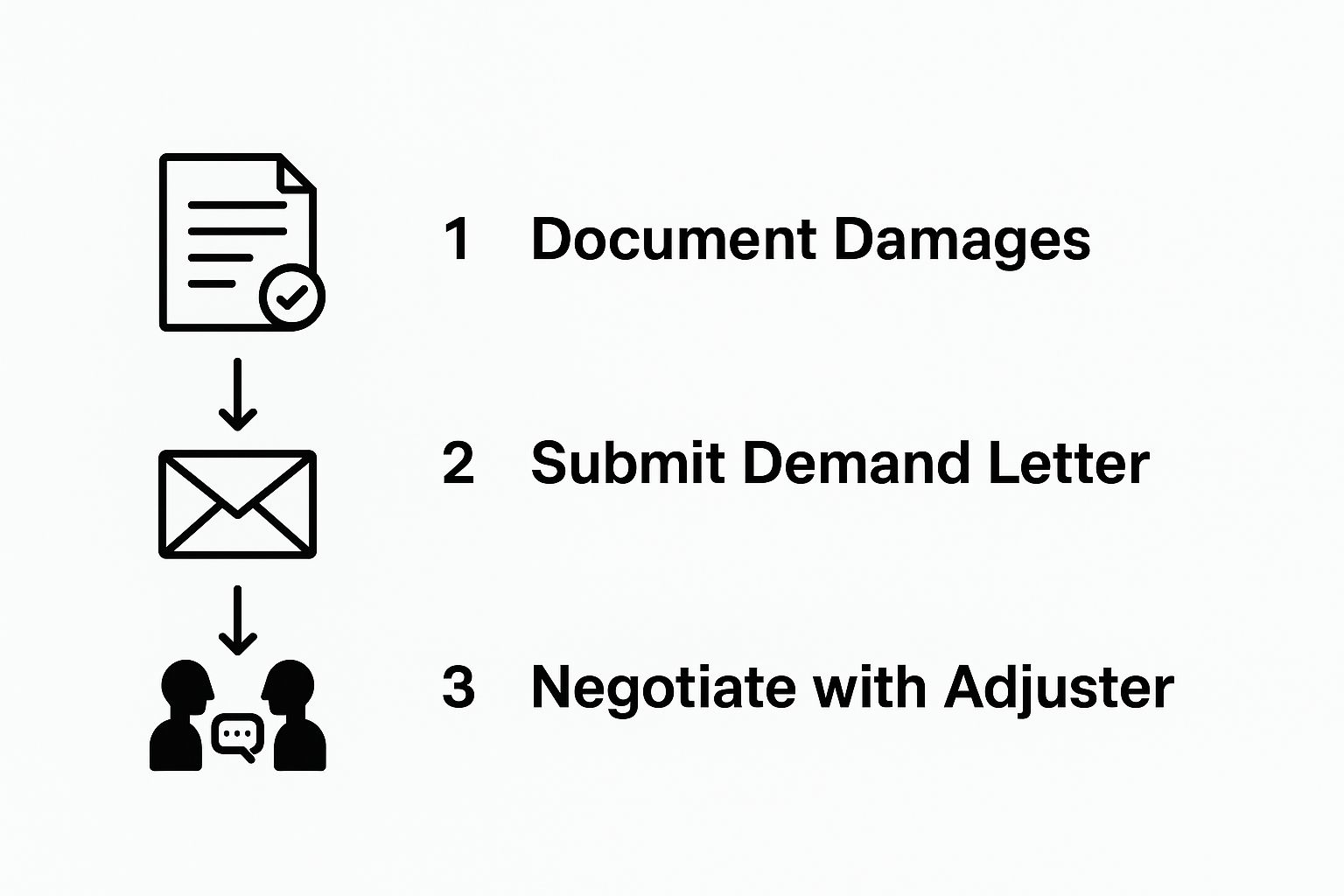
As the visual makes clear, organized documentation isn't just paperwork—it's the foundation for a strong demand and a successful negotiation.
Kicking Off Negotiations
Once your medical treatment is finished, or you've at least hit what's known as maximum medical improvement (MMI), it’s time to send a formal demand letter to the insurance company. This isn't just a simple note asking for money. It's a detailed package that tells the complete story of your accident and proves why the amount you're seeking is justified.
A strong demand letter must include:
- A clear explanation of how the accident happened and why their insured driver is at fault.
- A full summary of your injuries, the treatment you received, and how you've recovered.
- Copies of every single medical bill and all related records.
- Proof of lost income from any time you missed at work.
- The specific dollar amount you believe is fair compensation for both your economic and non-economic damages.
This letter is what officially gets the negotiation ball rolling.
The Back-and-Forth with the Adjuster
Get ready for the insurance adjuster’s first move: a lowball offer. It’s a standard tactic, not a personal insult. Their job is to close your claim for as little money as possible, and they fully expect you to push back.
This is where the real negotiation begins. Each side will trade counteroffers, using evidence and legal arguments to justify their position. To get a better handle on the legal side of these talks, it helps to understand the fundamentals of personal injury claims and how they are built.
The single biggest mistake you can make is rushing this process. Settling too early—before you know the full extent of your injuries or if you’ll need future medical care—can cost you dearly.
Patience is your best ally here. The timeline can stretch from a few weeks to several months, depending on the severity of your injuries and the insurance company's willingness to be reasonable. Ultimately, this structured negotiation is what decides how much settlement for car accident cases is finally agreed upon.
Helpful Resources for Georgia Drivers

After a crash, gathering credible information is one of the most powerful steps you can take. Knowing where to find official data and clear explanations can make a real difference in how you approach your claim.
Here are a few trusted, non-promotional websites that every driver in Georgia should have on hand. These resources provide everything from crash reports to key safety statistics.
- Georgia Department of Transportation (GDOT): The official source for information on Georgia's road conditions, traffic laws, and safety initiatives.
- Governor's Office of Highway Safety: A fantastic place to find crash data and statistics specific to our state.
- BuyCrash.com: This is the official portal where you can order a copy of your Georgia accident report—an essential piece of evidence.
- Insurance Information Institute: A great resource that breaks down insurance topics into plain, understandable language.
For more curated materials specifically for accident victims, we’ve also compiled a list of legal resources for accident victims right here on our site. Use these tools to build your knowledge and feel more confident as you move forward.
Frequently Asked Questions About Car Accident Settlements
When you're trying to figure out how much settlement for car accident you might be owed, it's completely normal for questions to pile up. To give you some clarity, here are straightforward answers to the questions we hear most often.
How Is Pain and Suffering Calculated in Georgia?
There's no single, state-mandated calculator for pain and suffering, but the most common method used is the "multiplier method."
Here's how it works: you take your total economic damages—things like medical bills and lost income—and multiply that figure by a number, usually between 1.5 and 5. The more severe and life-altering your injury, the higher the multiplier. A catastrophic injury with a long, painful recovery will command a much higher multiplier than a minor sprain that heals in a few weeks.
Should I Accept the First Settlement Offer?
In almost every case, no. It’s almost never a good idea to accept the insurance company’s first offer. That initial number isn’t their best offer; it’s a starting point for negotiation.
Insurance adjusters are trained to resolve claims for as little money as possible. Their first offer is often a lowball figure, made in the hopes that you'll take the quick cash before you fully grasp what your claim is actually worth.
How Long Do I Have to File a Car Accident Claim in Georgia?
Georgia law sets a strict deadline, known as the statute of limitations, for filing a lawsuit. If you miss this window, you could lose your right to seek compensation forever.
- For personal injury claims, you generally have two years from the date of the crash.
- For claims involving only property damage, you have four years.
These time limits provide a clear path for the legal system. You can find the specific state laws on the official Georgia General Assembly website. Understanding these rules is a vital part of protecting your rights and determining how much settlement for car accident you can pursue.
At Jamie Ballard Law, we believe an informed client is an empowered one. If you have more questions or need someone to stand up to the insurance companies for you, we’re here to help. Reach out for a free, no-obligation case evaluation. Visit us at https://jamieballardlaw.com.