The moments after a car crash are often a blur of stress and confusion. What you do next, however, can make a significant difference in your claim under Georgia's car accident laws. As an Atlanta personal injury attorney, I've seen firsthand how the initial steps can shape the outcome. Your first instinct should always be safety and health—check on yourself, your passengers, and then, if you can, move the vehicles out of harm's way. Understanding these auto collision statutes is vital for your protection.
What to Do Immediately After a Car Accident
In the chaos of a collision, staying as calm as possible is your best asset. The steps you take at the scene aren't just for immediate safety; they are the foundation of a solid insurance claim or legal case. Every detail you capture and every official report filed becomes a piece of important evidence.
Your well-being is the top priority. Adrenaline is a powerful chemical that can easily hide serious injuries. Even if you feel okay, it is a good idea to get a medical check-up. Injuries like whiplash or internal bleeding might not surface for hours or even days.
Secure the Scene and Your Safety
First, take a breath and assess the situation. Check on everyone involved—the people in your car and the other vehicle. If someone is hurt, try not to move them unless there's an immediate danger, like a fire.
Your next move is to call 911. This single action achieves two very important goals:
- It brings medical help: Paramedics can provide immediate, on-site care for anyone injured.
- It creates an official record: A police officer will arrive to file an official accident report. This impartial, third-party document is often a key piece of evidence in an insurance claim. You can typically get a copy of this report from the responding police department's website, such as the Atlanta Police Department.
While waiting for first responders, if it's safe, move your car to the shoulder or a nearby lot to avoid causing another accident. Turn on your hazard lights to warn oncoming traffic.
This straightforward flowchart breaks down the three most vital actions to take right after a crash.
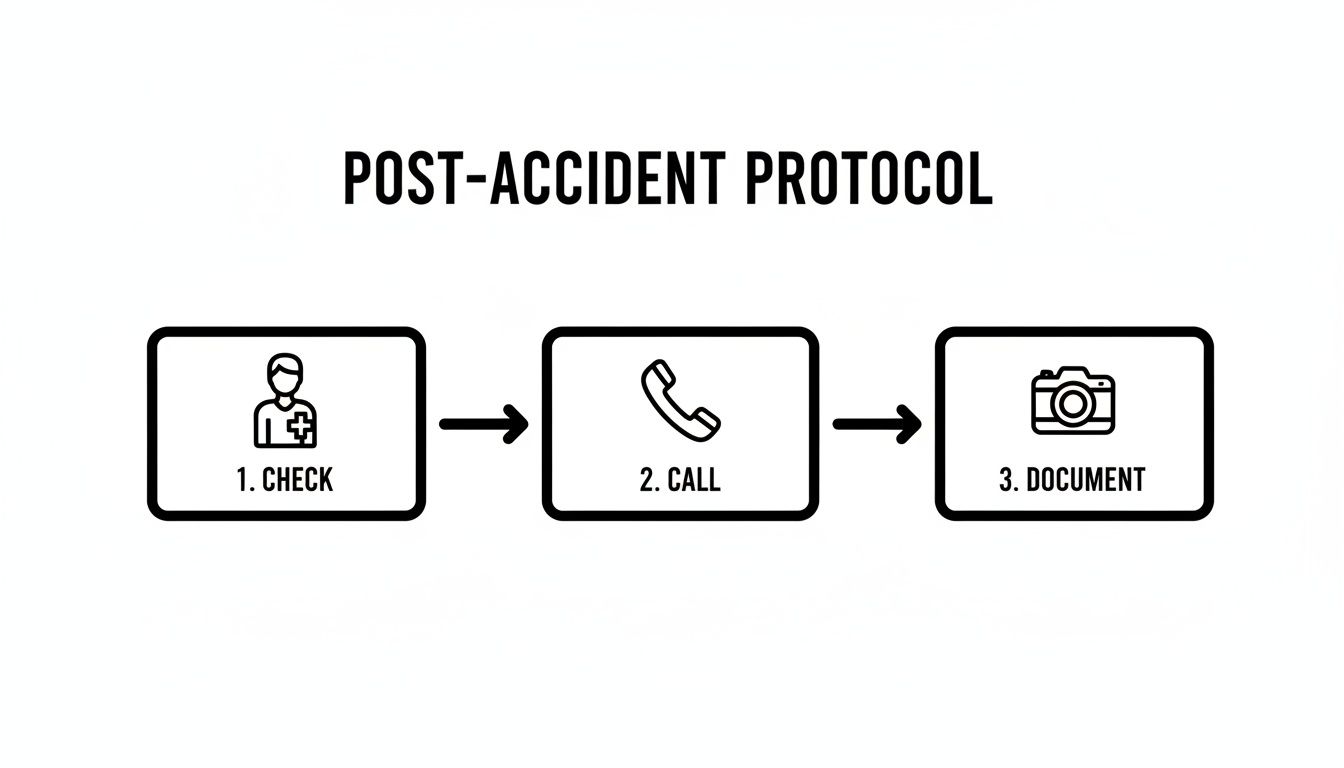
This visual guide reinforces the essentials: check for injuries, call for help, and document everything. These are your most important first responses.
Document Everything and Exchange Information
With the scene secured and help on the way, it's time to gather information. Use your smartphone to take photos and videos of everything you see. Document the damage to all cars from every angle, skid marks on the pavement, traffic signals, weather conditions, and any visible injuries. You can't have too much evidence.
Next, you'll need to exchange information with the other driver. The key here is to stay calm and stick to the facts. Get their:
- Full Name and Contact Information
- Insurance Company and Policy Number
- Driver’s License and License Plate Number
- Vehicle Make, Model, and Color
Important Note: When talking to the other driver, never apologize or admit fault. Even a simple, courteous "I'm sorry" can be used by an insurance adjuster as an admission of guilt. Just exchange information and nothing more.
If anyone witnessed the crash, get their name and phone number. An objective statement from a bystander can be incredibly powerful later on.
To help you stay organized in a stressful moment, here's a quick checklist of what to do at the scene.
Post-Accident Checklist What to Do at the Scene
| Action Item | Why It Matters for Your Claim |
|---|---|
| Check for Injuries | Your health is the priority. Medical records also link injuries directly to the crash. |
| Call 911 | This generates an official police report, a key piece of neutral evidence. |
| Move to Safety | Prevents further accidents and shows you acted responsibly. |
| Take Photos/Videos | Visual evidence of damage, road conditions, and the scene is hard to dispute. |
| Exchange Information | You need the other driver's details to file a claim with their insurer. |
| Get Witness Info | Independent third-party accounts can confirm your version of events. |
| Do Not Admit Fault | Avoid making statements that could be used against you by the insurance company. |
| Seek Medical Attention | Establishes a record of your injuries, even those that appear later. |
Following these steps lays the groundwork for a strong claim. Knowing how to handle these initial moments is just the start; you can learn more about how to file a car accident claim in Atlanta in our detailed guide. Protecting your rights begins the second the accident happens, and understanding Georgia's car accident laws is your first step toward a fair recovery.
Understanding How Negligence Works in Georgia

At the heart of nearly all Georgia car accident laws, you'll find one very important legal concept: negligence. This is the standard we use to figure out who is legally responsible for the costs and injuries from a crash. Don't let the legal term worry you; it's really just a four-step process for proving fault.
To hold another driver accountable, you can't just say they caused the accident. You have to prove they were negligent by establishing four specific elements required under Georgia law. If you're missing even one of these pieces, the entire claim can fall flat.
The Four Essential Elements of a Negligence Claim
Think of a negligence claim like a table with four legs. If one leg is missing or wobbly, the whole thing can fall. To succeed, your claim must be solidly supported by all four of these elements.
Let's walk through them with a common scenario: a driver runs a red light and T-bones your car.
Duty of Care: This is the baseline responsibility every single driver has when they get on the road. In Georgia, all motorists have a legal duty to drive with reasonable care to keep others safe. This means obeying traffic lights, maintaining a safe speed, and paying attention. It’s the unwritten rule of the road made law.
Breach of Duty: This happens when a driver fails to live up to that duty of care. When the other driver blew through that red light, they breached their duty. Texting while driving, tailgating, or getting behind the wheel intoxicated are all common breaches. It's the specific mistake they made.
Causation: Next, you have to connect the breach to the harm. You must show that the other driver's specific failure—running the red light—is what directly caused the crash and your injuries. If their action wasn't the direct cause of your injuries, there's no legal link, and therefore, no claim.
Damages: Finally, you have to show that you suffered actual, measurable harm because of the crash. Damages include concrete costs like medical bills, lost paychecks, and vehicle repairs, but they also cover non-economic losses like pain and suffering. If there's no harm, there’s nothing for the law to compensate.
Putting It All Together in the Real World
These four elements—Duty, Breach, Causation, and Damages—are the building blocks of every successful personal injury claim. For example, if a driver was texting but their distraction didn't actually cause them to hit you, the "causation" element is missing. Likewise, if they ran a red light but miraculously no one was hurt and no property was damaged, the "damages" element isn't there.
Proving negligence is about telling a clear, evidence-backed story. It's not just about what happened, but about demonstrating how one person's failure to be careful directly resulted in another person's suffering.
Sadly, these breaches of duty have devastating consequences. The World Health Organization's 2023 Global Status Report on Road Safety found that traffic accidents are the top cause of death for people aged 5-29, with about 1.19 million people dying on the world's roads each year. These stark numbers show exactly why holding negligent drivers accountable is so important.
Getting a handle on these concepts is the first step in protecting your rights. For a deeper look at the terms we use in injury cases, take a look at our legal dictionary. Understanding this legal structure is key to successfully working with Georgia's car accident laws.
Specific Georgia Car Accident Rules You Should Know
While the core idea of negligence is the same everywhere, Georgia has its own specific car accident laws that can make a difference in your case. These aren't just minor technicalities—they're fundamental rules that dictate who gets paid and how long you have to file a claim. If you've been in a wreck in our state, you absolutely have to understand them.
One of the most important is Georgia's rule for crashes where both drivers share some of the blame. It's pretty rare for an accident to be 100% one person's fault. So, what happens then? Georgia's answer is a system called modified comparative negligence.
Georgia’s Modified Comparative Negligence Rule
Picture the total blame for a crash as a pie that equals 100%. A jury or insurance adjuster will slice up that pie, assigning a percentage of fault to each driver. Your right to recover any money is directly tied to the size of your slice.
Here’s the part you need to remember:
- If you are found to be 49% or less at fault, you can still recover money for your damages. However, your total compensation will be reduced by your percentage of fault. So, if your damages are $100,000 but you were 20% to blame, your award drops by that 20% to $80,000.
- If you are found to be 50% or more at fault, you are completely barred from getting anything. Zero.
That 50% cutoff is a very fine line. An insurance company will do everything it can to push just enough blame onto you—say, from 45% to 51%—to deny your claim completely. This is precisely why solid, undeniable evidence of the other driver's negligence is so important in Georgia.
The Clock is Ticking: The Statute of Limitations
Another important rule in Georgia is the statute of limitations. Think of it as a legal stopwatch. Once it runs out, your right to file a lawsuit and seek compensation in court is gone forever, no matter how strong your case is.
For most personal injury claims from car accidents in Georgia, you have just two years from the date of the crash to file a lawsuit. For claims limited to property damage (like your totaled car), the deadline is usually four years. That two-year clock for injuries is non-negotiable, and waiting too long is a mistake you can't undo. You can read the official state code about this at O.C.G.A. § 9-3-33.
When You Are Required to Report an Accident
Georgia law is very clear about when you must report a crash to the police. You are legally required to notify law enforcement for any accident that involves:
- Injury or death to anyone.
- Property damage that appears to cost $500 or more.
With the high cost of modern vehicle repairs, almost any fender-bender will easily clear that $500 threshold. Your best move is always to call 911. The official police report is one of the most powerful pieces of evidence you can have. Failing to stop and report a crash can lead to very serious consequences, including Hit and Run Charges in Georgia.
The data below from the Georgia Governor's Office of Highway Safety shows exactly what's causing these crashes on our roads.

As you can see, things like following too closely, failing to yield, and improper lane changes are at the top of the list—all clear examples of driver negligence. One of the biggest modern culprits, distracted driving, presents its own unique challenges. You can learn more in our guide on what to do after a distracted driving accident in Atlanta.
Your Safety Net: Uninsured Motorist Coverage
What if the driver who hit you has no insurance, or their policy isn't enough to cover your medical bills and lost wages? This is where your own policy's Uninsured/Underinsured Motorist (UM/UIM) coverage becomes your lifeline.
Though it's optional in Georgia, I can't recommend it enough. If an uninsured driver hits you, your UM coverage steps in to pay for your damages. If the at-fault driver is underinsured, your UIM coverage bridges the gap between their low policy limit and your actual losses. It's your personal safety net, protecting you when others fail to be responsible.
Types of Compensation You Can Recover After a Crash
When you're hurt in a car crash, the legal process aims to recover compensation—or "damages," in legal terms—to help you put your life back together. Understanding the types of damages available under Georgia’s car accident laws is important. It ensures you're fighting for the full value of what you've lost.
Damages are generally split into two main buckets: economic and non-economic. You can think of them as the tangible, "price tag" losses and the intangible, "human cost" losses. Both are very real, and both are recognized by Georgia law as harms that must be addressed.
Economic Damages: The Tangible Financial Losses
Economic damages are the straightforward, calculable costs that come directly from the crash. These are the losses you can track with receipts, invoices, and pay stubs. Because they have a clear dollar amount attached, they are often the easiest part of a claim to prove.
Common examples of economic damages include:
- Medical Bills: This covers everything from the initial ambulance ride and emergency room visit to ongoing physical therapy, future surgeries, prescriptions, and any necessary medical equipment.
- Lost Wages: If your injuries force you to miss work—whether for a week, a month, or longer—you can recover the income you lost during that time.
- Loss of Earning Capacity: For severe injuries that permanently impact your ability to do your job or force you into a lower-paying one, you can be compensated for that future lost income.
- Property Damage: This is the cost to repair your vehicle or, if it's totaled, its fair market value at the time of the collision.
Imagine you suffered a broken leg in a wreck. Your economic damages would be the sum of your hospital bills ($15,000), the six weeks of missed paychecks ($6,000), and the cost to fix your car ($4,000). These concrete numbers form the foundation of your claim.
Non-Economic Damages: The Human Cost of the Crash
This is where the law acknowledges the true human impact of a car accident. Non-economic damages compensate you for the immense personal suffering and life changes that don't come with a neat price tag. They are just as real as a medical bill, but valuing them requires a deeper look at your experience.
These damages cover the profound, personal harms that disrupt your day-to-day existence.
Non-economic damages acknowledge that the worst part of a car accident is rarely the dented fender or the stack of bills. It’s the pain, the stress, and the loss of the ability to live your life the way you did before the crash.
Let's break down what this category includes:
- Pain and Suffering: This is compensation for the actual physical pain, discomfort, and emotional distress you've endured because of your injuries. It accounts for the daily struggle with pain.
- Emotional Distress: This can include anxiety, depression, a persistent fear of driving (vehicular anxiety), or PTSD that often follows a traumatic crash.
- Loss of Enjoyment of Life: If your injuries prevent you from doing the things you once loved—playing with your kids, gardening, or hiking—you can be compensated for that loss.
The person with the broken leg isn't just dealing with bills. They are also experiencing six weeks of intense pain, the frustration of being unable to get around, and the disappointment of missing a family vacation. These are significant losses that deserve compensation. The value of these damages is determined by looking at the severity of the injury and its long-term impact on your daily life, making a full recovery a central part of Georgia’s car accident laws.
To help clarify these concepts, here is a summary of the common types of damages available to accident victims in Georgia.
Common Types of Damages in a Car Accident Claim
| Type of Damage | What It Covers | Example |
|---|---|---|
| Economic | All direct, verifiable financial losses resulting from the accident. | Hospital bills, lost wages from missed work, car repair costs, prescription medication costs. |
| Non-Economic | The intangible, personal impact the injuries have had on your life. | Physical pain, emotional trauma (anxiety, PTSD), inability to enjoy hobbies, scarring. |
| Punitive (Rare) | Awarded to punish the defendant for extreme recklessness or malice. | A drunk driver with multiple prior DUIs causes a catastrophic injury crash. |
Understanding these categories is the first step toward building a strong claim that reflects the true scope of your losses after a crash.
Deciding Between an Insurance Claim and a Lawsuit
After a crash, most people rightly assume the first step involves dealing with an insurance company. While many cases are settled this way, it’s not the only path forward. Understanding the differences between an insurance claim and a personal injury lawsuit is fundamental to protecting your rights under Georgia's car accident laws.

The journey to compensation almost always begins with an insurance claim. This is the initial process where you, or your attorney, present your case to the at-fault driver's insurance provider. The goal here is to negotiate a fair settlement that covers all your damages without ever needing to step into a courtroom.
The Standard Insurance Claim Process
Think of the claim process as a formal negotiation. It kicks off when you notify the insurer of the accident and provide initial documents, like the police report and your early medical records. The insurance company then assigns an adjuster to your case; their job is to investigate the crash from their perspective and evaluate your damages.
Once you have a clear picture of your total losses—medical bills, lost wages, and other impacts—a formal demand letter is sent. This letter lays out the facts, proves the other driver's fault, and details the full extent of your economic and non-economic damages. From here, the back-and-forth really begins.
But you have to remember the adjuster's true objective.
An insurance adjuster's primary responsibility is to protect the company's bottom line by paying out as little as possible. They are not on your side and will often use tactics to devalue or deny a legitimate claim.
This is where things often get difficult. The insurer might try to argue you were partially at fault, question the severity of your injuries, or make a lowball offer that doesn't come close to covering your real-world losses. This is the point when the conversation often shifts from a simple claim to a potential lawsuit.
When a Lawsuit Becomes Necessary
Filing a lawsuit doesn't mean your case is destined for a jury trial. In fact, the vast majority of lawsuits still end in a settlement. Taking this step simply moves the fight into a formal legal arena and forces the insurance company to take your claim much more seriously.
Here are a few common situations that might require filing a lawsuit:
- The Insurance Company Denies Fault: They might claim their driver wasn't responsible, even when the evidence clearly says otherwise.
- The Settlement Offer is Unreasonably Low: The first offer is often very low and fails to cover your medical bills, let alone your pain and suffering.
- There is a Major Dispute Over the Facts: The insurer may disagree about how the accident happened or the true extent of your injuries.
- The Statute of Limitations is Approaching: Filing a lawsuit is the only way to protect your right to compensation before Georgia's two-year deadline expires.
Whether you're managing an insurance claim or a lawsuit, understanding the importance of document notarization after car accidents can be a key step. The legal process demands that certain papers be properly authenticated, and a notarized affidavit or statement can add significant weight to your evidence.
To get a clearer sense of what happens after a suit is filed, you can explore the steps of the car accident lawsuit process in more detail. Knowing when to escalate from a claim to a lawsuit is an important decision—one that directly impacts your ability to secure the compensation you deserve under Georgia's car accident laws.
Common Questions About Atlanta Car Accident Laws
When you're trying to pick up the pieces after a car wreck, it’s completely normal for your mind to be racing with questions. We've been doing this a long time, and we hear the same worries from people every single day. Here are some straightforward answers to the questions we get asked most often about Georgia’s car accident laws.
What Happens If I'm Partially At Fault for the Crash?
This is one of the most important questions we get, and it cuts right to the core of Georgia's specific legal rules. Our state operates under a system known as "modified comparative negligence."
It sounds complicated, but think of it this way: the total blame for an accident is a 100% pie. A judge, jury, or even an insurance adjuster will assign a slice of that pie—a percentage of fault—to each driver involved.
How that percentage affects your case is very important:
- If you are found to be 49% or less at fault, you can still recover compensation for your injuries and other damages.
- Your final financial award, however, will be reduced by your percentage of fault. For instance, if you have $100,000 in damages but are found 10% to blame, your recovery is cut by 10% down to $90,000.
- If you are determined to be 50% or more at fault, you are legally blocked from recovering anything at all.
That 50% rule is a hard cutoff. Insurance companies know this perfectly well, and they will fight hard to push just enough blame onto you to get past that threshold and deny your claim completely. This is exactly why having solid evidence is non-negotiable.
Do I Really Need a Lawyer for a Minor Accident?
Honestly, for a simple fender-bender with zero injuries and only minor vehicle damage, you probably don’t need an attorney. If everyone agrees on what happened and the other driver's insurance offers a fair amount to fix your car, you can likely handle it yourself.
But that simple situation can get difficult very quickly.
You should seriously consider speaking with an attorney if there are any injuries—even ones that seem minor—or if the other driver's insurance company starts giving you the runaround about fault or delaying your claim.
Even "minor" whiplash can turn into chronic pain and a mountain of medical bills. An insurance adjuster's job is to close your claim as cheaply as possible. An experienced attorney’s job, on the other hand, is to protect your long-term health and financial stability.
How Long Does It Take to Resolve a Car Accident Case?
There’s no magic number here. Every case has its own unique set of facts, so the timeline can stretch from a few months to well over a year. It all depends on a few key factors.
Here’s what really drives the timeline:
- Injury Severity: This is the biggest variable. A case can't settle until you reach what we call Maximum Medical Improvement (MMI). That’s the point where you’ve either fully recovered or your doctor confirms your condition is as good as it’s going to get. Settling before you know the full scope of your medical needs is a huge mistake.
- Disputes Over Fault: If the insurance company accepts 100% responsibility, things move much faster. If they dig in their heels and try to blame you, expect delays.
- Willingness to Negotiate: A reasonable adjuster can lead to a fair settlement in good time. An unreasonable one might force the issue into litigation, which adds months, if not years, to the process.
A straightforward case with clear fault and minor injuries might wrap up in four to six months. But a case involving serious injuries, a fight over liability, and a full-blown lawsuit could easily take 18 months or more to see through to the end.
The reality of road safety is constantly evolving, which directly impacts the legal challenges we face. For example, data from the World Health Organization reveals a shocking 175% global increase in fatalities among riders of powered two-wheelers. This isn't just a global statistic; it's a local reality on Atlanta's busy streets. We are seeing more collisions involving motorcyclists, bicyclists, and pedestrians, all of whom are incredibly vulnerable. While Georgia law requires drivers to yield, the truth is that many still don't. You can discover more insights about these global road safety statistics and see why we are so passionate about fighting for safer roads.
If you're feeling overwhelmed or just need clear answers about what to do next, the team at Jamie Ballard Law is ready to listen. We provide free, no-pressure case evaluations to help you understand your legal options. Contact us 24/7 to get the honest advice you deserve. https://jamieballardlaw.com