Walmart slip and fall settlement amounts vary widely — from a few thousand dollars for minor injuries with quick recovery to well over half a million dollars for serious, permanent harm. What drives the number is not the size of Walmart’s business. It is the strength of your evidence, the severity of your injuries, and whether you have an attorney who understands how Walmart handles these claims. This guide breaks down real settlement ranges, what factors determine value, how Georgia premises liability law applies, and what steps protect your claim from the moment you fall. If you are trying to understand what a Walmart slip and fall settlement might be worth in your situation, this is the place to start.
What Walmart Slip and Fall Settlements Actually Look Like
Walmart is the largest retailer in the world and one of the most frequently sued companies in America. They have a dedicated national claims management operation, experienced defense counsel, and a clear strategy: resolve small claims quickly and cheaply, and fight large claims aggressively. Understanding that context changes how you approach your case.
Documented Settlement Ranges in Georgia and Nationwide
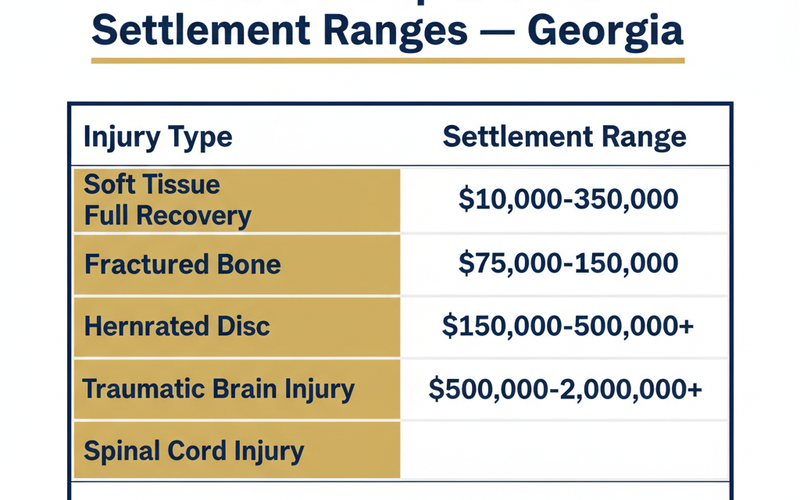
Slip and fall cases against Walmart settle across a wide range depending on injury type, liability clarity, and damages documentation. Here is what the data shows:
| Injury Type | Typical Settlement Range | Key Factors |
|---|---|---|
| Soft tissue (sprains, strains), full recovery | $10,000 – $35,000 | Clear liability, complete medical records, short treatment |
| Fractured bone (wrist, ankle, hip) | $50,000 – $150,000 | Surgery required, documented lost wages, age of claimant |
| Herniated disc with radiculopathy | $75,000 – $250,000 | Imaging confirmation, specialist treatment, ongoing symptoms |
| Traumatic brain injury (TBI) | $150,000 – $500,000+ | Neurological documentation, cognitive impact, long-term care |
| Spinal cord injury or permanent disability | $500,000 – $2,000,000+ | Life care plan, vocational loss, catastrophic impact |
| Wrongful death from fall | $500,000 – $3,000,000+ | Age, dependents, earning capacity, liability strength |
Practical rule: These ranges reflect cases where liability was established and damages were fully documented. Cases with disputed liability or incomplete medical records settle for significantly less — or not at all.
Notable Walmart Slip and Fall Verdicts and Settlements
Court records and legal reporting document significant Walmart premises liability outcomes. A March 2024 Georgia verdict reached $300,000 for a slip and fall with documented spinal injuries. Cases in other states have produced multi-million-dollar verdicts where Walmart’s negligence was clear and injuries were catastrophic. These outcomes are not guaranteed — but they reflect what Georgia juries are willing to award when the evidence is strong and the attorney is prepared.
Georgia Premises Liability Law and How It Applies to Walmart Falls
Your right to sue Walmart — and what you have to prove — is governed by Georgia’s premises liability law. Understanding this framework is essential before you can evaluate what your case is worth.
The Four Elements You Must Prove
Under O.C.G.A. § 51-3-1, Georgia premises liability law requires you to establish four things to hold Walmart liable for your slip and fall injuries:
1. Walmart owed you a duty of care. As a customer — a business invitee — Walmart owes you the highest duty of care under Georgia law. They must exercise ordinary care to keep the premises in a reasonably safe condition.
2. A hazardous condition existed. A wet floor, a spilled liquid, a broken floor tile, a poorly maintained entrance mat, a product left in an aisle — any condition that created an unreasonable risk of harm.
3. Walmart had knowledge of the hazard. Either Walmart created the condition, actually knew about it, or should have known about it through reasonable inspection. This is where most Walmart cases are won or lost.
4. The hazard caused your injuries. Your injuries must be directly and causally connected to the hazardous condition — not a pre-existing issue, not an unrelated cause.
Practical rule: The hardest element to prove in a Walmart slip and fall case is Walmart’s knowledge of the hazard. Your attorney must act fast to preserve surveillance footage, maintenance logs, and incident reports before they are overwritten or destroyed.
The “Constructive Knowledge” Standard in Georgia
Georgia courts recognize that a business does not have to have actual knowledge of a spill for liability to attach. The Georgia courts system has consistently upheld constructive knowledge claims in premises liability cases where evidence showed the hazard existed long before any employee addressed it. If the hazard existed long enough that a reasonable inspection would have discovered it — “constructive knowledge” — Walmart can be held liable. An eight-minute-old spill that no employee checked on is constructive knowledge. A two-minute-old spill may not be. The length of time the hazard existed, documented through timestamps on maintenance logs and surveillance footage, directly affects your case value.
Walmart’s Actual Knowledge Advantage
Walmart has extensive surveillance infrastructure in every store. They maintain digital maintenance logs, spill response records, and incident documentation. When a fall occurs, Walmart’s claims team begins their investigation immediately — long before you have retained an attorney. This is why contacting an attorney the same day as your fall, if possible, is so important. Preservation letters must be sent quickly to prevent the destruction of evidence that supports your case.

What Increases or Decreases Your Walmart Slip and Fall Settlement Amount
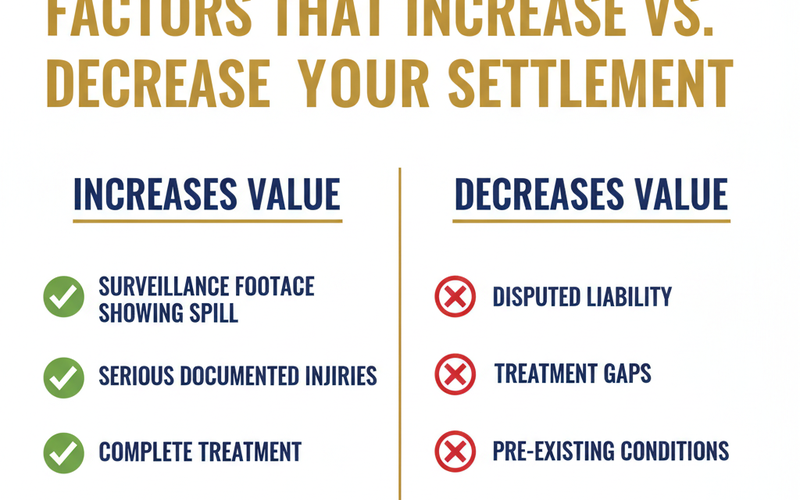
Within any injury category, individual case facts move the value up or down significantly. Here is what your attorney evaluates when assessing your claim.
Factors That Increase Settlement Value
- Clear liability evidence — surveillance video showing the spill, timestamped maintenance logs showing no inspection, a prior incident at the same location
- Serious, documented injuries — fractures, herniated discs confirmed on MRI, TBI documented by a neurologist, permanent restrictions from a physician
- Complete and consistent treatment — no gaps, every appointment attended, all referrals followed, treatment record tied directly to the fall
- Significant economic losses — high medical bills, documented lost wages, future care costs supported by a life care planner or medical expert
- Compelling non-economic impact — specific, documented life changes: inability to work, care for children, sleep through the night, or participate in activities that defined your life before the fall
- Prior incidents at the same location — evidence that Walmart had been notified of the same hazard before and failed to address it dramatically increases exposure
Factors That Decrease Settlement Value
- Disputed liability — no surveillance footage, conflicting witness accounts, or evidence that the spill just occurred
- Comparative fault — Georgia’s modified comparative negligence rule reduces your recovery proportionally to your assigned fault. If Walmart argues you were texting, wearing inappropriate footwear, or ignored visible warning signs, your damages are reduced accordingly
- Gaps in medical treatment — delays between the fall and first medical visit, or periods of missed appointments
- Pre-existing conditions — Walmart will argue that your back pain, knee problems, or prior injuries account for your current symptoms. Your attorney must counter this with before-and-after medical evidence
- No documented lost wages — self-employed or cash-income workers who cannot document lost earnings forfeit a significant damages category
Practical rule: Walmart’s defense team will scrutinize every gap, every pre-existing condition, and every inconsistency in your records. Your attorney builds the case knowing these attacks are coming — and counters them before they can reduce your recovery.
How Walmart Handles Slip and Fall Claims — What You Are Up Against
Walmart is not a typical defendant. They are a litigation machine. Understanding their playbook helps you and your Atlanta slip and fall attorney anticipate what is coming.
The Fast, Low Early Offer
Walmart’s claims team often reaches out to unrepresented claimants quickly after a fall — sometimes within days — with a settlement offer that feels like a relief after a scary experience. These early offers are almost always far below the actual value of the claim. They are designed to be accepted before you understand your injuries, before you have completed treatment, and before you have spoken to an attorney. Once signed, you waive all future claims — permanently.
Recorded Statements
Walmart’s adjusters will request a recorded statement. The questions seem routine — when did you fall, where exactly, what were you doing. But the answers create a permanent record used to establish your version of events before your injuries have fully manifested. Do not give a recorded statement to Walmart’s claims team without speaking to an attorney first.
Surveillance Footage — Their Weapon and Yours
Walmart stores have cameras covering virtually every area of the sales floor, entrances, and parking lots. That footage can either prove your case or be used against it. If the video shows you were not paying attention, were on your phone, or ignored a visible warning cone, Walmart will use it. If the video shows a six-hour-old spill with no cleanup, it proves your case. Your attorney must send a written preservation letter immediately to prevent footage from being overwritten under Walmart’s standard retention policies.
Steps to Take Immediately After a Walmart Slip and Fall in Georgia
What you do in the first 24 to 72 hours after a fall at Walmart directly affects what your case is worth. These steps protect your evidence and your health simultaneously.
Report the Incident to Store Management Before You Leave
Ask for the store manager — not just a floor associate — and report the fall formally. Request that a written incident report be completed and ask for a copy. This creates an official record that the fall occurred, establishes the location and approximate time, and triggers Walmart’s internal evidence preservation protocols. If they refuse to give you a copy, note the name of the manager and the time.
Photograph Everything
Before the hazard is cleaned up — before the wet floor sign appears — photograph the spill, the floor surface, the surrounding area, any warning signs (or their absence), your shoes, and any visible injuries. If a store employee approaches, do not let them rush you away from the scene before you have documented it.
Seek Medical Attention the Same Day
Go to an emergency room, urgent care, or your primary care physician the same day. Describe exactly what happened and every symptom — even minor ones. Falls frequently cause soft tissue injuries, spinal injuries, and concussions that feel mild initially and worsen over 24 to 72 hours. A same-day medical visit ties your injuries to the fall with a contemporaneous record that is very difficult for Walmart to dispute.
Contact an Atlanta Slip and Fall Attorney Before Talking to Walmart’s Adjuster
The Jamie Ballard Law team can send a preservation letter to Walmart within hours — protecting the surveillance footage, maintenance logs, and incident report before they disappear. Do not give Walmart’s adjuster a recorded statement or accept any offer without attorney representation. The CDC’s fall injury data shows that falls are the leading cause of injury-related emergency room visits — Walmart’s claims team knows the data and knows how to minimize payouts to unrepresented claimants.
This overview from Texan Translation on how personal injury cases work offers a clear, plain-language breakdown of premises liability claims that is useful context for anyone navigating this process for the first time.

Georgia’s Two-Year Statute of Limitations for Walmart Slip and Fall Cases
You have two years from the date of your fall to file a lawsuit against Walmart in Georgia. Under Georgia’s personal injury statute of limitations, missing this deadline means your claim is permanently barred — regardless of how strong your liability evidence is or how serious your injuries are. Two years sounds like a long time. It is not, once you factor in treatment time, investigation, demand letter negotiation, and filing preparation. Contact an attorney as soon as possible after your fall — not a year and a half later when the deadline is approaching.
Preservation of Evidence Is Time-Sensitive
Walmart’s standard surveillance footage retention period is typically 30 to 45 days. Maintenance logs and inspection records are similarly time-limited. Your attorney must act within weeks of your fall — not months — to preserve the evidence that supports your case. Once that footage is overwritten, it is gone permanently. The U.S. Occupational Safety and Health Administration’s slip and fall guidelines recognize the speed at which incident evidence degrades — and so should every claimant.
What Damages You Can Recover in a Georgia Walmart Slip and Fall Case
Georgia law allows injured claimants to pursue the full range of compensatory damages with no statutory cap. Every category your attorney pursues should be fully documented from day one.
Medical Expenses — Past and Future
Every dollar spent — and every dollar you will spend — on medical care tied to your fall is recoverable. Emergency room visits, imaging, specialist appointments, physical therapy, medications, medical devices, and future surgeries or ongoing care recommended by your physician. Future costs require a treating physician’s projection or a medical cost expert’s analysis attached to your demand. These costs frequently exceed initial treatment totals in serious injury cases.
Lost Wages and Earning Capacity
If your injuries prevented you from working, you can recover lost wages. If your injuries permanently limited your ability to work — reduced hours, changed duties, or inability to return to your prior occupation — you can recover the lifetime difference in earning capacity. Vocational and economic damages experts calculate this number in serious cases and present it with documented precision.
Pain and Suffering and Loss of Enjoyment of Life
Georgia law allows recovery for physical pain, emotional distress, and the loss of activities that gave your life meaning before the fall. If you can no longer run, garden, coach your child’s team, or engage in hobbies you valued — those losses are compensable. Your attorney documents them through your own account, physician restrictions, and family statements about your life before and after the fall.
Practical rule: Keep every receipt, every medical statement, and every record of expense from the day of your fall forward. Small costs add up to real money — and your attorney cannot recover what you did not document.
How Walmart’s Defense Team Will Try to Reduce Your Settlement
Walmart’s defense playbook is predictable. Your attorney builds a case hardened against each attack before it comes.
The Pre-Existing Condition Argument
Walmart’s defense counsel pulls every available medical record looking for prior back, knee, or related treatment. They argue the fall did not cause your injuries — it merely aggravated something pre-existing. Georgia law protects you through the eggshell plaintiff doctrine: defendants take their victims as they find them. If a pre-existing condition was significantly aggravated by the fall, Walmart is liable for that aggravation. Your attorney documents the before-and-after picture through treating physician opinions that separate baseline from new injury.
Comparative Fault Allocation
Walmart’s team looks for any basis to assign you a fault percentage — your footwear, your phone, any warning signs present. Under Georgia’s modified comparative negligence standard, each percentage assigned reduces your recovery by the same amount. An attorney who anticipates this builds the liability case from the start with evidence that counters every potential fault argument before it is raised.
Defense IME Challenges
Walmart may request an independent medical examination performed by a physician they select and compensate. These exams frequently conclude that treatment is complete or that injuries are unrelated to the fall. Your treating physician’s ongoing documentation, imaging records, and specialist referrals are the foundation your attorney uses to counter these conclusions. The American Medical Association’s impairment rating guidelines provide the clinical framework for evaluating and challenging defense IME reports.
Practical rule: If Walmart requests an IME, tell your attorney before you agree to anything. The rules around IME participation vary by case type — your attorney will advise you on your obligations and how to protect your interests during the examination.
Frequently Asked Questions — Walmart Slip and Fall Settlements
| Question | Answer |
|---|---|
| How much does Walmart typically settle slip and fall cases for? | Ranges vary widely — from $10,000 for minor soft tissue injuries to $500,000+ for serious permanent harm. Injury severity, liability clarity, and documentation quality drive the number. |
| Does Walmart settle slip and fall cases out of court? | Yes — the majority of Walmart slip and fall claims settle before trial. But Walmart fights aggressively when liability is disputed or the claim is large. |
| How long does a Walmart slip and fall case take to settle in Georgia? | Straightforward cases: 6 to 12 months. Cases with serious injuries or disputed liability: 1 to 3 years. |
| What if Walmart says the spill just happened and they didn’t know? | Georgia’s constructive knowledge standard means Walmart is liable if the hazard existed long enough for a reasonable inspection to discover it. Your attorney investigates the timeline through maintenance logs and surveillance. |
| Can I sue Walmart if I was partially at fault for the fall? | Yes — as long as you are less than 50% at fault under Georgia’s modified comparative negligence rule. Your damages are reduced by your fault percentage. |
| What if I didn’t report the fall to Walmart before leaving the store? | You can still pursue a claim — but reporting immediately creates a stronger record. Tell your attorney exactly what happened so they can investigate alternative evidence sources. |
| Do I need an attorney to settle a Walmart slip and fall claim? | You are not required to have one — but unrepresented claimants typically recover far less. Walmart’s claims teams are professional negotiators. Representation levels the playing field significantly. |
| What if Walmart’s offer seems fair? | Have an attorney evaluate it before accepting. Early offers are almost always below full claim value. Once you accept and sign a release, you cannot pursue additional compensation — ever. |
Know What Your Walmart Slip and Fall Settlement Is Actually Worth Before Accepting Anything
A Walmart slip and fall settlement amount depends on who is fighting for you, how fast evidence was preserved, and how completely your damages are documented. Accepting Walmart’s first offer without knowing your full injury picture is one of the most expensive mistakes an injured person can make. Jamie Ballard Law handles Walmart premises liability claims throughout Georgia — call (404) 885-8544 or reach the contact page for a free consultation today.
About Jamie Ballard Law
Jamie Ballard Law is an Atlanta-based personal injury firm representing injured Georgians in slip and fall cases, car accidents, wrongful death claims, and catastrophic injury matters. The firm handles Walmart and big-box retail premises liability cases throughout Georgia, fighting for maximum recovery for every client.