When you get hurt on someone else's property because of a safety failure, a premise liability settlement is the most common way to get compensated for your injuries without going to court. As an Atlanta personal injury attorney, I've seen firsthand how these agreements help people cover their medical bills, lost pay, and the real-world impact of an unexpected injury. It's about holding the property owner accountable.
Understanding the Basics of a Premises Liability Settlement
A settlement is a formal agreement that resolves a personal injury claim that happened on property owned or managed by someone else. The legal idea is simple: property owners in Georgia have a "duty of care" to keep their spaces reasonably safe for people who visit. When they don't meet that responsibility and someone is injured, they are legally responsible for the harm that results.
This responsibility applies to all sorts of places, not just major retail stores. It covers private homes, apartment buildings, restaurants, and parking garages. A common example is a grocery store that doesn’t clean up a spill in a timely manner. If a customer slips on the wet spot, falls, and breaks a wrist, the store has failed in its duty of care.
What Does the Settlement Cover?
A settlement isn’t a random number. It’s a carefully calculated sum meant to cover specific losses, which the law calls “damages.” A typical settlement should provide for:
- Medical Expenses: This includes everything from the ambulance and emergency room visit to ongoing physical therapy, medications, and any surgeries you might need down the road.
- Lost Wages: If your injury forces you to miss work, a settlement pays you back for that lost income. It can also compensate you if your ability to earn a living is permanently affected.
- Pain and Suffering: This is compensation for the physical pain, emotional distress, and disruption to your daily life caused by the injury. It's harder to put a dollar figure on, but it is an important part of any serious injury claim.
The goal is to restore you financially, as much as possible, to the position you were in before the incident happened. You can find more details on how these damages are calculated in our guide on personal injury claims.
The Legal Elements You Must Prove
To have a successful claim, you can't just show you were hurt on someone's property. You have to prove a few key things. We've broken down these legal requirements into a simple table.
Key Components of a Premises Liability Claim
| Legal Element | Simple Explanation | Example |
|---|---|---|
| Duty of Care | The property owner had a legal responsibility to keep the premises safe. | A store owner must routinely check for and clean up spills. |
| Breach of Duty | The owner failed to meet that responsibility through a negligent act or omission. | The store manager knew about a leaky freezer for hours but did nothing. |
| Causation | The owner's failure directly caused your injuries. | You slipped specifically on the puddle from the leaky freezer, causing you to fall. |
| Damages | You suffered actual, measurable harm as a result. | Your fall resulted in a broken hip, requiring surgery and time off work. |
Understanding these parts is the first step in building a strong case. If all four cannot be established, the insurance company will almost certainly deny your claim.
Key Factors That Determine Your Settlement Value

Figuring out the value of a premise liability settlement isn't a guessing game. It's a structured process that relies on solid evidence and documented losses.
Think of your claim like a building. The strength and size of that building depend on the quality of the materials used. Every medical bill, piece of evidence, and documented impact on your life is a building block that shapes the final settlement amount.
Insurance adjusters and attorneys look at several main factors to arrive at a figure. The biggest one is the seriousness of your injuries. A minor sprain that heals with a few doctor visits will have a completely different value than a spinal cord injury that causes permanent disability.
Medical Expenses Past and Future
The starting point for any settlement calculation is the total of your medical costs. This is much more than just adding up the bills you already have—it involves a full accounting of every single expense related to your injury.
- Immediate Medical Care: This covers initial costs like the ambulance ride, emergency room visit, X-rays or MRIs, and any hospital stay.
- Ongoing Treatment: Many injuries require follow-up care. This includes appointments with specialists, prescription drugs, and medical equipment like crutches or a brace.
- Future Medical Needs: This is where many people make a mistake. For serious injuries, the costs don't just stop. We often bring in medical experts to project the expenses for future surgeries, long-term physical therapy, or chronic pain management. These projected costs are a vital part of a fair settlement.
Taking a quick offer before you fully understand your long-term medical needs can leave you paying for future care out of your own pocket. It's a costly mistake.
Lost Income and Earning Capacity
The next major piece is how the injury has affected your ability to work. This isn't just about the workdays you missed right after the incident.
A settlement must account for the full scope of your financial losses. This includes not only the wages you've already lost but also your diminished capacity to earn a living in the future. A permanent injury that forces you into a lower-paying job can represent a substantial financial loss over a lifetime.
We calculate this by looking at two different categories:
- Lost Wages: This is a straightforward calculation of the income you lost while you were out recovering. We use pay stubs and employment records to prove it.
- Loss of Earning Capacity: If your injury stops you from returning to your old job or limits your ability to work, you can be compensated for that future loss. This often requires testimony from vocational experts who can assess how your injury will impact your career for years to come.
Quantifying Pain and Suffering
This category, known as "non-economic damages," is meant to compensate you for the human cost of the injury. There's no bill or receipt for pain, but Georgia law recognizes it has real value. It covers the physical pain, emotional distress, and overall loss of enjoyment of life you've experienced because of the incident.
Insurance companies often use a multiplier method. They take the total economic damages (your medical bills and lost wages) and multiply it by a number, typically between 1.5 and 5. The specific multiplier depends on how severe the injury is, how long your recovery takes, and how much it has disrupted your daily life. A knowledgeable attorney knows how to build the case for a higher multiplier.
Evidence of a property owner's negligence, such as a failure to follow standard safety measures like learning how to prevent workplace violence, can also strengthen a claim. If you were hurt in a slip and fall or another premises accident, our team is here to help you understand your legal options. You can find more detailed information in our guide to Atlanta slip and fall injuries. In the end, clear documentation and strong evidence are what maximize the value of your premise liability settlement.
Typical Settlement Ranges and Real-World Examples
When you're hurt, one of the first questions is always, "What is my case actually worth?" While no two cases are ever the same, we can look at typical premise liability settlement ranges to help you set realistic expectations.
The final number always comes back to the specific facts of your case—especially how serious the injury is and how strong your evidence is against the property owner. To give you a clearer picture, we can group potential outcomes into general categories based on the level of injury. This isn't a guarantee, but it's a useful starting point.
Minor Injury Settlements
Minor injuries are things like sprains, deep bruises, or cuts that need minimal medical attention and heal relatively quickly. Think of slipping on a wet floor and twisting an ankle, but without any broken bones.
- Medical Treatment: Usually limited to an ER visit, a follow-up with your doctor, and maybe a few physical therapy sessions.
- Time Off Work: You might miss a few days or a week of work at most.
- Settlement Range: These cases often settle in the $10,000 to $25,000 range. The amount is mostly driven by covering medical bills and making up for a short period of lost wages and discomfort.
For example, imagine a client trips over a frayed carpet in a hotel, bruising their knee and spraining their wrist. With a few doctor visits and a week off to recover, the settlement would aim to cover those medical costs and lost pay, plus a reasonable amount for their pain and inconvenience.
Moderate Injury Settlements
Moderate injuries are more serious and have a much longer-lasting impact. This category includes injuries like bone fractures requiring surgery, torn ligaments, or a concussion with ongoing symptoms. These injuries can disrupt your life for months and demand more extensive medical care.
A key factor that separates a moderate injury from a minor one is the need for surgery or ongoing intervention. When a surgeon has to repair a broken bone or a torn ACL, the costs, recovery time, and overall impact on your life increase dramatically, pushing the settlement value much higher.
Cases like these frequently settle for between $75,000 and $500,000, depending on the specifics. For instance, a fall down a poorly lit apartment staircase results in a broken leg that needs surgery and a metal rod. The victim will need months of physical therapy and can't work during that time. The settlement must account for the surgery, extensive rehab, significant lost income, and the prolonged, painful recovery process.
Severe and Catastrophic Injury Settlements
Severe injuries are life-altering. We're talking about traumatic brain injuries, spinal cord damage leading to paralysis, or severe burns. The impact is often permanent and requires a lifetime of medical care and daily assistance.
- Medical Treatment: This can involve multiple surgeries, long-term hospitalization, in-home nursing care, and adaptive equipment like wheelchairs.
- Impact on Life: The individual may never be able to return to work and will face a permanent loss of quality of life.
- Settlement Range: Settlements in these tragic cases can easily exceed $1,000,000.
Cases involving catastrophic harm, like a severe traumatic brain injury from falling merchandise, must account for a lifetime of lost earning potential and enormous future medical costs. The final premise liability settlement is calculated to provide financial security for the victim and their family for the rest of their lives.
The Step-By-Step Settlement Process in Georgia
Figuring out the path from the moment you're injured to receiving compensation can make a confusing situation feel much more manageable. While every case has its own unique twists and turns, the journey to a premise liability settlement in Georgia generally follows a clear, structured timeline. Knowing what to expect at each stage helps you stay in control.
The process kicks off the second you're hurt, but the legal journey really begins after you've sought medical attention and officially reported the incident. From there, the focus shifts to building a solid case grounded in strong evidence. This foundational work is what gives your claim leverage when it’s time to deal with the property owner’s insurance company.
This timeline shows the typical flow, from the initial injury through the investigation and negotiation phases, all the way to a final agreement.
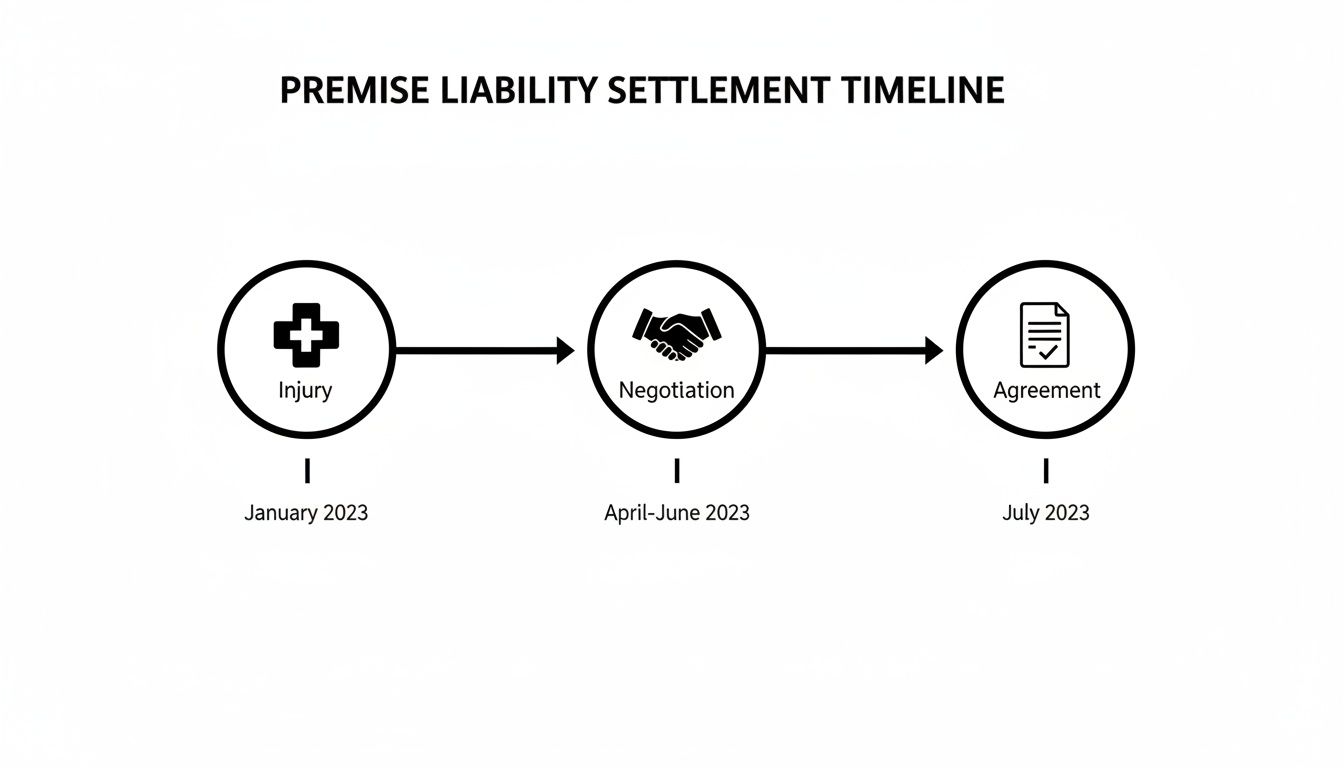
As you can see, it’s a progression. Each step builds on the last to create a compelling argument for the full and fair compensation you deserve.
The Georgia Settlement Timeline
Here's a breakdown of how a premises liability claim typically moves forward in Georgia. This table simplifies the key actions you and your attorney will take.
| Step | Action Required | Key Consideration |
|---|---|---|
| 1. Medical Treatment | Seek immediate medical attention. | Creates an official record linking your injuries to the incident. |
| 2. Incident Report | Notify the property owner or manager. | Get a written copy to document the event. |
| 3. Evidence Gathering | Take photos/videos of the hazard and get witness info. | On-scene evidence is powerful and hard to dispute later. |
| 4. Insurance Claim Filing | File a formal claim with the owner's insurance provider. | This officially starts the process of seeking damages. |
| 5. Investigation | Your attorney collects records; the insurer investigates. | Both sides build their case. Evidence is key. |
| 6. Demand Letter | Your attorney sends a detailed demand for a specific amount. | Outlines liability and justifies the settlement figure. |
| 7. Negotiation | Back-and-forth communication with the insurance adjuster. | Your attorney argues to counter lowball offers. |
| 8. Resolution | A settlement is reached, or a lawsuit is filed. | The goal is a fair agreement, but we prepare for court if needed. |
Following these steps methodically is important. Missing one can weaken your negotiating position and make it harder to secure a fair outcome.
Georgia’s Two-Year Statute of Limitations
In Georgia, the law sets a strict deadline for filing a lawsuit. This is called the statute of limitations, and for personal injury cases, it's a date you must watch.
Under Georgia Code § 9-3-33, you have two years from the date of the injury to file a lawsuit.
This two-year window is absolute. If you miss this deadline, Georgia courts will almost certainly bar you from seeking any compensation for your injuries, no matter how strong your case is.
This is exactly why acting promptly is so important. It gives your legal team the time needed to conduct a thorough investigation, gather all the necessary evidence, and build a strong negotiating position long before the clock runs out. Waiting until the last minute puts you at a disadvantage and can seriously impact the value of your premise liability settlement.
Why Most Premises Liability Cases Settle Out of Court
Contrary to what television dramas suggest, most injury cases don’t end in a climactic courtroom showdown. The reality is that the vast majority of claims, including those involving a premise liability settlement, are resolved long before a trial is necessary. This is a practical and strategic decision made by both sides for sound legal and financial reasons.
For an injured victim, settling provides a clear path forward. A trial is a lengthy, stressful, and emotionally taxing process with no guaranteed outcome. A settlement offers a definite financial result much sooner, enabling you to address medical bills, cover lost wages, and focus on recovery without the anxiety of a court date. It provides certainty when everything else feels uncertain.
The Insurance Company's Perspective
Property owners and their insurance carriers also have strong incentives to settle. While they retain large legal teams, taking a case to trial is an expensive endeavor for them as well. The costs associated with legal fees, expert witness testimony, and internal resources add up quickly.
More importantly, a jury is the ultimate unknown. An insurer may believe it has a strong defense, but a jury swayed by sympathy for an injured person could return a verdict far exceeding any potential settlement offer. Settling eliminates this risk, allowing the insurance company to close the file for a predictable, fixed amount and avoid a potentially massive financial loss.
By settling, both parties regain control over the outcome. The injured person secures guaranteed compensation, and the insurer caps its financial exposure, avoiding the all-or-nothing gamble of a jury trial.
The Numbers Tell the Story
This preference for settlement isn't just anecdotal; it's backed by clear data. Statistics consistently show that settling is the standard resolution path in civil litigation. In fact, a staggering 95% of personal injury lawsuits are settled before ever reaching a trial. When cases do go to court, the defense wins about 61% of the time, highlighting the significant risk an injured plaintiff takes by proceeding to a verdict.
From 2017 to 2021, annual liability claim payouts averaged $18.8 billion. Many slip and fall cases resolve for between $10,000 and $50,000, though this figure can be much higher when there is powerful evidence of negligence. You can explore more data about these personal injury trends and their outcomes.
This trend underscores an important point: building a strong, evidence-backed claim from the start is what creates the leverage needed for successful settlement negotiations. When the property owner’s insurer sees a well-documented case proving their client's fault, their motivation to offer a fair premise liability settlement increases dramatically to avoid the risks and expenses of trial.
When to Speak with an Atlanta Injury Attorney
While you have the right to file an insurance claim on your own, some situations almost always demand professional legal insight. Knowing when to make that call is often the most important decision in protecting your rights and securing a fair premise liability settlement.
Many people hesitate. They might think their injuries aren't "bad enough" or assume the legal process is too overwhelming. But if any of the following scenarios feel familiar, it's a clear signal to seek legal advice right away.
Clear Signs You Need an Attorney
You don't need to have everything figured out before you reach out. If you're facing one of these challenges, it’s the right time to speak with a lawyer:
- Your Injuries Are Serious: If your injury led to surgery, a hospital stay, or requires long-term physical therapy, the financial stakes are simply too high to go it alone. An attorney ensures the full scope of your future medical needs is correctly calculated and folded into your settlement demand.
- The Insurance Company Denies Liability: Insurers often open with a flat-out denial, claiming the property owner did nothing wrong. This is a common tactic designed to make you give up. Overcoming it requires a firm grasp of Georgia's liability laws and the specific evidence needed to prove fault.
- The Settlement Offer Seems Too Low: The first offer is almost never the best offer. In fact, it's usually a fraction of what your claim is actually worth. An experienced attorney can accurately value your claim and negotiate forcefully to counter these lowball tactics.
- You're Unsure of Your Claim's Value: How do you put a number on your medical bills, lost income, and pain and suffering? It's a calculation that requires experience. Without it, it’s easy to undervalue your claim and accept far less than you deserve.
The Benefits of Professional Representation
Hiring an attorney levels the playing field. You’re up against large insurance companies and their teams of lawyers whose job is to protect the company's bottom line. Our job is to protect you. A lawyer will manage every detail, from paperwork to phone calls, so you can focus on your recovery.
An experienced lawyer is your investigator, negotiator, and advocate, all in one. They gather evidence, consult with experts, and build a powerful case designed to maximize your recovery, making sure nothing is overlooked.
When a premises liability incident tragically results in a fatality, the case becomes even more involved. Understanding the role of a wrongful death expert witness is vital, and that's something a skilled legal professional is equipped to handle.
By managing all communications and leveraging deep negotiating experience, an attorney can significantly improve the outcome of your premise liability settlement. Our team is here to help you understand your options. Learn more about how an Atlanta premises liability lawyer can support your case.
Frequently Asked Questions About Premises Liability
After an injury on someone else's property, questions and uncertainty are completely normal. Here are some straightforward answers to the questions we hear most often about a premise liability settlement in Georgia.
What Is the Average Settlement for a Slip and Fall in Georgia?
There is no single "average" settlement amount because the facts of every case are different. A settlement can be as low as a few thousand dollars for a minor sprain or climb to several hundred thousand for an injury that requires surgery or results in a permanent disability.
The final number is driven entirely by the specifics—the severity of your injuries, your total medical bills, and how much income you've lost. For instance, a slip and fall that causes a broken hip will always command a much higher settlement than a fall that leads to minor bruises. The quality of the evidence proving the property owner was negligent is also a main factor.
How Do You Prove Fault in a Premises Liability Case?
To prove fault in Georgia, we must establish that the property owner either knew about the hazardous condition or reasonably should have known about it, yet failed to fix it or warn you. This is often the most challenging part of a premises liability claim.
We build the case for fault by compiling key evidence, including:
- Incident Reports: The official report you filed with the store manager or property owner right after the accident.
- Photos and Videos: Clear images of the hazard—a wet floor with no sign, a broken handrail, or a poorly lit staircase—taken as soon as possible.
- Witness Statements: Testimony from anyone who saw the accident or knew about the dangerous condition before you were injured.
- Maintenance Records: These documents can reveal a pattern of neglect or a failure to perform routine safety inspections.
How Long Do I Have to File a Claim in Georgia?
Under Georgia law, you generally have two years from the date of the injury to file a lawsuit. This legal deadline is called the statute of limitations. If you miss it, you will almost certainly be barred from ever recovering compensation for your injuries.
For a detailed look at the law, you can review O.C.G.A. § 9-3-33 on the Georgia Code website.
It is so important not to wait until the deadline is approaching. Building a strong case takes time. Evidence gets lost, memories fade, and witnesses move. The sooner you start the process, the stronger your position will be to secure a fair premise liability settlement.
If you have more questions or need to discuss the specifics of your accident, the team at Jamie Ballard Law is ready to help. We offer a free, no-obligation case evaluation to clarify your options and outline the next steps. Reach out 24/7 to get the support you need. Contact us today at https://jamieballardlaw.com.