How To Choose The Right Attorney In Atlanta
Finding the best injury lawyer in Atlanta, Georgia is one of the most important decisions you will make after a serious accident. The attorney you choose determines how your case is investigated, how aggressively your damages are pursued, and ultimately how much you recover. Atlanta has hundreds of personal injury attorneys advertising online — and most of them look identical on a website. Knowing what actually separates a great Atlanta injury lawyer from an average one, what questions to ask before signing a contract, and what red flags to walk away from gives you a real advantage when you are evaluating your options after an accident. This guide covers everything you need to make a confident, informed decision.
Why the Attorney You Choose in Atlanta Changes Your Outcome
The personal injury legal market in Atlanta is large, competitive, and uneven. Some firms settle every case as fast as possible regardless of value. Others have the trial experience, resources, and willingness to fight that forces insurers to take claims seriously. The difference in outcomes between these two types of attorneys — handling identical cases — can be tens of thousands of dollars or more.
Insurance Companies Track Which Attorneys Go to Trial
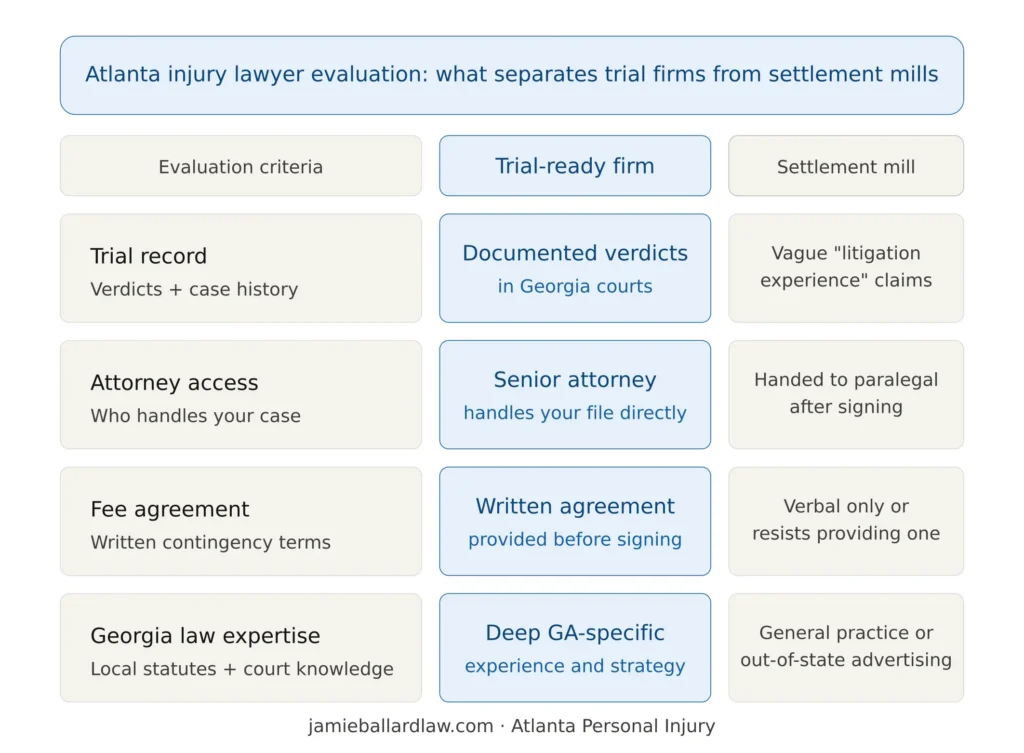
This is not commonly known, but it is how the industry works. Insurance defense teams and their adjusters know which plaintiff attorneys in Atlanta are willing to take cases to trial and which ones settle everything. An attorney with a documented trial record — and a reputation for winning in front of juries — commands higher settlement offers on the same facts than an attorney who never litigates. When an insurer knows your attorney will walk into a courtroom if they do not offer fair value, they adjust their offers accordingly. Your choice of attorney is part of your negotiating leverage before a single demand letter is sent.
Investigative Resources and Expert Networks Matter Early
Serious personal injury cases in Georgia require early investigation — accident reconstruction, medical expert retention, witness interviews, evidence preservation. Attorneys who handle only small, quick-settlement cases rarely invest in these resources. Attorneys who handle catastrophic injury claims maintain relationships with credentialed experts, private investigators, and litigation support professionals who can build the kind of evidence record that forces insurers to pay full value. If your case involves significant injuries, you want an attorney whose infrastructure matches the complexity of what you are dealing with.
Practical rule: The best injury lawyer near you in Atlanta is not the one with the most billboard advertising — it is the one with a trial record, real resources, and a track record of results in cases like yours.
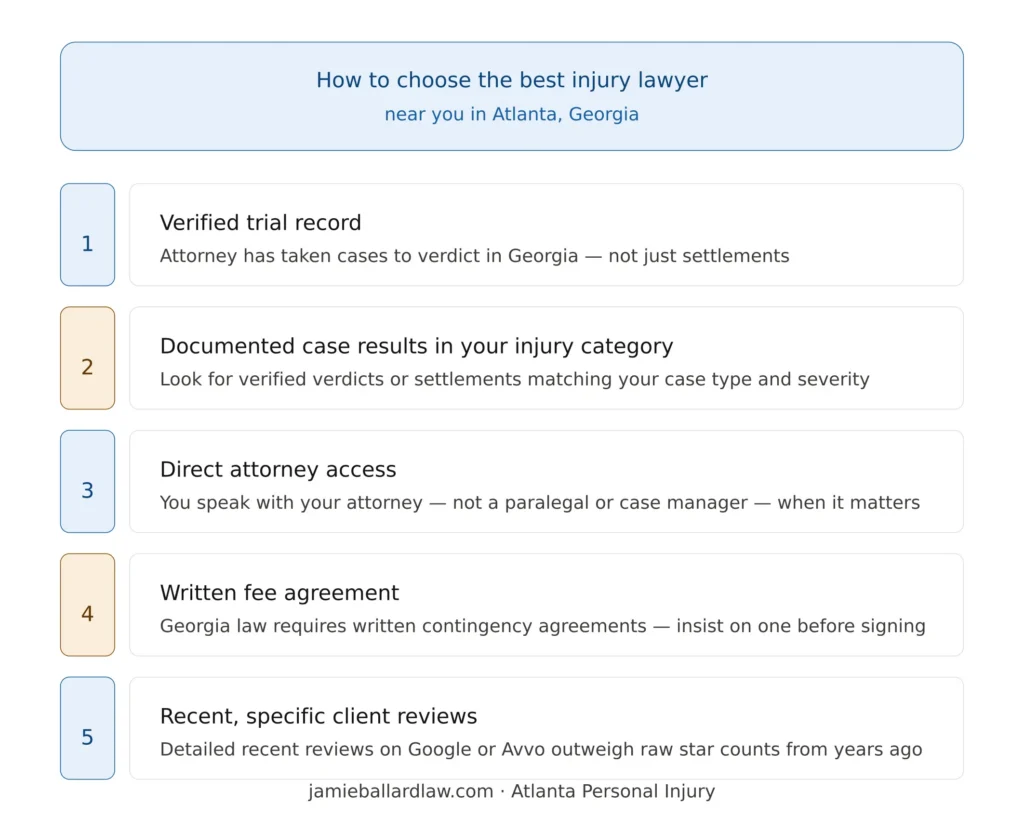
What to Look for in the Best Injury Lawyer Near You in Atlanta
These are the criteria that actually separate strong Atlanta personal injury attorneys from those who will underserve your case.
Verified Trial Experience — Not Just Settlements
Any attorney can settle cases. Only attorneys who are prepared to go to trial — and have actually done it — create the litigation pressure that produces full-value settlements. When evaluating any Atlanta injury attorney, ask directly: how many personal injury trials have you taken to verdict in the last three years? A good attorney can answer specifically. Vague answers about “extensive litigation experience” without specifics are a warning sign. You want an attorney who has stood in front of a Georgia jury, made closing arguments, and won — because that history is what makes insurers take your case seriously from day one.
Case Results in Your Injury Category
A car accident attorney is not necessarily the right choice for a catastrophic injury claim, a wrongful death case, or a premises liability matter. Look for documented results — on the firm’s website, in client reviews, or in public court records — in cases that match your injury type and severity. An attorney who has recovered substantial verdicts or settlements for clients with injuries like yours has already navigated the specific legal arguments, expert witnesses, and insurer tactics that will come up in your case. That experience has direct, practical value.
Real Client Reviews — Recent and Specific
Google reviews, Avvo ratings, and testimonials tell you something — but specific, recent reviews are far more valuable than volume. A firm with 400 reviews averaging 4.2 stars tells you less than a firm with 80 reviews averaging 4.9 stars where individual clients describe exactly how the attorney handled their case, communicated through difficult moments, and ultimately delivered a result. Read the negative reviews too. How a firm responds to criticism reveals how they treat clients who are frustrated or disappointed — which every client sometimes is during a long legal process.
Direct Attorney Access and Communication Standards
Large settlement-mill firms in Atlanta frequently sign up clients with a senior attorney and then hand them off to a paralegal or case manager who handles all real contact. You deserve to speak with your attorney when you have a meaningful question about your case. Before hiring anyone, ask specifically: who will I speak with when I call? How quickly does the attorney return calls? Will the attorney who signs my case be the one who handles depositions and negotiations? If those answers are vague, that tells you something important about how they operate.
Practical rule: If you cannot reach your attorney by phone to ask a real question about your case, find a different attorney. Communication is not a bonus feature — it is part of the representation you are paying for through your contingency fee.

Questions to Ask Before Hiring Any Atlanta Personal Injury Attorney
A free consultation is your opportunity to interview the attorney — not the other way around. These are the questions that give you the most useful information in the least time.
Have You Handled Cases Like Mine Before?
Specific to your injury type, your circumstances, and your county if possible. A Georgia attorney who has handled dozens of rear-end collision cases in Fulton County knows the local judges, the defense firms the insurers use, and the jury pool tendencies in ways that a general practitioner does not. Specificity in their answer — real case descriptions, not generalities — tells you they have the relevant experience.
What Is Your Honest Assessment of My Case?
A good attorney gives you an honest evaluation — including the weaknesses and risks — not just an enthusiastic pitch. If every attorney you consult tells you your case is a home run, be skeptical. Real cases have real issues. An attorney who identifies those issues early and explains how they plan to address them is demonstrating the analytical rigor your case actually needs. Attorneys who only validate are often the same attorneys who undersettle when those issues surface later in litigation.
What Is Your Fee Structure?
Most Georgia personal injury attorneys work on contingency — they receive a percentage of your recovery only if they win. Standard contingency fees in Georgia range from 33% pre-litigation to 40% at trial. Make sure you understand what costs are deducted from your recovery and when — case expenses like filing fees, expert witness costs, and deposition transcript fees are typically deducted separately from the contingency fee. Get the fee agreement in writing and read it before signing. The State Bar of Georgia requires written fee agreements in contingency fee arrangements — any attorney who resists providing one should be avoided.
Who Specifically Will Handle My Case Day to Day?
Ask by name who handles depositions, who writes the demand letter, who attends mediation. If the answer is “our team” without specifics, push for clarity. You are entering a legal relationship that may last one to three years. Knowing exactly who is responsible for your case — and meeting that person before you sign — is a reasonable request that a quality firm will accommodate without hesitation.
Practical rule: A free consultation is a two-way interview. The attorney is evaluating whether to take your case — and you are evaluating whether they are the right person to trust with it. Ask hard questions, expect specific answers, and trust your instincts.
Red Flags to Watch Out for When Choosing an Atlanta Injury Lawyer
Just as important as knowing what to look for is knowing what to walk away from. These patterns appear frequently in the Atlanta personal injury market and consistently signal attorneys who will not serve your case well.
Pressure to Sign Immediately
A reputable attorney never pressures you to sign a contract at the first meeting. You should be given time to consider your options, consult with family if appropriate, and compare two or three attorneys before committing. Any attorney who tells you their offer expires if you do not sign today is using a sales tactic that has no place in a legal representation relationship. Urgency around statute of limitations deadlines is legitimate — pressure to sign a specific attorney’s contract immediately is not.
Guarantees of Specific Outcomes
No Georgia attorney can legally guarantee a specific settlement amount or verdict. The Georgia Rules of Professional Conduct prohibit misleading statements about case outcomes. An attorney who promises you a specific dollar figure at the first consultation — before reviewing your medical records, the police report, or the liability facts in detail — is either uninformed or dishonest. Both are disqualifying. Honest attorneys give you ranges based on comparable cases and explain the factors that move outcomes up or down.
Lack of Clear Communication About Who Handles Your Case
In large Atlanta personal injury mills, cases are frequently handed off to junior associates or non-attorney staff after signing. If the attorney you consult will not be the attorney who actually manages your file, attends your deposition, and negotiates your settlement, you are not hiring who you think you are. Ask explicitly and get a clear answer. If the senior attorney cannot commit to primary involvement in your case, keep looking for an Atlanta personal injury attorney who can.
No Verifiable Case Results or Testimonials
Established Atlanta injury attorneys have public records of their work — verifiable verdicts, documented settlements, client reviews on Google and Avvo that can be cross-referenced. A firm that cannot point to specific, verifiable results in cases similar to yours is either too new to evaluate or deliberately obscuring their track record. Either way, that is information you need before signing.
How Georgia’s Legal System Affects Which Lawyer You Need
Georgia-specific laws shape personal injury claims in ways that make local expertise genuinely important — not just a marketing talking point.
Georgia’s Modified Comparative Fault Rule
Under O.C.G.A. § 51-12-33, Georgia uses a modified comparative fault system. If you are found more than 50% at fault for your accident, you recover nothing. Below that threshold, your damages are reduced proportionally by your percentage of fault. This means the way your attorney frames the liability facts — in the demand letter, at deposition, and at trial — directly affects your recovery. An attorney who understands how Georgia juries weigh comparative fault arguments, and who prepares your case to minimize your assigned fault percentage, is doing work that has direct financial impact on your outcome.
Georgia’s Two-Year Statute of Limitations
Under O.C.G.A. § 9-3-33, most Georgia personal injury claims must be filed within two years of the accident date. Missing this deadline extinguishes your right to recover entirely — regardless of how strong your case is on the merits. Exceptions exist for minors and for cases involving government entities, which have even shorter notice requirements. An attorney familiar with these deadlines and exceptions protects your rights from day one. The Georgia statute of limitations code at Justia provides the full text of this requirement for reference.
Georgia Bad Faith Insurance Penalties
Georgia’s bad faith statute, O.C.G.A. § 33-4-6, allows injured claimants to pursue penalties and attorney fees against insurers who refuse to settle within policy limits in bad faith. An experienced Atlanta injury attorney knows when this statute applies, how to make a proper demand that preserves your rights under it, and how to use the threat of bad faith exposure to move intransigent insurers toward reasonable settlement offers. This is a powerful tool — but only in the hands of an attorney who knows how to use it correctly.
Practical rule: Georgia law gives injured people real leverage against insurance companies — but only if your attorney knows how to use it. Local expertise in Georgia personal injury statutes is not a differentiator, it is a baseline requirement.
Types of Cases the Best Atlanta Injury Lawyers Handle
Understanding which case types your prospective attorney has deep experience in helps you match your situation to the right representation.
Car Accidents and Truck Accidents
Motor vehicle accidents are the most common personal injury matters in Atlanta. The best Atlanta car accident attorneys handle everything from rear-end collisions to catastrophic multi-vehicle crashes involving commercial vehicles. Truck accident cases require additional expertise — FMCSA regulations, electronic logging device data, and carrier liability structures make them significantly more complex than standard car accident claims. The Federal Motor Carrier Safety Administration sets the federal regulations that govern commercial trucking — and violations of those regulations are central to most truck accident liability cases. The National Highway Traffic Safety Administration also publishes crash data that expert witnesses use to establish causation and industry safety standards in Georgia vehicle accident cases.
Slip and Fall and Premises Liability
Premises liability cases in Georgia require proving that the property owner knew or should have known about the dangerous condition and failed to correct it before you were injured. These cases often involve significant front-end investigation — security camera footage, incident reports, maintenance logs, and records of prior complaints about the same hazard — that must be preserved quickly before it is overwritten, deleted, or claimed never to have existed. An attorney experienced in Georgia premises liability understands exactly what evidence matters, how to use preservation letters and litigation holds to secure it before it disappears, and how to frame the constructive knowledge argument that is the legal foundation of most Atlanta slip and fall claims.
Wrongful Death Claims
Georgia wrongful death law gives specific family members the right to pursue compensation for the full value of the deceased’s life — not just economic damages like lost income and medical expenses, but the intangible value of their life to those who loved and depended on them. Under O.C.G.A. § 51-4-2, the spouse and children of a deceased person hold the primary right to bring a wrongful death claim in Georgia. These claims are among the most legally complex and emotionally demanding matters in personal injury practice, requiring an attorney who understands the Georgia statutory framework, the evidentiary challenges specific to these cases, and the profound responsibility that comes with representing a family in the worst moment of their lives. Do not approach a Georgia wrongful death claim without an attorney who has handled them before.
Frequently Asked Questions — Best Injury Lawyer Near Me Atlanta
| Question | Answer |
|---|---|
| How do I find the best injury lawyer near me in Atlanta? | Look for verified trial experience in cases like yours, specific documented results, strong recent reviews, and direct attorney access. Consult at least two or three attorneys before signing. |
| How much does a personal injury lawyer in Atlanta cost? | Most work on contingency — typically 33% pre-litigation and up to 40% at trial. You pay nothing unless you recover. Always get the fee agreement in writing before signing. |
| How long do I have to hire an attorney after an accident in Georgia? | Georgia’s statute of limitations is two years from the accident date for most personal injury claims. Cases against government entities may have shorter notice requirements. Do not wait. |
| What if I was partially at fault for my accident? | Georgia’s modified comparative fault rule allows you to recover as long as you are 50% or less at fault. Your damages are reduced by your percentage of fault. An experienced attorney frames the liability facts to minimize your assigned fault. |
| Should I hire a large Atlanta firm or a smaller attorney? | Size is less important than trial record, resources, and direct attorney access. Some large firms are excellent. Others are high-volume settlement mills. Ask specifically who handles your case and what their personal trial record is. |
| What is a free consultation and what should I bring? | A free consultation is a no-obligation meeting where you describe your accident and the attorney evaluates your case. Bring the police report, medical records if you have them, any photos, and your insurance information. |
| Can I switch attorneys if I am unhappy? | Yes. You have the right to change attorneys at any time, though your original attorney may have a lien on the file for work performed. A new attorney can advise you on how to handle that transition. |
| What makes Jamie Ballard Law different from other Atlanta injury firms? | Jamie Ballard Law combines trial-ready representation with direct attorney access and a commitment to client communication. Every case is handled with the assumption that it may go to trial — because that posture is what produces full-value settlements. |
Practical rule: Georgia’s bad faith statute, its modified comparative fault rule, and its two-year statute of limitations all require an attorney who knows Georgia law specifically — not an out-of-state firm advertising in Atlanta or a general practitioner who occasionally handles injury cases.
The Right Atlanta Injury Attorney Makes the Difference From Day One
When you are searching for the best injury lawyer near me in Atlanta, you are not just looking for a name on a billboard or the highest advertising budget in your search results. You are looking for an attorney with a real trial record, the resources to build your case properly, and the professional integrity to give you honest guidance rather than just telling you what you want to hear. Jamie Ballard Law offers free consultations to injured Georgians across Atlanta and the surrounding areas. Call (404) 885-8544 or visit the contact page to get started today.
About Jamie Ballard Law
Jamie Ballard Law is an Atlanta-based personal injury firm serving injured Georgians throughout the metro area and across the state. The firm handles car accidents, truck accidents, slip and fall cases, wrongful death claims, and catastrophic injury matters — providing direct attorney access, transparent communication, and trial-ready representation at every stage of the case.