How long after a deposition does a case settle is one of the most common questions injured Georgians ask once depositions are done. You have sat through hours of questioning. Your attorney has deposed the other side. Now you want to know when this ends and what comes next. The honest answer is that it depends — but clear patterns apply to most Georgia personal injury cases, and understanding those patterns makes the waiting period far less uncertain. Most cases settle within 30 to 90 days after depositions close. Some take longer when liability is disputed or damages are complex. A few resolve within days when a defendant’s testimony was particularly damaging to their own position. Understanding what drives post-deposition timing helps you set realistic expectations, recognize when your case is moving on track, and identify when delays may signal a problem worth discussing with your attorney. This guide covers everything that happens after a deposition and how long it realistically takes to reach a settlement in Georgia.
What Actually Happens Right After Depositions End
Depositions do not end your case — they change it. Once depositions close, both sides have a clearer picture of what trial would look like. That clarity drives settlement activity in a way that pre-deposition negotiations rarely do.
Both Sides Reassess Their Position
After depositions, your attorney reviews the testimony of every witness, the defendant, and any experts. The defense reviews yours. Each side is now evaluating the same question: what does this case look like to a jury? If your deposition testimony was strong — credible, consistent, and sympathetic — the insurer’s settlement motivation increases immediately. Inconsistent or damaging testimony gives them grounds to hold firm.
Attorneys Resume and Intensify Settlement Negotiations
Within a few weeks of depositions closing, attorneys typically resume or intensify settlement discussions. Your attorney may send an updated demand letter incorporating deposition testimony and any new expert findings. The defense may respond with a revised offer — sometimes higher than previous positions, sometimes not. This back-and-forth exchange is the normal post-deposition negotiation cycle. It is where most Georgia personal injury cases finally resolve, often without any court appearance beyond the depositions themselves. The key is that both sides are now negotiating with full knowledge of what each witness said under oath — which changes the dynamic significantly compared to early-stage demand letter exchanges.
Practical rule: Depositions do not cause settlement — they create clarity. The clearer it becomes that a jury would side with you, the faster the insurer moves toward a resolution that makes litigation less attractive than paying a fair settlement.
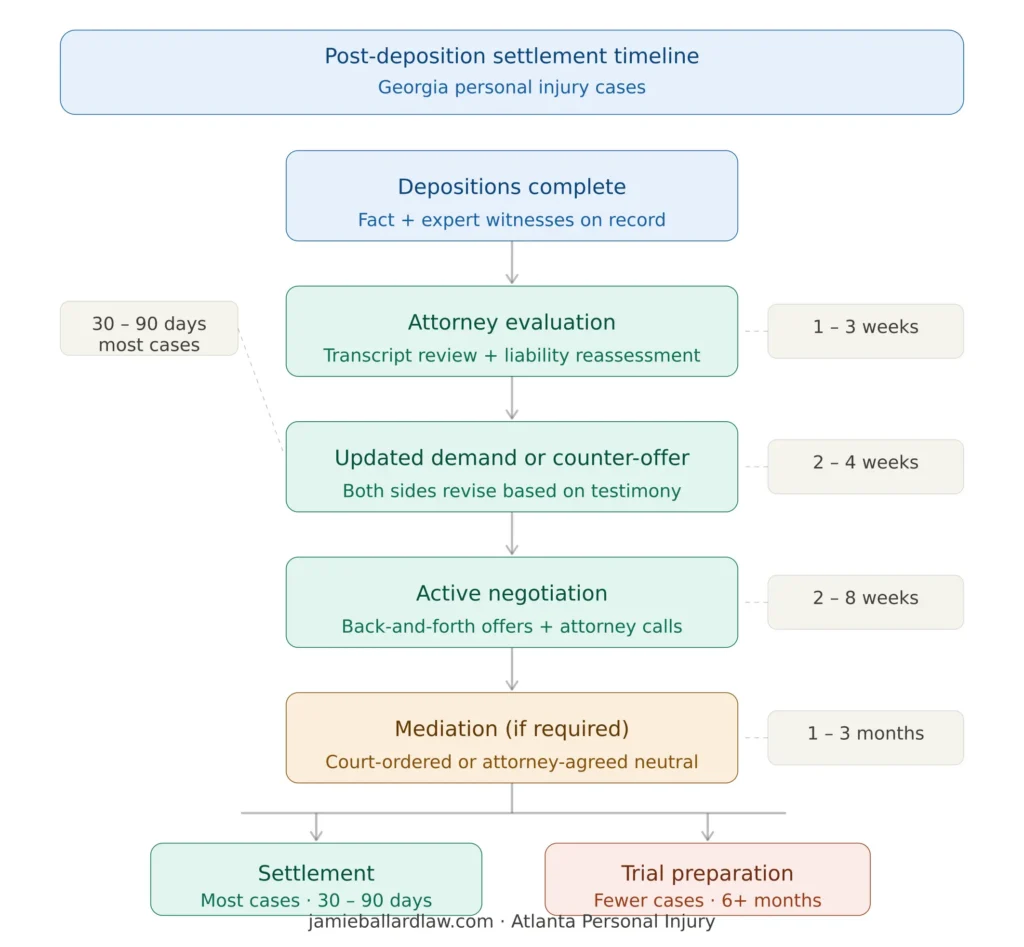
Realistic Post-Deposition Settlement Timelines in Georgia
There is no universal answer to how long after a deposition does a case settle — but these ranges reflect what Georgia personal injury outcomes actually look like.
30 to 90 Days — The Most Common Window
The majority of Georgia personal injury cases that settle post-deposition do so within 30 to 90 days of depositions closing. This window covers transcript review, updated demands, counter-offers, and final negotiation. Straightforward liability cases with clear damages and credible testimony settle toward the shorter end.
90 Days to 6 Months — Complex or Disputed Cases
Cases involving disputed liability, multiple defendants, significant damages disagreements, or defense expert challenges often take 3 to 6 months post-deposition to resolve. This window may also include mediation — a structured negotiation with a neutral third party — which Georgia courts frequently require before trial.
6 Months to Trial — Cases That Do Not Settle
A smaller percentage of cases — typically those with very large damages, strong liability disputes, or insurers refusing reasonable value — proceed toward trial preparation. Even these frequently settle during the final 30 to 60 days before the jury is seated, sometimes just days before opening statements. Georgia trial dates create real financial urgency that breaks settlement logjams that months of prior negotiation could not move. The cost of trial preparation, expert witness fees, and the risk of an adverse jury verdict all become very concrete as a trial date approaches — and insurers who were content to stall often reverse course quickly once that date is real.
| Post-Deposition Phase | Typical Timeline | What Drives It |
|---|---|---|
| Attorney review and evaluation | 1–3 weeks | Transcript review, liability reassessment |
| Updated demand or counter-offer | 2–4 weeks | Both sides revise positions based on testimony |
| Active negotiation | 2–8 weeks | Back-and-forth offers and attorney calls |
| Mediation if required | 1–3 months post-deposition | Court order or attorney agreement |
| Settlement finalized | 30–90 days for most cases | Agreement reached and release signed |
| Trial preparation or trial | 6+ months post-deposition | Cases that do not resolve through negotiation |
How Your Deposition Testimony Directly Affects Settlement Value
The content and quality of your deposition testimony shapes what happens next — including how quickly the insurer moves and how much they are willing to offer. Your attorney spends significant time preparing you for this reason.
Consistency Is the Foundation of Credibility
Defense attorneys compare your deposition testimony against every prior statement — the accident report, your medical records, your written discovery responses. Any inconsistency becomes an argument to reduce your credibility and justify a lower settlement offer. Saying your neck hurt immediately in your medical records but testifying you felt fine for two days creates a gap the defense exploits directly. Your attorney prepares you to tell your story clearly, accurately, and consistently — not to memorize a script, but to be ready for the questions that will come.
Jury Appeal Factors Into Every Offer
Defense attorneys and claims adjusters evaluate how sympathetic you would be to a Georgia jury. A claimant who comes across as genuine, clear-headed, and specific about their injuries and limitations is a litigation risk to the insurer. Post-deposition settlement offers frequently reflect the defense attorney’s honest assessment of how a jury would respond to your testimony — and your attorney uses that assessment as leverage in every negotiation that follows.
What the Defendant’s Deposition Revealed
Your attorney’s deposition of the at-fault party is equally important to the outcome. If the defendant admitted they were distracted, contradicted their own accident report, or revealed facts that clearly establish liability, settlement pressure on the insurer increases significantly. A defendant who testified confidently and consistently may give the insurer grounds to hold a lower position. The full picture from all depositions — not just yours — drives every offer made afterward.
Practical rule: Your deposition is a preview of trial. The more compelling that preview for your side, the more motivated the insurer is to resolve your case before a jury sees the same testimony in open court.

What Can Speed Up or Slow Down Settlement After Depositions
Certain case facts consistently accelerate post-deposition resolution in Georgia. Others cause delays that stretch the timeline well beyond the typical 30-to-90-day window.
Factors That Accelerate Settlement
Trial date proximity is one of the most powerful settlement drivers in Georgia. As a scheduled trial date approaches, defense costs accelerate — trial preparation, expert witness fees, attorney time — and the risk of an adverse jury verdict becomes concrete. Cases frequently settle in the final 30 to 60 days before trial for amounts far above what the insurer offered months earlier.
Mediation scheduled by the court also moves cases forward consistently. Many Georgia courts require formal mediation before setting a trial date. A skilled mediator — often a retired judge or experienced civil litigator — creates a structured, confidential environment where both sides can speak candidly about their risk assessments without those statements being used against them later. The Georgia courts system actively uses court-ordered mediation to reduce trial dockets, and it resolves a significant percentage of cases that were otherwise headed to a jury. Even deeply adversarial cases frequently settle at mediation once both sides are sitting in the same building and making real-time decisions.
Factors That Cause Delays
Disputed liability stalls post-deposition settlement when testimony left fault genuinely contested. Both sides may need additional discovery or expert analysis before positions shift. Medical causation disputes — where the defense deposed an expert challenging whether your injuries were caused by the accident — anchor their offers lower while they pursue that argument. And multiple defendants require coordination among multiple insurers and defense teams, where one holdout can delay the entire resolution. These cases consistently take longer than single-defendant matters.
Practical rule: If your case involves disputed liability, a defense IME, or multiple defendants, plan for 3 to 6 months post-deposition — and sometimes mediation before resolution. Cases with clear liability and well-documented damages almost always move faster.
What Happens Between Settlement and Money in Your Pocket
Even after a number is agreed upon, additional steps stand between a settlement and your receiving funds — and each takes time.
Release Negotiation and Signing
Once a settlement number is agreed, the defense prepares a release — a legal agreement in which you waive all future claims related to the accident in exchange for payment. Your attorney reviews the release terms carefully. Overly broad language, or releases that attempt to waive claims against parties not in the negotiation, must be identified and corrected before you sign anything.
Lien Resolution
If your medical treatment was paid by health insurance, Medicare, Medicaid, or a workers’ compensation carrier, those entities may hold a lien on your settlement proceeds. Your attorney negotiates these liens before or simultaneously with finalizing the settlement. Medicare and Medicaid lien resolution requires compliance with federal reporting requirements and can take several additional weeks. The Centers for Medicare and Medicaid Services administers the conditional payment process your attorney must navigate before disbursement.
Disbursement to You
After the release is signed and liens are resolved, the insurer issues payment to your attorney’s trust account. Your attorney deducts their contingency fee, any case expenses advanced during litigation, and lien payments — then disburses the net amount to you with a full itemized accounting of every dollar in and out. Georgia bar rules require this disbursement statement to be provided to you in writing. From the time the release is signed to money in your hands typically takes 3 to 6 weeks, though complex lien situations — particularly those involving Medicare conditional payment resolution — can extend this timeline. Your attorney will give you a realistic estimate once liens have been identified and resolution timelines are known.
Practical rule: From signed release to money in hand takes 3 to 6 weeks in most Georgia personal injury cases — longer when Medicare or Medicaid liens require federal conditional payment resolution. Ask your attorney for a specific estimate once all liens are identified.
For a clear walkthrough of what actually happens after depositions and what the settlement process looks like from inside a real case, this explanation from Empower Injury Law on what happens after a deposition covers the post-deposition timeline in practical, plain-language terms.
What to Do While You Wait for Settlement After Depositions
The post-deposition waiting period can feel frustrating — especially when you are managing ongoing pain, medical bills, and financial uncertainty. These steps protect your case and recovery during that window.
Keep Treating and Follow Your Doctor’s Recommendations
Do not stop treatment because depositions are done. If your physician recommends ongoing physical therapy, specialist follow-ups, or pain management, follow through. Stopping treatment prematurely signals that your injuries have resolved — which the defense uses directly to reduce your damages claim. Your medical records through final resolution are evidence your attorney uses to justify the full demand.
Maintain Your Pain Journal
A daily record of your symptoms, limitations, and the impact on your life is valuable at mediation and at trial. Specific dated entries — what you could not lift today, which activities you had to skip, how your sleep was affected, whether pain interrupted your work — are far more compelling to a mediator or jury than a general summary written months after the fact. Defense counsel and insurance adjusters know the difference between a journal maintained throughout treatment and a narrative reconstructed at the end. Keep it current, keep it specific, and share it with your attorney so they can incorporate it into the damages presentation as the case develops.
Stay Off Social Media About the Case
Even after depositions are complete, your social media activity is fair game if your case proceeds toward trial. A photo contradicting your testimony about physical limitations — even an innocent family event picture — can be used to attack your credibility with a jury. Stay off social media about anything related to the accident, your injuries, or your daily physical activity until the release is signed and your case is fully and finally resolved. Even posts that seem unrelated to your injuries — photos at a family barbecue, a walk, a vacation — can be pulled into litigation by a defense team looking for evidence that contradicts your claimed limitations. Assume everything you post online is being monitored until the settlement check clears.
Communicate Regularly With Your Attorney
Ask for specific status updates — what is the current offer on the table, what is the next scheduled event in the case, and what is the realistic timeline to resolution given where things stand. The State Bar of Georgia requires attorneys to keep clients reasonably informed about the status of their matters — not just when the client asks, but proactively as meaningful developments occur. If several weeks pass without any contact from your attorney’s office, call and ask specifically what has happened since depositions and what the next step is. Understanding exactly where your case stands eliminates the anxiety of uncertainty and ensures you can make clear, informed decisions when a settlement offer is presented that deserves serious consideration.
The Role of Expert Witnesses in Post-Deposition Settlement Negotiations
In serious injury cases, expert witness depositions — medical specialists, accident reconstructionists, and economic damages experts — are frequently taken after fact depositions. These expert depositions often determine the final settlement range more than any other single factor.
Medical Expert Depositions and Causation
Your treating physician or a retained medical expert may be deposed by the defense team. Defense counsel will challenge whether the accident caused your injuries, whether the treatment you received was medically necessary, and whether your future care projections are realistic. Your expert’s credibility and the strength of their clinical opinions — backed by imaging results, documented findings, and treatment records — directly shape the damages range both sides are working within. A strong, unshakeable medical expert deposition can increase the settlement offer that follows by a significant margin. A weak or contradicted one reduces it and emboldens the insurer to push toward trial.
Economic Damages and Lost Earning Capacity
In cases involving permanent disability, lost earning capacity, or long-term care needs, economic damages experts prepare detailed financial analyses based on your age, occupation, earnings history, and injury-related limitations. These experts are frequently deposed by the defense, and their testimony can dramatically expand or contract the damages range both sides are negotiating within. The Bureau of Labor Statistics Occupational Outlook Handbook provides the wage and employment data these experts rely on to calculate lifetime earning capacity losses in Georgia personal injury cases — and defense experts use the same data to challenge those projections.
Accident Reconstruction in Liability-Disputed Cases
In car accident cases where both parties gave conflicting accounts of how the collision occurred, accident reconstruction experts analyze vehicle damage patterns, skid marks, point of impact, and speed data to determine fault independently of testimony. Their depositions frequently resolve liability disputes that oral testimony alone could not settle. A reconstruction opinion that clearly places fault on the defendant often breaks a post-deposition stalemate and moves the insurer toward a realistic settlement offer for the first time. Your attorney works with reconstruction experts early in the litigation process — well before depositions — so their opinions are ready to support demand negotiations as soon as fact depositions close.
Practical rule: Expert witnesses are not just trial tools — they are settlement tools. A well-deposed expert whose opinions are solid and well-supported puts real pressure on the insurer’s risk calculation at every stage of post-deposition negotiations.
Frequently Asked Questions — How Long After a Deposition Does a Case Settle
| Question | Answer |
|---|---|
| How long does it typically take to settle after a deposition in Georgia? | Most cases settle within 30 to 90 days of depositions closing. Complex or disputed cases may take 3 to 6 months or proceed to mediation first. |
| Does a deposition mean my case will settle? | Not automatically — but depositions significantly increase settlement pressure by showing both sides what a jury would hear. Most cases do settle after depositions close. |
| What if the insurance company goes silent after depositions? | Your attorney continues toward mediation or trial. A scheduled trial date is typically what forces an insurer to respond seriously to a reasonable demand. |
| Can my case settle the same day as depositions? | Rarely, but it happens — especially when a defendant’s testimony was particularly damaging to their own position or clearly established fault. |
| What is mediation and will my case require it? | Mediation is a structured negotiation with a neutral third party. Many Georgia courts require it before trial. It resolves a large percentage of cases that survived post-deposition negotiations. |
| How long after settlement do I actually receive payment? | Typically 3 to 6 weeks after the release is signed — time needed for lien resolution, payment processing, and disbursement from your attorney’s trust account. |
| What if I disagree with my attorney’s post-deposition settlement recommendation? | The decision is always yours. Your attorney advises based on comparable Georgia outcomes and case strength, but you have the final say on accepting or rejecting any offer. |
| Does a deposition hurt my case? | Only if testimony was inconsistent or contradictory. Thorough preparation with your attorney before your deposition is the most important step you can take to protect your case value. |
Your Case Deserves a Clear Timeline — and an Attorney Who Creates One
Understanding how long after a deposition does a case settle matters — but what matters more is having an attorney who keeps your case moving, reads the post-deposition landscape correctly, and knows when to push hard and when to resolve. Jamie Ballard Law handles Georgia personal injury cases from deposition through final resolution — and keeps clients informed at every step. Call (404) 885-8544 or visit the contact page for a free consultation today.
About Jamie Ballard Law
Jamie Ballard Law is an Atlanta-based personal injury firm representing injured Georgians in car accidents, slip and fall cases, wrongful death claims, and catastrophic injury matters. The firm handles every phase of litigation — from investigation and depositions through mediation, negotiation, and trial — fighting for maximum recovery for every client across Georgia.