Choosing a black personal injury lawyer in Atlanta is a decision that goes beyond legal credentials. It is about who understands the community you come from, who knows how systemic bias can show up in a claims process, and who will fight for you with the same urgency they would fight for their own family. Atlanta has a deep tradition of Black legal excellence — and when you have been injured through someone else’s negligence, that tradition matters. A black personal injury lawyer in Atlanta brings both legal skill and lived context to your case. This guide explains what that means for your outcome.
Why Representation Matters in Personal Injury Cases
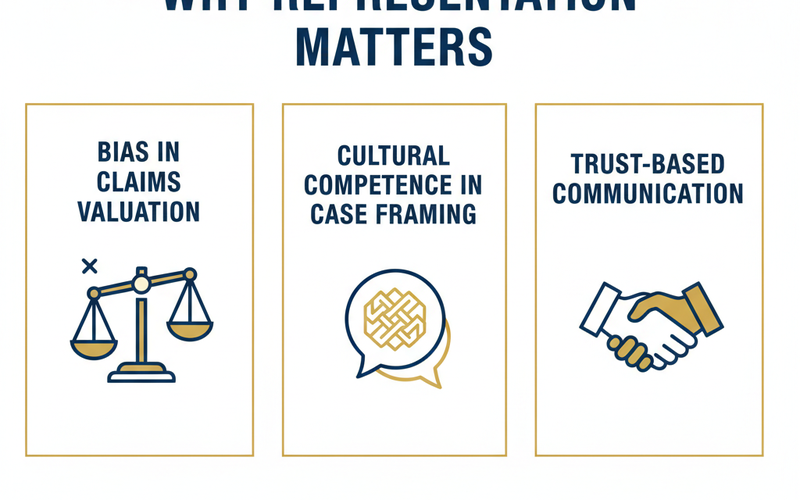
Personal injury law is not purely objective. Insurance adjusters make judgment calls. Juries evaluate credibility. Opposing counsel frames narratives. Who is in your corner — and how they show up — shapes the result.
Systemic Disparities in Claims Outcomes
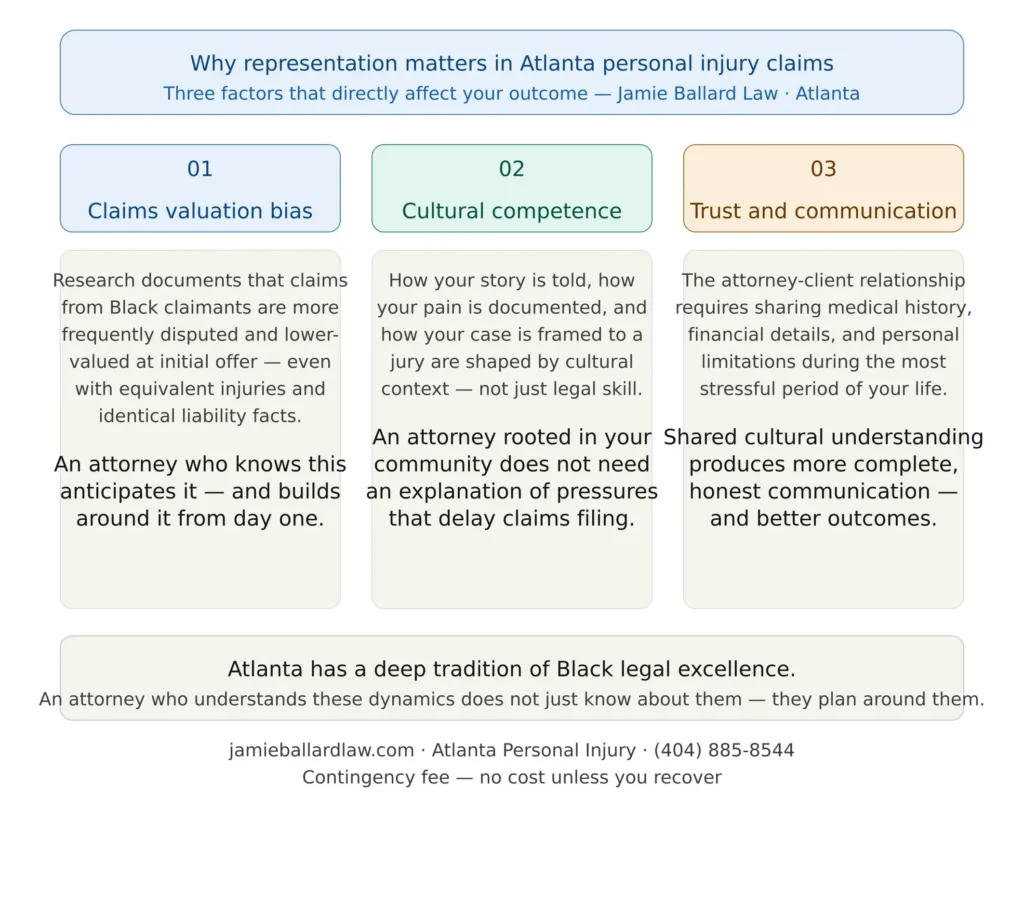
Research has consistently documented racial disparities in personal injury outcomes. Studies from the insurance industry itself show that claims from Black and Brown claimants are more frequently disputed, lower-valued in initial offers, and more often denied outright compared to similar claims from white claimants with equivalent injuries and liability facts. An attorney who understands these dynamics does not just know about them academically — they anticipate them, counter them, and build cases specifically designed to overcome them.
Practical rule: If an insurer’s first offer feels insultingly low, it may not just be a standard negotiating tactic. Racial bias in claims valuation is documented and real — and the right attorney knows how to push back against it.
Cultural Competence Is Not a Soft Skill
Cultural competence in legal representation affects how your story gets told, how your pain gets documented, and how your case gets framed to a jury. An attorney who shares your background or has deep roots in the Black Atlanta community understands the specific pressures that keep injured people from seeking treatment, from reporting workplace injuries, from filing claims at all. They do not need an explanation of why you waited before calling a lawyer. They already know.
Trust Changes How You Communicate
The attorney-client relationship requires trust. You have to share medical history, financial details, and personal limitations with your attorney — often during the most stressful period of your life. When that relationship is built on shared cultural understanding, communication is more complete, more honest, and more effective. Details your attorney knows because you trusted them enough to share them can be the difference between a good settlement and a great one.
Atlanta’s Legacy of Black Legal Excellence
Atlanta is not just a city with Black lawyers — it is a city with a tradition of Black legal power that runs through the civil rights movement, through the Georgia courts, and through generations of attorneys who used the law as a tool for justice.
A City Built on Legal Advocacy
From the attorneys who argued desegregation cases in federal courts to the lawyers who built civil rights organizations into legal powerhouses, Atlanta has produced Black legal minds that reshaped American law. That tradition lives in the law schools of Atlanta’s HBCUs, in the bar associations that trained generations of Black attorneys, and in the courtrooms where today’s personal injury lawyers fight for injured Georgians every day.
The Georgia Bar and Black Legal Community
The State Bar of Georgia and organizations like the Gate City Bar Association — founded in 1914 as a bar association for Black attorneys excluded from the white bar — represent a lineage of legal advocacy that informs how many Atlanta Black personal injury lawyers approach their work. This context shapes legal philosophy and courtroom presence.
Practical rule: When you hire a Black personal injury attorney in Atlanta, you are not just hiring a lawyer. You are accessing a tradition of advocacy built specifically to navigate systems that were not designed with your community in mind.
What a Black Personal Injury Lawyer in Atlanta Actually Does for Your Case
Building the Liability Case
Your attorney investigates the circumstances of your injury — whether it was a slip and fall, a car accident, a workplace injury, or a product defect. They gather police reports, surveillance footage, witness statements, maintenance logs, and prior incident records. They identify every liable party — not just the most obvious one. In Georgia, multiple defendants can mean multiple insurance policies.
Maximizing Medical Documentation
One of the most common ways injured people lose value in their claims is inadequate medical documentation. An experienced Atlanta personal injury attorney ensures your injuries are fully documented — through imaging, specialist referrals, functional capacity evaluations, and treating physician narratives that connect your symptoms directly to the incident.

Negotiating Against Experienced Insurance Teams
Insurance companies employ teams of adjusters, investigators, and defense attorneys whose job is to minimize your payout. Your attorney’s job is to counter every tactic — the lowball opening offer, the recorded statement request, the IME referral, the comparative fault argument. An attorney who has handled hundreds of Georgia cases knows these plays before they happen.
Taking Cases to Trial When Necessary
Most personal injury cases settle — but the threat of trial is what drives fair settlements. An insurer that knows your attorney tries cases and wins them calculates risk differently. Trial readiness is about case preparation from day one that makes clear you are ready to go the distance.
Practical rule: A settlement offer reflects what the insurance company thinks a jury might award — minus the risk and cost of trial. Your attorney’s courtroom reputation directly affects the number they put in front of you.
Types of Cases a Black Personal Injury Lawyer in Atlanta Handles
Car and Truck Accidents
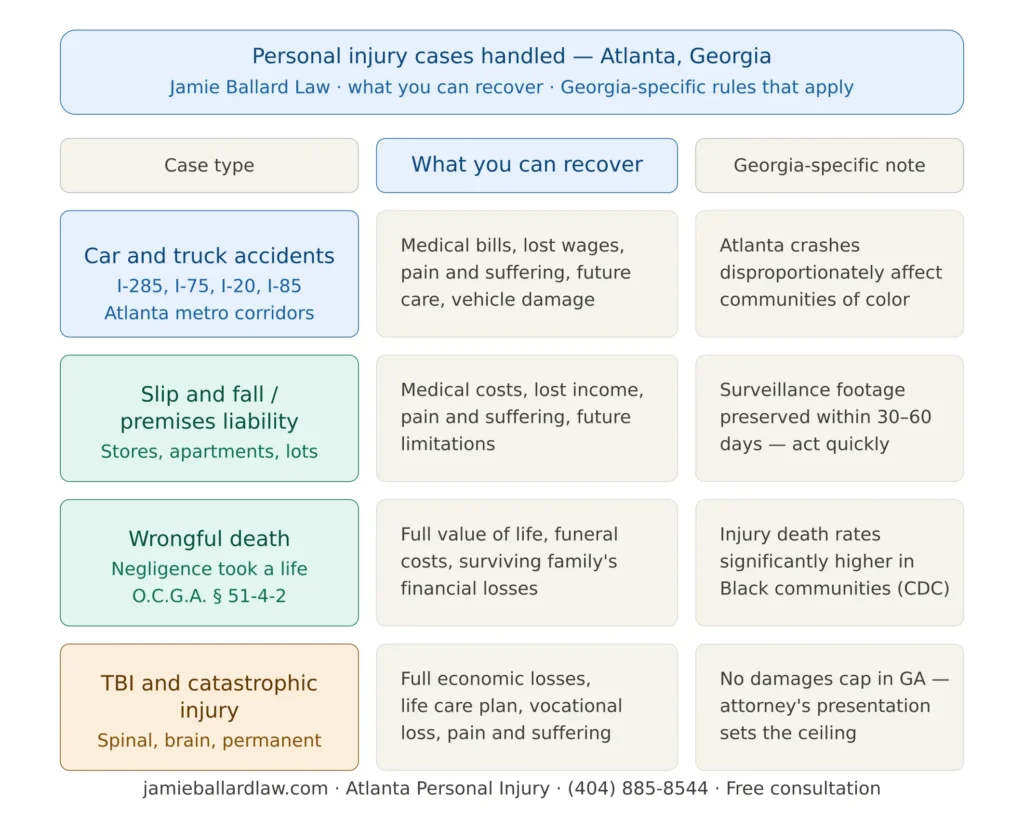
Georgia sees tens of thousands of car accidents each year. Atlanta’s highways — I-285, I-75, I-20, I-85 — are among the most congested in the Southeast. When another driver’s negligence causes your injuries, you are entitled to compensation for medical bills, lost wages, pain and suffering, and future care. Georgia’s Department of Driver Services data shows Atlanta-area crashes disproportionately affect communities of color due to highway placement and traffic patterns through historically Black neighborhoods.
Slip and Fall and Premises Liability
Property owners in Georgia owe invitees a duty of reasonable care. Falls in grocery stores, apartment complexes, parking lots, and public buildings are among the most common personal injury claims in Atlanta. These cases often involve surveillance video, maintenance records, and prior incident reports — evidence your attorney must preserve quickly.
Wrongful Death
When negligence takes a life, Georgia law allows surviving family members to pursue a wrongful death claim for the full value of the deceased’s life. The CDC’s injury data shows that unintentional injury death rates are significantly higher in Black communities — making wrongful death representation a critical area of advocacy.
Traumatic Brain Injuries and Catastrophic Harm
Cases involving traumatic brain injuries, spinal cord damage, or permanent disability require attorneys who understand both the medical complexity and the long-term economic impact. Life care planners, vocational experts, and economic damage specialists become part of the case team.
How Racial Bias Shows Up in the Claims Process — and How to Counter It
Initial Offer Disparities
Insurance companies use algorithmic claims management and adjuster discretion to value claims. Research by the investigative team at ProPublica documented that insurance companies systematically value claims differently based on zip code and demographic factors — proxies that correlate strongly with race. An attorney who knows this dynamic does not accept the first number as neutral. They treat it as a starting point to be challenged.
Credibility Attacks at Deposition and Trial
Studies on jury behavior show that Black and Brown plaintiffs face steeper credibility hurdles with certain jury compositions. An experienced trial attorney accounts for this in how they prepare you for deposition, how they conduct voir dire, and how they frame your story in opening and closing. The attorneys who win the most for their clients of color walk in expecting these dynamics and have already planned around them.
Medical Record Bias
Research has documented that pain reported by Black patients is more frequently undertreated and underdocumented by healthcare providers compared to identical complaints from white patients. This means your medical records may not fully reflect your actual condition. A skilled attorney works with your treating physicians and additional specialists to ensure your records accurately capture your injuries.
Practical rule: If you feel your pain is not being taken seriously by a treating provider, tell your attorney immediately. Incomplete medical records hurt your case — and they can often be supplemented through specialist referrals or functional assessments.
Georgia Law and Your Rights as an Injured Person
Two-Year Statute of Limitations
Georgia gives you two years from the date of injury to file a lawsuit under Georgia’s personal injury statute of limitations. Miss that deadline and your case is gone — regardless of evidence strength or injury severity.
Modified Comparative Negligence
Georgia’s modified comparative negligence rule reduces your recovery proportionally to your fault — and bars recovery entirely at 50% or more fault. Insurance adjusters routinely try to assign fault percentages to reduce exposure. Your attorney’s job is to fight that assignment through evidence and legal argument.
No Cap on Compensatory Damages
Georgia does not cap compensatory damages in personal injury cases. You can recover the full value of your medical bills, lost income, future losses, and pain and suffering with no statutory ceiling. The quality of your attorney’s damages presentation sets the ceiling on your recovery.
Practical rule: Georgia’s lack of a damages cap means the ceiling on your recovery is set by the evidence your attorney presents — not by a statute. Invest in an attorney who builds complete, compelling damages cases.
Steps to Take Immediately After an Injury in Atlanta
Seek Medical Attention the Same Day
Go to an emergency room, urgent care, or your primary care physician the same day if possible. Describe every symptom — even ones that seem minor. Soft tissue injuries, concussions, and spinal injuries often feel mild initially and worsen over days. A same-day medical visit creates a contemporaneous record tying your injuries directly to the incident.
Document the Scene and Report the Incident
Photograph the hazard, the location, and any visible injuries before you leave. Get witness names and numbers. For car accidents, call 911 and get a police report. For slip and falls, report to the property manager and request a written incident report. For workplace injuries, notify your employer in writing immediately. These records establish your timeline and support your claim.
Contact a Personal Injury Attorney Before Talking to the Insurer
The at-fault party’s insurance company will contact you quickly — sometimes within hours. Their goal is to settle fast and cheap before you know your full damages. Do not give a recorded statement, sign any releases, or accept any payment without first speaking to a black personal injury lawyer in Atlanta who can evaluate your claim. A consultation is free. A premature settlement is permanent.
Know That Your Rights Apply Regardless of Status
Georgia personal injury law protects anyone injured in the state — regardless of immigration status, health insurance status, or first language. The insurance company does not get to use your personal circumstances against your legal rights.
For broader context on diversity and representation in law, this conversation with attorney Elaine L. Thompson from Journey to Esquire on increasing diversity in appellate law explains why representation at every level matters.
What to Look for When Choosing a Black Personal Injury Lawyer in Atlanta
Not every attorney who markets to Black clients actually serves them well. These qualities separate meaningful representation from surface-level advertising.
Georgia Trial Experience — Ask Directly
How many personal injury cases have you taken to verdict in Georgia courts? That is the question to ask in your first consultation. An attorney who settles every case regardless of offer quality is not the same as one who evaluates every settlement against what a Georgia jury would likely award. Trial experience creates negotiating leverage that produces better settlements — even for clients who never see the inside of a courtroom.
Community Roots and Real Accountability
An attorney embedded in Atlanta’s Black community — through civic organizations, faith communities, HBCUs, or neighborhood relationships — carries a different kind of accountability than one who runs broad advertising campaigns without local roots. That accountability shapes how they treat clients, how they communicate, and how seriously they take every case. It is not a marketing differentiator. It is a character signal.
Clear Communication Throughout Your Case
You should be able to reach your attorney or their team within one business day. Your questions should be answered in plain language — not legal jargon. You are making major decisions about your life and your finances. You deserve to understand exactly where your case stands, what your options are, and what the next step is at every stage. Attorneys who disappear between updates are a red flag — not an industry norm you have to accept.
A Track Record You Can Verify
Ask for examples of cases similar to yours in injury type and liability facts. Client reviews, bar association standing, and community referrals are meaningful signals. The State Bar of Georgia’s attorney search tool lets you verify any attorney is licensed and in good standing before you sign anything.
Practical rule: The first consultation is free. Use it to interview the attorney — not just to be evaluated by them. Ask hard questions. The answers tell you everything you need to know about whether this is the right person to fight for you.
Insurance Company Tactics Every Atlanta Injury Claimant Should Know
Understanding what the opposing side will do gives you and your attorney the ability to prepare before it happens rather than react after the fact.
The Low Early Offer Before You Know Your Full Damages
Many insurers make a fast, low offer — sometimes within days — before you have completed treatment, before you know whether your injuries are temporary or permanent, and before you have spoken to an attorney. Accepting that offer releases all future claims. If your injury worsens or requires additional treatment after you settle, you cannot go back for more. Never accept a first offer or sign a release without attorney review — no matter how reasonable it sounds in the moment.
The Recorded Statement Request
Shortly after your accident, the at-fault party’s insurance adjuster will call and ask for a recorded statement. They will be polite, even sympathetic. Do not give one without speaking to an attorney first. Adjusters ask questions designed to lock you into answers used against you later. Describing your pain as “mild” in week one — before your injuries have fully developed — creates a record the insurer uses to dispute worsening symptoms weeks later.
Surveillance and Social Media Monitoring
Insurance companies routinely monitor social media accounts of personal injury claimants. Photos or videos showing physical activity — even in ways unrelated to your injury — can be used to attack the credibility of your pain complaints. From the day of your injury until your case resolves, do not post about your condition, your activities, or your case without discussing it with your attorney first.
Practical rule: From the day of your injury until your case resolves, assume the insurance company may be watching. Social media posts taken out of context have undermined legitimate injury claims. Your attorney will guide you on what is safe to share.
Frequently Asked Questions — Black Personal Injury Lawyer Atlanta
| Question | Answer |
|---|---|
| Does it matter if my personal injury lawyer is Black? | It can matter significantly — in terms of cultural competence, understanding of systemic bias in claims, community accountability, and the trust required for effective representation. |
| How do I find a reputable Black personal injury attorney in Atlanta? | Look for attorneys with Georgia trial experience, community presence, and a track record of results. The Gate City Bar Association is a good starting point. |
| What does a contingency fee mean? | You pay nothing unless you recover. The attorney’s fee is a percentage of the settlement — typically 33% pre-suit and 40% at trial. |
| How long does a personal injury case take in Georgia? | Most cases resolve in 6 to 18 months. Cases that go to trial can take 2 to 3 years. |
| Can I switch attorneys if I am unhappy with my current representation? | Yes. You can change attorneys at any time in Georgia. Your new attorney handles the fee split — you do not pay more overall. |
| What if the insurance company offers me money right away? | Do not accept without speaking to an attorney first. Early offers are almost always below full claim value and require you to waive all future rights. |
| What types of damages can I recover in Georgia? | Medical bills, lost wages, future medical costs, pain and suffering, emotional distress, and loss of enjoyment of life — with no statutory cap on compensatory damages. |
| Does Georgia law protect me regardless of immigration status? | Yes. Georgia personal injury law protects anyone injured in the state. Immigration status does not affect your right to pursue a claim. |
Atlanta’s Injured Deserve the Best — Find Your Black Personal Injury Lawyer in Atlanta Today
The attorney you choose shapes everything — the evidence gathered, the offers received, and the outcome reached. A black personal injury lawyer in Atlanta who is rooted in this community, skilled in Georgia courts, and committed to maximum recovery for every client is not a specialty — it is a standard. Jamie Ballard Law serves injured Atlantans with exactly that standard. Call (404) 885-8544 or visit the contact page for a free consultation.
About Jamie Ballard Law
Jamie Ballard Law is an Atlanta-based personal injury firm representing injured Georgians in car accidents, slip and falls, wrongful death cases, and catastrophic injury claims. The firm is committed to serving Atlanta’s diverse communities with experienced, accessible, and results-driven legal representation.