Yes, someone can sue you for a car accident, and it's a real possibility in an "at-fault" state like Georgia. When a car crash happens, it’s natural to worry about the legal fallout. If you were responsible for the accident, the other person has the legal right to take you to court to seek payment for their injuries and other losses.
This guide is here to provide helpful information on how this process works, what to expect, and what steps you can take to protect yourself if you find yourself in this situation.
Yes, You Can Be Sued After a Car Accident

The moments after a car accident are often a blur of stress and confusion. One of the biggest worries that can creep in is whether the other driver can take legal action against you. Understanding how that process works is the first step toward protecting yourself.
Here in Georgia, the law is built around the concept of "at-fault." This simply means that whoever caused the accident is responsible for paying for the damages. It's why we're all required to carry car insurance, but sometimes, an insurance claim just isn't enough to settle things.
When the injured person feels your insurance company's settlement offer is too low, or if their injuries are particularly severe, they might decide to file a lawsuit. This is their formal way of asking a court to step in and order you to pay for the harm they suffered.
The Foundation of a Car Accident Lawsuit: Negligence
Every car accident lawsuit boils down to one core legal idea: negligence. Think of it as a failure to be reasonably careful, which in turn hurts someone else. For the person suing you (the plaintiff) to win their case, they have to prove four distinct elements.
These are the four pillars their entire case must stand on. If even one is missing, their lawsuit will collapse.
Four Pillars of a Car Accident Lawsuit
| Legal Element | What It Means in Simple Terms | Real-World Example |
|---|---|---|
| Duty | You had a basic responsibility to be a safe driver. | Every driver on the road has a duty to obey traffic laws and watch out for others. It’s an automatic part of getting behind the wheel. |
| Breach | You failed to live up to that responsibility. | You ran a red light, were texting while driving, or were speeding. You broke a rule of the road and failed in your duty. |
| Causation | Your failure directly caused the accident and their injuries. | Running that red light is what caused the T-bone collision, which in turn broke the other driver's arm. The link has to be direct. |
| Damages | They suffered actual, measurable losses because of the crash. | They have medical bills from the broken arm, lost wages from missing work, and can prove their vehicle needs expensive repairs. |
Without all four of these pieces, there is no valid lawsuit.
Car accidents are unfortunately very common. According to the National Safety Council, medically consulted injuries from motor vehicle incidents totaled a staggering 5.1 million in 2023 alone. These numbers show just how often people are left dealing with the aftermath of a crash and why the legal system is so important for helping them recover.
This idea of negligence is the starting point for nearly every claim. For a closer look at what comes next, you might be interested in our guide on how to file a car accident claim in Atlanta. Understanding if someone can sue you is the first part, and that guide will walk you through the next steps.
Understanding Negligence in a Car Accident Lawsuit
So, when someone asks, "can someone sue you for a car accident," the answer is yes. But the lawsuit isn't just about the crash itself; it’s built on a legal principle called negligence.
What does that really mean? Think of it as the unwritten promise every driver makes: to operate their vehicle with reasonable care and avoid causing harm. When that promise is broken and someone gets hurt, that’s negligence.
To win a lawsuit against you, the other driver (the plaintiff) can't just claim you were careless. They have a legal burden to prove four specific elements. If they fail on even one, their case collapses.
The Four Elements of a Negligence Claim
Imagine a table with four legs. If you kick out even one leg, the whole thing topples. That's exactly how a negligence claim works in court.
1. Duty of Care: This one is straightforward. In Georgia, every driver on the road has a legal duty to operate their vehicle safely. That means following traffic laws, paying attention, and not creating obvious hazards for others. The moment you get behind the wheel, you accept this duty.
2. Breach of Duty: This is where the specific mistake happens. A breach occurs when a driver fails to meet their duty of care. Common examples include texting while driving, speeding through a work zone, running a red light, or driving under the influence.
3. Causation: It’s not enough to show you made a mistake. The plaintiff must prove your specific action—the breach—was the direct cause of the accident and their injuries. For instance, they have to prove that you running the red light is what caused the T-bone collision, not some other factor.
4. Damages: Finally, the plaintiff must demonstrate they suffered real, quantifiable harm, legally known as damages. This isn't just about hurt feelings. It's about measurable losses like medical bills, lost income from missed work, vehicle repair costs, and even compensation for physical pain and suffering.
This legal standard is universally recognized. For a more academic look, Wikipedia's entry on Negligence provides a formal overview defining these key elements.
As the resource shows, the central question is whether you failed to use the same care a "reasonably prudent person" would have in that situation. A jury is essentially asked to decide: what would an ordinary, careful driver have done differently?
Putting It All Together With an Example
Let's make this crystal clear. Say a driver glances down at a text message and fails to see that traffic has stopped.
Duty: The driver had a duty to watch the road.
Breach: They breached that duty by looking at their phone.
Causation: Texting directly caused them to rear-end the car ahead.
Damages: The driver they struck suffered whiplash, leading to $5,000 in medical bills, and their car sustained $3,000 in damage.
In this scenario, all four elements are solidly established, forming the basis for a valid negligence lawsuit. This is the exact roadmap the other party's attorney will follow to build their case against you. When someone considers if they can sue you for a car accident, what they're really asking is if they can prove these four points.
How Georgia's At-Fault Laws Work
Every state has its own playbook for handling car accidents, so it's important to know Georgia's specific rules. When you hear that Georgia is an "at-fault" state, it means one simple thing: whoever is legally responsible for causing the crash is also responsible for paying the bill.
If you’re the at-fault driver, the other person’s attorney will use the principles of negligence we just covered to prove their case against you. The entire question of if can someone sue you for a car accident almost always boils down to whether they can prove those key elements.
This flowchart gives you a quick visual of the process an injured person must follow to build a successful negligence claim.
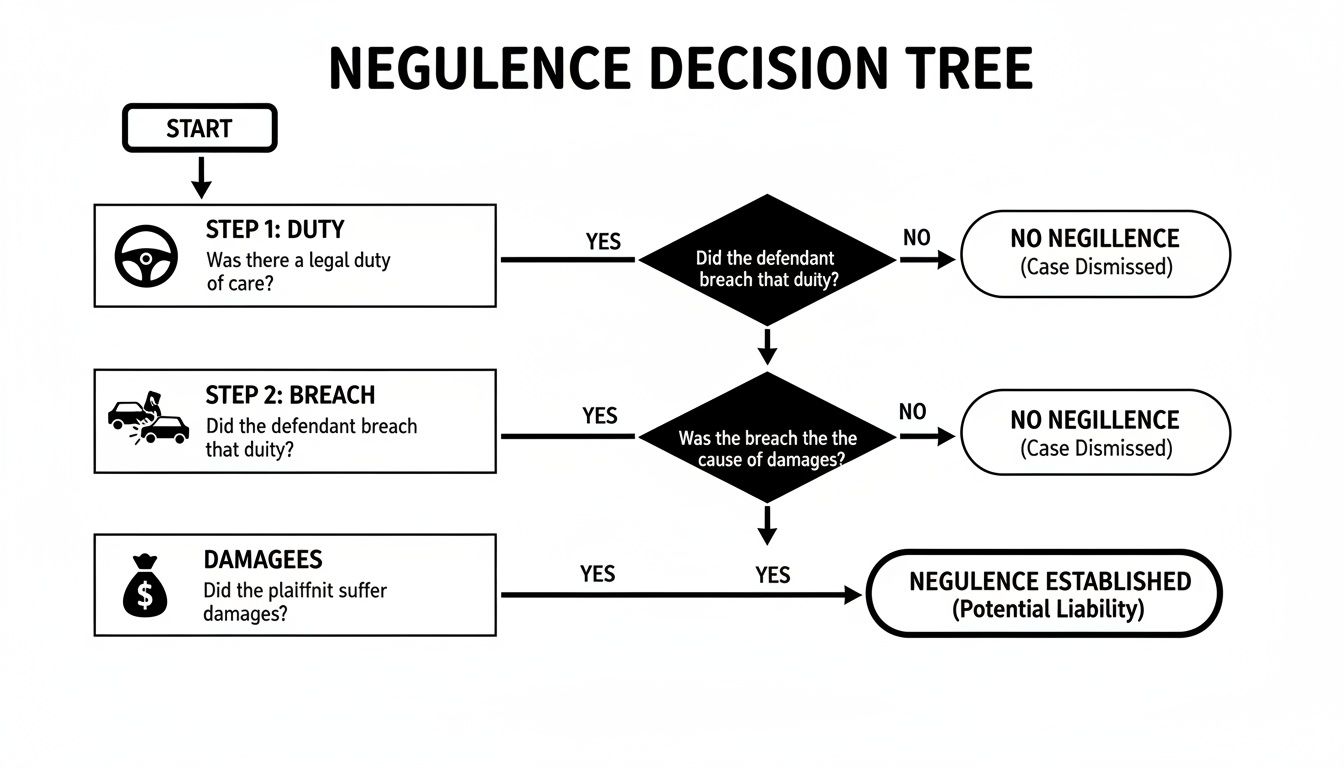
As you can see, each piece—Duty, Breach, Causation, and Damages—is a pillar holding up their argument. If even one of them is missing, the whole legal claim collapses. But what happens when things aren't so clear-cut?
What if Both Drivers Share Some Blame?
Real-world crashes are messy. It's rarely a simple case of one person being 100% right and the other being 100% wrong. For these situations, Georgia has a specific rule called modified comparative negligence.
This rule is laid out directly in O.C.G.A. § 51-12-33, and it dictates exactly how fault is divided and who can recover money.
The most important part of this law is the 50% bar rule. In plain English, it means someone can sue you and win, but only if a jury finds them to be less than 50% responsible for the accident.
The 50% Bar Rule in Action:
Imagine a driver is going a few miles over the speed limit (making them 10% at fault) when you run a stop sign and hit their car. Because their fault (10%) is less than your fault (90%), they can still successfully sue you. However, their final compensation award would be reduced by their 10% share of the blame.
If a jury decides the other driver was 50% or more at fault, they are completely barred from recovering a single penny from you. This rule is a massive factor in how insurance adjusters and lawyers evaluate and negotiate Georgia car accident cases.
The table below breaks down how this works with a few concrete examples.
How Fault Percentage Affects Compensation in Georgia
| Injured Party's Fault % | Total Damages Awarded | Amount Recoverable |
|---|---|---|
| 0% (Not at fault) | $100,000 | $100,000 (Full amount) |
| 10% (Slightly at fault) | $100,000 | $90,000 ($100k – 10%) |
| 49% (Partially at fault) | $100,000 | $51,000 ($100k – 49%) |
| 50% (Equally at fault) | $100,000 | $0 (Recovery is barred) |
| 75% (Mostly at fault) | $100,000 | $0 (Recovery is barred) |
As you can see, that 50% mark is a hard line. Being 49% at fault means you can still recover a portion of your damages, but hitting 50% means you get nothing.
The Clock is Ticking: The Statute of Limitations
Another key piece of Georgia law is the statute of limitations. Think of it as a legal deadline—a strict time limit on how long someone has to file a lawsuit after an injury.
In Georgia, the statute of limitations for a personal injury claim from a car accident is generally two years from the date of the crash.
- Why this matters to you: This deadline forces the injured party to act. They must file a lawsuit within that two-year window, or they lose their right to sue you forever.
- Are there exceptions? Yes, but they are rare and specific. For example, the clock might be paused if the injured person was a minor. You can find a more detailed explanation of these deadlines in the official Georgia Code.
This time limit ensures legal fights happen while evidence is still fresh and witnesses can remember what happened. It's also why you might not hear anything for months—or even over a year—before suddenly receiving notice of a lawsuit. For anyone wondering if they can sue you for a car accident, this two-year deadline is a line in the sand they can't cross.
What Damages Someone Can Sue You For
When someone files a lawsuit after a car accident, they’re asking a court to make you pay for their losses. In legal terms, these losses are called “damages.” It’s not just about a crumpled fender or a broken headlight; damages cover the full spectrum of harm the other person suffered because of the crash.
To really understand what’s at stake financially, you need to know what these damages include. They typically fall into three buckets: economic, non-economic, and, in some serious cases, punitive damages. Each one represents a different kind of loss the injured person can claim.
Economic Damages: The Tangible Costs
This is the most straightforward category. Economic damages are the specific, provable financial losses that came directly from the accident. Think of these as the black-and-white expenses you can track with receipts, invoices, and pay stubs.
Here are the most common types of economic damages a person can sue you for:
- Medical Expenses: This covers everything from the ambulance ride and ER visit to ongoing physical therapy, surgeries, medications, and any future medical care a doctor confirms they'll need.
- Lost Wages: If their injuries kept them from working, they can sue for the income they lost during recovery. This can also include a loss of future earning capacity if a permanent injury impacts their ability to do their job long-term.
- Property Damage: This is usually the cost to repair or replace their vehicle. It can also include other personal items destroyed in the crash, like a laptop, phone, or child’s car seat.
Non-Economic Damages: The Intangible Harms
Unlike economic damages, non-economic damages aren't tied to a specific bill. Instead, they are meant to compensate for the real, but less tangible, suffering someone has gone through. These harms are very real, even if you can’t put an exact price tag on them.
Examples include:
- Pain and Suffering: This compensates for the physical pain and general discomfort caused by the injuries. A common claim, for instance, is for persistent issues like neck pain after a car accident, which can drag on for months or even years.
- Emotional Distress: A serious crash is a traumatic event. This category covers the anxiety, fear, depression, and sleep loss that stem from the accident.
- Loss of Enjoyment of Life: If the injuries prevent someone from participating in hobbies, sports, or other activities they once enjoyed, they can be compensated for that loss. For a closer look at how these claims are built, you can learn more about personal injury claims in our detailed guide.
Punitive Damages: A Rare Penalty
Finally, there’s a third category called punitive damages. These aren't about compensating the victim. They are designed to punish the at-fault driver for extremely reckless or intentional behavior and to send a message to the community to deter others from acting the same way.
In Georgia, punitive damages are only awarded in cases where the at-fault driver showed willful misconduct, malice, fraud, or a conscious indifference to consequences. A classic example is a driver who causes a crash while under the influence of drugs or alcohol.
What to Do If You Receive a Lawsuit Notice
It’s a moment that can make your heart sink: you open an official-looking envelope and find a lawsuit notice, formally known as a Summons and Complaint. While jarring, this is not the time to panic. Knowing the immediate, practical steps to take is the best way to regain control and protect your interests.
Your very first move should be simple and direct: contact your auto insurance company immediately. Do not delay. Your policy is more than just a checkbook for claims; it includes an important provision called the "duty to defend."

This duty means your insurer is contractually obligated to hire a lawyer for you and pay for the legal costs of defending the lawsuit, all the way up to your policy's coverage limits. They will handle the formal response, deal with the other party’s attorney, and manage the entire legal process on your behalf.
Your Immediate Action Plan
Once you've made that call, your insurance carrier will assign both an adjuster and a defense attorney to your case. From here on, your primary role is to cooperate fully and arm them with all the necessary information. Start gathering every document related to the accident.
- The Lawsuit Papers: Have the Summons and Complaint right in front of you when you call your insurer. They'll need the date you received it and the court information listed on the documents.
- The Police Report: If you have a copy of the official accident report, it’s one of the first and most important pieces of evidence to provide.
- Photos and Videos: Any pictures you snapped at the scene—vehicle damage, road conditions, traffic signs—can be incredibly valuable.
- Correspondence: Collect any letters, emails, or notes from phone calls you've had with the other driver or their insurance company.
It is absolutely vital that you do not ignore the lawsuit. If you fail to respond within the legal deadline (typically 30 days in Georgia), you risk a "default judgment." This means the court could rule in the other person's favor by default, potentially holding you liable for the full amount they are demanding without you ever getting to present your side of the story.
Understanding the Lawsuit Timeline
It's also wise to prepare yourself for the road ahead, because the legal process is rarely fast. Most car accident cases are resolved within 12 to 36 months. The timeline can be stretched by things like the severity of injuries or disputes over who was at fault.
Your insurer’s legal team will take care of the next steps, which usually starts with filing a formal "Answer" to the lawsuit. You can learn more about the steps involved by reviewing our guide on the Georgia car accident lawsuit process.
After you've handed everything over to your insurance company, they will take the lead. This allows you to step back while they manage the legal defense. The key is to act fast, stay organized, and communicate openly with the team assigned to help you. Your insurance policy is your first and most important line of defense.
Frequently Asked Questions About Car Accident Lawsuits
After a car wreck, your mind is probably racing with questions. When you're worried that someone can sue you for a car accident, getting straight answers is the first step toward regaining control. Here are a few of the most common questions we get, with practical answers to clear things up.
What if the Other Driver's Injuries Seem Minor at First?
Never assume an injury is minor right after a crash. The adrenaline surging through your body can easily mask serious pain, and some conditions—like whiplash, concussions, or even internal injuries—don't show up for hours or days.
This is exactly why you should never admit fault or downplay what happened at the scene. If a doctor later connects a significant injury to the collision, the other person can still file a lawsuit. It's best to let medical professionals and insurance adjusters make the final call on the severity of the situation.
Can I Be Sued if the Other Driver Was Also Partially at Fault?
Yes, absolutely. This is a common scenario in Georgia. As we covered with the state's "modified comparative negligence" rule, a person can sue you even if they share some of the blame.
As long as a jury decides they were less than 50% at fault, they can still recover damages from you. Their final award is simply reduced by their percentage of fault. For instance, if they were found 30% responsible for the crash, they could still sue you for and collect 70% of their total damages.
Will My Insurance Rates Go Up if I Am Sued?
It’s very likely, yes. An at-fault accident, especially one that leads to a lawsuit and a payout, will almost certainly cause your insurance premiums to jump at your next renewal. Insurance companies set their rates based on risk, and being found liable in a lawsuit flags you as a higher-risk driver.
The exact increase depends on your insurance provider, your driving history, and how much the claim cost them.
What Happens if the Damages Exceed My Insurance Limits?
This is a serious position to be in. If a court awards damages that are higher than your policy's liability limits, you could be on the hook for paying the difference out of your own pocket. This is what's known as an "excess judgment."
An excess judgment can put your personal assets at risk—your savings, your investments, and even your home. It’s a stark reminder of why carrying adequate insurance coverage is one of the most important steps you can take to protect your financial future.
It's also a good idea to understand the deadlines for these legal actions. You can learn more about the specific timelines by reading about the statute of limitations for personal injury in Georgia. Knowing your rights and responsibilities is the best way to prepare if you're concerned that someone can sue you for a car accident.
If you've been in an accident and need guidance, the team at Jamie Ballard Law is here to help. We offer a free, no-obligation case evaluation to help you understand your options. Contact us 24/7 to get the support you need by visiting https://jamieballardlaw.com.