When you get hurt on the job, one of the first questions that comes to mind is, "Does workers' comp pay for pain and suffering?" Here in Georgia, the straightforward answer is no. The workers' compensation system is built to deliver specific, defined benefits quickly, without needing to prove your employer was at fault for the injury. It's a system designed for medical and wage support, not for non-economic damages like emotional distress.
Why Pain and Suffering Is Not a Workers' Comp Benefit

Think of Georgia's workers' compensation system as a kind of agreement—a trade-off. In exchange for receiving immediate medical care and partial wage replacement benefits regardless of who caused the accident, you, the injured employee, give up the right to sue your employer for other types of damages. This is the very foundation of the "no-fault" system.
This arrangement was put in place to make the process more direct for everyone. It helps you avoid long court battles over who was negligent while making sure you get financial support right away.
The Great Trade-Off of Workers' Compensation
The system prioritizes specific economic losses over non-economic ones. Damages tied to physical pain, emotional distress, and the loss of enjoyment of life are considered "non-economic," and they fall outside the scope of a standard workers' comp claim.
Here’s a practical breakdown of what that means for you:
- You receive guaranteed benefits: Your approved medical bills and a portion of your lost wages are covered without you having to prove fault. This provides a safety net when you need it most.
- Your employer is protected from lawsuits: In return, your employer is shielded from personal injury lawsuits from employees, which could result in much larger, less predictable payouts.
- The focus is on recovery and return to work: The entire structure is built to get you the medical treatment you need to heal and help you get back on your feet financially as you recover.
To clarify what’s on the table in a typical claim, this table breaks down the covered benefits versus the exclusions.
What Georgia Workers' Comp Covers vs. What It Excludes
| Benefit Category | Typically Covered by Workers' Comp? | Examples |
|---|---|---|
| Medical Expenses | Yes | Doctor visits, hospital stays, surgery, prescriptions, physical therapy. |
| Lost Wages | Yes (Partial) | Temporary Total Disability (TTD) or Temporary Partial Disability (TPD) benefits. |
| Permanent Disability | Yes | Permanent Partial Disability (PPD) benefits based on an impairment rating. |
| Vocational Rehabilitation | Yes | Job retraining services if you cannot return to your previous role. |
| Pain and Suffering | No | Compensation for physical pain, emotional distress, or mental anguish. |
| Loss of Consortium | No | Damages for the impact of the injury on your relationship with your spouse. |
| Punitive Damages | No | Damages intended to punish the employer for gross negligence. |
As you can see, the system is strictly limited to tangible, economic losses directly resulting from the workplace injury.
"The workers' compensation system operates as a 'no-fault' system, meaning injured workers receive benefits regardless of who caused the accident, but this trade-off typically eliminates their right to sue employers for additional damages including pain and suffering."
Understanding this basic concept is helpful from the start. For more detailed information on official rules, the Georgia State Board of Workers' Compensation is an excellent resource. While the system doesn't directly compensate for physical and emotional hardship, it provides a vital lifeline. This guide will walk you through the benefits you are entitled to and explain the rare exceptions where you might be able to pursue a claim for your pain and suffering.
How Workers’ Comp Differs From a Personal Injury Lawsuit
To really get why the system is set up this way, it’s helpful to understand that a workers' compensation claim and a personal injury lawsuit are on two completely different tracks. The core difference comes down to their purpose and process. This is the exact reason why the answer to “does workers comp pay for pain and suffering” is almost always no.
Think of workers’ compensation as a specialized insurance policy built for speed and reliability. Its main job is to get you approved medical care and cover a portion of your lost wages—fast. The goal is to avoid a long legal fight over who was at fault for the accident. It works on a “no-fault” basis, which means you get these benefits even if the mistake was yours.
The No-Fault Agreement
This no-fault system is a fundamental trade-off. In exchange for receiving guaranteed, prompt benefits without having to prove someone was negligent, you give up the right to sue your employer for any other damages. It's an agreement that shields employers from unpredictable lawsuit verdicts while making sure you get immediate support.
The National Academy of Social Insurance confirms that while workers’ compensation provides for medical care and lost wages, this trade-off is what typically eliminates an employee’s right to sue for things like pain and suffering. You can dive deeper into this topic with the CDC's official report on workers' compensation.
A personal injury lawsuit, on the other hand, is an entirely different animal. It’s built on one thing: proving that another person or company was negligent and that their negligence directly caused your injuries.
The purpose of a personal injury claim is to make the injured person "whole" again by assigning a monetary value to all of their losses—both economic and non-economic.
Comparing the Two Paths
Because their goals are so different, the potential outcomes for an injured person vary dramatically.
- Workers’ Compensation Focus: This system is structured to deal with your tangible, economic losses. It pays for your doctor visits and provides a check to help with bills while you're out of work. It’s about immediate financial stability.
- Personal Injury Focus: A lawsuit aims to cover a much wider spectrum of damages. This includes not just medical bills and lost income, but also compensation for the physical agony, emotional distress, and the massive disruption the injury caused in your life. You can learn more about what's involved in these cases by reading our guide on personal injury claims.
At the end of the day, the workers' compensation system was designed to be an administrative benefit program, not a tool to hold someone accountable for carelessness. For official details specific to our state, the Georgia State Board of Workers' Compensation website is an invaluable resource.
Because the system is intentionally designed to avoid assigning blame, it also omits compensation for the very real, but non-economic, impact of pain and suffering.
What Benefits Can You Actually Get?
So, while the system doesn't cut a check specifically labeled "pain and suffering," it isn't leaving you high and dry. The entire structure of workers' comp is built to provide a powerful, tangible safety net after a workplace injury. Getting a firm grip on what you're owed is the first step toward keeping your head above water while you focus on getting better.
The benefits are all about two things: fixing the physical damage and replacing the money you can't earn.

Here in Georgia, the workers' compensation system really boils down to three core pillars of support. Each one is designed to tackle a specific problem you'll face after getting hurt on the job.
Medical Benefits
This is the big one, and it kicks in immediately. Your employer’s insurance is on the hook for 100% of all authorized and necessary medical care for your injury. You won't see a single bill for deductibles or copays.
This coverage is pretty comprehensive and includes just about everything you can think of:
- Doctor and Specialist Visits: All your appointments with physicians, surgeons, and other medical experts.
- Hospital Stays and Procedures: Covers any time you need to be hospitalized, undergo surgery, or get emergency room care.
- Prescription Medications: Any approved drugs required for your treatment.
- Physical Therapy and Rehabilitation: The services you need to rebuild strength and get back to normal function.
- Medical Equipment: Things like crutches, braces, or any other durable medical gear.
- Travel Reimbursement: They even have to reimburse you for the mileage you put on your car driving to and from your medical appointments.
Lost Wage Benefits
If your injury keeps you out of work for more than seven days, the system steps in to help replace your paycheck. These are called income benefits, and they're meant to cover a chunk of what you're losing while you can't work.
There are two main types to be aware of:
- Temporary Total Disability (TTD): This is for when your doctor has you completely out of work. You'll get two-thirds of your average weekly wage, capped at a maximum amount set by Georgia law.
- Temporary Partial Disability (TPD): This applies if you're cleared for light-duty work but at a lower pay rate. TPD pays two-thirds of the difference between your old wage and your new, lower earnings.
Interestingly, national data shows that since 2015, the frequency of lost-time claims has dropped quite a bit. Experts believe this is because of better claims management and a stronger focus on getting injured employees back on their feet and back to work sooner. You can learn more from these national workers' compensation trends.
Permanent Partial Disability (PPD) Benefits
Finally, we get to what happens when your recovery plateaus. Once your doctor says you've reached Maximum Medical Improvement (MMI)—meaning your condition isn't likely to get any better—you might be eligible for PPD benefits.
If the injury left you with a permanent impairment, a physician will give you an impairment rating based on the American Medical Association guidelines. That rating is plugged into a formula to calculate a lump-sum payment. It’s not for pain and suffering, but it is a direct acknowledgment of the permanent physical toll the injury took on your body.
When You Can Pursue Damages for Pain and Suffering
We’ve established that the direct answer to "does workers comp pay for pain and suffering" is typically no, but that’s not always the end of the story. While you cannot sue your employer for a work injury, an important exception exists when another person or company—a "third party"—is actually responsible for what happened. This opens up a completely separate legal path.
This isn't an either/or situation. You can often have two cases moving forward at the same time: your workers' compensation claim and a personal injury lawsuit against the negligent third party. The workers' comp claim is your safety net, handling your immediate medical bills and lost wages.
Understanding Third-Party Claims
Let's make this simple. Imagine you're a delivery driver and another motorist blows through a red light, hitting your truck and causing a serious collision. Your injuries happened while you were working, so you're absolutely entitled to workers' comp benefits. But your employer didn't cause the crash—the other driver did.
In this scenario, that negligent driver is the third party. You can file a personal injury lawsuit directly against them to seek full compensation for all your losses, which absolutely includes damages for pain and suffering.
Here are a few common examples where a third-party claim might come into play:
- Vehicle Accidents: You are hurt in a car or truck accident caused by another driver while you're on the clock.
- Defective Equipment: A piece of machinery or a tool you use on the job malfunctions because of a manufacturing defect, causing you harm. The manufacturer could be the third party.
- Property Hazards: You are injured on a client's property or another job site due to unsafe conditions, like an unmarked slippery floor or a structural collapse. The property owner could be held liable.
- Contractor Negligence: On a busy construction site, an employee from a different company acts carelessly and causes your injury.
This separate personal injury lawsuit is your opportunity to be made whole. It allows you to pursue the non-economic damages—like physical pain, emotional distress, and loss of enjoyment of life—that workers' compensation simply does not cover.
The Two-Track System for Recovery
Juggling both a workers' comp claim and a personal injury lawsuit requires careful coordination. For instance, if you secure a settlement from the third party, your employer's insurance carrier might have a right to be reimbursed for the benefits they've already paid out. It's also important to know that these personal injury cases have strict deadlines. To learn more, you can check out our guide on the statute of limitations for personal injury in Georgia.
This two-track approach provides the most complete path to financial recovery. It combines the immediate, no-fault benefits of workers' comp with the chance to hold a negligent party fully accountable. Recognizing when a third party is involved is the key that unlocks the door to getting paid for your pain and suffering.
Dealing With Chronic Pain in Workers Comp Claims
Pain is an expected part of any injury, but what happens when it refuses to go away? When acute pain settles in for the long haul, becoming a chronic condition that lasts for months or even years, it creates a deeply frustrating challenge within the workers' comp system.
This is especially true for debilitating conditions like complex regional pain syndrome (CRPS) or a severe back injury that just won't heal. For anyone trying to recover while also managing their claim, exploring proven strategies to relieve chronic back pain can offer some much-needed relief. Unfortunately, this is often the point where insurance carriers start questioning the need for continued medical care, making an already difficult situation feel impossible.
The Reality of Chronic Pain and Mental Health
The physical struggle of chronic pain is only half the battle. Living with constant discomfort takes a heavy emotional and mental toll, often leading to very real conditions like depression and anxiety. This is a recognized part of your suffering.
However, the workers' comp system has a specific, and sometimes limited, way of handling it. It’s designed to address psychological conditions with approved medical treatment—like therapy or medication—not by issuing direct payments for the emotional hardship itself. Research confirms that injured workers battling chronic pain often face worse outcomes and more distress than those treated outside the compensation system.
Your experience with lasting pain is valid and significant. While the system provides a specific path for treatment, it's important to have a realistic view of how these lasting injuries are managed within the established rules.
So, where does that leave you? The flowchart below illustrates the decision-making process, highlighting the rare circumstances where a third party’s involvement might open the door to a traditional personal injury lawsuit for pain and suffering.
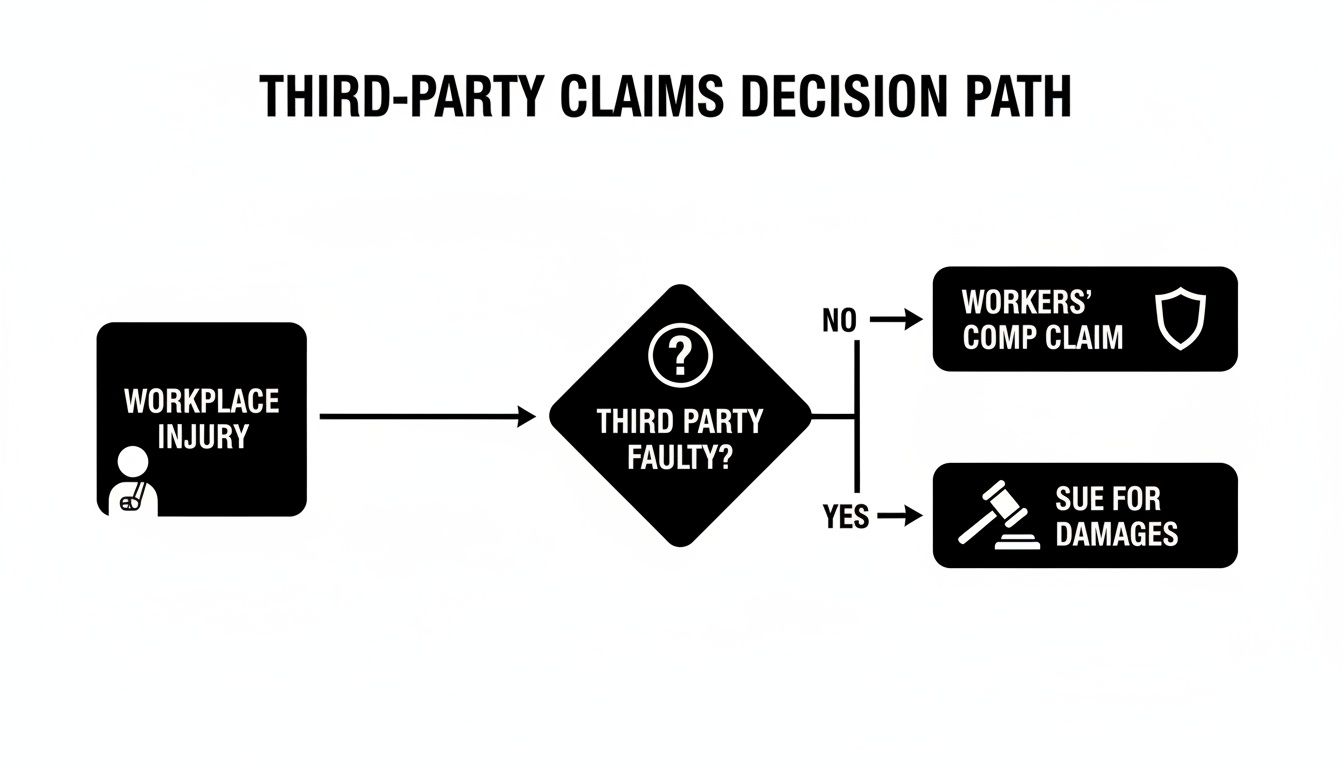
As you can see, the path to suing for pain and suffering only becomes an option when a non-employer third party is at fault for the injury. In most cases, you’ll be working within the workers' comp framework.
How the System Addresses Lasting Injuries
When an injury results in a permanent issue, the system does acknowledge it—just not in the way most people expect. It doesn't directly answer the question, "does workers comp pay for pain and suffering," but it does provide a different form of compensation through Permanent Partial Disability (PPD) benefits.
Here’s a breakdown of how that works:
- Maximum Medical Improvement (MMI): First, your doctor must determine that you have recovered as much as you possibly can from the injury. This is your new baseline.
- Impairment Rating: The doctor then assigns a percentage rating based on the permanent functional loss you’ve sustained.
- Benefit Calculation: That rating is plugged into a state-mandated formula, which calculates a specific monetary award.
This one-time payment is not for your daily pain or emotional distress. It is a formulaic acknowledgment of the permanent physical loss you have suffered. If you're dealing with a specific condition, our guide on navigating Chronic Pain Syndrome claims offers a more in-depth look.
Understanding this distinction is the key to managing your expectations and focusing on securing the benefits you are truly entitled to receive under the law.
What to Do Immediately After a Work Injury in Atlanta

The first few hours and days after a workplace injury are incredibly important. The steps you take can set the tone for your entire claim and directly impact your ability to secure benefits.
Before you even get to the bigger questions, like whether workers comp pays for pain and suffering, there are immediate, practical actions you must take to protect your health and your legal rights. Think of it as building a strong foundation for your case.
Here’s a clear action plan for any worker injured on the job in Georgia. Following these steps helps you avoid common mistakes that can jeopardize a claim.
Your Immediate Action Plan
-
Report Your Injury Immediately
You must tell your supervisor about your injury as soon as you possibly can. While Georgia law technically gives you 30 days to make this report, waiting is a bad idea. Delaying gives the insurance company room to argue that the injury didn't actually happen at work. Put it in writing—even a simple text or email creates a time-stamped record. -
Get Authorized Medical Help
Your health is the top priority. You need to see a doctor from your employer’s posted list of approved physicians. If they don't have a list posted or you're dealing with a true emergency, head to the nearest emergency room. Importantly, make sure you tell every medical provider that your injury is work-related from the very first visit. -
File an Official Claim (Form WC-14)
Telling your boss is just the first step. To formally start the process and protect your rights, you must file an official claim with the State Board of Workers' Compensation. This is done by completing and submitting a Form WC-14.
This is the state's official portal and the starting point for formally documenting your claim. Filing this form is a non-negotiable step in the legal process.
- Keep Detailed Records
Document everything. Start a log of your symptoms, keep track of every doctor's appointment, and record any time you miss from work. This information will become invaluable as your claim moves forward. If you have questions about what to track or how to handle these initial steps, get in touch with us for guidance.
Properly handling these first few actions puts you in the strongest possible position, even while the bigger questions about whether workers comp pays for pain and suffering still need to be answered.
Common Questions About Georgia Workers’ Compensation
We've covered a lot, but a work injury always brings up more specific concerns. While we know the direct answer to "does workers comp pay for pain and suffering" is no, other questions inevitably pop up.
Here are a few we hear all the time from injured workers here in Atlanta.
Can My Employer Fire Me for Filing a Claim?
No. That's illegal. It is illegal for an employer in Georgia to retaliate against you for filing a legitimate workers' compensation claim.
This protection covers firing, demoting, or any form of harassment. Your right to seek benefits after getting hurt on the job is firmly protected by state law.
What if My Employer Doesn't Have Insurance?
In Georgia, nearly every employer with three or more employees must carry workers' compensation insurance. It's the law.
If your employer broke that rule, they face serious state penalties. More importantly for you, their failure to carry insurance may open the door for you to file a personal injury lawsuit directly against them—a type of claim where you can seek damages for pain and suffering.
Do I Get Paid for a Permanent Scar?
Yes, in certain situations. Georgia law provides compensation for permanent scarring or disfigurement under what’s called Permanent Partial Disability (PPD) benefits.
This typically applies to visible scars on the head, neck, hands, or arms resulting from a work injury. While it isn't "pain and suffering," it is a specific payment for a permanent physical change to your body.
Knowing these answers helps set the right expectations. The system is designed to deliver specific medical and wage benefits, and understanding its limits from the start is the first step toward a realistic recovery plan.
At Jamie Ballard Law, we believe every injured worker deserves clear answers and a strong advocate. If you have questions about your rights after a workplace injury in Atlanta, we’re here to help. Contact us for a free, no-obligation case evaluation to understand all your options. https://jamieballardlaw.com