If you're trying to figure out typical slip and fall injury settlement amounts, you'll quickly learn there's no single magic number. As an Atlanta personal injury lawyer, I can tell you that payouts can be a few thousand dollars for a minor sprain or climb well into the six figures for an injury that changes your life forever. Understanding the common factors that determine these outcomes is the first step to knowing what’s fair in your case. This guide is designed to provide helpful information, not legal advice.
Unpacking the Value of a Slip and Fall Claim
After getting hurt on someone else's property, it’s completely normal to wonder what your case might be worth. A slip and fall settlement isn't a random figure; it's a calculated amount based on every loss—both financial and personal—you suffered because a property owner was negligent.
Think of it this way: a minor fall that leads to a couple of doctor visits and a quick recovery might settle for enough to cover those medical bills plus a bit extra for your trouble, maybe in the $10,000 to $25,000 range. But a fall that requires surgery, months of physical therapy, and significant time off work? That claim is going to have a much higher value.
How Different Injuries Affect Settlement Ranges
The severity of your injury is the biggest factor driving your claim's potential value. A more serious injury means higher medical bills, more lost wages, and greater pain and suffering—all of which push the settlement amount up.
To give you a general idea, here’s a look at how injury severity often maps to different settlement brackets.
Estimated Slip and Fall Settlement Ranges by Injury Severity
This table provides a general idea of potential settlement amounts based on the seriousness of the injuries sustained.
| Injury Severity | Common Injuries | Typical Settlement Range (Estimate) |
|---|---|---|
| Minor | Soft tissue injuries like sprains, bruises | $10,000 – $25,000 |
| Moderate | Broken bones (fractured wrist, ankle), torn ligaments | $25,000 – $75,000 |
| Severe | Traumatic brain injury (TBI), spinal cord damage, injuries requiring major surgery | $100,000+ (can reach seven figures) |
It is important to remember these are just estimates. The specific details of your accident are what truly matter. For more information on TBI's, you can consult resources like the Centers for Disease Control and Prevention.
The unique details of your accident—from the strength of the evidence proving negligence to the quality of your medical records—play a massive role in the final number.
Across the board, personal injury case data reveals a wide spectrum of results. While the average personal injury settlement hovers around $52,900, many people receive far less, and a surprising number receive nothing at all.
This really shows how having skilled legal guidance can make a world of difference. Claimants with an experienced attorney on their side often recover significantly more than those who try to handle it alone. To learn more, you can explore detailed personal injury settlement statistics and see just how much representation impacts the outcome. Getting a fair evaluation is the key to understanding what your specific slip and fall injury settlement amounts could truly be.
The Two Types of Damages That Build Your Claim
When we start talking about slip and fall injury settlement amounts, it's important to understand that the final number isn't just pulled out of thin air. It’s built, piece by piece, by adding up every specific, provable loss you've suffered because of the accident. In legal terms, these losses are called "damages," and they are the foundation of your claim's value.
To really get a handle on what a potential settlement covers, you have to know the two main categories of damages. Each one represents a different kind of loss, and both are necessary for calculating what’s fair.
Economic Damages: The Tangible Costs
First up are economic damages. The easiest way to think about these is to see them as any direct financial loss that leaves a paper trail. These are the costs you can prove with receipts, bills, invoices, and pay stubs.
Because they correspond to actual dollar amounts, these tangible losses are the most straightforward part of a settlement to calculate.
Common examples of economic damages include:
- Medical Bills: This covers everything from the ambulance ride and emergency room visit to any surgeries, hospital stays, and follow-up care with specialists.
- Future Medical Care: If your injury demands ongoing treatment—like physical therapy, future operations, or long-term prescription medication—those projected costs are factored in.
- Lost Wages: This is the income you couldn't earn because you were out of work recovering. It also includes any sick leave or vacation days you were forced to use.
- Loss of Earning Capacity: If your injuries are so severe that you can't go back to your old job or can't work in the same capacity, this damage compensates for that long-term hit to your income.
It's not just about the bills you have today; it's about accounting for every dollar the injury will cost you over your lifetime. Properly documenting these expenses is a foundational step in building a strong claim.
Non-Economic Damages: The Human Cost
Next, we have non-economic damages. These are just as real as the economic ones, but they are much harder to put a price tag on. This category is all about the immense personal toll—the human cost—of an injury. You won't get a receipt for your pain or an invoice for your anxiety, but these losses are deeply impactful. For more insight into how these damages are handled in a case, you can read about what an experienced Atlanta slip and fall attorney focuses on.
This part of the claim is meant to compensate you for things like:
- Pain and Suffering: This refers to the physical pain, discomfort, and general misery you have to endure because of the injury itself and the medical treatments that follow.
- Emotional Distress: A serious injury often brings significant psychological harm. We’re talking about anxiety, depression, persistent fear, and even post-traumatic stress disorder (PTSD).
- Loss of Enjoyment of Life: This accounts for all the ways the injury has stripped you of your ability to enjoy hobbies, activities, and simple daily routines that used to bring you happiness.
Because these damages are subjective, they often become the most contested part of any settlement negotiation. Still, they are a vital component for reflecting the true, full impact an injury has had on your life and directly influence the final slip and fall injury settlement amounts.
Key Factors That Influence Your Settlement Amount

No two slip and fall cases are identical, even if the accidents look similar at first glance. Think of a settlement as an equation with several key variables. Each one can push the final number up or down.
Understanding these factors is the first step toward setting realistic expectations for your claim. It's not just about what happened—it's about what you can prove.
The Strength of Evidence and Proof of Negligence
The entire foundation of your claim rests on one thing: proving the property owner was negligent. This means showing they knew (or reasonably should have known) about a dangerous condition and failed to fix it or warn you about it. This legal concept is known as premises liability.
The stronger your evidence, the stronger your negotiating position. Solid proof is non-negotiable.
Key pieces of evidence that make or break a case include:
- Photographs and Videos: A clear picture of the spilled liquid without a "wet floor" sign or the broken handrail is worth a thousand words. Capturing this evidence immediately after the fall is incredibly powerful.
- Witness Statements: Independent testimony from someone who saw you fall or noticed the hazard beforehand can completely validate your story.
- Incident Reports: If you filed a report with a manager or property owner, that document becomes an important piece of the timeline, showing you reported the event promptly.
Without solid proof of the owner's fault, it’s nearly impossible to secure a fair settlement, no matter how severe your injuries are. This is the first and most important hurdle.
The Severity and Long-Term Impact of Your Injuries
The nature and extent of your injuries are arguably the biggest drivers of your settlement's value. Insurance adjusters and juries look at the required medical care, recovery time, and any long-term consequences.
A sprained wrist that heals in a few weeks will always result in a much lower settlement than a shattered hip that requires surgery, months of physical therapy, and leaves you with a permanent limp.
Here’s a simple way to think about it:
- Minor Injuries: Bruises, scrapes, and minor sprains. These involve lower medical bills and a quick recovery, leading to smaller settlements.
- Serious Injuries: Broken bones, torn ligaments, and concussions. These demand more intensive treatment and have a much bigger impact on your daily life.
- Catastrophic Injuries: Traumatic brain injuries (TBIs), spinal cord damage, and permanent disabilities. These often require lifelong care and rightly result in the highest settlement values.
Your medical records tell the official story of your injury. Complete, consistent documentation from your doctors is absolutely essential to prove the extent of your damages.
How Georgia's Negligence Laws Can Affect Your Payout
Georgia operates under a legal rule called "modified comparative negligence." This is a significant factor in how slip and fall injury settlement amounts are calculated. Put simply, it means your final award can be reduced if you are found partially at fault for the accident. You can review the specific law at O.C.G.A. § 51-12-33.
The court will examine your actions. Were you looking at your phone? Were you running in an area where you should have been walking? If a jury decides you were 20% responsible for your fall, your total settlement will be cut by 20%.
But here's the most important part: Georgia has a "50% bar" rule. If you are found to be 50% or more at fault, you are barred from recovering any compensation. It's an all-or-nothing threshold.
Also, remember there's a strict deadline for filing a lawsuit. You can learn more about the statute of limitations for personal injury in GA in our detailed guide.
Insurance Policy Limits
Finally, the practical reality of insurance can place a hard cap on your potential settlement. A small, local business might only carry a $100,000 liability policy, whereas a major national retailer could be insured for millions.
No matter how severe your injuries or how strong your case, you generally cannot recover more than the maximum limit of the available insurance policy. This is why a thorough investigation to identify all possible sources of coverage is one of the first things a good attorney will do.
How Pain and Suffering Is Calculated in Georgia
Out of all the factors driving final slip and fall injury settlement amounts, the award for "pain and suffering" is usually the largest—and the most confusing. It's not like a medical bill or a lost paycheck. How do you put a price tag on the physical pain of a shattered hip, the anxiety of a long recovery, or the simple loss of enjoying life?
There's no official formula carved in stone here in Georgia. Instead, experienced attorneys and insurance adjusters use a couple of standard methods to translate these abstract, non-economic damages into a real number. These approaches give us a logical starting point for negotiations, making sure the final figure isn't just pulled out of thin air.
The Multiplier Method
The most common approach you'll see is the Multiplier Method. The thinking behind it is simple: the bigger your tangible financial losses (your economic damages), the more intense your pain and suffering was likely to be.
Here's the breakdown:
- First, we add up every single economic damage with a paper trail. This includes all your medical bills, therapy costs, prescription co-pays, and lost wages. This total is called your "special damages."
- Next, we multiply that total by a specific number, usually between 1.5 and 5. This is the "multiplier."
The multiplier itself depends entirely on the unique facts of your case. A minor sprain with a fast recovery might only warrant a 1.5 or 2. On the other hand, a devastating fall causing permanent disability and multiple surgeries could easily justify a multiplier of 4 or 5.
Example of the Multiplier Method
Let's say someone slips, falls, and breaks their wrist. Their combined medical bills and lost income come to $20,000. Given the moderate severity of the injury, their attorney argues for a multiplier of 3.
- $20,000 (Economic Damages) x 3 (Multiplier) = $60,000 (Pain and Suffering)
- The total initial settlement demand would be $80,000 ($60,000 + $20,000).
The Per Diem Method
Another tool, though less common for severe or long-term injuries, is the Per Diem Method. "Per diem" is just Latin for "per day." This method assigns a daily dollar amount for your suffering, which is then multiplied by the number of days you were recovering.
Often, this daily rate is pegged to what you earned per day at your job. The argument is that a day spent in pain is worth at least as much as a day of work you couldn't do.
This method works best for short-term injuries that have a clear end date for recovery. It loses its impact when dealing with injuries that have permanent, lifelong consequences.
For instance, if you earned $200 a day and your recovery from a fall took 90 days, the math would be $200 x 90 = $18,000 for pain and suffering.
To help clarify when each method is used, here is a simple comparison.
Comparing Pain and Suffering Calculation Methods
| Calculation Method | How It Works | Best Used For |
|---|---|---|
| The Multiplier Method | Total economic damages (medical bills, lost wages) are multiplied by a number from 1.5 to 5, based on injury severity. | Most personal injury cases, especially those involving moderate to severe injuries with long-term effects. |
| The Per Diem Method | A daily rate (often based on daily earnings) is multiplied by the number of days the victim was in recovery. | Cases with a clear and relatively short recovery timeline, where the end of the pain and suffering period is well-defined. |
Understanding these calculations demystifies how a claim is valued. It takes an intangible loss and turns it into a concrete figure, which is the foundation of any negotiation for fair slip and fall injury settlement amounts.
The Slip and Fall Claims Process Step by Step
Understanding the path from the moment you fall to when you receive a settlement can make a massive difference in your claim's outcome. The process for securing fair slip and fall injury settlement amounts is a logical sequence, beginning with important actions at the scene and progressing through evidence gathering, negotiation, and, if necessary, litigation.
Think of it as building your case brick by brick. Each step creates the foundation for the next, ensuring your claim is solid.
First Steps After the Fall
What you do in the immediate aftermath of a slip and fall is incredibly important. Your health is the absolute first priority, so get medical attention right away—even if you think you’re fine. Some serious injuries, like concussions or internal damage, don't show symptoms immediately.
Once you've seen a doctor, your focus should shift to documenting everything you can remember about the incident itself:
- Take Photos and Videos: Use your smartphone to capture clear images of whatever caused you to fall. This could be a wet floor without a sign, a broken staircase, or just dangerously poor lighting. Don't forget to take pictures of your injuries, too.
- Get Witness Information: If anyone else saw what happened, get their name and phone number. A statement from an impartial third party can be a powerful piece of evidence.
- Report the Incident: Make sure you notify the property owner, manager, or an employee on duty. Insist on filing an official incident report and ask for a copy for your records.
These initial actions create a timestamped record of the scene and preserve evidence that could otherwise be cleaned up or repaired.
Notifying the Property Owner and Building Your Case
After your immediate medical needs are handled, the next formal step is to notify the property owner and their insurance company. This is what officially kicks off the claims process. From this point on, the goal is to systematically collect all the documentation required to prove your damages.
This is the stage where you gather every piece of paper related to your fall. That includes medical records, bills from doctors and hospitals, physical therapy notes, and documentation from your employer showing any lost wages. All this evidence forms the backbone of your demand for compensation. If you're working with an attorney, they will manage this entire process for you, making sure every single loss is properly accounted for. For more details on how a local lawyer can help, a dedicated Mableton slip and fall lawyer can be an asset.
This infographic breaks down the core phases of moving your claim forward.
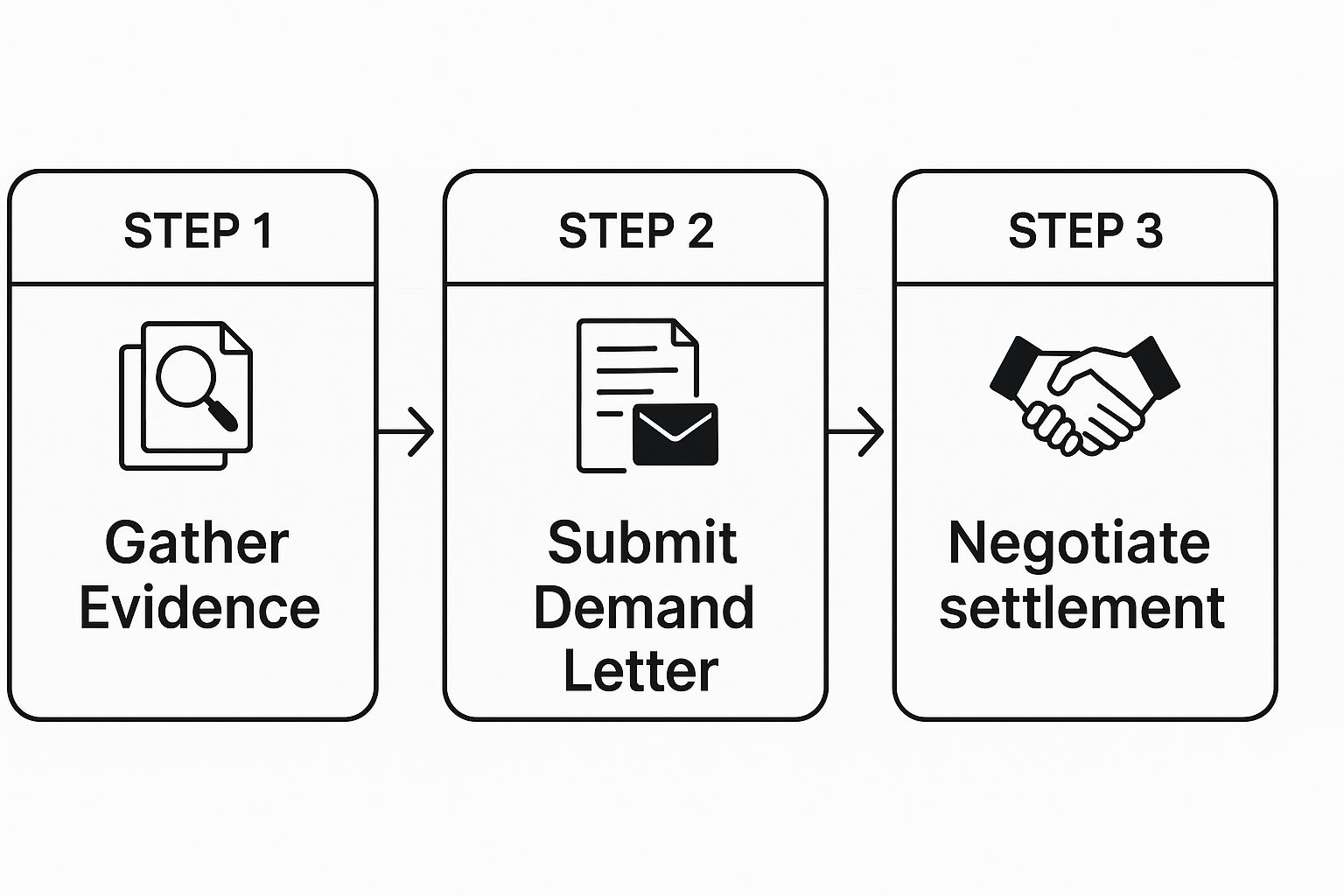
As the graphic shows, the process moves from collecting proof to making a formal demand and then negotiating a fair result.
Negotiation and Reaching a Settlement
Once all your evidence is compiled, the negotiation phase can begin. It starts with sending a formal demand letter to the insurance company. This document clearly lays out the facts of the case, explains how the property owner was negligent, details your injuries and all related damages, and states an initial settlement amount.
The insurance adjuster will review the demand and almost always respond with a much lower counteroffer. This is standard practice. The back-and-forth of negotiation is where having an experienced advocate on your side provides the most value.
If a fair agreement can be reached, you'll sign a release form, and the settlement check will be issued. However, if the insurance company simply refuses to offer a reasonable amount, the next step is filing a lawsuit. While most slip and fall cases settle long before they reach a courtroom, being fully prepared to go to trial is essential for securing just slip and fall injury settlement amounts.
Frequently Asked Questions About Atlanta Slip and Fall Claims

When you start digging into slip and fall injury settlement amounts, a lot of questions pop up. It's completely normal. To help, we've put together some straightforward answers to the questions we hear most often from people right here in Atlanta.
Think of this as your quick-reference guide. Getting clear on the rules and timelines early on can make a world of difference, especially when you’re already dealing with the stress of an injury.
How Long Do I Have to File a Slip and Fall Claim in Georgia?
In Georgia, the clock is ticking from the moment you get hurt. The state sets a strict time limit for filing a personal injury lawsuit, which is called the statute of limitations. For the vast majority of slip and fall cases, you have exactly two years from the date of the incident to file your claim.
While two years might sound like plenty of time, it flies by. Evidence disappears and memories fade. It's always in your best interest to act quickly. There are also a few rare exceptions that can shorten or extend this deadline, so getting the right advice is a good idea. An experienced Smyrna slip and fall lawyer can confirm the exact timeline for your specific situation.
What if the Fall Happened on Government Property?
This is where things get tricky. If your fall happened on property owned by the government—a city sidewalk, a public park, or inside a government building—the rules change completely. And they get much tougher.
Claims against government bodies in Georgia operate on a much shorter timeline. You’re typically required to provide a formal notice of your claim, known as an "ante litem" notice, sometimes within just six months. If you miss this deadline, you may lose your right to ever seek compensation. When the government is involved, immediate action isn't just a good idea; it's a necessity.
Do I Have to Pay Taxes on My Settlement Money?
This is a big one, and thankfully, the news is mostly good. The short answer is no—usually. The IRS generally states that compensation received for physical injuries or physical sickness is not considered taxable income.
Be aware, though, that some parts of a settlement can be taxed. For instance, if a portion of your award is specifically for lost wages, or if you receive punitive damages (which are meant to punish the defendant), that money could be subject to income tax.
Will My Case Have to Go to Court?
Most people picture a dramatic courtroom battle, but that’s rarely the reality. The overwhelming majority of slip and fall claims are resolved through negotiation and settled out of court. The process usually involves your attorney negotiating directly with the property owner's insurance company to reach a fair agreement.
A lawsuit is typically a last resort, filed only when an insurance company refuses to offer a settlement that fairly covers your damages. Even after a suit is filed, most cases settle before they ever see a trial. The goal is always to secure fair slip and fall injury settlement amounts in the most efficient way possible.