As an Atlanta personal injury attorney, I've seen far too many good people left in a tough spot because their insurance simply wasn't enough after a crash. Understanding the auto insurance requirements in Georgia is the first step in protecting yourself and your family. The state mandates what’s known as '25/50/25' liability coverage. This isn't just a random set of numbers; it's the minimum level of financial responsibility every driver must have to legally operate a vehicle.
Breaking Down Georgia's Mandatory Insurance Laws
You’ll hear the shorthand "25/50/25" thrown around a lot when discussing Georgia’s car insurance laws. This isn't just industry jargon—it's the core of your legal duty as a driver in our state. Think of it as the minimum safety net you're required to carry.
It’s important to understand that this liability coverage doesn’t pay for your car or your injuries. It’s designed to cover the harm you cause to someone else if you are at fault for an accident.
What 25/50/25 Really Means
So, let's unpack those numbers. Each one corresponds to a specific type of liability coverage and a minimum dollar amount you must have. Getting these terms straight is essential. For a more in-depth look at legal phrases you might encounter, our firm’s legal dictionary is an excellent resource.
Here’s a clear summary of what the state legally requires for every driver.
Georgia's Minimum Liability Insurance Requirements
| Coverage Type | Minimum Amount Required |
|---|---|
| Bodily Injury Liability (BI) per person | $25,000 |
| Bodily Injury Liability (BI) per accident | $50,000 |
| Property Damage Liability (PD) per accident | $25,000 |
Let's break that down even further:
- $25,000 in Bodily Injury Liability (BI) per person: This is the most your insurance will pay for a single person's medical bills and related costs if you injure them in a crash.
- $50,000 in Bodily Injury Liability (BI) per accident: This is the total cap your policy will pay for all injuries in one accident, no matter how many people were hurt.
- $25,000 in Property Damage Liability (PD) per accident: This covers the cost to repair or replace someone else’s property you damage. That’s usually their car, but it can also include things like a mailbox, a fence, or even a storefront.
The state sets these minimums to make sure drivers can cover at least some of the damage they might cause if they’re found at fault.
Georgia is a "Fault" State
It's also fundamental to know that Georgia operates under an "at-fault" (or "tort") system. In simple terms, this means the person who is legally responsible for causing the collision is also responsible for paying for the resulting damages.
Their liability insurance is what kicks in to handle the other party's medical bills and property damage, but only up to the policy's limits. This is why having enough coverage is so important. If the costs from an accident are higher than your policy limits, you can be held personally liable for the rest. That’s a key reason why just meeting the minimum auto insurance requirements in Georgia often isn't enough to truly protect yourself financially.
The High Cost of Driving Without Insurance in Georgia

Let's be clear: meeting the minimum auto insurance requirements in Georgia is not optional. It’s the law. I've seen far too many drivers discover the hard way that getting caught without coverage is a serious offense with immediate, escalating consequences. What starts as a simple traffic stop can quickly spiral into a legal and financial problem.
The state doesn’t take this lightly. The penalties aren't just about collecting a fine; they are designed to be a powerful deterrent. Forget a simple ticket. You're looking at losing your license and, for repeat offenders, much worse.
What Happens on Your First Offense
If you're pulled over without insurance for the first time, you're facing a misdemeanor charge. This is not just a slap on the wrist. The penalties hit hard and fast:
- License and Registration Suspension: The Georgia Department of Driver Services (DDS) can suspend both your driver's license and your vehicle registration for up to 60 days.
- Fines and Fees: Expect a fine anywhere from $200 to $1,000. On top of that, you'll owe a $210 reinstatement fee ($200 if you pay by mail) just to get your license back.
Before you can legally drive again, you’ll have to show proof of a new insurance policy and pay every last dollar of those fines. It's an expensive, inconvenient, and entirely avoidable lesson.
Penalties for a Second and Subsequent Offenses
Get caught a second time within five years, and the consequences get significantly worse. The state's patience runs out, and the penalties reflect that.
For a second offense, you can expect:
- A longer suspension period of 90 days.
- An increased reinstatement fee of $310 ($300 by mail).
A third offense within that same five-year window brings the hammer down. You could face up to 12 months in jail in addition to hefty fines and an even longer suspension. The risk of losing your freedom makes it crystal clear how seriously Georgia treats repeat offenders.
The penalties are cumulative. Each offense builds on the last, bringing longer suspensions, higher fines, and the very real possibility of jail time.
The SR-22 Filing Requirement
In many cases, especially after a license suspension for being uninsured, the state will require you to file an SR-22 form. This isn't a type of insurance. It's a certificate your insurance company sends directly to the state, basically vouching for you.
Think of it as a promise your insurer makes to the DDS, confirming you have at least the minimum required liability coverage and will keep it active. An SR-22 filing typically lasts for three years. If your coverage lapses for even a day during that time, your insurer is required to notify the DDS immediately, which could trigger another suspension. You can find more details on these requirements on the official Georgia Department of Driver Services website.
Failing to stay insured is a gamble against the house, and the house always wins. The severe penalties underscore why following the auto insurance requirements in Georgia is a fundamental responsibility for every driver on the road.
Why State Minimum Coverage Is Rarely Enough
Meeting Georgia's minimum auto insurance requirements makes you legal on the road, but it’s a dangerous mistake to confuse "legal" with "protected." I’ve seen it time and again: clients are left blindsided when the true costs of a serious accident completely eclipse the state-mandated limits. The gap between Georgia's required 25/50/25 coverage and the financial reality of a collision is vast, and falling into it can put everything you own on the line.
Think of the state minimum policy as a paper umbrella in a thunderstorm. Sure, it might stop a light drizzle, but it offers zero protection in a real downpour. With today's soaring medical bills and vehicle repair costs, those $25,000 and $50,000 limits have never been more inadequate.
The Real Cost of Modern Car Accidents
Let’s break down what those minimums actually look like in a real-world scenario. Imagine you cause an accident on I-285 that involves another car. The other driver requires back surgery and a few days of hospital recovery. Their medical bills can easily shoot past $100,000. Your $25,000 per person Bodily Injury Liability policy won't even make a dent.
So, what happens to the other $75,000? It doesn't just disappear—it becomes your personal debt. The injured driver's attorney can then come after you directly, targeting your savings account, your home equity, and even garnishing your future wages. It's a harsh reality that most people don't consider until it's far too late.
A single serious injury can trigger medical expenses that are three, four, or even five times higher than the state minimum coverage. Relying on the bare minimum is a significant financial gamble.
Now let's look at the property damage side. The average price of a new car today is well over $40,000. If you're at fault for an accident that totals a newer pickup or SUV, your $25,000 property damage limit is gone in an instant. That doesn't even factor in a multi-car pileup, where you could be on the hook for repairing several vehicles at once.
Rising Premiums and What They Mean for You
It's no secret that costs are climbing everywhere, and auto insurance is a prime example. Premiums in Georgia have jumped so dramatically that our state is now the 10th most expensive for coverage. The average full-coverage policy is running about $2,688 per year—that’s 15% higher than the national average and a 21% increase from last year alone. This surge is fueled by everything from higher vehicle repair costs to a rise in auto thefts.
This trend underscores a key point. While it's tempting to save money by sticking with a minimum policy, the financial risk you're taking is also growing. As vehicle values and medical costs inflate, the potential debt from an at-fault accident gets bigger, too. Paying a little more each month for higher liability limits is one of the smartest defensive moves you can make for your financial future.
Shielding Your Assets and Your Future
At the end of the day, your auto insurance policy is more than just a piece of paper that keeps you legal. It’s a shield for your financial health. Choosing coverage well above the state minimum isn't about overpaying; it's about safeguarding what you've worked so hard to build.
Consider these all-too-common situations where minimum coverage fails:
- Accidents with Multiple Injuries: If you cause a crash that injures a family of three, your $50,000 total bodily injury limit has to be split among all of them. It's almost never enough, which opens the door for multiple lawsuits filed directly against you.
- Collisions with Commercial Vehicles: Damaging a work van or a commercial truck can lead to repair bills that blow past the $25,000 property damage limit before you can blink.
- Long-Term Medical Care: If someone you injure needs months of physical therapy, rehabilitation, or ongoing medical care, the costs will dwarf the state minimum limits almost immediately.
By increasing your liability limits to something more substantial—like $100,000/$300,000/$100,000—you create a powerful buffer between an accident and your personal assets. It’s a wise investment in your peace of mind. Should you ever find yourself dealing with the fallout from an accident, understanding the full scope of your personal injury claims is the first step in protecting yourself. This is precisely why a clear grasp of the auto insurance requirements in Georgia is so important.
Essential Protection Beyond the Basics
What happens when the driver who hits you has no insurance? What if their policy is so minimal it won't cover a fraction of your medical bills? This is a frightening and all-too-common scenario on Georgia roads.
While knowing the basic auto insurance requirements in Georgia is a start, specialized, optional coverages are your most powerful line of defense. Think of them as a personal safety net, protecting you and your family from the financial fallout caused by other drivers.
Without these extra layers of protection, you could be stuck paying for your own injuries and car repairs out of pocket—even when the accident wasn't your fault. This is where you can take control.
Uninsured and Underinsured Motorist Coverage Explained
Imagine getting hit by someone who only carries the bare minimum $25,000 liability coverage, but your hospital bills are already pushing six figures. Or worse, the other driver just speeds off. This is precisely where Uninsured/Underinsured Motorist (UM/UIM) coverage steps in to save the day.
In Georgia, insurers are legally required to offer you this coverage. If you decide you don't want it, you must reject it in writing. It's that important.
- Uninsured Motorist (UM) Coverage: This protects you when you're injured by a driver with no insurance at all. It also covers you in a hit-and-run where the driver is never identified. Your UM policy will pay for your medical bills, lost income, and pain and suffering, just like the at-fault driver's insurance should have.
- Underinsured Motorist (UIM) Coverage: This applies when the at-fault driver does have insurance, but their policy limits are too low to cover all your damages. Your UIM coverage kicks in to pay the difference, right up to your own policy's limits.
Essentially, UM/UIM is insurance you buy for yourself to fill the gap when a responsible driver's policy is missing or inadequate.
Other Valuable Optional Coverages
Beyond UM/UIM, a few other optional coverages can create a truly protective policy. While liability coverage is for others, these next options are designed to take care of you and your property.
Medical Payments (MedPay)
This is one of the most practical and straightforward add-ons you can get. MedPay helps cover medical and even funeral expenses for you and your passengers after a crash, no matter who was at fault. It can immediately pay for ambulance rides, hospital co-pays, and doctor visits while you wait for a larger claim to be sorted out.
Collision and Comprehensive Coverage
Often sold as a pair, these two are usually required if you have a loan or lease on your vehicle. They are absolutely essential for protecting your own car from damage.
- Collision Coverage: This pays to repair or replace your vehicle if it's damaged in a wreck with another car or an object, like a fence or a guardrail. Fault doesn't matter.
- Comprehensive Coverage: This covers damage to your vehicle from just about everything else—think theft, vandalism, fire, hail, or hitting a deer.
Having Collision and Comprehensive means you won't be left without a car or facing thousands in repair bills if your vehicle is damaged, stolen, or totaled.
Beyond just the insurance policy, it's also wise to consider physical safeguards for your vehicle, as they can sometimes lower your premiums. For example, some people invest in advanced anti-theft measures like a Ghost Immobiliser to better protect their asset.
Building a policy that goes beyond the state-mandated minimums is the single best way to ensure one bad accident doesn't derail your financial future. It reinforces why a deep knowledge of the auto insurance requirements in Georgia is so valuable for every driver.
What to Do Right After a Car Accident in Georgia
The first few moments after a car crash are pure chaos. Your adrenaline is surging, you're disoriented, and it's tough to think clearly. But what you do right then and there can make or break your ability to get fair compensation, especially when it comes to the other driver's compliance with auto insurance requirements in Georgia.
Safety is always the number one priority. First, check on yourself and your passengers. If you can, and it's safe, move your vehicle to the shoulder and out of traffic. The second you're stopped, flip on your hazard lights to warn oncoming drivers.
Your Immediate Action Checklist
Once you've moved to a safe spot, the next steps are all about documentation and protecting your rights. Every single piece of information you gather at the scene is a potential building block for your insurance claim.
Here’s exactly what you need to do:
- Call 911: This is not optional, even for a minor fender-bender. A police officer will create an official accident report, which is a powerful piece of evidence that lays out the objective facts of what happened.
- Exchange Information: Get the other driver's full name, address, phone number, and driver's license number. Be sure to get their insurance company name and policy number. Give them your info, too, but don't offer any extra details.
- Document Everything: Use your smartphone. Take photos and videos of everything from every angle you can think of—damage to all cars, license plates, skid marks, nearby traffic signs, and the general scene of the accident.
- Talk to Witnesses: If anyone stopped and saw what happened, get their name and number. An independent witness provides an unbiased account that can be incredibly valuable later on.
What to Say and What to Avoid
At the accident scene, words have weight. It’s a natural human instinct to apologize or say you're sorry, but you have to fight that urge. Never admit fault, even if you have a nagging feeling you might have contributed. Leave that determination to the police and the insurance companies.
Stick to the facts and only the facts. A simple, well-meaning "I'm so sorry" can be twisted by an insurance adjuster looking for any excuse to deny or lowball your claim. Keep the conversation calm, professional, and focused on exchanging information.
For a deeper dive into the immediate aftermath, you can explore your recovery roadmap after a car accident.
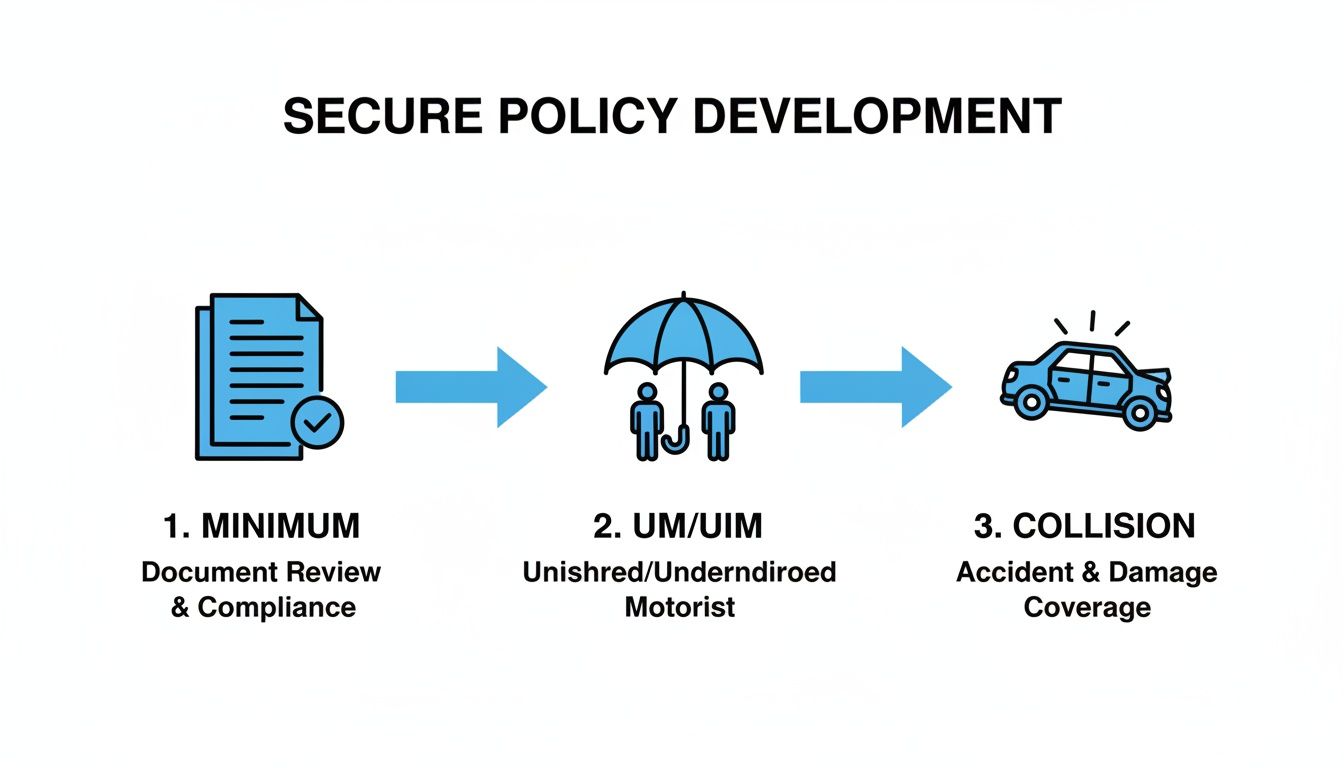
This visual breaks down how a solid insurance policy is built. It starts with the state-mandated basics and then layers on essential protections like UM/UIM coverage to make sure you're truly protected.
Seek Medical Attention Right Away
You might feel fine right after a crash, but that's often just the adrenaline talking. You absolutely must see a doctor. Many serious injuries—like whiplash, internal bleeding, or even a concussion—have delayed symptoms that won't show up for hours or days.
A medical record created right after the accident is undeniable proof linking your injuries directly to the crash. If you wait, the at-fault driver's insurance company has an opening to argue your injuries happened somewhere else.
This medical documentation is the cornerstone of any personal injury claim. Following these steps helps protect you physically and financially. From here, the next step is learning how to file a car accident claim in Atlanta. Knowing the auto insurance requirements in Georgia is just the first piece of the puzzle.
When You Should Speak with a Personal Injury Attorney
After a crash, the thought of wrangling with an insurance company is the last thing anyone wants. It's completely normal to wonder if you really need a lawyer. While a minor fender-bender might be manageable on your own, certain situations absolutely demand professional legal advice to protect your rights and financial stability, especially when dealing with the fine print of auto insurance requirements in Georgia.
Trying to handle a serious claim alone is like trying to perform surgery on yourself—you know something is wrong, but you lack the tools and expertise to fix it properly. An attorney has the experience to build your case correctly from the start, making sure no detail is overlooked.
Red Flags That Signal You Need an Attorney
You should strongly consider contacting an attorney if your accident involves any of these scenarios. These are clear signs that the claims process will be an uphill battle and the insurance company is unlikely to treat you fairly without a professional fighting for you.
- You or a passenger suffered a serious injury: If the accident resulted in hospitalization, surgery, ongoing physical therapy, or long-term impairment, the stakes are far too high to go it alone.
- The insurance company is disputing who was at fault: When the other driver’s insurer tries to shift the blame to you, an attorney is essential. They will gather the police report, track down witnesses, and secure the evidence needed to prove what actually happened.
- You've received a lowball settlement offer: The first offer is almost never the best one. If an adjuster makes a quick offer that doesn't come close to covering your medical bills, lost wages, and other losses, it's a clear tactic to settle your claim for pennies on the dollar.
An experienced attorney knows how to calculate the true value of your claim. This includes not just your current bills but also future medical needs and pain and suffering—damages that insurance adjusters are trained to minimize or dismiss entirely.
How a Lawyer Can Help Your Case
Hiring an attorney does more than just give you a legal expert; it levels the playing field against massive insurance corporations. Their entire job is to manage the legal details so you can focus on getting better.
A lawyer will take over all communication with adjusters, preventing you from accidentally saying something that could hurt your claim. They meticulously collect all necessary evidence, from medical records to expert testimony, to build a powerful case for full compensation. Their primary goal is to fight for a settlement that truly covers every one of your losses. Ultimately, having an expert who understands the nuances of auto insurance requirements in Georgia is a key part of a fair outcome. For more detailed legal statutes, the official Georgia Code serves as a foundational resource.
Answering Your Questions About Georgia Car Insurance
Here are some straightforward answers to the questions we get asked most often about Georgia's car insurance rules.
I Just Moved to Georgia. What Do I Need to Do?
Welcome to the Peach State! Once you've settled in and officially become a resident, you have a 30-day window to get your vehicle registered here. That also means you need to secure a new auto insurance policy that meets Georgia's requirements.
Don't let this deadline sneak up on you. After 30 days, you could be considered an uninsured driver. For official details, the Georgia Department of Revenue's website is your best source of truth.
Is Georgia a No-Fault State?
No, and this is an important point to understand. Georgia is an "at-fault" state, sometimes called a "tort" state.
In simple terms, this means the driver who caused the accident is financially responsible for the damages and injuries that result. Their insurance company is the one that has to pay.
This is precisely why proving who was at fault is the most important part of any car accident claim. A police report, photos from the scene, and witness statements aren't just paperwork—they are the foundation of your case.
Do I Really Need to Keep Proof of Insurance in My Car?
Yes, absolutely. Georgia law is clear: you must have proof of insurance with you anytime you're behind the wheel.
While it's true that law enforcement can often check your coverage status electronically using the Georgia Electronic Insurance Compliance System (GEICS), you should never rely on it. Technology can fail. A dead phone battery or a system glitch could create a major headache during a traffic stop.
The best practice is simple: keep a physical insurance card in your glove box or a digital copy saved to your phone.
Remember, the consequences of an accident can linger, but your time to take legal action is short. To understand the strict deadlines for filing a claim, read our guide on the statute of limitations for personal injury in Georgia. Knowing the auto insurance requirements in Georgia is the first step in protecting yourself.
If you were hurt in an accident and the insurance company is giving you the runaround, you don't have to fight them alone. The team at Jamie Ballard Law is here to make sure you understand your rights and to fight for the fair compensation you are owed.
Contact us for a free, no-obligation case evaluation today.