If you were hurt at a store, apartment complex, or business here in Atlanta, speaking with a premises liability attorney in Atlanta, GA, is a smart first move to protect your rights. Georgia law is clear: property owners are responsible for keeping their spaces reasonably safe. However, the exact level of care they owe you depends entirely on why you were on their property in the first place.
Getting a handle on these basics is the key to understanding whether you have a solid claim for your medical bills, lost wages, and other damages. A skilled Atlanta premises liability attorney can help you make sense of your situation.
What Happens When You Get Hurt on Someone Else's Property
At its core, a premises liability case is about a property owner's failure to manage risk. When an owner neglects a known or foreseeable danger—and someone gets hurt as a result—they can be held accountable. Think of something like a professional tree hazard assessment; it’s a proactive step owners can take to identify and fix dangers before they can cause harm.
The central idea is that property and business owners have a legal duty to keep their premises in a reasonably safe condition for visitors.
But here’s the important part: that legal duty isn't a one-size-fits-all obligation. Georgia law, specifically O.C.G.A. § 51-3-1, breaks down visitors into different categories. Your legal status on the property is the single most important factor determining the owner's responsibility for your safety.
Your Legal Status as a Visitor Matters
The duty of care a property owner owes you is directly tied to your reason for being there. This is one of the very first things an attorney will analyze when looking at your potential case.
Georgia law recognizes three main types of visitors:
- Invitees: You're an invitee if you are on the property for the mutual benefit of you and the owner. This is you when you're a customer in a grocery store, a client in an office, or a fan at a concert. Invitees are owed the highest duty of care. The owner must actively inspect the property for hidden dangers and either fix them or clearly warn you about them.
- Licensees: A licensee is on the property for their own reasons but has the owner's permission to be there. The classic example is a social guest at a friend's home. The owner’s duty is lower here; they only have to warn you about dangers they already know about. They don't have a duty to go looking for unknown hazards.
- Trespassers: A trespasser enters a property without any permission. Property owners owe almost no duty to trespassers, except to avoid willfully or wantonly injuring them. You can learn more about these classifications on Wikipedia's page on premises liability.
This legal hierarchy is the foundation of every premises liability claim in Georgia.
As the diagram shows, customers and clients in business settings ("Invitees") get the highest level of protection under Georgia law. Understanding exactly where your situation falls within this legal structure is why talking to an experienced premises liability attorney in Atlanta, GA, is so important.
Common Premises Liability Claims in the Atlanta Area
When most people hear “premises liability,” they immediately picture a classic slip and fall. And while those are definitely a huge part of what we handle, the reality is that unsafe property conditions across Atlanta lead to all sorts of preventable injuries.
From a slick floor in a Buckhead grocery store to a broken stair rail at an apartment complex in Sandy Springs, these incidents aren’t just bad luck. They’re often the direct result of a property owner dropping the ball on their legal duty to keep people safe. A premises liability attorney in Atlanta, GA, can determine if your injury was caused by that kind of negligence.

Classic Slip and Fall or Trip and Fall Incidents
By a long shot, the most frequent cases we see involve someone slipping or tripping over a hazard. These claims make up the bulk of premises liability cases in Georgia, mainly because businesses owe their customers (known as "invitees") the highest duty of care.
It’s no small issue. Fulton County court data has shown that premises liability cases account for nearly a quarter of all tort trials—a staggering number that shows just how common these injuries are right here in our community.
These accidents can happen anywhere, but they usually boil down to a few common hazards:
- Wet or Slippery Surfaces: This is the big one. Spilled drinks, freshly mopped floors without a warning sign, or even just rainwater tracked in at a store’s entrance.
- Uneven Walking Surfaces: Think cracked sidewalks, deep potholes in a dark parking lot, or bunched-up carpeting that catches your foot.
- Cluttered Aisles: Boxes, merchandise, or stray equipment left in walkways can create a dangerous and completely avoidable obstacle course.
The legal test always comes back to one key question: Did the property owner know, or should they have known, about the hazard? A carton of milk that just fell and spilled is one thing. But a puddle that’s been sitting on the floor for an hour? That’s something the staff should have reasonably found and cleaned up. You can find more specifics in our guide to Atlanta slip and fall injuries.
Injuries from Falling Objects
Another surprisingly common—and serious—claim involves objects falling from high shelves in retail stores. We've all been in warehouse-style stores where heavy merchandise is stacked high over the aisles. If those items aren't secured properly or the shelving itself is weak, they can become deadly projectiles.
These accidents can cause devastating harm, including traumatic brain injuries. Property owners have a clear responsibility to train employees on safe stacking and to inspect their shelving. When they cut corners on this duty, they can be held financially responsible for the aftermath.
Swimming Pool Accidents
Atlanta’s apartment complexes, hotels, and community centers are full of pools that offer a great way to beat the heat. But they also carry immense risk. A fun day can turn tragic in an instant, leading to drowning or other catastrophic injuries.
Most of these accidents stem from a few key failures:
- Inadequate Fencing or Gates: Georgia law is very clear about the need for proper barriers to keep young children from wandering into a pool area alone.
- Lack of Proper Safety Equipment: Every pool should have rescue equipment like ring buoys or a shepherd's hook readily available. When it's missing, a minor struggle in the water can become fatal.
- Slippery Pool Decks: The surfaces around a pool are going to get wet, but owners have a duty to use non-slip materials and manage standing water to prevent dangerous falls.
When a property owner fails to meet these basic safety standards, the law holds them accountable. If you or someone you love was hurt because of unsafe conditions on someone else’s property, speaking with a premises liability attorney in Atlanta, GA, is the first step toward getting answers and understanding your rights.
Understanding Negligent Security Claims in Atlanta
When you visit an apartment complex, shopping mall, or concert venue in Atlanta, you have a right to expect a reasonable degree of safety. Property owners have a duty to protect visitors from harm, but sometimes they fail. When that failure leads to a violent crime like an assault or robbery, it may be grounds for a specific type of premises liability claim: negligent security.
A premises liability attorney in Atlanta, GA, is the right professional to handle these sensitive cases. Simply put, a negligent security claim arises when a property owner fails to implement reasonable safety measures to protect people from foreseeable criminal attacks. The key isn't about preventing random, unpredictable crime; it’s about holding owners accountable when they knew—or should have known—a dangerous environment existed and did nothing to fix it.
What Does Negligent Security Look Like?
These security failures are often practical and easy to spot in hindsight. The legal challenge is proving the property owner should have addressed them before someone was hurt.
Common examples of security failures in Atlanta include:
- Poor Lighting: Dark, unlit parking garages, stairwells, or hallways create a perfect cover for criminal activity. An owner’s refusal to replace burnt-out bulbs or install adequate lighting can be a direct cause of an attack.
- Broken Gates and Locks: An apartment complex might advertise itself as a "gated community," but if the gate is always broken, it provides only a false sense of security. The same applies to broken locks on exterior doors or individual units.
- Lack of Security Personnel: In places with a documented history of crime, like a shopping center with frequent car break-ins, failing to have visible security guards on patrol could be considered negligent.
- Malfunctioning Security Cameras: Cameras that don't work or are poorly positioned do nothing to deter criminals or help identify them after an incident.
The core of any negligent security claim is demonstrating that the property owner was aware of the risks.
The legal standard often comes down to "foreseeability." If there have been multiple robberies in a specific parking lot over the past year, another robbery becomes foreseeable. At that point, the property owner can no longer claim ignorance and has a heightened duty to take reasonable steps to protect visitors.
Proving a Property Owner Knew About the Danger
To build a successful case, we must show the owner had "superior knowledge" of the danger. This means they were in a better position than you to know about the criminal risk on their property.
Evidence used to establish this knowledge might include:
- Prior Criminal Activity: We can obtain police reports for the property and surrounding area to show a pattern of similar crimes.
- Tenant or Customer Complaints: Did other people report broken lights, suspicious individuals, or feelings of being unsafe to management? These complaints prove the owner was put on notice.
- Industry Standards: Certain businesses, like hotels or banks, have generally accepted security standards they are expected to follow.
Unfortunately, negligent security cases have become more common across our city. Escalating crime rates have turned many everyday locations into liability hotspots, leading to significant verdicts and settlements that underscore a property owner's duty to protect patrons. When news reports and crime data show a clear rise in local crime, it strengthens the argument that property owners should have known about the risks and acted to prevent harm—especially when previous incidents made future attacks predictable. For more details on this trend, you can read an analysis of recent Atlanta-area verdicts.
If you were the victim of a crime that better security could have prevented, you are likely facing physical injuries, emotional trauma, and significant financial burdens. Understanding your rights is the first step toward holding the responsible property owner accountable. Consulting a knowledgeable premises liability attorney in Atlanta, GA, can help you determine if you have a valid claim.
How Georgia Law Shapes Your Injury Claim
When you get hurt on someone else's property, what happened is only half the story. The other half is how Georgia’s specific laws apply to your situation. An experienced premises liability attorney in Atlanta, GA, knows that a winning strategy is built on a solid understanding of these state-specific rules.
Two laws, in particular, have a massive impact on any injury claim. The first is a non-negotiable deadline for taking legal action. The second is a rule for assigning blame to everyone involved. Getting a handle on both is the first important step toward a successful case.
The Two-Year Clock: The Statute of Limitations
In Georgia, the law gives you a set amount of time to file a personal injury lawsuit. This deadline is called the statute of limitations. For nearly all premises liability claims, you have just two years from the date you were injured to file. This rule is cemented in the Official Code of Georgia Annotated (O.C.G.A.) § 9-3-33.
Think of this two-year window as a hard cutoff, not a friendly suggestion. If you miss it by even a single day, the court will almost certainly throw out your case. You lose your right to seek compensation forever. This is exactly why it’s so important to contact an attorney quickly after an injury.
The legal system has these deadlines for a practical reason: to make sure evidence is still available and that witnesses can clearly remember what happened. The longer you wait, the harder it is to build a strong case.
Modified Comparative Fault: What It Means for You
The second major rule you need to know is Georgia’s "modified comparative fault" law. This is just a legal term for how the court assigns responsibility. In simple terms, a judge or jury will look at the actions of both you and the property owner to decide who was at fault and by how much.
This system, found in O.C.G.A. § 51-12-33, works on percentages. Here’s a quick breakdown of how it could affect your compensation:
- If You Are 0% to 49% at Fault: You can still recover money for your injuries. However, the final amount will be reduced by whatever percentage of fault is assigned to you. For example, if you have $100,000 in damages but are found 10% at fault for not paying attention, your award drops to $90,000.
- If You Are 50% or More at Fault: You get nothing. Under Georgia law, if your share of the blame is equal to or greater than the property owner’s, you are completely barred from recovering any compensation.
Insurance adjusters are experts on this rule. Their primary goal is often to shift as much blame as they can onto you, hoping to reduce their payout or deny your claim entirely. You can learn more about how these deadlines work by reading about the statute of limitations for personal injury in GA.
These two state laws set the rules of the game for your case. The job of a sharp premises liability attorney in Atlanta, GA, is to use them strategically, protecting you from unfair blame while making sure every legal deadline is met.
Gathering the Evidence Needed to Prove Your Claim
When you're injured on someone else's property, proving what happened is everything. A strong premises liability claim isn't built on stories; it's built on credible evidence, collected piece by piece.
Without proof, your case is just your word against the property owner and their insurance company. A premises liability attorney in Atlanta, GA, will steer the legal strategy, but the important evidence collection starts with you, right at the scene.
The steps you take in the first few minutes after an accident can fundamentally change the outcome of your claim. Documenting the scene and your injuries in real-time creates an undeniable record of events, one that can’t be easily disputed later.
Documenting the Scene and Your Injuries
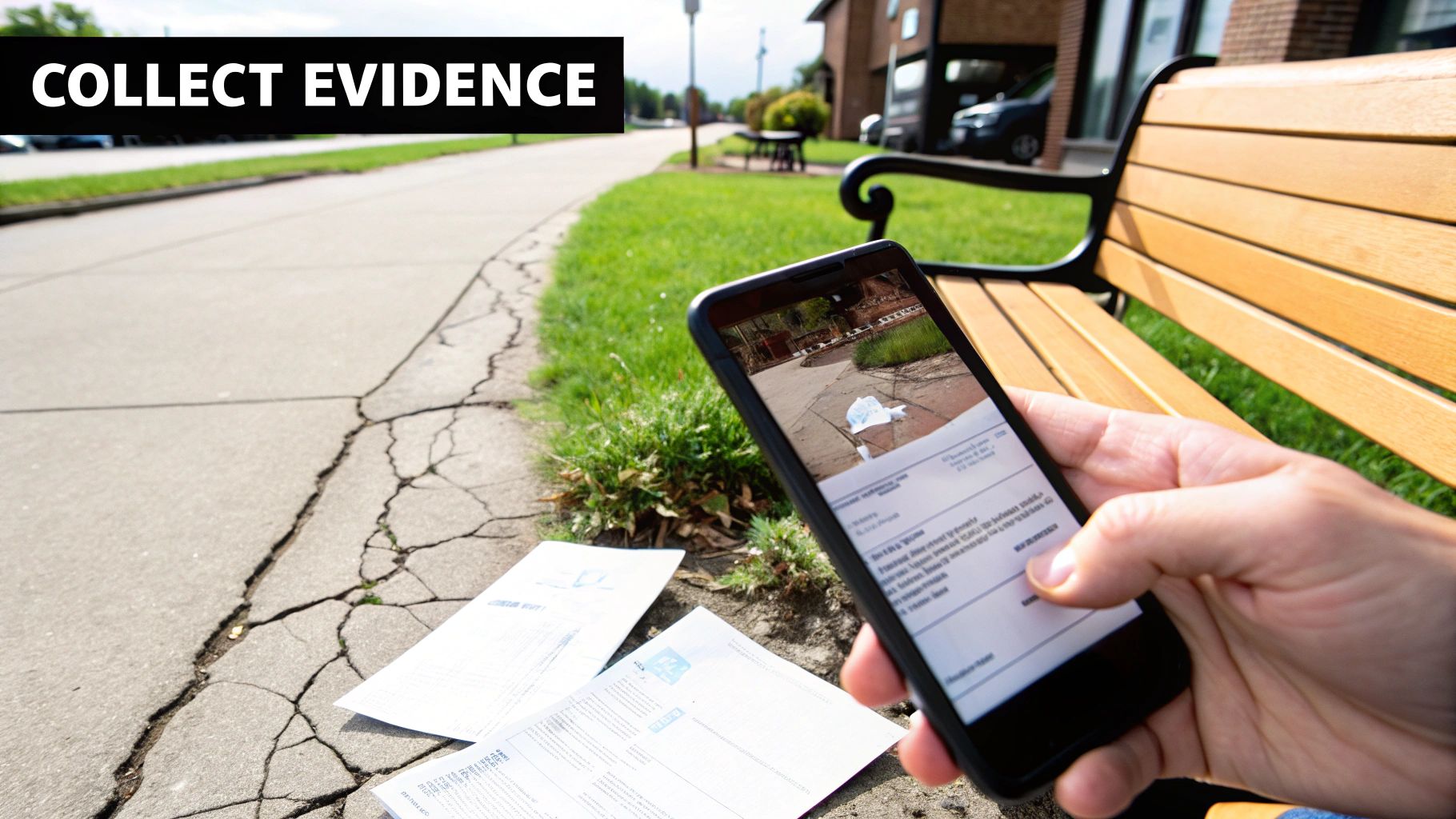
Your smartphone is the most powerful tool you have immediately after a slip and fall or another incident. Use it.
- Take Photos and Videos: Get pictures of the entire area from several different angles. Zoom in on the specific hazard—the wet floor, the broken step, the trip hazard. Photograph your injuries as soon as you can.
- Identify Witnesses: If anyone saw what happened, get their name and phone number. An unbiased witness statement is incredibly valuable.
- File an Incident Report: Find the manager or owner and report the incident immediately. Stick to the facts when you fill out the report and always ask for a copy before you leave.
This documentation creates a timestamped snapshot of the conditions at the exact moment you were hurt. It’s your best defense against the owner later trying to fix the hazard and claim it never existed.
An official incident report is important. It formally notifies the property owner of the injury and creates a paper trail confirming the date, time, and location—all essential for your claim.
Preserving Medical and Financial Records
The evidence doesn't stop at the scene. You must also meticulously document how the injury has impacted your life.
Your medical journey tells a vital part of the story. Keep a detailed file of every doctor's visit, therapy session, prescription, and medical bill. These records aren't just for adding up expenses; they create a clear timeline of your injury's severity and the long road to recovery. For more on your rights, the State Bar of Georgia provides helpful public resources.
Don't forget to track your lost income. Pay stubs are the best way to prove lost wages, which is a key component of your potential compensation. The more organized your records are, the stronger the case a premises liability attorney in Atlanta, GA, can build for you.
The Role Your Attorney Plays in a Premises Liability Case
When you're hurt on someone else’s property, your only job should be to get better. The last thing you need is to deal with mountains of paperwork, constant phone calls, and pressure tactics from insurance companies. This is precisely where a skilled premises liability attorney in Atlanta, GA steps in. We take over every detail of your claim so you can focus entirely on your recovery.
An attorney’s work starts the moment you hire them, beginning with a deep-dive investigation into what really happened. You might have a few photos from your phone, but a legal team goes much further, working to secure important evidence that property owners often aren't eager to share.

From Investigation to Negotiation
The entire goal is to build an ironclad case that leaves no doubt about the property owner’s negligence. To get there, your legal team will take several immediate and important steps.
The investigative process is thorough and includes:
- Securing Surveillance Footage: We move quickly to get security camera videos before they are recorded over or deleted.
- Gathering Official Records: This means collecting police reports, any internal incident reports filed by the business, and ambulance records.
- Reviewing Internal Documents: We can formally request maintenance logs, cleaning schedules, and employee records that might prove the owner knew about the dangerous condition.
- Interviewing Witnesses: We track down and speak with anyone who saw what happened to get their unbiased account of the events.
With this evidence in hand, your attorney becomes your shield. They handle all communication, especially the difficult task to negotiate with insurance adjusters, whose primary job is to pay you as little as possible. Your lawyer will field every call and respond to every letter, protecting you from their tactics.
How We Get Paid: A Contingency Fee
We know that one of the biggest worries for injured people is how to afford a good lawyer. That’s why we work on a contingency fee basis.
It’s simple: you pay nothing upfront. No retainers, no hourly bills. Our fee is a percentage of the final settlement or verdict we win on your behalf.
If we don't win your case, you owe us nothing. This approach guarantees that everyone can afford top-tier legal help, no matter their financial situation.
Settlement values can vary dramatically depending on how serious the injuries are. Historically, data from Fulton County has shown that the median trial award for premises liability cases was $90,000, while slip-and-fall settlements frequently land in the $20,000 to over $100,000 range.
By managing the entire legal process, your premises liability attorney in Atlanta, GA aims to maximize your compensation while you get the medical care you need. If you'd like to hear from our past clients, you can read some of our personal injury testimonials.
Common Questions About Atlanta Premises Liability Claims
When you get hurt on someone else's property, your mind is probably racing with questions. Getting straight answers is the first step toward regaining some control. Here are some of the most frequent questions we address for clients across Atlanta. For advice specific to your case, a premises liability attorney in Atlanta, GA can provide the clarity you need.
How Much Does It Cost to Hire a Premises Liability Attorney?
The cost of hiring a lawyer is one of the biggest initial concerns for most people, and that's completely understandable. The good news is, nearly all personal injury attorneys operate on a contingency fee basis.
In plain terms, this means you pay nothing upfront. Our fee is a percentage of the financial recovery we secure for you, whether through a settlement or a court verdict. If we don't win your case, you owe us nothing for our legal services. This model removes the financial risk and allows everyone access to experienced legal representation.
What If I Was Partly at Fault for My Injury?
This is an important question because it comes up in almost every case. Georgia law follows a rule called “modified comparative negligence,” and it has a very strict cutoff.
- If you are found 49% or less at fault, you can still recover damages, but your award will be reduced by your percentage of fault. For example, a $100,000 award would be reduced to $90,000 if you were found 10% responsible.
- However, if you are found 50% or more responsible for the incident, you are barred from recovering any compensation.
Insurance companies will try to shift as much blame onto you as possible to avoid paying. A key part of our job is to build a strong case that defends you against these unfair blame-shifting tactics.
How Long Does a Premises Liability Case Take?
There’s no one-size-fits-all answer here; the timeline varies significantly.
A straightforward case with clear liability and minor injuries might settle within a few months. On the other hand, a case involving severe injuries, a dispute over fault, or a stubborn insurance company can take a year or more, especially if a lawsuit is necessary. Our primary goal is always to achieve a full and fair result, and sometimes that requires patience and meticulous preparation. You can learn more about Georgia's court system on the Judicial Council of Georgia website.
What Kind of Compensation Can I Receive?
In a Georgia premises liability claim, the compensation you can pursue is categorized as "damages." These damages fall into two main groups:
- Economic Damages: This covers all the measurable financial losses you've incurred. Think of things like medical bills (past and future), lost wages from being out of work, and any other out-of-pocket costs tied to your injury.
- Non-Economic Damages: This compensates you for the human cost of the injury—the losses that don't come with a receipt. This includes physical pain and suffering, emotional distress, and the loss of enjoyment of life.
In rare instances where a property owner's conduct was particularly reckless or malicious, punitive damages may be awarded to punish the defendant. A skilled premises liability attorney in Atlanta, GA will meticulously document every loss to ensure we demand the full compensation you are owed.
At Jamie Ballard Law, we’re here to give you the answers and guidance you need to move forward. If you have more questions or just want to talk about what happened, we offer a free, no-obligation case evaluation to help you understand your legal options. Contact us today.