Establishing liability in a personal injury claim is the starting point for your case. In simple terms, it's the legal process of proving someone else was at fault for the accident that injured you. It answers the fundamental question: "Who is legally responsible for my injuries and the financial costs that come with them?" When someone else's carelessness causes you harm, you shouldn't have to carry the financial burden alone. Understanding liability personal injury principles is the first step toward holding the right person accountable.
It’s not about blame; it's about making things right. The law is set up to ensure the responsible party covers the harm they caused.
What Liability Means for Your Injury Claim
When you've been hurt, the initial legal task is to show how another person's actions—or their failure to act—led directly to your injury.
For instance, if a driver was texting, ran a red light, and hit your car, proving that sequence of events is what establishing liability is all about. You connect the texting, the traffic violation, and the resulting collision to your injuries.
Without this step, there is no way to recover payment for your medical bills, lost wages, or pain and suffering. Think of it as the key that opens the door to a fair settlement.
Why Liability Matters
Proving liability is the "why" that supports your entire claim. It gives the legal reason for an insurance company or a court to provide you with financial compensation. Here’s what it does:
- It Assigns Legal Responsibility: Liability officially identifies the person, company, or other party whose negligence caused the accident.
- It Justifies Your Compensation: Once fault is legally confirmed, the responsible party has a legal duty to pay for the damages they caused.
- It Forms the Foundation of Your Case: Every piece of evidence we gather, from police reports to witness statements, is used to build a clear and strong argument for liability.
This is not a rare occurrence. According to some reports, around 39.5 million Americans need medical care for injuries each year. With nearly 400,000 personal injury claims filed annually, it’s clear many people find themselves in this situation. You can look at more personal injury law statistics to see the full scope.
Here in Georgia, the idea behind liability is straightforward: if someone else’s carelessness hurt you, the financial weight shouldn’t be yours to bear. The law offers a clear method for accountability.
This is about getting the resources you need to heal and rebuild your life after an unexpected injury. A successful claim always begins by clearly showing who is responsible.
Common Ways Liability Is Established in Georgia
When it comes to proving liability in a personal injury case, the approach can vary. Georgia law has several different grounds for holding someone accountable for the harm they cause, and figuring out which one fits your situation is the first important step.
Each type of liability is like a different legal theory—a different way of looking at the facts of your case to determine who is at fault. Let’s go over the most common ones we see here in Atlanta.
Negligence: The Most Common Path
Most personal injury claims are based on negligence. This means someone had a duty to be reasonably careful, they failed in that duty, and their failure directly caused your injury.
Think about a typical drive on I-285. A driver looking at their phone doesn't see that traffic has stopped and crashes into the car in front of them. Their carelessness—failing in their duty to drive safely—is the very definition of negligence.
To successfully prove a negligence claim, we must show four specific things:
- Duty: The at-fault party had a legal responsibility to act with a certain level of care. For example, every driver has a duty to follow traffic laws.
- Breach: They did not meet that legal duty. The driver texting instead of watching the road is a clear breach.
- Causation: Their failure to act with care was the direct cause of the accident and your injuries.
- Damages: You suffered real, provable harm, such as medical bills, lost income, and physical pain.
These four points are all necessary; without every one of them, a negligence claim will not succeed.
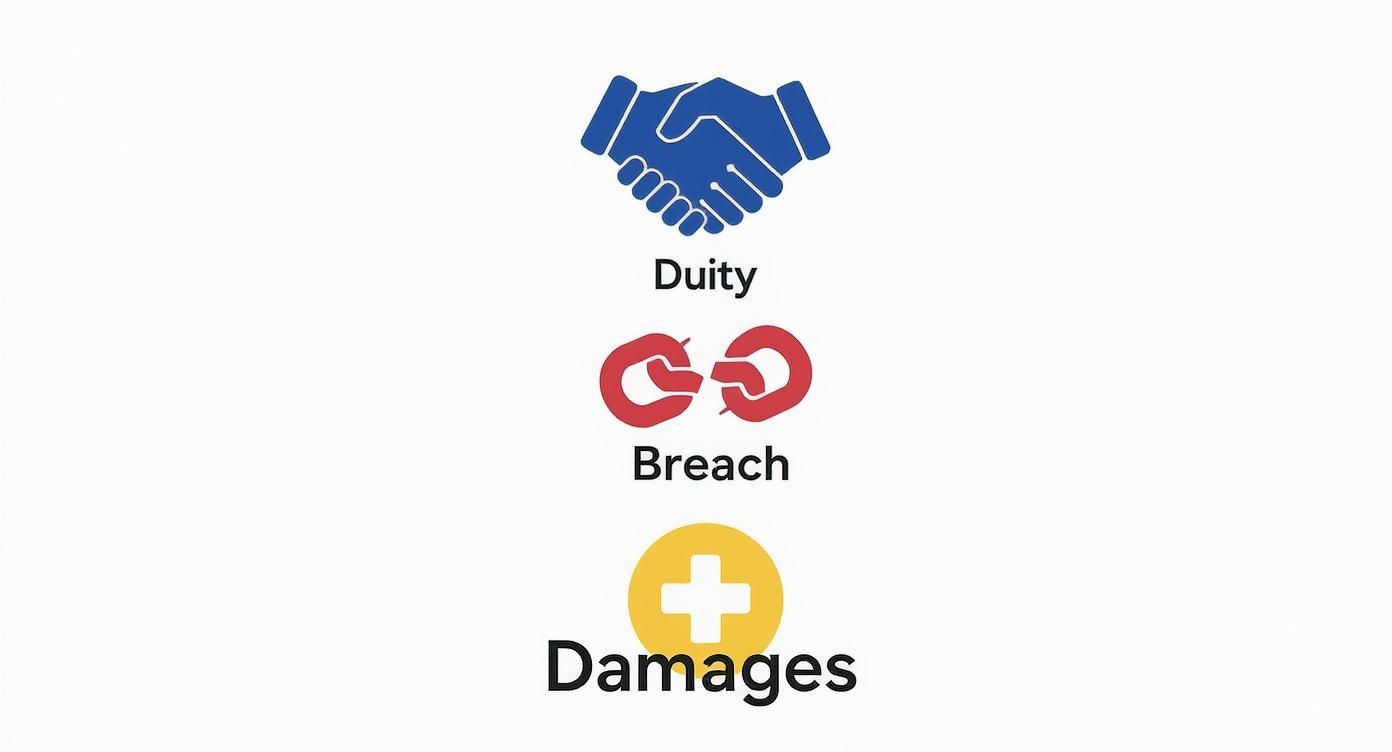
As you can see, each element connects to the next. Without a duty, there can be no breach, and without a breach causing harm, there are no damages to recover.
Premises Liability: When Property Owners Are at Fault
Sometimes, an injury is caused not by someone's direct action but by a dangerous condition on their property. This is covered by premises liability, a legal idea that holds Georgia property owners responsible for keeping their property reasonably safe for visitors. For more information, you can read about the duty of care on Wikipedia.
A common example is slipping on a spilled liquid in a Buckhead grocery store aisle that wasn't marked with a "wet floor" sign. The store's management had a duty to either clean up the spill or warn customers about it. Their failure to do so makes them liable for any injuries that happen as a result. You can find more details on these specific cases in our guide to Atlanta premises liability claims.
A property owner’s responsibility is not just a nice gesture; it's a legal obligation. When they ignore this duty, they are accountable for the results.
Other Important Types of Liability
Beyond basic negligence and unsafe properties, two other forms of liability often come up in personal injury cases.
Strict Liability
This legal rule applies in cases where an activity or product is so dangerous by its nature that the responsible party is held liable no matter their fault or intent. The most frequent use is for defective products. If a new car’s brakes fail because of a manufacturing problem and cause a crash, the car company can be held strictly liable. We don't have to prove they were careless—only that the product was defective and caused you harm.
Vicarious Liability
This is a legal rule that holds one person or company responsible for the negligent actions of another. A classic example involves employers and their employees. If a delivery driver for a local Atlanta company causes an accident while working, the company itself can be held liable for the damages. This is because the driver was acting on behalf of the company when the accident happened.
Each of these approaches provides a different legal way to establish liability personal injury responsibility under Georgia law.
How We Investigate and Prove Your Claim
Building a strong case to establish liability in a personal injury matter is more than just making an accusation. It's a careful process of collecting solid proof that shows what really happened. A successful claim is built on a foundation of clear, undeniable evidence.
Our first step is always a thorough investigation. This work is what turns an unfortunate event into a convincing case for the fair payment you are owed. It’s about creating a story backed by facts, one that is hard to argue with.
Gathering the Core Evidence
The moment we take on your case, we start preserving and collecting important information. Time is a factor. Evidence can disappear, and memories can fade. Our initial focus is on getting the official records and physical proof that outline the event.
This usually includes:
- Official Reports: We get the police or incident report right away. In Georgia, these reports have key details like the officer's observations, witness information, and an initial opinion on who was at fault.
- Scene Documentation: Photos and videos from the scene are very helpful. We look at any pictures you took and often send our own investigators to document road conditions, property hazards, or other relevant factors.
- Witness Statements: Eyewitness accounts give a third-party view that can support your story. We quickly contact anyone who saw what happened to get their formal statement while the details are still fresh in their minds.
This initial collection of facts creates the backbone of your claim, making sure the basic details of the event are secured.
Building the Medical and Expert Case
Once we have the facts of the event, the next step is to prove how badly you were hurt. This means carefully documenting your injuries and, when needed, bringing in experts to explain technical parts of the case.
A successful personal injury claim needs to directly connect the at-fault party's actions to the specific injuries you received. This connection has to be clear, well-documented, and medically supported.
To do this, we take several important steps:
- Comprehensive Medical Record Review: We collect every single medical record related to your injury—reports from the emergency room, your primary doctor, specialists, surgeons, and physical therapists. These papers create a detailed timeline of your injuries, treatment, and recovery.
- Consulting with Experts: For some cases, expert testimony is very important. We might work with an accident reconstructionist to show how a crash happened or a medical expert to explain the long-term effects of your injuries and the need for future care.
- Calculating Full Damages: We gather all related costs, including medical bills, prescription costs, and lost wages. This makes sure we have a complete view of the financial effect the injury has had on your life.
This two-part approach—proving what happened and proving the harm it caused—is key to a strong legal argument. While we focus on personal injury, it can be helpful to understand the general ideas of building a legal case. For instance, learning how to prove defamation and win your case gives a different view on the elements needed for a successful lawsuit, showing the shared importance of evidence in different areas of law. Our detailed process is designed to build an undeniable case showing the other party's liability, and you can learn more by looking at our approach to personal injury claims.
Common Defense Arguments You Might Face
When you file a personal injury claim, you’re not just telling your side of the story—you’re getting ready for the other side to tell theirs. Insurance companies and their lawyers have a standard set of arguments they use to try to reduce or deny your claim.
It’s not personal; it’s business. Knowing their strategies in advance is the best way to build a case that can stand up to their arguments.
Georgia’s Comparative Fault Rule
One of the most common defense strategies is to shift the blame to you. In Georgia, this isn't just an argument—it's a legal rule known as modified comparative fault. This rule has a big impact on injury claims.
Here’s how it works. Let's say another driver ran a red light and hit you, but the defense finds out one of your brake lights was out. They will argue that your broken light contributed to the crash, even if their client was clearly the main cause.
If a jury agrees and assigns you 20% of the fault, your total payment is automatically cut by that same 20%. A $100,000 award becomes $80,000.
The real risk is the cutoff point. Under Georgia law, if you are found to be 50% or more at fault, you get nothing. Zero. This "50% bar" is why we fight so hard against any attempt to unfairly place blame on our clients.
This rule is laid out in the Official Code of Georgia Annotated (O.C.G.A.) § 51-12-33, and it shows why having solid, clear evidence is so important for your case.
Pre-Existing Conditions and Other Defenses
Another favorite defense argument is that your injuries were not caused by the accident but by a pre-existing condition. If you had a history of back problems, for example, the defense will almost always claim your current pain is from that old issue, not the recent accident.
We respond to this by using medical records and expert testimony to show exactly how the accident made your prior condition worse or caused a brand new injury. The law is clear: a defendant is responsible for making a pre-existing condition worse.
The liability insurance market is a huge, multi-billion dollar industry. Globally, it was valued at around $290.5 billion recently, and that number is growing. You can read more about liability insurance statistics and their growth. This financial size helps explain the aggressive defense strategies—every dollar they can avoid paying you goes to their profit.
A few other arguments to be ready for:
- Failure to Mitigate Damages: They might claim you made your injuries worse by not following your doctor’s advice or by waiting too long to get medical treatment.
- Assumption of Risk: This is used less often but argues you knowingly and willingly accepted a clear danger, like walking past a "Danger: Do Not Enter" sign.
By understanding these arguments from the beginning, we can build a case that addresses them directly with strong evidence. This preparation is key to protecting your claim's value and getting the fair outcome you deserve.
Georgia's Time Limit for Filing an Injury Lawsuit
When you're focused on healing after a serious accident, legal deadlines are probably the last thing on your mind. But in Georgia, the clock starts ticking right away. State law sets a firm time limit for taking legal action, and this deadline—the statute of limitations—is one of the most important rules in any personal injury case.
For most injury claims in Georgia, including car accidents, slip-and-falls, and other events based on negligence, you have exactly two years from the date the injury occurred to file a lawsuit. This isn't a suggestion; it's a firm deadline.
Understanding the Two-Year Rule
This two-year window is legally defined in the Official Code of Georgia Annotated (O.C.G.A.) § 9-3-33. If you miss this deadline, the court will almost certainly dismiss your case. You lose your right to seek payment forever.
It doesn’t matter how strong your evidence is or how clear the other party’s fault was. Once that two-year period is over, the at-fault party and their insurance company are no longer responsible.
Are There Any Exceptions to the Deadline?
While the two-year rule is strict, a few rare exceptions can extend the deadline. These situations are very specific and do not apply to most cases.
A few possible exceptions include:
- Minority: If the injured person is under 18, the statute of limitations clock is usually paused (or "tolled") until their 18th birthday. After that, they typically have two years to file their claim.
- Mental Incapacity: If an injured person is legally declared unable to manage their own affairs, the clock may be paused until their ability is restored.
- Government Claims: Lawsuits against a city, county, or state government have much shorter deadlines and specific notice rules. Action is often required within just a few months. You can learn more about these types of claims from the Georgia Department of Administrative Services.
The most important thing to remember is that time is not on your side after an injury. Every day you wait, you risk losing your right to recover damages. The only safe approach is to act quickly.
These timelines are firm, which is why it's so important to know how they apply to your case. We cover these rules in more detail in our guide to the statute of limitations for personal injury in Georgia. Don't let a legal rule stop you from getting the payment you deserve.
What to Do When Someone Else Is Liable

The moments after an accident can be confusing and stressful. When someone else's negligence causes you a liability personal injury, knowing the right steps to take can protect both your health and your legal rights. Think of this as your practical guide for what to do right away.
Your first priority, always, is your health. You must seek immediate medical attention, even if you think you’re okay. Serious conditions like concussions or internal bleeding often don't show symptoms for hours or even days.
Immediate Actions to Protect Your Claim
Once you've taken care of your medical needs, the next important phase is about saving the facts. Evidence can disappear quickly, so acting fast is a big advantage.
Your first step is to report the incident officially. For a car crash, that means calling 911 to get a police report. If you slip and fall in a store, tell the manager right away and make sure they create an incident report.
Next, document everything. Use your phone to take photos and videos of the scene, your injuries, and any property damage. If anyone saw what happened, get their name and phone number. Eyewitness testimony can be very helpful later on.
Protecting Yourself from Insurance Adjusters
It is almost certain that the other party’s insurance adjuster will call you soon after the event. Their job is to pay out as little as possible for the company, which means you have to be very careful what you say.
Never agree to give a recorded statement without talking to a lawyer first. Adjusters are trained to ask questions that are designed to weaken your claim later. A simple, polite answer like "I'm doing okay" can be twisted to suggest you were not seriously injured.
The most powerful thing you can do after an injury is to control the flow of information. Give only the basic facts of the incident and politely say you do not want to discuss your injuries or fault until you are ready.
Taking these steps builds a strong foundation for your case. If a car crash caused your injury, it’s also a good idea to understand the specifics of how to file a car accident claim in Atlanta. When someone else is liable, finding the right legal help is important, and a lawyer's public profile, often shaped by effective lawyer reputation management, can be a key factor in your decision. These first actions give you the power to make good choices as you move forward with your liability personal injury claim.
Frequently Asked Questions About Liability
When you’re trying to recover after an accident, the legal questions can feel like a lot. We understand. Here are some simple answers to the liability questions we hear most often from our Atlanta neighbors.
What if I Was Partially at Fault for the Accident?
This is a common concern, but it doesn't automatically ruin your case. Georgia law knows that accidents are rarely 100% one person's fault.
Under our state's “modified comparative negligence” rule, you can still get compensation as long as you are found to be less than 50% responsible. Your final award is just reduced by your percentage of fault. So, if you were 10% at fault, your payment would be reduced by 10%. If a court decides you were 50% or more to blame, you are blocked from getting anything.
How Long Does It Take to Prove Liability?
The timeline really depends on how involved your case is. A simple car wreck with a clear police report and several witnesses might have liability established in a few months.
On the other hand, a case with multiple at-fault parties or one that needs expert analysis—like from an accident reconstructionist—could take a year or longer. The most important thing is to be detailed. Rushing the investigation can mean missing a key piece of evidence that could determine the outcome of your claim.
Does Proving Liability Guarantee a Certain Payout?
Not exactly. Proving liability is the first important step, but it doesn't set a dollar amount. Once we show that someone else was at fault, the focus changes to proving the full amount of your damages.
Damages are the real and emotional losses you've had, including:
- Medical Expenses: Every bill from the ER to physical therapy, plus future care costs.
- Lost Wages: The income you lost because you couldn't work.
- Pain and Suffering: Payment for the physical and emotional effects the injury has had on you.
- Loss of Future Earning Capacity: If your injuries stop you from going back to your old job or earning what you used to.
The value of your claim is based on two things: proving who was liable and carefully documenting every single way the injury has affected your life.
Remember, the goal isn't just to prove someone else was responsible. It's to get fair payment that covers every part of your recovery.
Can More Than One Person Be Held Liable?
Absolutely. In many personal injury cases, the fault doesn't lie with just one person or company. Think about a commercial truck accident—liability could be shared by the speeding driver, the trucking company that failed to maintain the vehicle, and even the cargo loader who created an unsafe load.
Georgia’s joint and several liability rules are made for these situations. A good lawyer will look into every possible angle to find all responsible parties, which is key to getting the most financial recovery. Every liability personal injury case is different, and getting clear answers is the first step toward getting justice.
If you've been injured and have more questions about your specific situation, the team at Jamie Ballard Law is here to provide the answers you need. We offer a free, no-obligation case evaluation to help you understand your options. Contact us today to get the help you deserve.