A cobb county police report usually becomes important the moment the adrenaline wears off. You’ve left the crash scene, your car may be in a tow yard, your phone is full of calls from insurance, and now you’re being asked for a report number, officer name, and proof of what happened. That’s normal. It’s also where many people make avoidable mistakes that hurt their claim.
The good news is that getting the report is usually straightforward if you know which agency responded, what information to gather, and what to check once the report is in your hands. The harder part is understanding why each step matters and what can go wrong if you rush it.
Why You Need the Official Police Report After a Cobb County Accident
The first version of a wreck story is almost never the final version. Drivers calm down. Witnesses leave. People start second-guessing what they said. Insurance adjusters ask narrow questions that don’t always help you. The official report helps lock in the basics before that happens.

It creates the first neutral record
After a Cobb County crash, the report is often the first third-party record of the scene. It usually captures the date, time, location, vehicle information, insurance details, visible injuries, road conditions, and whether anyone was cited.
That matters because claims often turn into disputes over simple points:
- Where the impact happened
- Which lane each driver occupied
- Whether anyone complained of pain at the scene
- Whether a driver admitted fault or denied it
- Whether weather, traffic control devices, or visibility played a part
When those points are preserved early, you have a stronger foundation for the rest of the case.
Cobb County traffic scenes can get messy fast
In 2022, Cobb County reported a total crime rate of 4,276 incidents per 100,000 people, which was higher than both the state and national averages, according to Cobb County crime data. That kind of environment can mean distracted scenes, chaotic parking lots, hurried departures, and witnesses who don’t want to stay long. An official report helps sort out facts before they drift.
Practical rule: If there’s an officer-generated report, get it. Don’t assume the insurance companies will exchange complete and accurate information on their own.
The report helps beyond the insurance claim
The report isn’t only for the insurer. It also helps your medical timeline, property damage dispute, rental reimbursement request, and any later legal claim if fault is contested.
If you were hurt in a wreck in Marietta or nearby, this kind of documentation often becomes part of the larger claim file that supports injury damages, vehicle damage, and witness development.
What doesn’t work
Several things tend to backfire:
- Relying on memory alone because details fade quickly.
- Using only photos without the officer’s narrative or party information.
- Letting the other insurer “pull the report” and assuming you’ll see the same version they use.
- Ignoring small errors because “the report is close enough.”
A report isn’t perfect, but it is often the document everyone reaches for first. That’s why getting your cobb county police report early is one of the smartest moves you can make.
Accessing Your Report Online The Fast Way
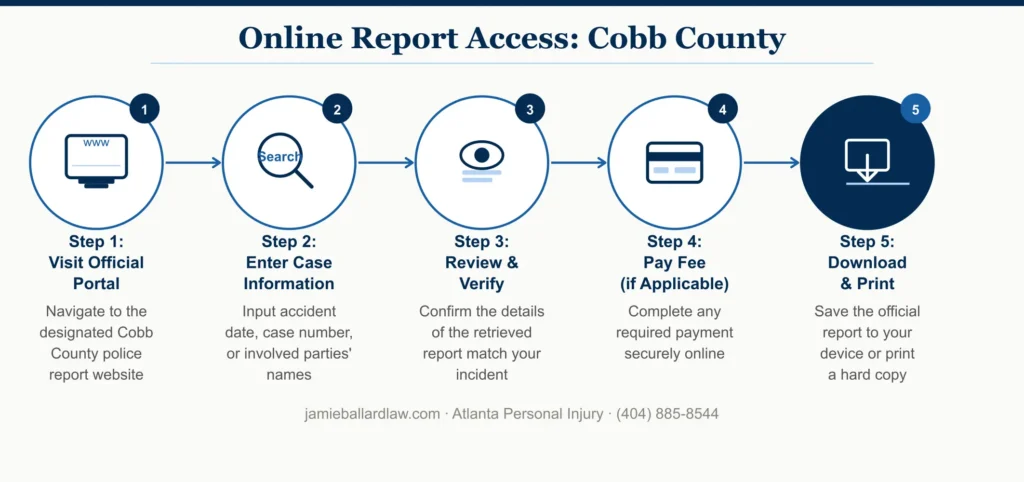
If you can get the report online, do that first. It saves time, it gives you something to review from home, and it lets you catch problems before an adjuster builds a claim decision around them.
Start by identifying the responding agency
Searching the wrong portal causes people to lose a day or two. They search the wrong portal.
If the Cobb County Police Department handled the crash, check the department’s Police to Citizen portal first. If the wreck happened on a highway and Georgia State Patrol investigated, the report may be easier to find through BuyCrash.
Look at any card the officer gave you. If you don’t have one, check:
- Your exchange sheet
- Tow paperwork
- Insurance claim notes
- Any text or email sent by the insurer mentioning the report number or agency
What to have ready before you search
Online portals usually work best if you gather the core identifiers first.
- Report number if you have it. This is usually the fastest search key.
- Accident date. Use the exact date from the scene, not the date you reported it to insurance.
- Last name of a driver involved. Spell it exactly as it appeared at the scene if possible.
- Agency name. Cobb County Police and Georgia State Patrol reports may route differently.
- Location details. This helps if multiple incidents occurred near the same date.
The fastest search is usually report number plus date. Names help, but they also create problems when there are spelling mistakes, suffixes, or hyphenated names.
How the Cobb County route usually works
For Cobb County Police reports, the local online system is often the quickest path. Search carefully, then compare the result to your crash before downloading or paying.
Use this checklist:
- Confirm the crash date
- Match the drivers listed
- Check the location
- Make sure the vehicle descriptions fit
- Save a digital copy immediately
If you find the report, download it and keep more than one copy. Save it to your phone, email it to yourself, and store it in a dedicated claim folder.
When BuyCrash may make more sense
BuyCrash is commonly used for Georgia crash reports, especially when another agency handled the scene. The key is not to assume every Cobb County wreck went through the same channel.
What works:
- searching with the precise report number
- double-checking the reporting agency
- trying the date format again if the first search fails
What does not work:
- guessing at the agency
- entering a nickname instead of the legal last name
- treating “no record found” as proof that no report exists
Save more than the PDF
Once you have the report, also keep:
- The confirmation email
- Any payment receipt
- A screenshot of the portal result
- The file name exactly as downloaded
That small habit helps when an insurer later claims they need a cleaner copy or says the attachment never came through.
Requesting Reports In-Person or By Mail
Online access is faster when it works. But not every report is easy to pull that way, and some people would rather talk to a records clerk, hand over identification, and leave with clear next steps.
That’s especially true when the responding agency wasn’t Cobb County Police, or when the portal search keeps failing.
The main trade-off
In-person requests give you immediate human feedback. If you have the wrong agency, wrong date, or incomplete case number, a records clerk may spot the problem quickly.
Mail requests are slower, but they still work well for people who want a paper trail or can’t travel.
The Cobb County Police Department’s Central Records Unit processes reports for a $5 fee per copy, with a typical turnaround of 3 to 5 business days, and the county logged 27,362 collisions in one year. That volume is one reason the process is standardized.
What to bring or include
For an in-person request, bring:
- Photo identification
- The report number if you have it
- Date and location of the crash
- Names of the drivers involved
- Payment for the copy fee
For a mail request, include:
- A written request with identifying details
- Your contact information
- Payment in the accepted form
- A self-addressed stamped envelope if the agency requires it
If any part of that packet is missing, the request can stall.
Cobb County area police report request methods
| Agency | Online Portal | In-Person Location | Mail-In Option | Typical Fee |
|---|---|---|---|---|
| Cobb County Police Department | Police to Citizen portal may be available | Central Records Unit in Marietta | Yes | $5 |
| Marietta Police Department | Check official city records page | Records Division in Marietta | Yes | Varies by agency |
| Smyrna Police Department | Check official city records page | Records and Identification Section in Smyrna | Check with agency | Varies by agency |
| Kennesaw Police Department | Check official city records page | Records Unit in Kennesaw | Check with agency | Varies by agency |
| Acworth Police Department | Check official city records page | Records Department in Acworth | Check with agency | Varies by agency |
| Georgia State Patrol | BuyCrash may be available depending on report routing | Through the responding post or records process | Yes | Varies by agency |
Check the city if the wreck happened inside city limits
One of the most common problems is assuming “Cobb County” means the county police wrote the report. If the collision happened in Marietta, Smyrna, Kennesaw, or Acworth, a city department may have handled it.
Use official government pages to confirm records procedures:
What usually works best
If you need speed, try online first.
If you need clarity, go in person.
If mobility is an issue or you’re helping a family member from outside the area, mail can still do the job.
What hurts people most is not the method. It’s requesting the report from the wrong department and waiting days to learn that no one there has it.
How to Read and Understand Your Accident Report
A police report can look simple until you try to use it in a real claim. Then every line starts to matter.
Insurance companies don’t read these reports casually. They scan for fault clues, injury references, witness names, and anything they can use to narrow or dispute the claim. You should read it the same way.

The first boxes to check
Start at the top and verify the basic identifiers.
Look for:
- Date and time
- Exact crash location
- Names and addresses of involved parties
- Vehicle year, make, and plate information
- Insurance company names and policy details if listed
If any of that is wrong, the error can spread into the property damage claim, rental claim, or medical claim.
The officer narrative matters more than many people think
The narrative is where the responding officer usually summarizes what happened. This may include each driver’s statement, scene observations, traffic control details, and whether a citation was issued.
That short paragraph can shape the first liability decision. It isn’t the final word, but adjusters often treat it as the starting point.
Read the narrative next to your photos, not by itself. Reports summarize. Photos fill in what a short narrative leaves out.
Pay attention to the diagram and impact area
The crash diagram often answers questions people argue about later:
- Which direction each car was moving
- Where the point of impact occurred
- Whether a turn, lane change, or rear-end sequence is shown
- How many vehicles were involved
Then compare that to the listed damage areas. If the report says your car was struck in one area but the photos show something else, flag it.
Injury notation can affect the whole claim
Reports often include a brief injury classification. That entry can help, but it can also be misleading.
At the scene, many injured people say they’re “okay” because they’re shaken up, embarrassed, or focused on getting traffic moving. Hours later, the pain starts. So if the report understates your condition, don’t panic. It doesn’t erase your injury claim. It does mean your medical records and follow-up documentation become even more important.
Citations and contributing factors
If the officer issued a citation, find where it appears. Also look for any listed contributing factor.
Those entries often influence the insurer’s early fault analysis. But they still need to be weighed against the rest of the evidence, especially in multi-car crashes or disputed lane-change cases.
Other evidence may support or correct the report
Cobb County law enforcement uses tools that can generate objective data beyond the paper report. According to Fox 5 Atlanta’s reporting on the Cobb County Real Time Crime Center and Flock Safety readers, the county’s systems include hundreds of county-wide cameras and License Plate Readers, and those same kinds of systems can sometimes capture information relevant to accident investigations.
That matters when the narrative is thin, a vehicle left the scene, or timing is disputed.
Terms that confuse people
If the report uses unfamiliar legal or insurance language, don’t guess. Look up the term and make sure you understand how it affects your case.
Troubleshooting Common Report Problems
Problems with police reports are common. Most can be fixed, but waiting too long makes everything harder.
What if the report isn’t ready after a week
Start by confirming you have the right agency. County police, city police, and state patrol reports don’t always appear in the same place.
Then do this:
- Call the records unit
- Confirm the date of the crash
- Verify the spelling of every driver’s name
- Ask whether a supplement is pending
- Ask whether the report was rejected for correction and refiled
A delay doesn’t always mean something is wrong. Sometimes the officer needed follow-up information before finalizing it.
If a report is delayed, keep moving on the rest of your claim file. Get treatment, save receipts, and preserve photos. Don’t let the report delay everything else.
What if the portal says the case number can’t be found
Usually one of three things happened. The number was entered incorrectly, the report hasn’t posted yet, or you’re in the wrong system.
Try:
- Searching by date and last name
- Removing extra spaces or dashes from the number
- Checking whether a city police department responded instead
- Calling records to ask if the report number changed format
This problem is usually administrative, not legal.
What if the report contains a factual error
Not every mistake can be erased, but many can be addressed through a correction request or a supplemental statement.
Focus on objective errors first:
- Wrong vehicle
- Wrong insurance carrier
- Wrong location
- Misspelled name
- Incorrect passenger listing
- Incorrect direction of travel
Gather documents that support the correction. That may include photos, insurance cards, registration, medical intake records, or witness contact information. Then contact the reporting agency and ask about its process for an amendment or supplement.
What if the report leaves out an injury
This happens often. People decline EMS, go home, and then wake up sore or go to urgent care later.
Don’t try to “fix” that only by arguing with the insurer on the phone. Instead:
- Get medical care promptly
- Tell the provider the injury came from the crash
- Keep the first intake paperwork
- Send the insurer the report and the medical record together
That creates a cleaner timeline.
What if the other driver is using the report against you
Don’t assume the report ends the case. Officers often make quick scene assessments based on limited information. If later evidence shows something different, the claim can still be challenged.
The best response is not outrage. It’s evidence.
Putting Your Police Report to Work for Your Claim
The report starts as paperwork. Then it becomes an advantage.
Insurance adjusters use it to make an early call on fault, credibility, and claim value. If the report supports your version of events, it can push negotiations in the right direction fast. If it contains errors or leaves out key facts, you need to answer it with stronger supporting proof.
Why adjusters care about it
An adjuster wants a clean story. The report often gives them:
- A neutral scene summary
- Driver and witness identification
- Citation information
- Initial injury notes
- A diagram they can compare to photos
That doesn’t make the report unbeatable. It just means it usually frames the first conversation.
Why you should treat it as one piece of a larger file
From 2013 to 2023, data tied to the Cobb County Police Department showed 172 civilian complaints of misconduct, with 21% ruled in favor of civilians. Those numbers don’t mean accident reports are unreliable as a rule. They do remind people that an official record still needs to be reviewed carefully, especially if something about the scene interaction later becomes disputed.
That’s why strong claims don’t rely on the report alone. They pair it with:
- Scene photographs
- Medical records
- Witness statements
- Vehicle damage photos
- Phone logs or timeline notes
- Any available camera footage
Organize the file before the insurer defines it for you
One habit that helps is keeping every report, estimate, bill, image, and email in one searchable place. If you’re comparing ways to keep case documents organized, this overview of document management software is a useful starting point.
If you’re dealing with injuries, missed work, or a fault dispute, it also helps to understand how the report fits into a broader personal injury claim.
A good report helps. A complete file wins arguments the report can’t settle by itself.
The strongest use of a cobb county police report is simple. Get it early, read it carefully, correct what you can, and back it up with records that show the full story.
If you need help understanding a Cobb County accident report or using it in an injury claim, Jamie Ballard Law can help you sort through the paperwork, spot issues that may hurt your case, and take pressure off while you focus on getting better.